
Are Europeans – and with them the NATO member states – still living in an era of peace, or are there mounting attacks, particularly by the Russians, targeting naval fleets and the maritime infrastructure of the alliance’s member states? That was the overlapping question of the interdisciplinary symposium organized by the Ballin Forum at Kuehne University in Hamburg’s Harbor City on 12-13MAY26, attended by 100 invitees. In short, the answer to the question was neither peace nor war. Instead, Europeans are living in a phase of escalating hybrid warfare.
Scientists, speakers, and panelists quickly agreed that the initiator of the naval aggressions is Putin’s Russia, which is acting in an increasingly belligerent manner. Especially, but not only, in the Baltic Sea region, where undersea cables connecting Scandinavia to countries on the continental shelf are being deliberately cut, military aircraft with their transponders turned off, regularly intrude the airspace of NATO countries, and drones have been spotted spying on military facilities in Denmark, Germany, Poland, Romania, Estonia, and Norway, and have even been detected over Alaska at least a dozen times. Added to this, are ships from the shadow fleet chartered by Russia, which are intended to facilitate the export of Russian oil sanctioned by the EU, but which, at the same time, carry out espionage missions or deliberately damage undersea cables with their anchors.
Only the actors have changed
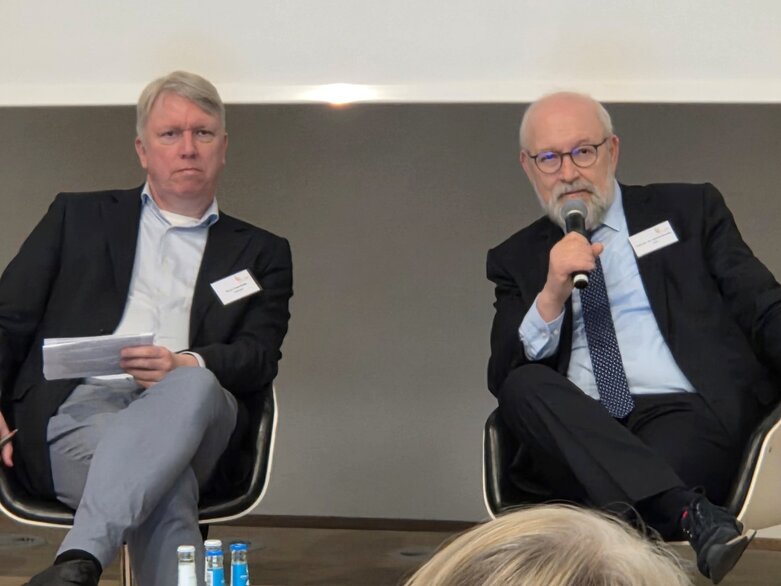
That is the current situation. In a historical overview, Frank Möller and Herfried Münkler, both internationally renowned political scientists, examined the role of war and peace at sea, and the impact on supply chain security. In doing so, they made it clear that the construction and deployment of large fleets have always served an overarching political goal. Only the actors have changed. While historically, it was the Spanish and, above all, the English who sought to consolidate their imperial power through naval supremacy, the Germans joined them in the second half of the 19th century through World War I and, starting with World War II, the U.S. took command of the world’s oceans.
The long-time hegemon is gone
This hegemonic policy can work if the hegemon feels committed to a legal order that serves as a protective shield over allied countries. However, since Trump’s reelection in the U.S., such a hegemon no longer exists for NATO members. Europe therefore finds itself wedged between the aggressor, Putin, who views the seas as a staging ground for his expansionist ambitions, and the former hegemon, the United States, whose interests, however, are primarily focused on dominance on the American continent.
New Club solution is needed
A ruthless aggressor to the east, a collapsing hegemon to the west: this is the current political and military situation Europeans are facing. They can only meet these challenges if they step up their maritime efforts and cooperate in a targeted manner, both scholars recommended unanimously. After all, many can act like one. There are plenty of historical examples of this, Münkler and Möller argued. “What we need is a club solution,” stated Herfried Münkler. This includes civil and military capabilities which greatly increase the risk for an attacker through collective countermeasures, he reasoned. Following the looming withdrawal of the U.S. from NATO, or at least its threats to quit the club, a new alliance of reliable partners is needed. And this must be transcontinental in order to protect global supply chains and, in an emergency case, to be able to intervene quickly. In addition to the EU – or at least the majority of its members – countries such as Canada, Japan, Australia, Brazil, and a few other willing nations should join the club. It would not spell the end of NATO, but at least it would mean breaking free from an erratic U.S. hegemon that says one thing today and another tomorrow.
“Peace at sea is over”
… Felix Brake exclaimed, following the scholar’s presentations.
He served as officer in the German Naval Forces and took part in numerous missions to combat pirate attacks on merchant ships off the coast of Somalia. Today, Brake runs a company called Nexmaris, that continuously analyzes the threat situation, particularly in the Baltic and North Seas, and provides guidance to EU member states bordering these waters.
“Our vital interests extend across the sea, and there they have long been under attack. We are not yet at war. But what we know as peace is long gone,” Brake exclaimed.
Since the blockade of the Strait of Hormuz, a former regional conflict has turned into a global crisis. “This is evidenced by the disruption of classic supply chains involving helium, raw materials, oil shipments, and can ultimately be felt by anyone at service stations where gas and diesel prices hit new heights.” His conclusion: Germany, the EU, and allied democratic states must fast strengthen their defense capabilities after years of deep slumber. Putin, Trump, and China’s Xi Jinping have left them no other choice if they do not want to become political, cultural, and economic vassals soon.
Addendum
The interdisciplinary forum was named after Albert Ballin (1857–1918). During his tenure as the shipping company’s General Director (1888–1918), he shaped the development of Hapag-Lloyd like no other. The proud motto he coined remains the shipping company’s guiding principle to this day: “My field is the world.” At the same time, it stands for bold entrepreneurial action even in difficult times, whether caused by economic crises or military threats. Currently, the duality in these conflict situations is becoming increasingly apparent. This was the central theme of the interdisciplinary forum held at Kuehne University in Hamburg’s HafenCity: “War and Peace at Sea – where do we stand today?”