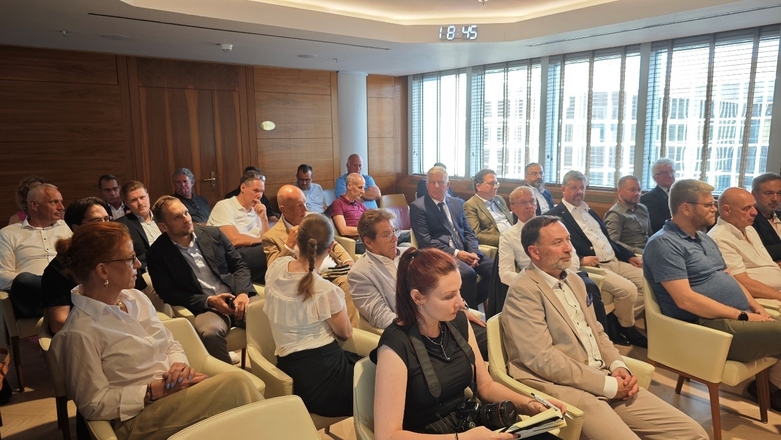
The topic presented by the Air Cargo Club Deutschland (ACD) sounded promising: “The Current Status of Road Feeder Services (RFS) in Germany.” Three executives took to the podium and briefed the approximately 40 ACD members attending the event on the current situation. And this was the outcome in short: Technical innovation and perseverance threaten the future of RFS providers if they are not prepared to change their mindset soon and actively address fundamental challenges.
And those pressing issues are robotics, AI, electric and – at a later stage – autonomous driving: Topics that will determine the future of European RFS actors. In China, for example, or to some extent in California/USA, these issues are already increasingly shaping the processes of air cargo road transportation. Not so in Europe, where, in comparison, development is happening at a snail’s pace. If this does not change, Chinese e-trucks, software and data networks will set the pace, and increase European dependence on Beijing.

Major challenges, but few solutions
However, instead of tabling these pressing futuristic issues and presenting new concepts on how to deal with these challenges, the ACD discussion revolved around rising fuel prices, toll fees, bottlenecks in loading and handling processes, and the rapidly worsening shortage of truck drivers. “A big chance was missed,” resumed a participant following the event. One prominent topic for excessive government regulations discussed at the ACD meeting, was the so-called ‘gold-standard solutions’ favored by German authorities. This translates into 110% compliance with all government requirements, whether they come from Brussels or Berlin. “Why 110%? To my understanding 100% would suffice,” remarked Wallenborn executive, Nina Strippel.
Unlevel playing fields remain…
This referred to the use of explosives detection dogs (RAS) at airports and in freight terminals. In some EU countries, they are permitted to secure cargo, in others, not or to a very limited degree. Their deployment is particularly useful when screening reaches its technical limits. This includes large, dense, or airtight containers, liquids, powders, granules, or certain industrial goods. RAS dogs can detect whether explosives or drugs are contained within the packages. In Germany, however, where the ‘gold standard’ prevails, sniffer dogs may only be used under extremely limited conditions.
The situation is different in France, for example. This leads to the absurd situation wherein trucks from Berlin, Hamburg, or Nuremberg head to Strasbourg in France, where sniffer dogs secure the loads. Afterwards, the drivers return to Frankfurt, Düsseldorf, or Stuttgart to hand over the secured loads to their local airport handling partner. This is economic madness, the panelists criticized, since it is time-consuming and, due to the longer driving distance, increases the freight forwarders’ carbon footprint – not to mention, unnecessarily binds truck drivers in an industry struggling to cope with a growing lack of drivers.
Another obstacle holding the industry back is the issue of customs and data handling for consolidated air freight. Particularly with consolidated shipments, e-commerce, and shipment structures involving many house AWBs or individual shipments. Significant additional effort is required to reference, verify, and reconcile information in detail at the individual shipment level. In practice, this means more data reconciliations, more cases requiring clarification, more interface effort, and, in some cases, longer dwell and transit times. For time-sensitive air freight, this has a direct impact on a location’s attractiveness.
… although level playing fields are urgently required
Addressing the regulator, the panelists called for a level playing field within the EU, including external actors. Environmental requirements to decarbonize the transportation sector are one such issue. These regulations must be implemented and complied within all countries to prevent distortions of competition.
The EU must wake up. Its industry can no longer afford the current patchwork of regulations. Otherwise, it will fall further behind its aggressive international competitors, was a key takeaway from the evening, which also served as a call to action for policymakers.
“Europe is in the midst of a rapidly escalating economic and technical war initiated by the U.S. and China. But we still defend our interests with blunt weapons. The Romans were already more advanced 2,000 years ago, when they secured their empire over centuries very successfully,” one participant told CargoForwarder Global, summarizing his impressions of the ACD meeting after it concluded.
In summary
As things stand, the RFS issue receives little attention from the broader public. Given the outstanding economic significance of road feeder services in keeping supply chains running day in, day out, this is completely unjustified. Hence, closer cooperation among RFS industry stakeholders was a major claim voiced at the Frankfurt meeting. Another demand was the rapid formation of networks rather than siloed solutions, and a stronger media presence – aimed at specifically informing the general public about the industry’s importance for the daily availability of consumer goods and the air transport of key industrial products. Two major topics that were described as “highly desirable and worth being further developed at high speed in an alliance of like-minded players, including air carriers, ground handlers, forwarding agents, trucking firms, airport operators and customs authorities.”
The next ACD meeting will take place on 22SEP26, in Frankfurt. The topic will be: air freight and climate change.