
Dangerous goods require particular care when it comes to safe, efficient air transportation, and for years the industry has relied on manual, paper-based checks to keep them compliant. IATA’s DG AutoCheck was built to close that gap by automating the compliance process. Its slowly growing rollout across airlines and ground handlers recently celebrated another new milestone: LATAM Cargo’s announcement that it was going live in the Americas. Here’s a quick look at how the tool came about, why it matters, how quickly the industry is adopting it, where the friction points remain, and what LATAM Cargo’s recent integration means for the region.
Shipping dangerous goods by air has always been a paperwork-heavy business. Every lithium battery pallet, chemical drum, or aerosol shipment travels with a Shipper’s Declaration for Dangerous Goods (DGD) that has to be checked, line by line, against the IATA Dangerous Goods Regulations before an airline will accept it. For decades that check has been done by hand – and it mostly still is. IATA estimates that roughly 95% of DGDs are still submitted on paper, requiring agents to scan, convert, and manually cross-reference each form.
Built for change and efficiency
DG AutoCheck was built to change that. Unveiled by IATA around 2018 and launched commercially in 2019, it is a digital rules engine that accepts a DGD – either scanned via OCR or submitted as structured electronic data – and automatically checks it against the current DGR, including State Variations, Operator Variations, and Special Provisions. It calculates Q values, flags non-compliance with the specific regulation cited, and produces a package preview showing the marks and labels inspectors should expect to see on the physical shipment. The tool was developed by IATA’s Dangerous Goods Solutions team in consultation with airlines, ground handlers, and freight forwarders, and has continued to expand – most recently with DG Digital, launched in MAR26, which digitalizes the declaration itself to avoid paper altogether, and uses a Connect API to push validated data into airline and ground-handling systems, including automated NOTOC generation.
Why it matters, and the benefits
The case for DG AutoCheck rests on safety and speed. Manual checks are prone to human error, and a missed detail on a hazmat declaration is a real safety risk. The automated compliance check reduces the chance that an unsafe or non-compliant shipment gets accepted. At the same time, it speeds up the traditionally slow acceptance time. For airlines and ground handlers, this translates into fewer rejected shipments, less rework, and better visibility into where problems recur – the system’s reporting tools let operators see rejection patterns and identify which shippers need support. For shippers and forwarders, it means fewer delays and more predictable acceptance.
How fast is the industry adopting it
Adoption has been steady rather than swift, but it is accelerating. Since its 2019 launch, DG AutoCheck has processed over one million Dangerous Goods checks, with more than a third of that volume completed in 2025 alone – a jump that also reflects a 17.5% year-on-year rise in dangerous goods shipments, largely driven by lithium battery demand. Air France-KLM was the first airline group to adopt the tool, and it has since been taken up by Japan Airlines, All Nippon Airways, IAG Cargo, and ground handler, dnata, which now runs it at more than 20 stations worldwide and has connected it to its warehouse management system.
The main barriers to faster adoption are structural rather than technological. The 95% of declarations still arriving on paper reflects how deeply manual habits are embedded across a fragmented global shipper base, many of whom lack the systems or incentive to switch. Integrating DG AutoCheck into an airline’s own core operating system – rather than using it as a standalone checker – also requires real IT investment and cross-functional coordination, which explains why most rollouts have started at a single hub or station before expanding.
LATAM Cargo’s milestone
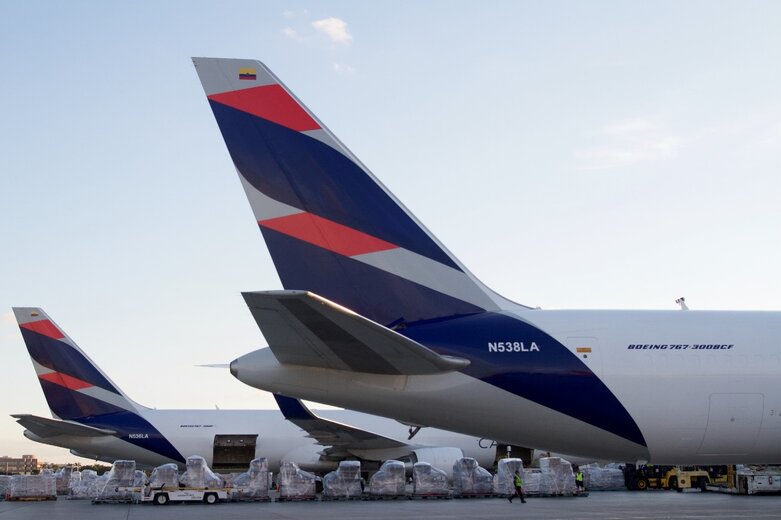
That pattern is exactly how LATAM Cargo has approached its own rollout. LATAM has become the first airline in the Americas to integrate DG AutoCheck directly into its core operating system, Croamis, following a successful launch at its Miami station, with adoption set to expand gradually across the network. The integration, built in collaboration with IATA and Wipro, validates DGD information in real time and automatically alerts customers to discrepancies, allowing corrections before they cause delays. It also gives cargo acceptance agents an interactive checklist for physical inspection and automates NOTOC creation.
For LATAM, the payoff is fewer acceptance rejections, a more consistent and reliable service for customers shipping hazardous cargo across its network, and a stronger safety position – all while reinforcing its standing as a digital leader in a region where dangerous goods volumes, driven in large part by lithium batteries, are only growing.
As commented on by those involved
Daniel Leng, VP of Operations at LATAM Cargo, said: “Being the first airline in the Americas to achieve this integration demonstrates our commitment to driving digitalization for our customers’ benefit. We are not only prioritizing safety; we are also simplifying a complex process to give them valuable time back through a far more efficient operation for everyone.”
Frederic Leger, IATA’s Senior Vice President of Products and Services, commented: “LATAM Cargo’s integration of DG AutoCheck into its core operational systems marks an important milestone in the digital transformation of dangerous goods handling. By enabling the seamless flow of validated data in compliance with IATA Dangerous Goods Regulations and automating key processes, it enhances safety, operational efficiency and the customer experience by reducing acceptance rejections. The integration with Croamis streamlines compliance verification, reduces manual processing and improves critical safety information, including the automated creation of the NOTOC. This is a strong example of industry collaboration delivering tangible benefits for airlines, customers and the safe transport of dangerous goods.”