
At the panel that put the Road Feeder Services (RFS) in air cargo under its microscope, executives from airline, association, and trucking company backgrounds painted a very diverse picture: driver shortages, overstretched infrastructure, and political inertia are threatening the ground transport network that moves roughly one third of all air cargo shipments. But electric vehicles are on the rise, as orders from DHL, Sovereign Speed, the Andreas Schmidt Group and other forwarding agents show. This trend is likely to shift the image of the industry toward clean and climate-friendly RFS.
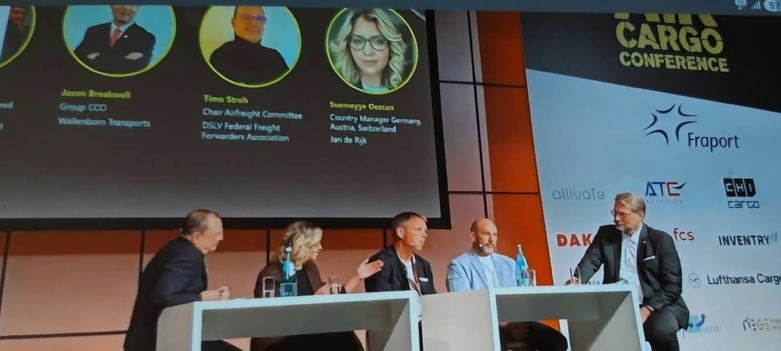
The Panel
- Hendrik Bender, Chief Commercial Officer, Sovereign Speed GmbH
- Jason Breakwell, Group Chief Commercial Officer, Wallenborn Transport S.A.
- Timo Stroh, Chairman Airfreight Committee of the German Freight Forwarding and Logistics Association (DSLV)
- Sümeyye Özcan-Lübbers, Country Manager for Germany, Austria, and Switzerland, Jan de Rijk Logistics
- Joachim von Winning, Fraport AG, Director Cargo Partnership, Moderator
The panel’s outcome in a nutshell: without a reliable, end-to-end RFS network, the air cargo supply chain simply does not function.
Driver shortage: The core challenge
Asked about the industry’s biggest current challenges, panelists pointed unanimously to the driver shortage. Özcan-Lübbers highlighted strict regulations for non-EU drivers, whose qualifications are frequently not recognized, compounding the problem. There is also an image issue at play: while piloting an aircraft is seen as glamorous, driving a truck is not – making the profession harder to sell to new talent.
The numbers underline the urgency. The industry faces between 300,000 and 400,000 unfilled driving positions over the next five years, even as 20% of the current driver workforce heads into retirement. At the same time, expected growth in air cargo volumes is projected to drive a 34% increase in demand for truck transport by 2040 – a challenge compounded by additional risks such as low water levels on rivers, which can disrupt alternative transport routes. These risks will surely not diminish in future, speakers agreed.
Panelists also sharply criticized policymakers for not taking action but shifting the issue onto the trucking companies’ shoulders instead. However, one ray of hope is the EU initiative to establish parking spaces at 50-kilometer intervals along major European trucking routes within the next ten years, enabling drivers to rest. Yet, since driver shortage is not a German problem alone, the panelists urged European policymakers to push this issue harder in Strasbourg and Brussels. Due to the driver shortage, their salaries have lately grown by double digits, a trend the market will need to accept. The panelists regretted that the demanding working conditions and the truck drivers’ daily commitment to maintaining supply chains, are still significantly underappreciatedby the broad public.
Infrastructure: Growth outpacing capacity
Sovereign manager, Bender turned the attendees’ attention to what he called an “underestimated issue”: the infrastructure itself. Investment in new terminals, warehouses, and parking capacity is taking place, but faces significant headwinds – including weekend and night driving bans and long-running road construction processes that cannot keep pace with planned growth. As an example, he cited Frankfurt Airport’s plan to increase cargo volumes from currently 2 to 3 million tons, without a corresponding expansion of the infrastructure outside the fence, needed to support it.
A possible solution would be to move registration and documentation processes outside the airport fence entirely, so that trucks only enter the airport once assigned a valid delivery slot to the warehouse. Truck parking could similarly be relocated off-site – though parking capacity itself is not the core issue; the real bottleneck is loading and unloading times for time-critical goods. At warehouses, the infrastructure is improving, however limited workforce at the facilities are a hindrance, although slot management at FRA already outperforms other airports, as data evidences.
Electrification and Autonomous Driving
The conversation also turned to technology. Semi-autonomous driving is already a reality on the road today, and the panelists expect artificial intelligence to increasingly optimize load planning, reduce empty legs, and multiply overall efficiency – though adoption in Germany lags behind markets like Sweden.
Progress on electrification has been rapid. Five years ago, electric trucks had a range of just 100 to 150 kilometers per charge; today that figure stands at around 450 kilometers, with vehicles offering up to 700 kilometers already on the market. This is fundamentally reshaping route planning, which increasingly needs to be built around truck battery levels and charging infrastructure rather than the most efficient route alone.
Pricing for electric trucks is converging with diesel, though Chinese manufacturers pose significant competitive pressure thanks to lower production costs and longer ranges – up to 1,000 kilometers. Reduced toll rates for electric trucks, combined with rising CO2 levies on diesel, should considerably accelerate the break-even point for electric fleets; and charging infrastructure is now a mandatory consideration when planning new warehouse builds.
Security: Organized Crime on the Rise
The panelists flagged security as another growing concern. A shortage of secure parking spaces along motorways and interstates encourages theft, particularly around the Christmas/New Year period.
Simultaneously, crime targeting the trucking sector is becoming increasingly organized – starting with small-scale pilferage and escalating from there by organized crime groups – with documented losses from cargo theft already running into the millions. The proposed remedy: expanding secure parking capacity and rolling out awareness training for drivers and staff.
Beside a shortage of secure, guarded parking spaces, there is also a lack of proper sanitary facilities for drivers.
Conclusion: “Together we are stronger”
In the closing round, the panelists agreed that the industry needs most urgently are filled driver seats and clean, secure parking infrastructure. As a structural response, they announced that plans for a European industry association dedicated to RFS issues, are already well advanced – modelled on practical improvements pushed forward at Rhine-Main Airport by the Air Cargo Community Frankfurt. The new body is expected to be officially unveiled by the end of this month, with a mandate covering safety, security, sustainability, and infrastructure within and outside the airport fences. “We need to speak with one voice,” Moderator Joachim von Winning concluded: “Truckers, handling agents, airports, airlines and customs authorities. Because we all share a common interest: to make the supply chain fast, resilient, and secure from beginning to end, for the benefit of the entire ecosystem.” Plans include the creation of a dedicated RFS standard – modelled on the existing SGHA (Standard Ground Handling Agreement) framework – to establish consistent quality benchmarks across the industry. CargoForwarder Global will report.
Isabella Zörner