
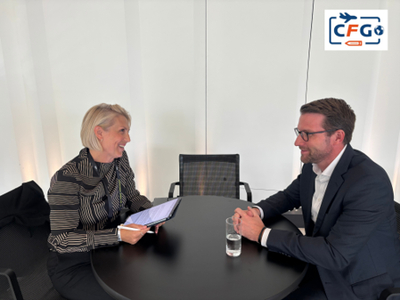
Four months after he left Etihad to take on a leadership role at the ground handling company, Frankfurt Cargo Services, a subsidiary of Worldwide Flight Services (WFS), Thomas Schürmann, sees his new role from an unusual dual perspective. Having managed the global cargo operations across passenger and freighter stations for Etihad, he now represents the ground handler serving the airlines. Speaking to CargoForwarder Global at the recent Frankfurt Air Cargo Conference, Schürmann said closer cooperation, integrated processes and faster decision-making will be crucial if Frankfurt is to maintain its position in an increasingly competitive handling market.
Schürmann took over as Managing Director Germany of FCS in APR26, returning to the ground-handling side of the industry where his career originally began. Before joining FCS, he headed Cargo Operations & Delivery at Etihad Airways and was responsible for all international stations.
That background, he said, has made the differences between airline and handler priorities particularly visible.
“Ground Handlers often face very local challenges – staffing, replacement of personnel and making sure operations work consistently at individual stations,” Schürmann said.“For the airline, the focus is much more to have a stable and reliable handling solution over the long term across an entire network.”
Neither side, however, can solve the next generation of challenges independently. For Schürmann, cooperation remains the central issue.
Competition is more than speed
FCS is Frankfurt Airport’s largest airline-independent cargo handler, with more than 700 employees handling roughly over 650,000 tons annually for more than 30 airlines, according to current company information.
Asked where the company’s competitive advantage lies, Schürmann did not single out speed or automation.
”FCS’ competitive advantage is that we are globally connected through WFS and the broader SATS Group network and locally rooted at Frankfurt. Here in Frankfurt, the most important factor is collaboration,” he said. “Frankfurt is a very competitive environment, but nevertheless it is important that the various stakeholders collaborate to ensure Frankfurt Airport remains a cargo hub of choice and the air cargo community at Frankfurt Airport allows for that:”
Specialized handling is becoming increasingly important within that competition, particularly pharmaceuticals.
One of Schürmann’s first major projects after taking office, was the opening of the expanded Pharma Center of FCS in MAY26. The CEIV- and GDP-certified facility is almost 3,300 m² in size, and quadrupled the FCS-managed temperature–controlled handling space. It allows entire pallets to be built and broken down inside controlled environments, covering both 15-25°C and 2-8°C temperature ranges.
Pharma capacity – but no overcapacity?
With airports across Europe investing heavily in temperature-controlled logistics, the obvious question is whether too much pharma infrastructure is being built.
Schürmann does not currently see that risk in Frankfurt.
“The issue is not overcapacity. What matters is integrating the entire process chain,” he said. A larger refrigerated warehouse alone is of limited value if shipments leave controlled conditions between acceptance, storage, build-up and aircraft delivery.
That argument fits Frankfurt’s wider pharma strategy. The airport says around 200,000 tons of pharma and healthcare cargo are handled annually, supported by more than 22,000 m² of temperature-controlled space and 14 CEIV-certified service providers.
What can Frankfurt learn from Abu Dhabi?
Schürmann’s years in the Gulf also allow him a direct comparison between two very different cargo environments.
If he could transfer one characteristic from the Gulf to Frankfurt, he said, it would be decision-making speed.
That does not mean that he considers Frankfurt operationally slow. Quite the opposite.
“In the actual handling process, Germany can be extremely fast,” he said.“Where we need to become more dynamic, is in the speed at how we respond to change and make decisions.”
It is an important distinction. Frankfurt handled around 2.1 million tons of cargo in 2025, up 1.1% year on year. Its challenge, therefore, is less about proving that it can move freight efficiently than ensuring that infrastructure, regulation and processes evolve as quickly as the competitive environment around it. For Schürmann, the lesson from working on both sides of the handling contract appears straightforward: airlines and handlers may approach operations from different directions, but neither can afford slow decisions when the cargo market itself is accelerating.