
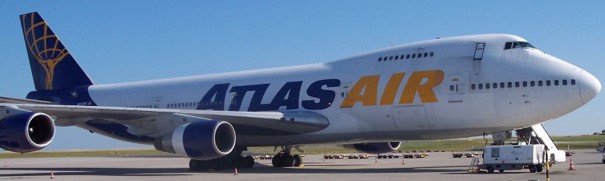
Four years ago, U.S. investor, Apollo Global Management acquired cargo carrier, Atlas Air, for US$ 5.2 billion. Meanwhile, negotiations are underway for a takeover by L’Imad Holding, a sovereign wealth fund based in Abu Dhabi.
However, the price tag for acquiring the cargo airline now stands at a whopping US$ 12 billion. For Apollo, that represents a gain of US$ 6.8 billion, achieved in less than four years. Consequently, it is a deal the U.S. investor cannot really do without, provided both sides come to terms. That is what it looks like, because negotiations are at an advanced stage, sources close to the case have indicated.
The UAE struggles to secure its status
It is not so much economic as primarily political motives that are prompting the Arab sovereign wealth fund to pursue the intended takeover. The move is driven by the United Arab Emirates ruler’s concern that the closure of the Strait of Hormuz and the conflict with Iran could destabilize its economic framework. This model is based on free trade, a liberalized transportation policy, low corporate tax rates, booming tourism, and the free movement of capital – all guaranteed by authoritarian political structures that are largely hidden from public view.
Since the conflict between the U.S. and Israel on one side and Iran on the other – a clash in which the UAE has also been drawn into on multiple occasions due to Iranian attacks on airport infrastructure – the Gulf states’ existing business model has been thrown into disarray. Consequently, they are seeking new paths to safeguard their wealth, allowing them to continue fulfilling their role as a hub for trade and transportation.
Strait of Hormuz blockade is a gamechanger
As far as the maritime angle of the business is concerned, this is shattered by Iran’s hostile blockade policy, so air transport remains the only viable option to retain their hub function. From this perspective, it makes sense for the UAE’s leaders to invest USD 12 billion in Atlas to secure air transport assets in addition to those offered very efficiently by local UAE players such as Emirates, Etihad, and, more recently, flydubai.
If the deal goes through, Atlas Air will provide a large chunk of the needed capacity. It remains to be seen whether this will affect existing flight schedules and lead to a greater concentration of Atlas flights at airports in the UAE. Currently, the carrier operates a fleet of 86 wide-body freighter aircraft, solidifying its position as the world’s largest operator of the Boeing 747F. However, its long-standing loyalty to Boeing came to an end on 16MAR26, when management placed a major order for 20 factory-built A350 freighters with Airbus. This made the carrier the largest single customer to date for this wide-body cargo jetliner. In addition to the firm order, Atlas Air has signed options for 20 further aircraft. Deliveries of the firm-ordered units will begin in 2029, and are scheduled to be completed by 2034.
Smart move
The switch from Boeing to Airbus is also an investment in the future: The A350F is the only large freighter that fully complies with ICAO’s stricter CO₂ emission standards, which take effect in 2027. Airlines that violate the requirements will have to pay escalating emissions fees from next year onwards, which will inevitably make freight transport based on B747F services more expensive. From this perspective, L’Imad Holding’s planned acquisition of Atlas Air is a smart move, from a strategic, business, and environmental angle, despite the high price demanded by Apollo.