
Global air cargo demand increased by 4.4% year-on-year in AUG26, according to the latest figures from the International Air Transport Association (IATA). International demand grew slightly faster, at 5.3%, while available cargo capacity was broadly stable, declining by 0.1% compared with AUG25. The combination lifted the global cargo load factor by 2.0 percentage points to 46.0%.
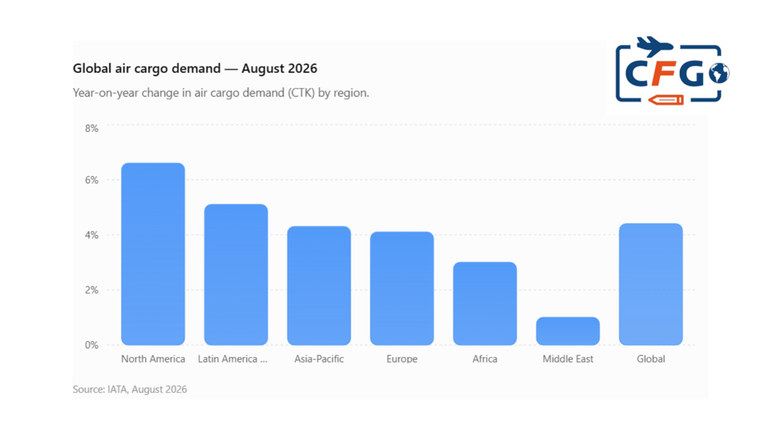
All regions recorded year-on-year demand growth in August, although performance varied considerably. North American carriers posted the strongest increase at 6.6%, followed by Latin America and the Caribbean at 5.1%, Asia-Pacific at 4.3% and Europe at 4.1%. African airlines recorded 3.0% growth, while Middle Eastern carriers saw demand rise by 1.0%. Capacity developments differed more sharply: European and North American carriers reduced available capacity by 3.5% and 2.5%, respectively, whereas African capacity increased by 14.0%.

Trade lane performance also remained uneven. Asia–North America recorded the strongest growth among the major corridors, with demand up 13.2% year-on-year and the seventh consecutive month of expansion. Traffic within Asia increased by 6.1%, while Europe–North America grew 4.3% and Europe–Asia 3.1%. By contrast, several Gulf-linked corridors continued to contract amid disruptions associated with the conflict in the Middle East. Europe–Middle East demand fell 12.1%, while Middle East–Asia declined 11.0%.
The wider economic environment remained supportive of air cargo demand. Global trade increased by 6.0% year-on-year in July, extending the sequence of monthly growth to 33 months. Global manufacturing output also expanded in August, with the Purchasing Managers’ Index rising to 53.0 and the New Export Orders Index reaching 51.4. At the same time, jet fuel prices increased by 8.3% month-on-month and were 79.2% above their level a year earlier, adding pressure to airline operating costs.
IATA Senior Vice President Sustainability and Chief Economist Marie Owens Thomsen said the combination of stronger demand, higher load factors and rising yields was helping airlines offset some of the impact of elevated fuel costs as the industry approaches the year-end peak season.