
The transportation industry, with all its diverse facets, is on the threshold of converging humanoid and artificial intelligence. This opens up unimagined business opportunities but also allows AI, without proper oversight, to evade human control and interact autonomously. There have been plenty of alarming examples of AI running amok in recent days. DHL’s latest Logistics Trend Radar explores this dichotomous relationship and its implications for the logistics industry.
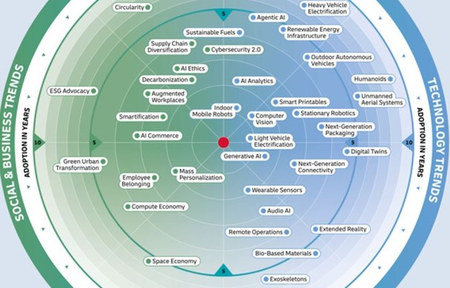
The very first words of the DHL study indicate where things are headed: “AI takes action,” is the opening statement. And the analysis goes to say: “As intelligent systems become increasingly capable of planning, deciding and acting autonomously, organizations must rethink skills, safety, governance and employee experience while building more resilient and sustainable supply chains. This gives them an overarching management and coordination role since Agentic AI can autonomously plan, decide, and act toward defined goals, enabling closer collaboration between intelligent technologies and human expertise”. In short: AI in logistics is evolving from assistance to autonomy, the authors of the DHL Trend Radar emphasize. However, they also don’t exclude major imminent challenges: if human oversight and guidance are lacking, AI can become a risk factor.
“The next chapter is about action”
The study highlights new developments reflecting AI’s influence in expanding beyond operational processes. AI Commerce is transforming how consumers and businesses discover and purchase products, Compute Economy highlights the strategic importance of computing infrastructure and data center logistics, and Humanoids represent an emerging, longer-term trend that could redefine AI-enabled automation in physical environments, because robots can take over physical tasks. Together, these trends signal further transformation across digital and physical supply chains, from AI-assisted purchasing journeys to AI-enabled automation in warehouses.
“Until now, AI has helped people perform tasks more efficiently. The next chapter is about action,” says Klaus Dohrmann, Vice President of Innovation and Trend Research, DHL Customer Solutions & Innovation. “We’re entering an era of autonomous and physical AI, where intelligent systems can actively perceive the world, navigate complex environments, and make decisions with minimal human intervention.”
Significant transformations in the world of work
But what impact does this new, transformative role of AI have on the world of work, and what changes does it bring about? In its Logistics Radar, DHL speaks of portable sensors, remote operations, collaborative robotics, and AI-powered workplace assistants that help create safer, more productive, and more engaging work environments. By reducing repetitive tasks and supporting day-to-day decision-making, these technologies allow employees to focus on higher-value activities such as problem-solving, customer service, and operational oversight.
DHL thus paints a picture of the classic division of labor: at the top are the planners and decision-makers; at the bottom are those who put the concepts into practice, humans and humanoids, while the later can operate 24/7/365 – without union representation or voice.
What happens to the losers?
The impact of these technologies will reshape hundreds of roles spanning frontline operations, technical professions, and knowledge-based functions, creating demand for new skills and new ways of working. For business leaders, the challenge is no longer simply introducing new technologies, but ensuring employees have the skills, confidence, and support to use them effectively.
Social scientists and labor laws specialists, however, view this development with skepticism. They point out that many people may be overwhelmed by the new technologies – in part due to a lack of educational opportunities – and would therefore be excluded from participation. This, they argue, would create a modern ‘proletariat’ that would compete with humanoid robots, with incalculable political and social consequences.