
Gone are the days when Airbus viewed the construction of cargo aircraft as a less-than-attractive venture. Today, the company offers a wide range of aircraft, from small cargo planes to large variants, closing the decades-long gap that existedbetween itself and Boeing in the freighter segment. This applies not only to new aircraft but also to the conversion of passenger aircraft into cargo planes. Company executives provided detailed insights into the current program and the business outlook during a video conference on Thursday 21OCT26, in Nashville, Tennessee, at the presentation of the plane maker’s Global Market Forecast 2026.
The key message from Francois Cabaret, Head of Global Market Forecast at Airbus, is: Cargo traffic will continue to grow over the next two decades at an average annual rate of 3.2%, rising from 280 billion freight ton kilometers in 2025, to an expected 530 billion FTK in 2045. As in previous years, the volumes transported are widely split across various markets. Two trade lanes stand out in particular: Asia-Pacific will continue to be the leading region for international air cargo traffic, with routes to North America being the largest (3.8% annual growth rate), followed by Europe/CIS at 2.4%.
2,640 newbuilds expected until 2025
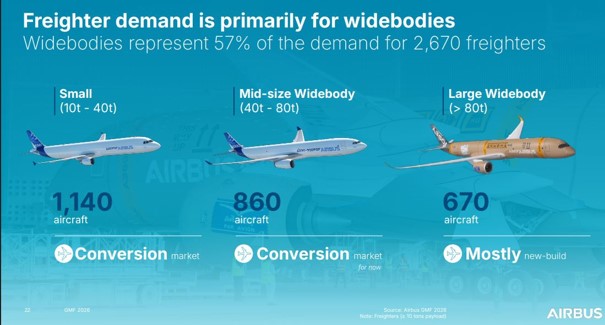
In light of growing markets – despite geopolitical crises and ongoing regional tensions – Airbus experts anticipate a total demand of 3,460 commercial freighters by 2045. Of these, 2,670 units will be newbuilds, while 790 aircraft from the current fleet will still be in service come 2045. Regional demand will be led by North America and Asia-Pacific, requiring 925 and 850 aircraft respectively and together accounting for two-thirds of total global demand. Demand in Europe and CIS will reach 515 aircraft, followed by Latin America with 165, the Middle East with 125, and Africa with 90.
P2F conversions account for a large portion of demand
An increasing number of previous-generation freighters will be retired and replaced by highly efficient next-generation freighters over the next 20 years. This includes newbuild models such as the A350F or the future B777-8F, as well as passenger-to-freighter conversions across the A320, A321, and A330 families, helping operators lower fuel consumption and reduce carbon emissions.
While air cargo accounts for less than 1% of global trade volume by weight, it carries more than 30% of total trade by value, proving it to be a vital mode of transport for goods requiring the quickest routes to market. In the last three years, computers and high-technology goods in air cargo have doubled in value, reaching 15% in 2026. E-commerce also keeps growing but to a lesser extent.
No freighter production in Mobile
Regarding Airbus’ contribution, Francois Cabaret pointed to the successful flight tests program of the A350F. “The cargo aircraft is meeting and even exceeding our expectations,” he emphasized at the event in Nashville. He confirmed that the aircraft will be delivered to the launch customer, CMA CGM, in the second half of next year. According to the Airbus executive, there are now a total of 115 firm orders for the new freighter, representing a 57% market share in this class. When asked by CargoForwarder Global whether Airbus plans to manufacture cargo aircraft at its U.S. production site in Mobile in the foreseeable future, Cabaret explained that there are currently no such plans. The distribution of the individual models across the various plants – with Toulouse and Hamburg as the main sites – is very balanced and structured.
CFRP vs Aluminum
At the Nashville event, he took a small jab at Boeing and its competing product. He pointed out that the Boeing 777-8F is not expected to enter service until late 2028 – some sources even speak of 2029, provided there are no further delays in the production program. By then, the first A350s will have long been in service. The Airbus freighter can carry up to 111 metric tons of cargo, while the B777-8F has a maximum payload of 118 metric tons, according to figures from the manufacturers. While the A350F is made entirely of carbon-fiber-reinforced plastic (CFRP), which makes it relatively light and thus fuel-efficient, the U.S. frame maker has opted for aluminum for the fuselage of the B777-8F.