

In Part 1 of our 3-part series on air cargo automation, Manuel Wehner (MW), Project Manager and Research Associate at the Fraunhofer Institute for Material Flow and Logistics IML, touched on the overall autonomous robot testing/maturity situation in the industry, and the general scope for the future. In Part 2, we take a more detailed look at the robot projects trialed by Fraunhofer IML and Digital Testbed Air Cargo (DTAC), at Germany’s Munich (MUC) and Stuttgart (STR) Airports.
CFG: Can you tell me a bit about the individual robot projects you are working on? Which have been piloted already (and where) and to what success?
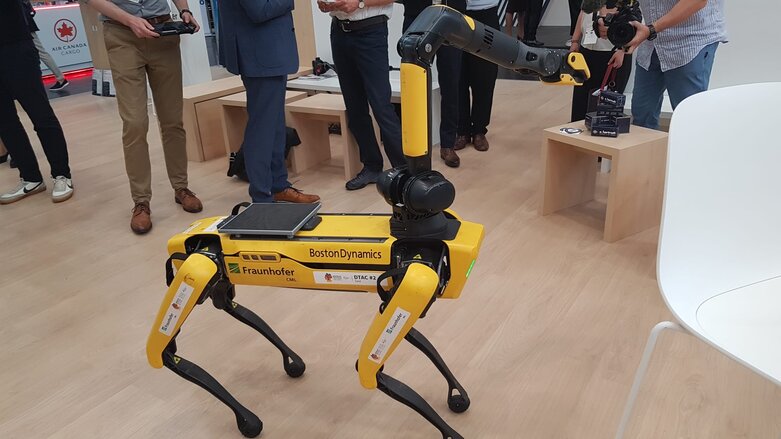
MW: In the Digital Testbed Air Cargo (DTAC), funded by the German Ministry for Digitalization and Government Modernization (BMDS) with €13.7 million, we have already tested five different robots at the two partner airports Munich (MUC) and Stuttgart (STR). Two-and-a-half of which are Fraunhofer IML’s own research prototypes. They were developed by us as the consortium leader: O³dyn (pallet transport robot), evoBOT (piece handling robot), and a modified version of Boston Dynamic’s Spot (autonomous patrols and information gathering). These were complemented by Aurrigo’s AutoDolly Tug (ULD transports) and Götting KG’s Linde E20 forklift (storage pallet transports) as a retrofit automation solution.
AutoDolly Tug was tested at STR under the supervision of Frankfurt University of Applied Sciences; the other four were tested at MUC under IML’s lead. Furthermore, we tested IML’s openTCS as an open-source and manufacturer-independent centralized control system software. Some test insights are shared on Youtube.
In these test scenarios, we tested the five robots in air cargo import live operations between the aircraft position airside (highloader hand-over point) and RFS truck docks landside (truck loading hand-over point), with apron roads, checkpoints, and warehouses in-between. The process is as follows: AutoDolly Tug picks up ULDs from the highloader and transports them to the air cargo warehouses. After palletizing the cargo on LSPs manually – it is still a major challenge for robots to haptically deal with the little to no standardization in ULD loading around the globe – Spot identifies ready-to-store LSPs on its autonomous patrol, which triggers the forklift to transport these to the automated stacker system. After the forklift delivers ready-to-be-picked-up LSPs to the ramp, O³dyn picks up EPALs from the LSPs and transports them to other airport warehouses, where evoBOT picks up single pieces from the EPALs.
CFG: What do LSP and EPAL stand for?
MW: We use LSP as an abbreviation for Large Storage Pallet, which, in German, is a common term for certain metal pallets (“Großlagerpalette”) used in air cargo warehouses. Our robot fleet, which we tested at Munich Airport in 2024, was deployed to identify ready-to-store LSPs (with a patrol robot dog) and to then pick up and transport these LSPs (transport robot) and eventually pick up smaller standardized wooden euro pallets (EPALs) from these LSPs (another transport robot).
CFG: What is your approach to automation?
MW: We explore automation potential in a holistic way, with an airport automation vision extending beyond cargo operations, and knowing that a perfect robot does not exist. It will likely never exist, so we must continue dealing with a multitude of different solutions, manufacturers and pallet types.
To our knowledge, our current approach represents the world’s first scientific testbed for such a mixed robot fleet in an airport environment. We conducted a total of 3 months of intensive live testing, following on extensive laboratory testing.
CFG: How successful have your tests been?
MW: The individual success rates depend on the criteria used. We tested isolated functionalities, ideal world scenarios without disruption and, of course, we ambitiously and creatively challenged the robots. That was fun! For example, we had the fire brigade wet the apron, we placed all sorts of static and dynamic hindrances including humans crossing the driveway and plastic foil, we used different types of cargo, and we loaded pallets unevenly. It is not our goal to identify the ideal solution. We aim to better understand automation potential based on real-life tests and are currently developing a new robot for ULD handling from scratch, along with an updated version of openTCS as a control system. It is worth mentioning that not all use cases require level 5 autonomy and expensive new smart functions. For many cases, good old automation solutions from other industries, like maritime, production and distribution, could be a decent fit.
As Fraunhofer, representing Europe’s largest non-profit applied research organization, we think far beyond specific use cases. We view logistics automation as a goal yet to be achieved in environments such as airports and air cargo facilities. This is why we develop prototypes and software not only for cargo transport and handling, but also for all sorts of ramp and terminal automation, such as the aircraft turnaround. New solutions, based on swarm intelligence, will facilitate securing aircraft with autonomous chocks and cones, among other ideas. We work on different projects simultaneously, and we always look at economies-of-scale and long-term impact for aviation stakeholders.
CFG: Of those robots tested so far – which are the most mature and ready for commercial use?
MW: As mentioned, we employed both market solutions and research prototypes. We have evaluated all of them for their autonomy levels and their test success rates within the defined test scenarios. We are aware, and it must be mentioned, that none of the tested solutions is suitable for overnight implementation. There is still lots of work to do to have these robots operate by themselves in an air cargo environment, and to our knowledge there is no autonomous solution yet operating at level 5, no matter what marketing brochures suggest.
This means, no matter what solution is being evaluated, it will either be a level 3 to 4 automated solution that might be scalable already but not autonomous, or a level 5 prototype, which still needs further development regarding airport-specific challenges, such as taxiway crossings, dynamic obstacle avoidance, etc.
CFG: What about O³dyn and Spot? Can they also function outside in adverse weather conditions? (Snow, hail, ice?)
MW: While both robots are designed for outdoor usage, difficult weather conditions remain a serious challenge for sensors. With our trials, we could show that rain, indoor-outdoor temperature differences, and exposure to direct sunlight do somewhat affect the robots’ performance. However, they already deal fairly well with that in many scenarios. Snow, hail and ice are extreme weather conditions that are being investigated in winter-specific projects, such as de-icing and snow clearing trucks. It is not impossible to deal with extreme weather conditions, however, employing the required sensor mix in every 365/24/7 robot will make the unit costs even higher than they already are.
We expect this development to continue in two tracks for a while – standard robots not suitable for extreme weather conditions, and specialized solutions for outdoor operations in winter times. Eventually, these two tracks could obviously be brought together once prices start matching expectations.
Thank you, Manuel Wehner. In our third and final part of this interview series, next week, we will talk about Circular Economy, costs, safety, and the future warehouse set-up: man and/or machine?


Here’s the link to Part 1: Automating Air Cargo: Robo-Ops – Part 1 – CargoForwarder Global https://share.google/Y9Yk9NOMwM6z20qTq
Here is the link to Part 3: https://cargoforwarder.eu/2026/03/01/automating-air-cargo-robo-ops-part-3/