

The difference could hardly be greater. While north of the Rio Grande under Trump, the decarbonization of the economy and industry was put on hold, a nation located about 2,500 km south of it is celebrating great success with its green strategy: Costa Rica. Antonio Lehmann Gutierrez provided evidence of this at the Fruit Logistica trade fair in Berlin in an interview with CargoForwarder Global. He is the Central American state‘s Ambassador to Germany.
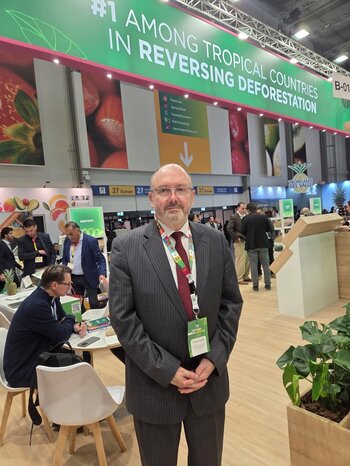
The message is unmistakable: “#1 among tropical countries in reversing deforestation,” reads the large banner above Costa Rica’s stand at the Berlin-held trade show. The opposite, namely the clearing of natural forests, leads in the long term to economic decline and the impoverishment of the population, not to mention the gradual loss of biodiversity, stresses the diplomat. “Not so long ago, we exported almost exclusively coffee, bananas, pineapples and wooden products. Many forested areas fell victim to this. Our natural resources were destroyed, so we decided to stop and reverse this kind of exploitation of nature.”
Economic U-turn
Today, 60.4% of Costa Rica’s land mass is tree-covered again. Parallel to reforestation efforts, the Costa Rican government launched an education campaign. The result: 8% of GDP is invested in schools and universities, and one-third of the country’s land area has been declared protected areas. At the same time, there was a shift in tourism strategy. The country focused specifically on environmentally friendly eco-tourism rather than mass tourism.
Amplifying the business
With the slogan “Pura vida – enjoy your life,” visitors were specifically invited to spend their vacations in Costa Rica and enjoy the country’s natural beauty. Foreign companies were encouraged to set up operations in the country with reference to its intact environment. “The prerequisite, however, was that they commit to complying with the sustainability criteria specified by the government,” stressed the Ambassador.
Intel and the pull factor
One of the first global players responding to this call was Intel, which established a branch in Costa Rica in 1993. Starting with 240 employees, it now has 3,800 people working there. In addition, there are suppliers and local service providers. This development, which was also boosted by the arrival of chemical giant Bayer, created a pull factor, attracting other European and U.S. companies. Added to this was the decision by multinationals to scale back their involvement in China and invest in Mexico or Costa Rica instead. “Due to these favorable internal conditions, which also include a well-educated workforce, as well as beneficial external developments, our annual GDP growth is currently 19 to 20 percent,” says the diplomat. Figures, the entire EU and the U.S. are dreaming of.
Switzerland of Latin America
At the same time, he points to stable democratic conditions and a low crime rate compared to other countries on the American continent. The main beneficiaries of this development are the people of Costa Rica, emphasizes Antonio Lehmann Gutierrez’s. Earnings in Costa Rica are two to four times higher than in all other Latin American countries. Because labor in the agricultural sector is slowly becoming scarce, seasonal workers are being recruited from neighboring countries. “We bring them in seasonally and treat them in a respectful and friendly manner,” emphasizes the diplomat. This attitude sets CR apart. ”As we have no military, we refer to ourselves as the Switzerland of Latin America. Instead, we prefer to spend the money for defense on schools and universities.”
Wide product range
CR has long since moved away from its focus on pineapples, bananas, and coffee. Today, the product range is very diverse and broad, as official figures show: Last year, 644 companies exported 320 agricultural products from Costa Rica to 109 different destinations. Many of these goods were transported by air, such as flowers and other perishable products. In addition, there is an increase in industrial goods such as optical, technical, and medical apparatus, accounting for 44% of all exports, added by pharmaceuticals and electrical machinery equipment.
Challenges impact production and supply chains
Despite all changes, agribusiness remains a cornerstone of the country’s economy, contributing around 7% to the national GDP and employing nearly 14% of the population. According to a report by the Ministry of Foreign Trade (COMEX), over 50% of Costa Rica’s agricultural exports are sent to markets in North America and Europe. But new challenges are just around the corner, impacting international supply chains. Evolving global trade dynamics, shift towards more protectionist policies, as seen in the USA, and growing demand for sustainable practices (EU) are reshaping the landscape of Costa Rica’s agricultural export market. As a result, many small and medium-sized farmers, as well as larger cooperatives, are navigating these changing conditions with urgency.