
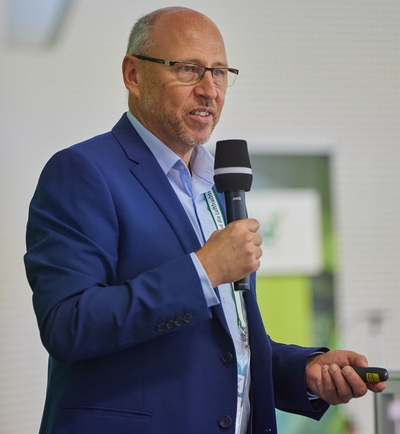
Glyn Hughes, Director General of TIACA, is stepping down at a moment when the air cargo industry is under pressure to evolve. After more than four decades in the sector – and five years leading the association – his departure comes as the industry faces a bigger question: is it actually changing fast enough? For Hughes, the timing is both personal – and strategic. Leaving at the right time.
“I’ve just turned 60, and that is part of the attraction,” he says. “I’ve had some amazing jobs, worked with amazing people, been to incredible places, and been involved in amazing projects. But I also like the idea of leaving the party when people are saying, ‘I wish Glyn was still here,’ rather than waiting too long and sitting in the corner while people ask, ‘Why is he still here?’”
The role, he admits, has come at a cost. “This job, this industry, consumes your life if you don’t have very good control or clear boundaries – which I don’t. I love it, but I do recognize it means I’ve kind of put life on hold a little bit. So I think that’s an opportunity as well.” Hughes believes TIACA is in a strong position. “I think this industry is going through such profound changes, and I think it’s a good opportunity for somebody that’s got a little bit more of a future-thinking approach to things.”
A platform built – a shift ahead
“We’ve created an incredible platform with the board, the team, and our programs over the last five years,” he says. But he is equally clear that the next phase will require a different mindset.
“I’m into networks, collaboration, understanding how the industry got here. But going forward, this industry is going to need to be much more innovative. If we want to continue to be the premier mode of transport – and grow beyond that 1% to 2% share of international trade – we’re going to need to have innovation everywhere.”
That raises a harder question: after years of talking about digitalization, sustainability, and modernization, why does progress still feel slow?
It’s a gap the industry itself increasingly acknowledges – caught between ambition and the reality of a fragmented, multi-stakeholder ecosystem where alignment takes time.
Not leaving—just stepping back
Despite stepping down, Hughes has no intention of moving into another role. “I don’t want to work anywhere else. I love this job so much. If I were going to continue working somewhere else, I would stay doing this job.”
Instead, he plans to support the transition and then remain connected at a distance. “I want to support the board and my successor for as long as they would like me to. After that, I hope to stay connected through industry events for as long as they need me.”
The reality behind the role
Part of that shift is also about stepping away from the realities of the job—especially travel. “Travelling is not as enjoyable as it used to be,” he says. “I’ve just come back from a trip with a 16-hour delay, overnight stays, early morning flights, and two nights of two hours’ worth of sleep.”
The routine has become relentless. “Airport, Uber, hotel, conference, airport – you could be anywhere in the world. I don’t even know where I am half the time.”
He still wants to travel, but on different terms. “I would like to travel without a suit, just shorts, sneakers, and flip-flops. I would like to travel, but to travel rather than business travel.”
An industry defined by people
Even so, what he will miss most is not the role, but the people. “I’ll miss the camaraderie. There are people I’ve known in this industry for 30 or 35 years, and wherever we meet in the world, we reconnect instantly.”
That sense of connection, he argues, is what defines air cargo. “Air cargo is probably the best industry I could ever imagine – not just because the benefits they bring to the global community, the opportunity we have to really make an impact, but because of the people you meet along the way.” And despite the push toward digitalization, he does not see that changing. “Technology will drive the business side going forward, but people will always drive the heart of the industry. It’s the partners that we work with, and I do cherish all of them, and I will miss them, for sure.”
From moving boxes to moving emotions
Looking back over four decades, Hughes sees a fundamental shift in how the industry understands its role. “In the early ’80s, we were just moving boxes around the world. Today, we talk about the emotions of what’s inside the box.”
That change has raised expectations – and responsibility. “It could be a live organ, a wedding ring, a bunch of flowers, a smartphone for somebody’s birthday present – mit doesn’t matter. There’s an emotional connection. We cannot lose it. We cannot be late. We must communicate.”
At the same time, the pace of the industry has accelerated dramatically. “Twenty-five years ago, if I wanted to communicate with you, I would have had to type a letter, and you might get it three or four days later. Now everything is instant. Time has become much more important. The stress has increased because expectations are higher – but that’s also what’s kept the interest in the industry.”
A career without boredom
Across 44 years, one thing never changed. “I’ve never been bored. I’ve never had a moment where I thought, ‘What do I do now?’ I’ve never got to the point where I’ve said, ‘I have all the answers,’ and I’ve never got to the point where I’ve said, ‘That’s it, it’s all done.’”
For him, that constant evolution is exactly what makes the industry compelling. “Everything is improving. Everything is evolving. Everything is exciting. I learn new stuff every day. I fell into this industry – but I’m very thankful that I did.”
Opening doors for the next generation
Hughes also takes pride in helping others step forward. “One of the things I’ve always loved is being able to give people their first speaking opportunity at TIACA – whether that’s moderating a panel, speaking on a panel, or making a presentation. I find that really rewarding.”
He sees generational change as an opportunity rather than a challenge. “We’ve got some super young moderators coming through and first-time speakers. It’s sometimes nice to get different perspectives, and I hope that continues.”
Gender parity: “We’re not there”
Hughes is direct when it comes to gender balance in the industry – and clear that progress has been too slow. “We try and increase gender parity. We haven’t got it up to 50%, which is what I would love to get to. I think we’ve hit the mid-20s. We aim for mid to upper 20s wherever we can.”
What stands out most to him is the difference in how men and women respond to opportunities. “When we invite men, on average, there’s like a nanosecond – ‘Yep, done.’ When we invite women, it’s a much more analytical assessment. We get a lot more rejections. For men, it’s probably around 90% acceptance, and for women around 50%.”
He’s cautious about overinterpreting the reasons, but the pattern is clear. “There are different value assessments. Sometimes there are more expectations in the workplace. There are a lot of factors here which I’m probably not qualified to comment on – but I do find it interesting that the pressures on women in this industry are much greater. I can observe that.”
At a leadership level, the imbalance becomes even more visible. “It’s more unusual than not to have a woman leading a team of men. And that’s what’s wrong with this industry. It should be as natural as anything else.”
The pipeline, he stresses, is not the problem. “Women account for around 50% of graduates globally. In mathematics and engineering, it’s also about 50%. The feedstock is there.”
And yet the numbers tell a different story. “Only about 6% of pilots globally are women. India has the highest percentage, and it’s around 12%. We should be talking about 12% as the worst country, not the best.”
For him, the conclusion is straightforward. “As an industry, we still have a lot more to do. We have to make it so, that people look beyond gender, age, religion, education, and just look at competency, capability, and attitude. And I think there are industries that really get that spot on. We’re not there yet. That’s one of the journeys that’s still unfinished.”
An industry still in transition
After 44 years, Hughes leaves without any sense that the job is finished – because the industry itself isn’t. “There’s still a lot more to do,” he says. And that, more than anything, is why his departure matters now – and exposes an uncomfortable truth: the air cargo industry has spent years talking about transformation. The next phase will be defined by whether it can actually deliver it.