
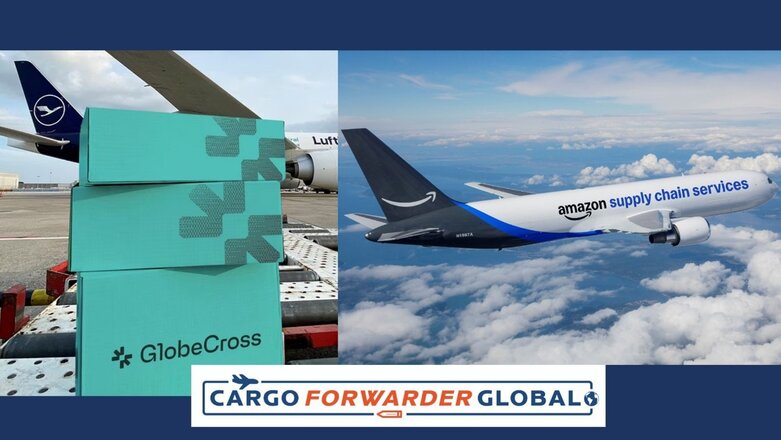
Within days of each other in the first week of MAY26, the global household name in e-commerce and a veteran air cargo airline both made announcements that reflect the shifting face of global logistics. Amazon launched Amazon Supply Chain Services (ASCS) on 04MAY26, throwing open the doors of its massive logistics empire to practically any business on the planet. Two days later, Lufthansa Cargo finally unveiled GlobeCross GmbH, a wholly owned subsidiary born from the merger of heyworld GmbH and CB Customs Broker GmbH, and designed to tackle the growing complexity of cross-border e-commerce. Both moves are direct responses to a changing global trade environment, yet the two solutions are very different in scale, scope and approach.
“Amazon is bringing the infrastructure, intelligence, and scale of its supply chain services – proven over decades – to businesses everywhere, much like Amazon Web Services did for cloud computing,” Peter Larsen, Vice President of Amazon Supply Chain Services announced on 04MAY26. “Supply chain wasn’t just a function at Amazon. It was core to providing an exceptional shopping experience. Our differentiator. The reason we could offer fast, dependable delivery that nobody else could. And with the launch of ASCS, we’re confident we can give any other business access to the same cost efficiency, reliability, and speed that we’ve built for Amazon customers.”
“One network to move, store and deliver goods for any business”
Basically, Amazon is doing what it does best – having built up a highly-sophisticated internal infrastructure to support a vision – in this case, fast delivery of goods – it is now commoditizing that asset by opening it up to the market, with a view to embedding it as the global logistics default pretty much in the same way as online shopping is synonymous with its name. The scale of Amazon’s logistics operations which now include over 200 fulfillment centers in the U.S. alone, a fleet of over 100 freighter aircraft, 80,000 trailers, and 24,000 intermodal containers – all built up in a relative short period (it began investing in its own aircraft just 10 years ago), is unparalleled in its scope. That infrastructure has served its own retail operations and marketplace sellers, to date. Now, that same infrastructure is open to any business, regardless of whether they sell a single product on Amazon.com, and is being offered as: ‘One network to move, store and deliver goods for any business’.
ASCS’s huge scope
ASCS covers three pillars: global freight – which is not just road and air, but also ocean, and includes customs clearance from China to the U.S.; distribution and storage (with AI-powered demand forecasting); and parcel delivery within two to five days, seven days a week. Its solution covers all customers’ requirements: capacity, speed, and reliability all in one, for a wide pallet of services including time-sensitive shipments, simplified booking, customs clearance, and end-to-end shipment visibility. Businesses can choose to import, store, and position inventory closer to where it is required, so as to swiftly respond to customer orders across their sales channels. “By using a unified inventory pool and advanced forecasting capabilities, businesses can improve delivery speed and accuracy across their own website, ecommerce marketplaces, social media channels, and physical stores,” Amazon’s release underlines, going on to point out that “Businesses can benefit from flexible pickup from their own warehouses or third-party providers and track shipments from label creation to customer doorsteps.”
Early adopters have already stepped in: Procter & Gamble, 3M, Lands’ End, and American Eagle Outfitters – names that lend instant credibility and signal that ASCS is already competing at the enterprise level, not just with SMEs. Plus, with this launch, Amazon is expanding its third-party logistics capacity to support businesses in industries such as healthcare, automotive, manufacturing, and retail.
From behemoth to bijou
Where Amazon is selling scale, GlobeCross aims to sell precision. Over on LinkedIn, following the GlobeCross GmbH announcement, its Managing Director, Murat Odabas, revealed with a wink: “Took a little longer than expected … but hey, mergers aren’t built overnight. It’s official:
- We have merged.
- Stronger together.
- Same direction.
- One future.”
Originally, talk at Lufthansa Cargo had been of the merger launching at the start of the year (CFG reported). As it is, Lufthansa Cargo’s digital e-commerce subsidiary, heyworld (founded in 2019], and CB Customs Broker which its 20+ years of customs expertise, have now finally joined together to become GlobeCross. (See the full launch story here)
The press release explains that the subsidiary’s name “reflects the company’s role in global cross border trade. ‘Globe’ stands for international reach, while ‘Cross’ represents the ability to overcome geographic and regulatory boundaries by connecting markets, partners and systems into seamless, compliant logistics flows.”
While ASCS targets three main transport modes, and is asset-heavy (infrastructure), Globecross is deliberately asset-light – focusing on software, processes and expertise, is air-centric, and is particularly relevant in the EU regulatory environment. As its tagline on its website states: ‘Turning Borders into Gateways’, it is solving a specific e-commerce pain point: the regulatory friction of cross-border trade.
Murat Odabas explains in the press release: “By organizing information flows and embedding regulatory requirements into our software and solutions, we reduce complexity, minimize delays at borders, and remove friction from cross-border logistics.”
Blurring lines
While ASCS is an e-commerce platform and infrastructure open to all kinds of businesses and thus offering change and opportunity, for existing customers of heyworld and CB Customs Broker, it is business as usual but under the new and unified label ‘GlobeCross’. That said, in this case, we have an airline strengthening its portfolio in cross-border logistics and customs services. The one company is e-commerce with airline fleet, the other is airline with e-commerce solution. What both launches this week therefore confirm, is that the traditional lines separating carrier, forwarder, broker, and 3PL are dissolving. The logistics industry is entering a new era of platform competition, and companies that can offer seamless, transparent, end-to-end execution – regardless of who owns the aircraft or the warehouse – will define what supply chain services mean in the decade ahead.