In Part 1 of this series, we examined how Artificial Intelligence is moving rapidly into the operational core of the air cargo industry. What only recently sounded futuristic is now becoming operational reality. AI-driven systems are already supporting airlines, freight forwarders, handlers, and logistics providers in capacity planning, disruption management, forecasting, pricing, and shipment prioritization.
The pressure to accelerate this transformation continues to grow.
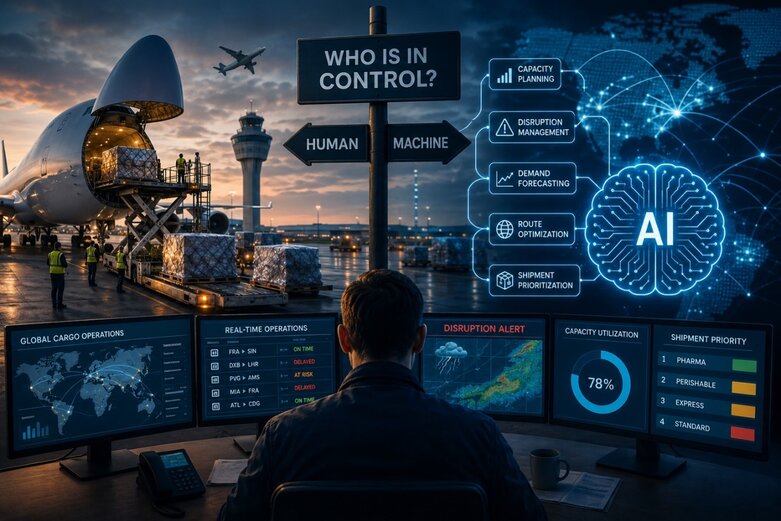
Who Will Control the Systems Running Global Cargo Operations?
Geopolitical instability, volatile demand, labor shortages, disrupted supply chains, and increasingly complex cargo flows are forcing the industry to rethink traditional operating models. For many companies, AI is no longer viewed simply as innovation. It is increasingly seen as a competitive necessity.
At the same time, the deeper AI becomes integrated into operational control, the more strategic the discussion becomes.
The industry is entering a phase in which operational efficiency alone is no longer the primary issue. Governance, accountability, transparency, and control are becoming equally important. The discussion has therefore shifted from what AI can do to how far operational authority should be delegated to intelligent systems.
Governance Is Becoming a Core Operational Requirement
For years, digitalization in air cargo focused primarily on efficiency improvements. Automation, digital booking environments, visibility platforms, and paperless processes dominated investment strategies across the industry.
AI fundamentally changes that environment.
Traditional software follows fixed instructions. AI systems increasingly interpret operational situations independently, evaluate scenarios, prioritize outcomes, and support real-time decision-making. In some operational environments, AI systems are already capable of identifying disruptions and operational risks faster than human control teams.
This development is pushing governance to the center of industry discussion.
As AI systems gain influence over operational workflows, companies are being forced to establish new control structures surrounding transparency, escalation management, system validation, and human oversight. Regulators are moving in the same direction.
The European Union’s AI Act has already classified many transportation-related AI applications as “high-risk systems.” This classification introduces stricter requirements surrounding explainability, accountability, documentation, and human supervision.
For aviation, this development is particularly significant because the industry operates within one of the world’s most tightly regulated safety environments. Operational decision-making has historically remained closely linked to clearly defined responsibility structures. AI increasingly challenges those structures because intelligent systems are becoming active participants in operational processes rather than passive software tools.
The result is a growing industry consensus that AI deployment in aviation logistics will ultimately require governance frameworks that are nearly as sophisticated as the operational systems themselves.
The Human Role Inside Cargo Operations Is Changing
One of the most underestimated aspects of AI is its impact on the people working inside the industry itself. Air cargo has always been a people business. Operational experience, improvisation, customer relationships, crisis management, and human judgment under pressure still define large parts of day-to-day cargo operations. Many situations simply cannot be solved through data alone.
But operational roles are beginning to change.
Tasks that once required years of operational experience are increasingly supported by intelligent systems capable of processing far larger volumes of operational data than humans ever could. This creates both opportunity and uncertainty.
For many operational teams, AI can reduce repetitive administrative workloads and allow employees to focus more on strategic decision-making, customer interaction, and exception management. In many ways, AI already functions as what some experts describe as a “cognitive co-pilot”, extending human capabilities through speed, data processing, and scenario analysis.
For experienced cargo professionals, this can feel like operational knowledge is suddenly being amplified by an additional layer of computational power.
And the industry clearly sees the advantages. At the same time, however, the discussion is becoming far more human than technological. The deeper AI moves into operational decision-making, the more the role of the human operator begins to shift.
Operational expertise is gradually evolving from direct process execution toward supervision, validation, and control of machine-supported environments. Cargo professionals may increasingly become supervisors of automated systems rather than traditional operational decision-makers themselves.
And this transformation raises growing concerns inside the industry.
Work in air cargo has never only been about productivity. Operational responsibility also creates identity, structure, experience, and professional value. As intelligent systems take over larger parts of operational analysis and decision support, many professionals are beginning to question how their own expertise will evolve in increasingly AI-driven environments.
This challenge is therefore not only operational.
It is cultural. And perhaps even existential.
The industry is entering a phase in which human value may no longer depend primarily on processing information manually, but on the ability to interpret, challenge, and supervise machine-generated recommendations before they become operational reality.
That may ultimately become the defining skill of the next generation of cargo professionals.
Because despite all technological progress, AI still does not “understand” operations the way humans do. Intelligent systems recognize patterns, probabilities, and correlations at enormous speed. But contextual judgment, ethical prioritization, intuition, and accountability remain deeply human capabilities.
And this is exactly why the debate around human oversight is becoming so important.
The more operational authority AI receives, the more critical human supervision becomes.
Not because humans are faster than machines.
But because humans remain responsible when systems fail.
Outlook to Part 3
The discussion surrounding AI in air cargo is only beginning.
While operational efficiency and human-machine collaboration currently dominate the debate, the next phase will become even more strategic. As intelligent systems gain greater influence over operational environments, entirely new questions surrounding responsibility, liability, cybersecurity, and technological power are emerging across the industry.
Part 3 of this series will therefore focus on:
- liability and accountability in AI-supported operations
- growing dependence on technology ecosystems
- cybersecurity and operational risk
- the concentration of technological power
- and why human oversight may become more important, not less, in increasingly autonomous cargo environments
Because the future of air cargo will not only depend on how intelligent AI systems become.
It will depend on how effectively the industry remains capable of controlling them.
Anastasia Kazantzis / Gerton Hulsman