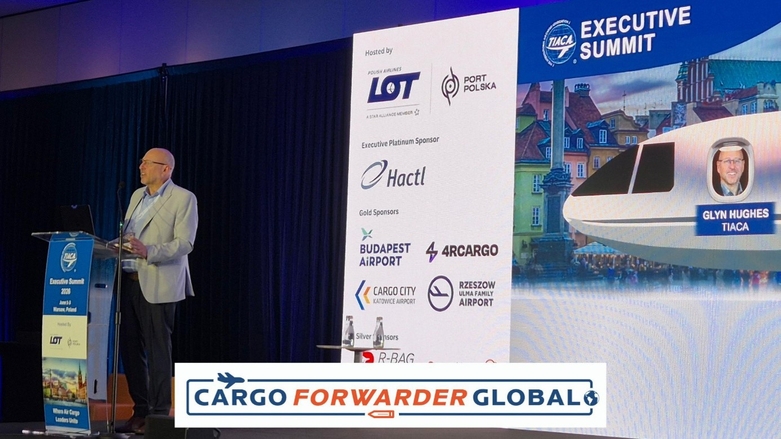
This year’s TIACA Executive Summit took place in Warsaw’s Hilton Hotel, bringing a resilient, positive and forward-looking Central European attitude to an air cargo industry continuing to navigate volatile geopolitical obstacles alongside the usual topics of digitalization, sustainability, and talent attraction. 325 participants had registered for the 3-day event in Poland, from 01-03JUN26, which combined an exclusive freighter tour with a full agenda of topics and two excellent networking evenings.
From geopolitical disruption and digital transformation to LOT Cargo’s 30th anniversary reflections and TIACA’s sustainability honors, this year’s summit highlighted an industry balancing uncertainty with ambition. The event’s discussions, panels and keynote sessions showed that air cargo is proving resilient, but resilience alone is not enough. The industry has to become even more agile, more connected and more intentional about how it responds to geopolitical volatility, changing trade flows, digital disruption, customer expectations and sustainability pressures.
Power of movement
That tone was set early in the summit. Following TIACA Chair, Roos Bakker’s opening speech, where she spoke of the “power of movement” and emphasized once more that the sector must invest not only in innovation but also in people, Poland’s Secretary of State and Minister of Infrastructure, Maciej Lasek, as well as the CEO of Port Polska, Dr Filip Czernicki, and LOT’s CEO, Michal Fijol, all underlined the host country’s growing importance as a logistics gateway for Central Europe. Come 2032, Port Polska will offer Poland and the greater Central Europe catchment area substantial cargo capacities in a multimodal environment connecting airport, rail and road: “We aim to take advantage of being right in the middle of Europe – the perfect gateway linking East and West and North and South”, said Dr. Filip Czernicki. Central Europe’s drive and growth factors were highlighted in more detail in a dedicated and very well-attended panel in the late afternoon of 02JUN26, featuring airline LOT Cargo, GSA 4RCargo, Budapest Airport and airport in spe, Port Polska.
Cargo always finds a way
Across multiple sessions, speakers returned to a common set of themes. One was the sheer scale of disruption now facing the industry. Data presentations from WorldACD and other contributors showed that although global cargo demand has remained positive overall, the market is increasingly shaped by conflict, shifting trade routes, rate volatility and regional realignments. The Middle East crisis, changes in e-commerce policy, tightening widebody freighter supply and the redirection of flows out of China all featured prominently. Yet speakers also pointed to the sector’s ability to respond quickly, reroute capacity and continue serving customers under pressure. The message was not that complexity will disappear, but that the winners will be those who can manage it best.
Coming clean with AI
Digital transformation, which was another major thread running through the program, is one major tool to help manage that complexity. AI was mentioned in leadership, airline, ground handling and technology sessions alike, but always with the urge to carefully consider its application and to ensure that the data feeding is accurate. As Kai Domscheit, CHI, warned: “Without clean data, AI is worthless!” Data quality, workflow design and human adoption will determine whether AI delivers real value. “30% of efficiency comes from tech, 70% from people-related action,” keynote speaker, Olivia Kinghorst revealed. AI is an enabler of better planning, visibility and decision-making but is not a substitute for people. That perspective echoed a wider mood at the summit: progress depends not just on better tools, but on better cultures, clearer communication and stronger collaboration across the supply chain. HACTL’s Joanna Li stressed a sentiment shared by many: “AI and tech can help in terms of special processes but will not replace people.”
An insight into LOT Cargo’s success
One of the most engaging sessions came in the fireside chat marking 30 years of LOT Cargo. In conversation with TIACA Director General, Glyn Hughes, the airline’s Head of Cargo & Mail, Michal Grochowski reflected on how LOT has built a business model designed not just for growth, but for endurance. His central argument was that LOT’s current strength is rooted in lessons learned during the 2020 crisis: “We didn’t waste the 2020 crisis – we created mechanisms of protection and are ready for any crisis today.” LOT’s adaptive operating culture and preparedness allows the carrier to face current and future shocks with more confidence.
Grochowski also gave a clear sense of how LOT sees its future: “Growth comes not only from fleet growth but also optimization of the network,” as well as strong partnerships and deeper specialization. He highlighted LOT’s achievement in being the fastest airline to secure the full CEIV portfolio, its early move into digital dangerous goods processes, and its commitment to pharma and other specialist products. Perhaps the strongest note of all came on partnerships, including seeing other airlines as partners, too, not competition. For Grochowski, strong cargo relationships are built on shared values, loyalty, communication, taking responsibility, and making partners feel part of the same family rather than treating them as transactional counterparts.
People, people, people
The People theme was one of the defining subjects of the entire summit. Olivia Kinghorst’s keynote on leadership urged companies to create psychological safety, invest in durable skills and become better storytellers. Later sessions on next-generation talent reinforced the idea that air cargo still struggles with visibility as a career destination, even though it sits at the center of global trade. Speakers called for stronger outreach, more structured development pathways and more confidence in giving younger professionals meaningful responsibility.
When Orange threatens Green
Sustainability was another major strand, and the shocking consensus (highlighted by example) was that the issue has become harder rather than easier “thanks to the White House”, one of the panelists admitted. Speakers acknowledged a real gap between long-term ambition and current operational reality. Rising costs, fuel pressure, geopolitical disruption and policy fragmentation are making decarbonization more difficult, even for companies that remain committed. Still, there was no sense that sustainability has disappeared from the agenda. Instead, the discussion shifted toward practical collaboration, lighter materials, smarter routings, better fleet decisions and more realistic thinking about where SAF fits within a broader decarbonization strategy.
Recognition of excellence and innovation
The summit also made time to celebrate achievement. In the 7th edition of the TIACA Sustainability Awards, the corporate winner was HACTL, recognized on stage with Winnie and Joanna Li. Following shortlisted Start-Up/Small Business Sustainability presentations by BioNatur Plastics, CargoAi, and GOODS2LOAD, the audience cast its votes and main prize was awarded to BioNatur Plastics. The event program also included TIACA Honors for Hall of Fame (Cargo Jet’s Dr. Ajay Virmini), Inspirational Leader (Air Canada Cargo’s Janet Wallace) and Rising Star (Awery’s Anna Balan).
Who and where next?
With the announcement in March of this year, that Glyn Hughes would be stepping down as TIACA’s Director General after 5 years in the role, the expectations were that his successor would be announced at the Warsaw summit. This did not happen and Glyn assured CargoForwarder Global, that he would be remaining for as long as it takes for a successor to be found and smooth handover made. What was disclosed, however, were the location and dates of next year’s Executive Summit. It will take place in Singapore from 21-24JUN27.