
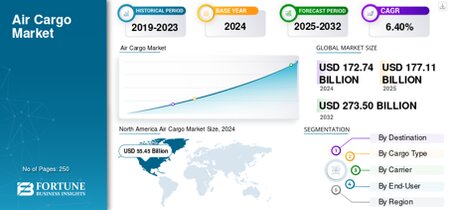
The global air cargo market is expected to expand significantly over the next six years. Fortune Business Insights forecasts revenues to increase from US$ 177.1 billion in 2025 to US$ 273.5 billion by 2032, corresponding to a compound annual growth rate of 6.4%. But the forecast also raises a more interesting question: which cargo segments will generate that growth? E-commerce remains an important driver, while healthcare, critical shipments and high-value commercial goods are becoming increasingly relevant.
E-commerce remains a key growth driver
E-commerce has been one of the strongest growth engines for air cargo in recent years. The market study identifies the continued expansion of cross-border online trade as a major driver through 2032. At the same time, recent developments show that the segment is becoming more complex.
CargoForwarder Global reported in July that the EU’s new EUR 3 charge on low-value imports was expected to cause an initial dip in e-commerce-related airfreight demand. The first signs of this adjustment are now emerging, with changes to China-Europe cargo flows following the introduction of the new rules. https://cargoforwarder.eu/2026/07/05/verhasselt-eu-e-commerce-fee-to-cause-brief-dip-only/
This does not necessarily point to a long-term decline in e-commerce airfreight. Instead, the market could see a shift towards more consolidated shipments, European fulfilment centers and alternative gateways. The segment is therefore likely to remain important through 2032, although its growth model may look different from the one that drove volumes over the past few years.
Pharma and healthcare gain ground
Healthcare is another segment identified by Fortune Business Insights as an important part of the future air cargo market. The growing importance of temperature-sensitive pharmaceuticals, biologics and other high-value products is also reflected in current industry investments.
The latest example comes from IAG Cargo. The carrier has added Kuala Lumpur International Airport to its Constant Climate network, expanding its pharmaceutical cold-chain offering in Southeast Asia. The network now comprises around 100 approved stations globally, including 13 in the Asia-Pacific region. The company says the expansion reflects growing demand for the transport of biologics, cell and gene therapies and personalized medicines.
The development fits a wider industry trend. IATA notes that pharmaceuticals are becoming increasingly value-dense and that biologics, reagents and cell and gene therapies require increasingly precise temperature control and monitoring throughout the supply chain.
AI creates another cargo opportunity
Another segment attracting attention is high-tech cargo. The rapid expansion of artificial intelligence infrastructure is generating demand for semiconductors, processors, servers and other high-value components.
Reuters recently reported that AI-related shipments are reshaping Asian air cargo, with airlines adapting networks to accommodate increased flows of semiconductors and AI hardware. Korean Air, China Airlines and EVA Air have all reported strong demand linked to the sector.
Without a doubt, the industry is already moving from experimentation to operational deployment. CargoForwarder Global has reported on AI being used for booking, pricing, forecasting and customer service, while other applications are emerging in cargo tracking and operational control.
This development is particularly relevant for the 2032 outlook. Unlike low-value e-commerce parcels, AI hardware is compact, expensive and often time-critical. Characteristics that favor airfreight.
Asia-Pacific remains central
Asia-Pacific is expected to remain a major growth region through 2032. Fortune Business Insights identifies the region as the fastest-growing market during the forecast period, supported by manufacturing, international trade and e-commerce.
Recent developments suggest that its importance will extend beyond consumer goods. Taiwan, South Korea, Japan and Southeast Asia are becoming increasingly important in semiconductor and high-tech supply chains. At the same time, pharmaceutical flows are generating demand for specialized cold-chain infrastructure.
A larger market with a broader cargo mix
The forecast points to a significantly larger global air cargo market by 2032. But the growth is unlikely to come from a single source.
E-commerce will remain important, although regulation is forcing the sector to adjust. Pharma and healthcare create demand for specialized infrastructure, while AI and semiconductor-related shipments are adding another high-value cargo stream. General cargo and traditional industrial commodities will continue to form the backbone of the market.