
Electronics, pharmaceuticals and automotives are reshaping India’s export profile. At the Air Cargo Conference 2026 in Frankfurt, high-ranking experts discussed why India is becoming one of the most important growth markets in global air freight – and how carriers and airports can secure a share of the business.
The topic dominated this year’s ACCF trade show, due to its particular relevance. On 25FEB26, the airports of Frankfurt and Bangalore signed a Memorandum of Understanding (MoU) to establish a close partnership in air cargo. [CFG reported: https://cargoforwarder.eu/2026/02/25/exclusive-fra-and-blr-ink-strategic-partnership/]
Industrial shift
Their collaboration is based on the fact that India is no longer just a huge consumer market but has developed into a provider of high-value, time-sensitive goods – commodities that really drive air cargo.
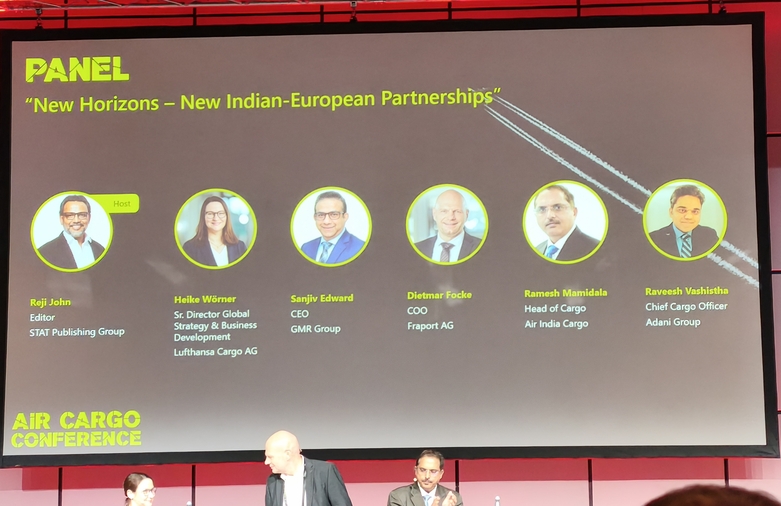
This industrial shift stood at the center of the panel “New Horizons – New Indian-European Partnerships”, which brought together Ramesh Mamidala, Head of Cargo at Air India Cargo; Heike Wörner of Lufthansa Cargo; Sanjiv Edward of GMR Group; Fraport COO, Dietmar Focke; and Raveesh Mohan Vashistha of Adani Group. They discussed why India is becoming one of the most important growth markets in global air freight – and how carriers and airports intend to secure a share of that expansion.
India is no longer simply regarded as a huge consumer market. Increasingly, it has developed into a manufacturing and export base for high-value, time-sensitive goods – exactly the type of commodities that drive air cargo. The upturn is evident in the increasing number of flight connections and the growing volumes being flown between the two markets. Given the MoU signed earlier this year between Frankfurt and Bangalore, it came as no surprise that Fraport manager, Felix Toepsch, and his team listed the topic at the top of the agenda of this year’s ACCF event.
Electronics and pharma lead the way
For Mamidala, electronics are one of the clearest signs of India’s industrial transformation. The country has massively expanded manufacturing capacity for smartphones, components and other technology products, with electronics exports rising sharply in recent times.
This development is particularly relevant for air cargo. Electronics are high-value, relatively lightweight and often time-sensitive. Pharmaceuticals remain another key pillar. India is already firmly integrated into global pharmaceutical supply chains, while engineering goods and chemicals add further potential.
Germany is one of India’s most important European trading partners, with Indian merchandise exports to Germany exceeding USD 10 billion in FY 2024/25. According to Mamidala, Air India currently accounts for around 15% of the India-Germany air cargo market. This figure should be understood as the carrier’s own assessment, as no independent public dataset is available for confirmation.
Covid accelerated an existing trend
Another key message was that India’s manufacturing transformation had already picked up speed during the Covid-19 phase, but the pandemic clearly accelerated it.
India also benefitted from the ‘China-plus-one’ strategy of U.S. and European companies, which invested in production sites outside China to mitigate supply chain risks. This effect pushed exports up, with electronics, pharmaceuticals, and engineering goods gaining weight. All these products have a strong affinity to air freight. Covid therefore acted less as a starting point but primarily as a catalyst for an industrial transition already under way.
Delhi’s cargo hub ambitions
India’s vast domestic aviation network could become one of its biggest competitive advantages, was the unanimous opinion of the five speakers. For instance, Air India wants to use Delhi not only as an origin-and-destination airport, but increasingly as a transit hub for shipments coming from production centers such as Chennai, Bengaluru, Hyderabad, Ahmedabad and Mumbai.
Until recently, cumbersome domestic-to-international transfer procedures made this difficult. A new transshipment framework which is in the pipeline could change that. On the pilot corridor, Chennai-Delhi-Frankfurt, Air India reported that transfer times fell from 36-48 hours to around five to eight hours. Simultaneously, the average daily cargo volumes more than doubled.
If the procedure is rolled out further, Delhi could increasingly compete with hubs such as Dubai, Doha or Istanbul for Indian transit traffic. Delhi already handles more than one million tons of cargo annually, giving it the scale required to build such a hub model.
Frankfurt wants to secure the flow
At the European end, Fraport is preparing for stronger India-related traffic.
COO Dietmar Focke made it clear that Frankfurt is on its way to positioning itself as the preferred European gateway for cargo flows from and to India. This reflects the increasing competition between major gateways for future freight traffic between India and Europe. The executive said that Frankfurt is in a very competitive position. It offers the market a dense road feeder network, established pharma capabilities, a large and well-working cargo community, complemented by the global network of Frankfurt-based Lufthansa Cargo. He admitted, however, that Amsterdam, Paris, London, Istanbul, and the Gulf hubs are equally interested in the same traffic.
For Lufthansa Cargo, the key question is therefore not only how much Indian traffic will grow, but which commodities will drive this growth.
Automotive: India becomes an export base
One particularly significant trend is the growing role of India in the global strategies of German carmakers. Take the Volkswagen Group. Headed by Škoda in India, this speaks for India becoming a future export hub for markets in the ASEAN region, the Middle East, Australia and New Zealand. That marks a shift from producing primarily in India for domestic buyers, by targeting markets in the broader Indo-Pacific region.
For Germany, the consequences are twofold, panelists said. Producing closer to growth markets can reduce costs, improve competitiveness and secure market share. At the same time, a deeper localization of production, sourcing and engineering could gradually shift parts of the value chain away from German plants and suppliers.
The key question is therefore not whether German companies manufacture abroad – which they have done for decades – but how much high-value activity remains in Germany as overseas production ecosystems become more integrated and independent from their parents.
From the air freight perspective, localization can generate new traffic since automotive plants require machinery, tooling, electronics, prototypes, urgent supply of spare parts and high-value components. As Indian factories become integrated into global production networks, cargo flows can increasingly move in both directions or between Indian factories and plants in Southeast Asia.
The next growth sectors
Aerospace and defense could add another layer to the existing ones. Companies such as Tata and Airbus are increasingly scaling up production activities in India. Both industries are particularly attractive for air freight because parts tend to be high-value, specialized and time-critical.
The pending EU-India Free Trade Agreement could further accelerate bilateral trade once implemented, potentially supporting more balanced eastbound and westbound cargo flows.
India currently handles around 3.7 million tons of air cargo annually but has ambitions to reach 10 million tons in the longer term. Ambitious plans, but it remains to be seen if this target will be achieved.
The main takeaway of the panel is that India is on its way to becoming an industrial heavyweight offering fast throughputs of goods thanks to its airports’ and airlines’ hubbing activities. For Air India, Lufthansa Cargo and Fraport, the business opportunities are substantial, as indicated by the panelists. Therefore, the decisive question is who will secure the largest slice of the growing pie.