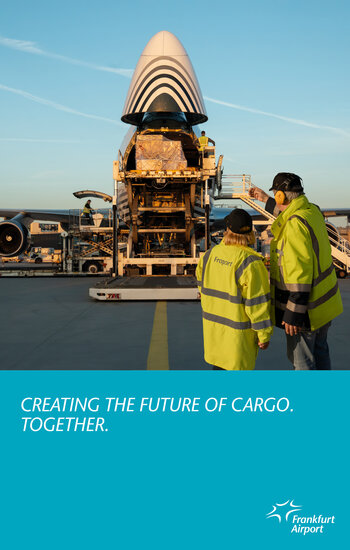

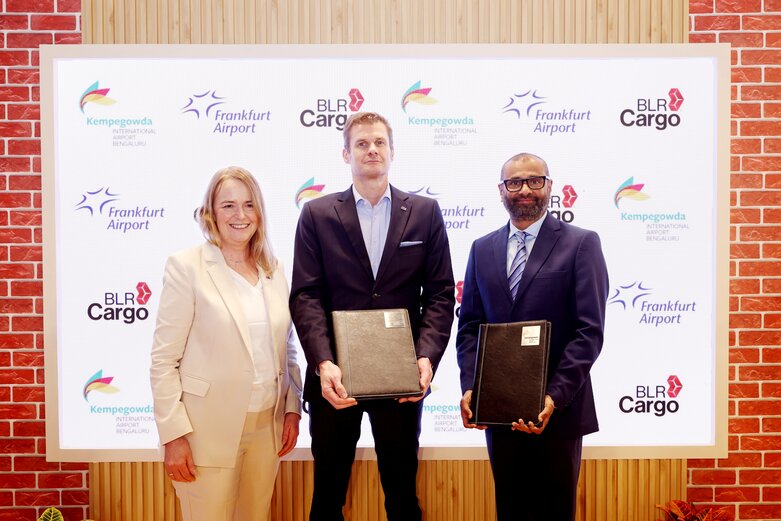
Frankfurt Airport and Bangalore Airport signed a memorandum of understanding today (25FEB2026) at the Air Cargo India trade show, which runs until 27FEB in Mumbai. During the ceremony, both sides emphasized that the pact paves the way for far-reaching cooperation particularly in the air freight sector. Fraport had previously signed a similar agreement with Shanghai Pudong Airport.
Partnerships are significantly less demanding than financial participation concepts or even takeover maneuvers. The latter two strategies are pursued by Fraport, the French Vinci Group, and – most recently – the Mexican AZUR Group, among others. Last November, AZUR acquired 20 Brazilian airports in one fell swoop, as well as others in Curacao, Ecuador, and Costa Rica.
Roadshows paved the way
It remains to be seen which strategy will be more successful in the long term: takeover or cooperation. Fraport Cargo focuses on cooperation rather than financial participation. This has become evident in Mumbai. Following the agreement on closer cooperation in the air freight sector between Shanghai Pudong and Fraport announced in NOV25, a similar agreement has now been signed by FRA Cargo and Bangalore International Airport (BLR). And, as in the case of Shanghai, the way for the deal was paved by a series of roadshows, at which Fraport Cargo managers highlighted the performance and development potential of the cargo business at Frankfurt Airport.
Assumptions were adjusted
“During our discussions with local executives and air freight managers, we realized that it was not widely known that we are currently developing an area of 53,000 square meters that will soon be available for marketing,” says Denis Duarte, VP Cargo Development at Fraport. “They were also surprised to hear that we had signed a lease agreement with Kuehne + Nagel for a site measuring almost 17,000 square meters, where a 7,600-square-meter cargo terminal is to be built and additional 1,100 sqm office space.”
Apparently, the prevailing impression in India was that Frankfurt Airport was operating at full capacity and had little to offer for a further ramp-up of pallets, containers or parcels. “We were able to clearly correct this impression during our roadshows and in subsequent negotiations with Bangalore Airport executives on an MoU,” Manager Duarte added.
Worldclass level
According to him, talks between the cargo departments of both airports with the aim of close cooperation began as early as April 2025. During his stays he got an insight into how attractive Bangalore and the surrounding market is for the air freight business. He confirms that the semiconductor production, IT industry, and electronics sector are at a worldclass level. It is not without reason that Bangalore has a reputation as the “Silicon Valley of India,” i.e., the hotspot of the Indian technology industry. This is complemented by metal processing, the manufacture of life science products, and chemical products.
Well-developed infrastructure and efficient transport links
In a nutshell: Value creation is characterized by an exchange of goods on an equal footing that does not follow the traditional pattern of international division of labor between raw material suppliers and industrial producers. “India has largely left this stage of development behind,” says Duarte. In the case of Bangalore, he also points to the excellent connection to the airport’s road network, which ensures the rapid delivery of goods and the onward transport of imported items to their final destinations.
Similar to Shanghai, Fraport Cargo intends to establish a gateway concept there. This is based on close cooperation between all parties involved: airport operators, freight carriers, customs authorities, ground handlers and forwarding agents. The Frankfurt Air Cargo Community, with its broad membership and coordinated processes, serves as a role model for this intent. By using a digital cargo community system, named FAIR&Link, complemented by an Allivate branded slot booking system, pick-up and delivery processes are fully automated, cutting dwell time substantially, speeding up cargo flows. According to Fraport Cargo’s vision, this gateway concept is to be implemented locally at BLR in close coordination with Kale Logistics, one of the top Indian cloud-based solutions providers.
Focusing on trade lane development
“We will not be investing financially in Bangalore Airport, local warehouse projects or other facilities,” emphasizes manager Duarte. “Instead, we’ll fully focus on the development of trade lanes and hope to achieve growth through deeper and long-lasting cooperation.”
The prospects for this are favorable following the agreement between the EU and India on the creation of a free trade zone between the two markets, eliminating close tom 95% of current tariffs. “Once it comes into force, there will be a significant upturn in rule-based trade between the two signatory powerhouses.,” Denis enthuses. This should benefit both Bangalore and Fraport equally. Why the executive emphasizes the word “rule-based” needs no further explanation.