
The preliminary investigation into the fatal runway overrun involving a 21 Air Boeing 767 points to an unstable approach, missing wind information and a late attempt to abort the landing. The investigation remains ongoing.
The U.S. National Transportation Safety Board (NTSB) has published its preliminary findings on the fatal accident involving a Boeing 767-300 freighter operated by 21 Air on behalf of Amazon Air at Miami International Airport on 06SEP26. The aircraft overran the runway during landing, struck vehicles beyond the airport boundary, and came to a stop several hundred meters beyond the paved surface. Five people on the ground were killed, while others, including both pilots, sustained injuries. The report outlines a sequence of events in which excessive approach speed, a late touchdown, and the handling of the landing after touchdown all feature prominently. It also raises questions about the information provided by air traffic control. The findings remain preliminary and do not yet establish a definitive cause of the accident.
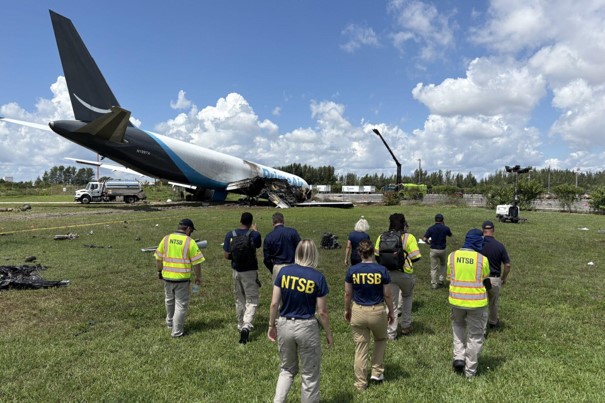
High-speed touchdown left limited stopping distance
According to flight data and aircraft tracking information cited by the NTSB, the Boeing 767 crossed the threshold of runway 30 at approximately 105 feet above the ground, travelling at a groundspeed of 177 knots, equivalent to around 330 km/h. The aircraft touched down approximately 1,140 meters beyond the threshold at 160 knots, or nearly 300 km/h.
The runway, including its displaced threshold, measures around 2,850 meters. The aircraft therefore used a substantial portion of the available landing distance before reaching the ground. The runway end is not equipped with an engineered materials arresting system (EMAS), which can help decelerate aircraft that overrun a runway.
The recorded data also indicate that the aircraft’s speed brakes remained retracted throughout the landing and that neither engine’s thrust reverser was activated. The wheel brakes were applied but were released as the aircraft was still travelling at high speed. The thrust levers were then advanced to settings associated with a go-around.
By that point, only around 280 meters of runway remained. According to the cockpit voice recorder, the captain called for a go-around after touchdown. The thrust was subsequently reduced again and braking resumed, but the aircraft could no longer be stopped before reaching the runway end.
Wind information and cockpit communication under scrutiny
The report also highlights the role of the weather and the information available to the flight crew. At the time of the accident, the airport weather station recorded winds from 190 degrees at 17 knots, with gusts reaching 26 knots, alongside thunderstorms. With the aircraft landing on runway 30, these conditions included a tailwind component.
The air traffic controller cleared the flight to land without providing wind direction and speed. According to the report, U.S. Federal Aviation Administration (FAA) rules require this information to be stated when a tailwind component exists. The same controller had provided wind information to another aircraft approximately four minutes earlier, but the 21 Air crew was not yet on the same radio frequency.
Cockpit recordings further indicate that the first officer repeatedly raised concerns about the aircraft’s excessive speed during the approach. Automated warnings also sounded, including alerts relating to sink rate and insufficient height. The preliminary findings indicate no clear verbal response from the captain to the first officer’s repeated warnings.
These details do not, on their own, establish why the crew continued the approach or why the landing was not abandoned earlier. Investigators will need to establish how the pilots assessed the situation, interpreted the warnings and coordinated their actions in the final stages of the flight.
Investigation continues as Amazon suspends 21 Air operations
The flight was operating from San Juan, Puerto Rico, to Miami. It was the aircraft’s third flight of the day, following earlier sectors between Cincinnati and Miami, and between Miami and San Juan.
Amazon has suspended its cooperation with 21 Air following the accident. The carrier has said it is reviewing the preliminary report and will take appropriate steps to improve safety based on the findings. The NTSB is continuing its investigation, including a detailed assessment of the aircraft’s performance during the approach and landing.
Reassessing existing safety procedures
The accident also raises broader questions about the effectiveness of existing safety procedures. If repeated speed warnings, concerns raised by the first officer, and challenging wind conditions did not lead to an earlier decision to discontinue the approach, the investigation will need to examine whether current cockpit protocols provide sufficient safeguards when a landing becomes unstable. Equally, the reported omission of wind information by air traffic control raises questions about how reliably established procedures are followed and monitored in practice. The decisive issue is not simply whether individual rules were breached, but whether the systems designed to prevent a single error from escalating into a fatal accident worked as intended.