
In 2022, Condor revolutionized its look, changing the plain white fuselages of its fleet to a striped livery. “When I saw the first aircraft with this design, I was slightly shocked,” recalls the then CEO, Ralf Teckentrup, now retired. Former Lufthansa Cargo manager, Peter Gerber is now at the helm of the airline. And he probably owes his predecessor, Ralf Teckentrup, a debt of gratitude for the exceptional and bold aircraft branding. Thanks to the design, Condor’s aircraft are unmistakable, which not only has a positive effect on passenger numbers but also stimulates its air freight business.
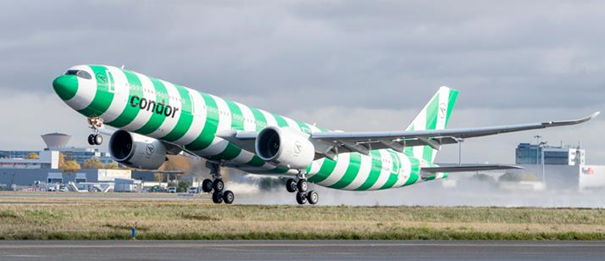
This is confirmed by Thilo Schäfer, the airline’s Director Cargo. “Our striped aircraft are clearly different in design from other airlines, have a high recognition value, and attract attention also from our cargo customers, both shippers and freight forwarders.” Revenue figures back up this statement. Since he took office on 01NOV23, volumes of air freight carried have almost doubled to over 35,000 tons.
Fleet rollover
In addition to the emotional aspect triggered by the design, the modernization of the fleet is the key growth criterion. Just a week and a half ago, Condor’s last B757-300 was retired. This Boeing variant had been the workhorse of the airline’s fleet since 1990. It operated a total of 33 units of the B757-200 and B757-300 variants. Meanwhile, the airline’s long-haul fleet consists of 18 Airbus A330neo aircraft, which offer a cargo capacity, depending on passenger luggage, of between 10 and 16 tons per flight in the belly compartments.
The decommissioning of the B757 also led to a change in the carrier’s network strategy. In addition to long-haul flights, Condor (IATA: DE) is increasingly offering passengers and cargo customers flights within Europe and on domestic German routes. For example: between Hamburg, Munich, Berlin, and Frankfurt. There are now three flights per route per day available for travelers and freight.
Network adjustments
These city flights also feed the airline’s long-haul network, as an alternative to the former Lufthansa feeder flights. Without these shuttle services, however, Condor can hardly fill its own long-haul aircraft based in Frankfurt.
In addition, Condor has set new standards in its long-haul network, illustrates Thilo Schäfer: “In Cancun, in the Dominican Republic, we have set up a hub in close cooperation with Panama’s Copa Airlines, enabling us to offer our customers onward transport of their shipments to Mexico and other destinations in Central America.” While westbound flights are mainly filled with machinery items, car parts, instruments, and high-tech products, the return journey carries loads of flowers, fruit, and other agricultural products.
More hubs are to come
As in Cancun, Condor Cargo also operates a hub in Seattle with its partner, Air New Zealand, thus covering transpacific routes to and from Australia. The same applies to EAT/DHL in the Dominican Republic and Philippine Airlines also via SEA in the APAC region. “From a freight perspective, the vast majority of routes are two-way businesses, meaning that Condor aircraft have a high load factor on both outbound and return flights,” summarizes Manager Schäfer.
Photo and striped activities
He also says that there is still room for improvement in terms of public perception of the stripe logo. Passengers and other aviation enthusiasts are always invited to take photos and share them with the airline. “We are delighted to receive every submission because it shows us that the design of our fleet is attracting attention in people’s everyday lives,” explains Condor’s Director Cargo. In addition, every year on the anniversary of the striped branding, there is a ‘Match the Stripes’ promotion for all guests, encouraging them to wear striped clothes matching the aircraft colors.
Owner seeking suitable partner
According to market information available to CFG, Condor owner and financial investor, Attestor (51%), is looking for a suitable partner for the airline in order to further consolidate and expand the business. When asked about this point, the airline’s response to our question was as follows:
“Condor does not comment on rumors or speculation about a possible strategic partnership. As Germany’s second-largest airline, Condor has grown significantly in recent years and has gradually developed from a holiday airline into a network airline with its own city connections. Condor has thus demonstrated that it is capable of developing successfully on its own. At the same time, thanks to its new route network, a strategic partner could be a useful addition to Condor enabling mutual growth.”