
From 04-06FEB26, Berlin was the epicenter for representatives of the global fresh produce industry. It was a colorful event, with halls full of participants attending interesting presentations where a multitude of innovative ideas from experts, companies and business associations were unveiled. Carriers such as Condor Cargo or Turkish Airlines Cargo, the world’s major shipping lines, forwarding agents and hundreds of fruit producers or traders showed their face to the customer at stands or during panels. In a nutshell: Berlin was worth the admittance fee. It provided new and valuable inspiration for the industry.
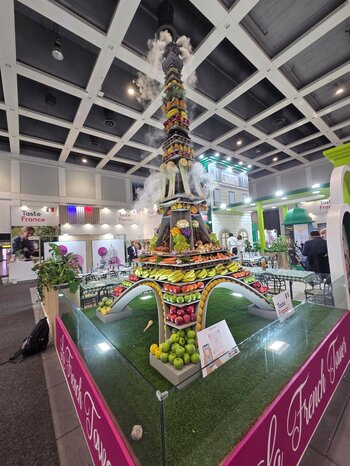
2,600 exhibitors from 90 countries presented their products or showcased business ideas and innovations at the Berlin-held trade fair. In addition to the suppliers, organizer Messe Berlin welcomed more than 67,000 visitors from 151 countries. With all due journalistic objectivity, it was a trade show of superlatives. The products were visible and could be experienced firsthand by anyone interested, and exhibitor staff were always present at stands to answer questions raised by attendees. Fruit Logistica 2026 offered ample food for thought for industry or the broad public in presentations, lectures, and discussion forums – on topics such as improved quality control, greener supply chains, and intelligent packaging and technological solutions, to name just a few highlights of the extensive program. Climate change, rising production costs, volatile markets and shifting consumer behavior make face-to-face exchange more important than ever. “Especially in challenging times, the industry needs places where it can look ahead together,” emphasized David Ruetz, “FRUIT LOGISTICA provides exactly that framework.”
The official thus sent out an optimistic signal right from the start.
AI dominated the agenda
For the very first time and in contrast to last year’s Fruit Logistica, artificial intelligence played a prominent role. Whether in automation, production, transport solutions, or predictive planning, AI has emerged at this year’s fair as a true game changer, emphasized David Ruetz, SVP Messe Berlin GmbH, in his welcoming address. AI and automation are reconfiguring global supply chains, making them faster, more connected and more resilient. Practical examples from production, logistics and trade illustrate that technological innovation is already part of everyday operations and is increasingly influencing strategic decisions.
Fresh perspectives were also provided by StartupWorld. Young companies from various countries presented practical solutions to real-world challenges, ranging from automated quality control and disease tracking to robotics and new packaging materials. In pitch sessions, innovative ideas meet decision-makers from retail, production and logistics directly.
Should the fresh food industry refrain from air transport?
A high-level panel discussed how the fresh produce trade can establish sustainable supply chains by avoiding flying fresh fruit halfway around the world for climate protection reasons? “Sustainability is no longer a buzzword, but a reality,” said Dorra Zairi, Expert Sourcing & Markets at Import Promotion Desk. Agriculture in particular is feeling the harsh consequences of the overexploitation of the planet, explained Simon Derrick, Head of Sustainability at Blue Skies Holdings and co-founder of the Fairmiles initiative: “Climate change is here, and it is already determining how and where food can be produced.” Biodiversity is declining and the depletion of resources is accelerating. And there is something else to note: “For decades, poverty in the world has been declining, but now it is rising again, and that shows that sustainability as we have approached it so far is not working for everyone in this world.”
Sweden leads the way in climate protection
ICA Sverige, Sweden’s largest retail chain, decided a few years ago to stop using air freight. Swedish consumers care deeply about sustainability and climate protection, explained ICA Business Area Director Maria Wieloch, and air freight is part of the emissions problem. For the ICA chain, this meant that it could no longer offer some fresh products with a short shelf life. The company weighed up the options and prioritized its sustainability mission over some of the products in its range, but the question remains: “This may be fair for the planet, but is it also fair for people?”:

No, exclaimed Jeremy Knops, Délégué Général at COLEAD, a network for sustainable and inclusive agriculture and partner organization of Fairmiles. The problem is he reasoned that such sustainability initiatives by industrialized countries often deprive producers in poorer countries and communities of their livelihoods. These are the people who are already suffering the most from climate change – even though they are the least responsible for global warming and pollution. If these producers were cut off from supply chains, it would mean the loss of their livelihoods – money for food, healthcare and their children’s education. This must be weighed against the actual climate impact of transporting fresh fruit by aircraft. “Yes, aviation is growing, but fresh fruit transport is not the driver here,” Jeremy summarized.
“We need more research to understand the consequences of our sustainability decisions,” warned Simon Derrick. “We must ensure that any measures we take in the name of sustainability do not disproportionately and unfairly harm the most vulnerable people or communities.” Fairmiles and COLEAD have therefore established five “just transition” principles to ensure that environmental sustainability does not destroy families’ livelihoods: business fundamentals, impact on people, proportionality, responsible data collection and fairness in change.