
If the design and construction phase for the A350F were broken down into a 24-hour cycle, the first aircraft – prototype MSN 700, would be at the 11 p.m. mark. This is good news for the 14 customers that have placed orders for 101 units. Similarly, the build status enthuses manufacturer Airbus, since the freighter is entering a market in which demand for air transport capacity significantly exceeds supply.
And the gap is likely to widen further. According to market studies cited by Marvin Ehrmann, Innovation Lab Manager at Airbus, the volume of freight transported by air is expected to double over the next two decades. The manager presented this forecast at the manufacturer’s Cargo Media Day in Hamburg, on 21APR26, attended by a dozen trade journalists from several European media. Airbus experts briefed the participants on the current status of the A350F by unveiling the progression of the program in their Hamburg and Bremen production plants.
The complexity of aircraft construction is illustrated by this figure cited by press spokesman, Daniel Werdung: “Roughly 11,000 suppliers are involved in Airbus’s manufacturing programs,” he says. Final assembly of the A350F takes place in Toulouse once Beluga freighters have carried the fuselage sections, wings, engines, and landing gears from the individual Airbus facilities in Hamburg, Toulouse, Broughton/Wales, and Getafe/Madrid, to the production plant in southern France.
No more delays
As for the timeline, the A350 freighter is on schedule following repeated delays in component deliveries from supplier, Spirit AeroSystems. As things stand, the first flight tests will commence in the fall of 2026. “The company is currently in the process of supplying certification documents to the European Union Aviation Safety Agency (EASA) and Washington’s Federal Aviation Administration (FAA)”, media is told. If all goes well, the A350F is set to enter commercial service in mid-2027, provided both certifiers give their green light. Meantime, Airbus has begun to provide the first sets of documents to the regulatory authorities, which will be augmented as construction progresses.
Launching customer is CMA CGM Air Cargo, the air freight division of the French shipping giant of the same name, which has placed firm orders for eight A350F units.
A350F versus B777-8F – the race is on
Its direct competitor, the B777-8F will be delivered to launching customer, Cargolux Airlines, in 2028, about a year later than its
Airbus rival. The Boeing freighter currently has 68 orders placed by seven customers: Cargolux, Qatar Airways, Lufthansa Cargo, Emirates, China Airlines, Silk Way West, and ANA.
And these are the KPIs: The A350F can carry 111 tons over a distance of 8,700 km (4,704 nm). This allows for a nonstop flight from Hong Kong to Anchorage (8,200 km), where the aircraft is refueled to continue its journey – for instance, to New York (7,000 km). On the other side of the globe, the aircraft easily covers the Beijing–Frankfurt leg (8,000 km) without requiring refueling.
24 A350 freighters per year
The frame maker’s current plans provide for the construction of two cargo aircraft per month following its certification. It will be manufactured at the same assembly line as the passenger version.
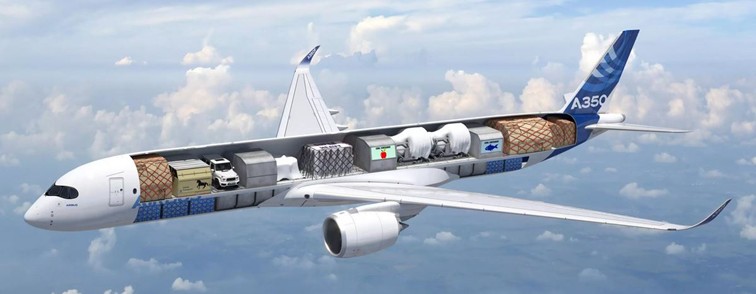
According to Airbus, 70% of the airframe is made of advanced materials, resulting in a 30% lighter takeoff weight compared to the competing Boeing newbuild. This weight reduction has a positive impact on fuel efficiency. The main deck offers space for 30 ULDs (96 x 125″), while the lower deck can accommodate 12 units (96 x 125″). Both sections offer different temperature zones, ranging from +2°C to 26°C – depending on product requirements.
Technologically ahead of its time
The A350F is powered by new generation Rolls-Royce Trent XWB 97K engines that burn less fuel compared to current freighter models, emit fewer greenhouse gases and are quieter. Another factor likely to add value is that the A350F meets ICAO CO2 emission standards applicable to production freighters come 31DEC27. Finally, it can operate with up to 50% SAF, that will be scaled up to 100% by 2030.
The centerpiece
The new Airbus freighter’s distinctive feature is its massive cargo door. It measures 3.8 meters (width) by 3.7 meters (height). It weighs 1.2 tons and allows for the loading of all kinds of bulky and oversized cargo. “Because of these superior technical and operational capabilities, we did not consider a nose loader, especially since front loading is time-consuming and not feasible at all airports,” explains Ian Orton, lead engineer for the A350F cargo door testbed. “The biggest challenge was tailoring the individual components to the dimensions of the XL cargo door so that the hatch locks securely in all weather and operational conditions,” he adds. After numerous trials and some hiccups, this was achieved perfectly, the expert assures. On 23APR26, the first fully completed main deck cargo door was flown from the production plant in Spain to the final assembly line in Toulouse. There, it will be fitted into the fuselage of the first test aircraft and undergo trials in the coming weeks.
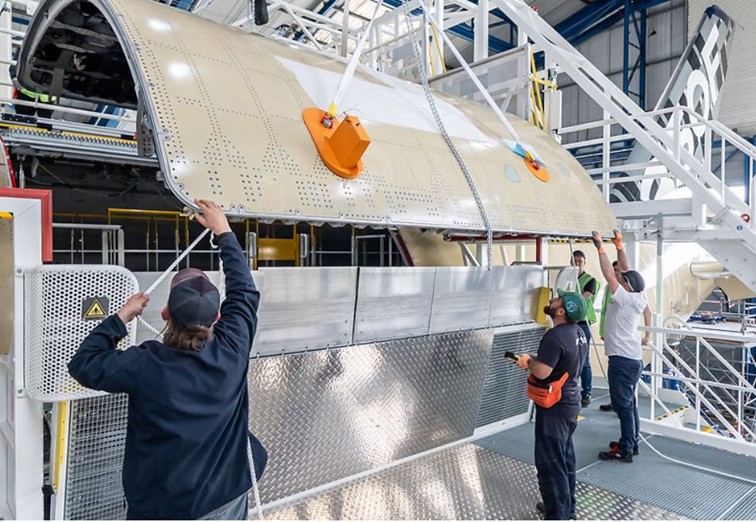
Airbus management also told media people that the A350F is not purely an Airbus aircraft, but has benefited greatly from the industrial expertise of partners such as KLM Cargo, Swissport, and others.
Result of close teamwork
“We’ve set up various working groups that cover the entire cargo ecosystem from end to end,” states Ian Orton. That said, the A350F is a collaborative effort based on teamwork. His personal highlight: When, following numerous technical adjustments and months of testing, the cargo door lowered and snapped into place with millimeter precision in the designated locking mechanisms. “That was an overwhelming feeling.”
In operation, the hatch can withstand wind speeds of up to 40 knots; only then are warnings activated. While at 60 knots, it locks automatically for safety reasons.
The A350F offers yet another innovation: “Thanks to an integrated server that records and shares cargo data, it is a smart freighter,” emphasizes management. Officials also point out that Airbus offers customer airlines loadmaster courses to help them optimally coordinate the loading processes for the most efficient aircraft trim.