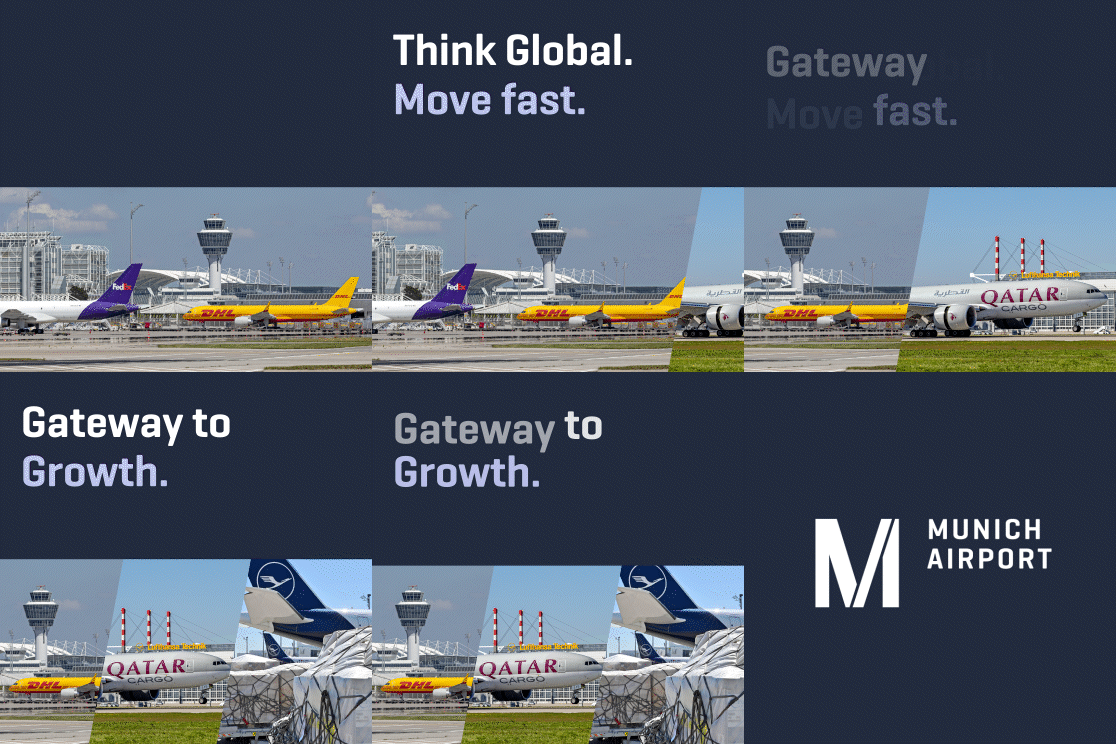

In the public eye, Munich is primarily seen as an airport where passenger traffic takes center stage. That remains the case. But now the cargo business is drawing significant attention with remarkably positive figures. The key message is this: Air cargo has become a major revenue driver for airlines operating scheduled flights to/from Munich. It often determines the success or failure of a route. We spoke with Markus Heinelt (MH), Director of Cargo Development at MUC Airport, about the growing role of air freight at his airport. Here is what the executive said.

CFG: As stated in our CFG issue from 17MAY26, Central and Eastern Europe are fast becoming new cargo hotspots seen by the tonnage growth in VIE, BUD, WAW or PRG during 2025. Since Munich is also geographically part of this greater region, the question is whether MUC did also experience a significant uptick in volume in 2025?
MH: In 2025, Munich Airport saw a 9.5% increase in cargo, reaching approximately 340,000 tons, while the average growth rate for all German airports was just 1.1%. However, unlike others, we do not include trucked air freight in this figure. If we did, the total would be around 570,000 tons. We can therefore proudly state that we were No.1 in Germany for cargo growth in 2025, and we continue to lead the ranking in terms of tonnage among the other airports mentioned by you.
CFG: Did the upswing continue in the first quarter of this year? And if so, what is your forecast for cargo throughput until 31DEC2026?
MH: In January and February 2026, we achieved a growth of 11.7% (ADV/average of all German airports: +3.7%). However, due to the conflict in the Middle East, which began on 28FEB26, this growth momentum could not be sustained, although the first quarter still closed with a 5.2% increase in tonnage (ADV/average of all German airports: +2.4%). Looking at May, we have already returned to a cargo growth rate of just under 8%. Provided there will be no further global conflicts and the situation at the Gulf region is easing up, we expect air traffic to and from the Middle East to normalize again. In addition, we expect long-haul routes to grow further. This will be driven partly by additional flights— for example, Singapore Airlines will increase its service from Munich from daily to ten flights per week, starting with the winter schedule — and partly by new airlines that we will announce shortly. This said, I am optimistic about our cargo performance in 2026.
Growing integrator traffic
CFG: At MUC, belly cargo dominates. Not many freighters are serving the airport. An exception is the integrators. What role do DHL, FedEx at alia currently play and what are their business prospects?
MH: You are right.It is estimated that belly cargo accounts for between 10 to 20% of the revenue generated by passenger airlines on long-haul flights to and from Munich, depending on the routing and market situation. In that regard, it is, of course, very important to us that our airline partners continue to succeed and keep growing their business. Sometimes cargo is the deciding factor for a passenger airline’s decision in favor of an airport or for upping its flight frequencies. Not only the integrators DHL, FedEx, and UPS, but all major airlines are successfully expanding their cargo activities here in Munich seen by their steadily growing volumes and sales figures. The business of the package delivery companies, for example, grew by almost 6% from January until mid-May this year – with corresponding upside potential. Just a few months ago, DHL moved into a brand new, state-of-the-art cargo terminal at MUC Airport. The 105 million euros invested by the integrator are likely to be money well spent and should serve as a springboard for the company’s continued growth here.
CFG: Are flights from e-commerce platforms like Temo, Shein, Shaoke, or Alibaba/Cainiao a topic of discussion in Munich as they are in neighboring Budapest, for instance? Or is Munich not very interested in this kind of air freight?
MH: Despite an upcoming change to EU regulations, e-commerce is the ‘new normal’ in air freight and of great interest to Munich Airport. An increasing number of theses shipments are already passing through our airport. However, they cannot be classified by tonnage or volume because this data is not tracked statistically. With 26 million residents in the greater Munich area, we have an excellent catchment area and are highly attractive to e-commerce providers. However, because of certain local conditions, many shipments are still sent to other European airports and then trucked to Germany (as the largest e-commerce market in Europe). This results in longer transit times and additional costs. However, despite these “deviations”, we see excellent opportunities for direct flights and growth.
Strong cargo trade lane TPE > < MUC
CFG: According to information, EVA Air intends to up its passenger services between Taipei and Munich. This would also be good news for your cargo business. Can you deliver specifics?
MH: We are proud that EVA Air decided more than three years ago to choose Munich as airport of choice. MUC is still their only destination in Germany. Consequently, the airline’s German passenger and cargo headquarters is also located at Munich Airport. Due to their successful operations and the high passenger and cargo demand, the flights, which were previously operated with the B789, have been switched to the larger B777. In the cargo industry, this type of passenger aircraft is referred to as a “mini-freighter” because its cargo capacity is exceptionally high – effectively doubling the previous capacity they offered for sale. Taiwan is known for its leading position in semiconductor production, and our region is also home to companies active in this sector. Therefore, the increased capacity offering between the two markets is particularly good news for this industry. Southern Germany accounts for around 45% of the total air freight tonnage between Germany and Taiwan. Therefore, EVA Air’s capacity expansion positively impacts not only our cargo business but also stimulates our local Bavarian industry and their trade relations with Taiwan.
CFG: Finally, MUC intends to expand the Cargo Handling Area. Kindly unveil the plans, allowing our readers to get a holistic picture.
MH: Given our continued growth in cargo volumes, the construction of approximately 15,000 square meters of additional cargo handling space on the apron is currently underway. This space will be ready by the end of the year. However, this is only a small part of our plans for growth in the cargo sector. We will have more information on this coming soon. Stay tuned!