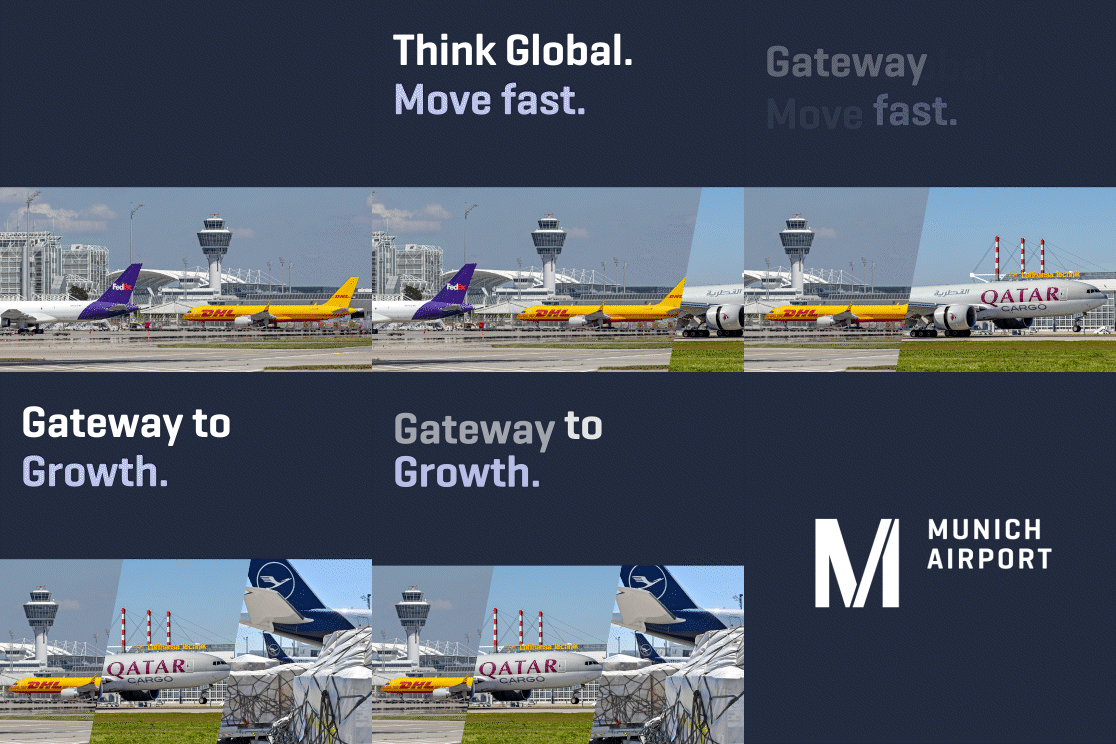

For decades, the spotlight in European air cargo shone firmly on the West – Frankfurt, Paris-CDG, London Heathrow, Amsterdam… These hubs defined the continent’s freight landscape. But a tectonic shift is underway and other gateways into Europe are opening up. One extraordinary example in recent years, is Istanbul, bridging Asia and Europe, which shot up from 47th place in 2019, to become Europe’s largest cargo hub in 2025, tonnage-wise (CFG reported). And Central Europe, too, is fast becoming a strategically critical region in air cargo, driven by geography, industrial transformation, e-commerce, and nearshoring. Central Europe has a strong future in the continent’s cargo industry and the topic of how it is seeking to shape its success will be discussed in a panel titled “Central European Challenges & Opportunities, plotting the pathway to further success” at TIACA’s upcoming Executive Summit in Warsaw, Poland on 02JUN26.

Central Europe is not a formal subregion under the United Nations geoscheme, and its definition therefore often varies, depending on historical, cultural, or political context. The most cited countries are Austria, the Czech Republic, Germany (which bridges Central and Western Europe), Hungary, Liechtenstein, Poland, Slovakia, and Slovenia. Some include Switzerland, the Baltics, or Croatia and neighboring countries in the CET time zone. In any case, Central Europe’s most enduring asset is its location. Sitting at the crossroads of East and West, the region offers unrivalled access across an entire continent. Vienna Airport, for example, reaches the most important consumer and business centers across Central and Eastern Europe within 24 to 48 hours via road feeder services. And it is no surprise that Frankfurt’s position ‘at the heart of Central Europe’ has long made Germany an international air transport hub connecting to all global regions.
Growing cargo figures
Leaving Germany aside for the moment, a number of countries in Central Europe are showing striking results when it comes to cargo volumes. Vienna Airport delivered its best cargo figures to date in 2025, handling 313,763 tons – a 5.3% increase on previous year. Budapest Airport has been even more dramatic: it handled 426,519 tons in 2025, a 42.3% increase versus the previous year [which, too, had seen a 48% increase on 2023] – representing a 200+% increase over five years (CFG reported). Almost half of its throughput is now e-commerce from China, but it also offers excellent solutions for perishables or high-value products, thanks to its BUD Cargo City, which was further expanded in 2022, enhancing its handling infrastructure. Warsaw’s Chopin Airport also had a record year – at roughly 137,000 tons throughput in 2025, it has grown its cargo volumes by 40% over the past 5 years. And a new Polish airport is on the horizon in the next decade. Prague’s Václav Havel Airport, too, has seen impressive momentum, handling a record 96,481 tons of air cargo and mail in 2025 – a year-on-year increase of 48%. It is investing CZK 16 billion (EUR 641.1 million) in a new terminal and expanding its logistics hub to double its cargo handling capacity. The project’s completion is planned for 2029. These examples all confirm a continuing growth pattern.
What is driving this growth?
The answers to this question will be delivered on 02JUN26 at the TIACA Executive Summit panel on “Central European Challenges & Opportunities, plotting the pathway to further success”. With Pawel Kazmierczak, Commercial Manager at 4RCargo, József Kossuth, Head of Cargo at Budapest Airport, Pawel Zagrajek, Commercial Deputy Director, Port Polska Program, CPK, and Michal Grochowski – Cargo and Mail Director at LOT Cargo, the panel offers a GSSA, Airport and Airline view on Central Europe’s success factors, its strategies for a strong future, its infrastructure investments, but also the risks and challenges it faces. How have and are current events impacting growth? Are secondary airports becoming more attractive? Has the region been underestimated? What does and will it have to offer, once Port Polska (located between Warsaw and Lodz) opens in 2032? And what could the air cargo landscape look like in the next 5–10 years?
Looking ahead
Looking to 2031 and beyond, the Europe air cargo market is projected to grow from approximately USD 35.9 billion in 2024 to USD 54.8 billion by 2031. Central Europe has a good chance of capturing a great deal of that growth, as its development in cargo volumes is already confirming. For airlines, freight forwarders, integrators, and shippers navigating an era of supply chain disruption and e-commerce acceleration, Central Europe is not just an option – it is increasingly the obvious choice.