

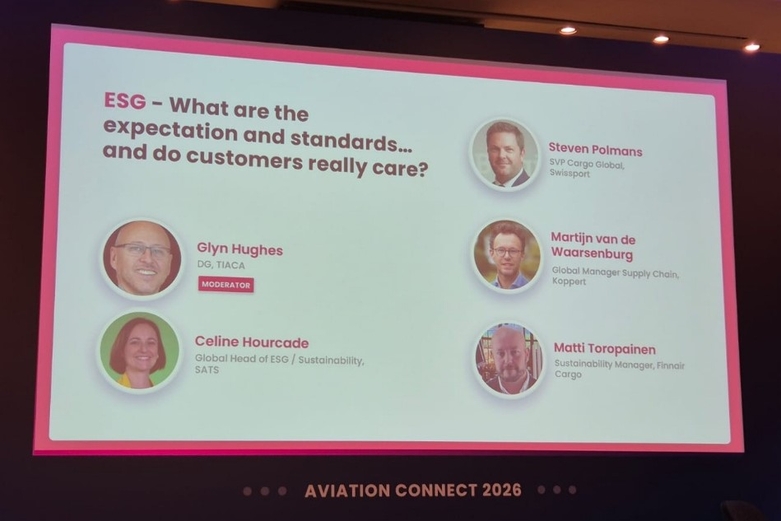
Over the past 18 months, geopolitical turbulence and operational headaches have pushed environmental, social and governance (ESG) issues down many agendas. At the recent Aviation Connect 2026 industry panel on the topic, moderator Glyn Hughes asked four leaders whether customers really care about ESG. The answers suggest the picture is more nuanced than “yes” or “no”.
Not everywhere, and not for everyone
Celine Hourcade, Global Head of ESG at SATS, rejected the idea that interest is fading. In Singapore, she said, sustainability is actively pushed by local authorities and the wider ecosystem. Steven Polmans, SVP Cargo Global at Swissport, agreed that the slowdown is not universal, and that it is often governments and authorities easing off rather than the industry itself.
On customer demand, the panel was candid. Polmans said it depends on who you talk to: airports rank ESG highly, while some airlines and forwarders do and others don’t. ESG is becoming a must-have, he said, but it is hard to quantify due to the great number of companies and partners involved. He underlined that Swissport certainly pursues it, laying the focus on the balance between People, Planet, and Profit.
Hourcade went further. Beyond regulatory reporting obligations, she argued, the real driver is business sense. Just as companies digitalised to survive, they will decarbonise to cut their dependence on fossil fuels. That question, not customer pressure, is what SATS’ board discusses.
Finnair Cargo’s Sustainability Manager, Matti Toropainen offered a different view from the airline side. ESG demand has risen markedly in recent years, with tenders increasingly requiring emissions reporting and customers asking about regulations and wider issues such as wildlife trafficking. The shipper’s view came from Martijn van de Waarsenburg, Global Manager Supply Chain at Koppert (which supplies beneficial insects to growers). He said Koppert wants to be the example shipper that pushes airlines and forwarders in the right direction, even though footprints are often hard to measure and options limited.
Fuel, fleets and infrastructure
Sustainable aviation fuel (SAF) remains under 1% of global fuel use, though Finnair is one of the leading airlines in this field, Hughes pointed out. Toropainen revealed that his airline had managed 1.6% in 2025, and called SAF the most concrete decarbonisation lever for airlines. He urged everyone to support start-ups working on alternative fuels. Hughes noted that of more than 100 potential SAF pathways, only a handful are economically viable.
On the ground, Hourcade described SATS’ decarbonization strategy as being aligned with its airline customers: electrify ground fleet, use low-carbon fuel where electric vehicles aren’t feasible, and boost renewable electricity (SATS’ supply of which, incidentally, rose from 38% in the previous year to now 42%). The main obstacle is electricity infrastructure, which requires conversations with airports and local communities.
Polmans echoed this. Electrifying forklifts and warehouses is the easy part. Securing enough charging points at airports or putting solar panels on ageing buildings is harder, and regulators vary from obstructive to enthusiastic. New buildings, however, are now designed around ESG targets rather than lowest cost.
Starting clean versus changing course
Sustainability is the core of the business for Koppert, which van de Waarsenburg likened to being “the Tesla of agriculture”. There were no legacy systems to abandon – instead it focused on sustainable operations from the get-go. Since its products are live and temperature-sensitive, air cargo is essential, so Kopport reduced volumes by decentralising production and packaging, and ensured that finished products are made near their destination. That meant owners having to undergo a mind shift and give up some of their control in exchange for more sustainable growth.
What the industry wants from regulators
On regulation, Toropainen said flying keeps getting more expensive, so supportive policy is needed to make the transition attractive. Polmans called for long-term, stable and fair rules, with a trustworthy path of clear milestones rather than a distant end goal. Voluntary approaches, he warned, are a big concern as they do not really lead to action.
Hourcade pointed to climate resilience, especially when it comes to workers’ health and safety. Recent flooding in Bangkok showed that compliance is a matter of reality on the ground, requiring both short-term continuity plans and long-term adaptation.
Finally, van de Waarsenburg highlighted Scope 3 emissions, which companies are responsible for but cannot directly control. His advice was to take small, pragmatic steps, avoid constantly changing approaches or over-administrating, and keep the end goal in sight.
The panel’s overall message: ESG may not always be a customer demand, but for many in the industry it is a business and survival question.