
After more than two decades of negotiations, the EU–Mercosur Interim Trade Agreement (iTA) became provisionally applicable on 01MAY26, creating a free trade area wherein the European Commission projects will boost EU exports to Mercosur by 39% (EUR 48.7 billion) and increase EU GDP by EUR 77.6 billion by 2040. See here for more information.
While tariff reductions may take years to reshape sourcing decisions, freight forwarders, customs brokers, cargo airlines, and compliance providers are often among the first to experience the operational consequences of new trade agreements through changes in documentation requirements, customs procedures, and shipment volumes.
A Strategic Shift in Europe > < South America Trade
Spain and the Mercosur bloc (Brazil, Argentina, Uruguay and Paraguay) share a highly intertwined commercial relationship. Mercosur is Spain’s fifth-largest trading partner outside the EU, with bilateral trade valued at around EUR 13.8 billion and services at over EUR 3.78 billion annually. Spain and Germany were among the strongest supporters of the EU-Mercosur Partnership Agreement during the JAN26 approval process. The agreement comes at a time of increasing volatility in U.S. tariff policy and a growing intention to diversify the EU’s current dependence on mineral imports from China.
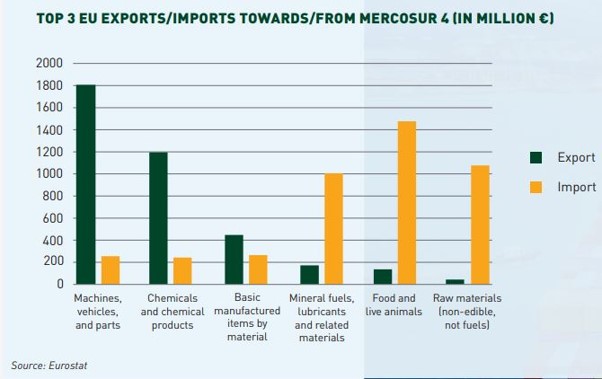
For air cargo operators, the most immediate opportunities are likely to emerge in high-value and time-sensitive sectors. Mercosur already exports perishables, automotive components, and other manufactured goods to Europe, while European manufacturers supply industrial machinery, medical equipment, chemicals, pharmaceuticals, and technology products to South America. Any increase in these flows would disproportionately benefit air freight compared with lower-value commodities that remain predominantly ocean freight cargo.
The pace and scale of any shift remain uncertain, but carriers and forwarders will be closely monitoring which trade lanes generate sustained demand.
Rules of Origin: The Real Test
The EU–Mercosur Partnership Agreement promises simpler customs procedures, reduced non-tariff barriers and easier rules of origin administration. That sounds administrative, but operationally it means more transactions, more declarations, and more compliance data moving across borders.
This is where many companies either capture or lose the benefits of the agreement: Tariff reductions only apply if exporters can prove that products meet origin requirements. A shipment that cannot demonstrate origin may lose preferential tariff treatment, affecting competitiveness and potentially delaying clearance.
The agreement introduces new origin-management requirements that companies must actively manage. Historically, these processes have been highly labor-intensive and largely managed through spreadsheets, making them vulnerable to errors and inconsistencies.
ONE Record Meets Mercosur
The challenge is not simply moving more cargo but managing more trade data. Every origin claim, supplier declaration, customs filing, and shipment milestone creates information that must be exchanged among multiple parties. More trade means more documents, more customs interactions and more stakeholders.
IATA’s ONE Record standard replaces fragmented shipment messaging with a shared data model in which authorized stakeholders access a common shipment record. It may provide, once implemented, the digital infrastructure to manage that complexity.
AI and Revenue Management
Once trade barriers fall, uncertainty rises. Airlines and forwarders will increasingly be making investment and capacity decisions based on their own forecasts of which Europe–South America trade lanes will grow fastest, which commodities will drive demand, and where additional capacity should be deployed.
If demand on São Paulo–Brussels exceeds expectations, airlines must decide whether to allocate scarce capacity to pharmaceuticals, industrial machinery, or general cargo. Modern revenue management systems increasingly use machine learning to determine not only what price to charge, but also which shipments should receive priority access to capacity. Revenue management determines what capacity to sell, to whom, at what price and on which route.
In an environment where trade flows may shift faster than historical data can explain, AI offers a way to identify emerging demand patterns and support more informed capacity and pricing decisions. The winners will not necessarily be the largest air cargo operators, but those with the best pricing and allocation algorithms.
Digital EU-Mercosur
The full economic impact of the EU–Mercosur iTA will take years to materialize. Yet the digital consequences are already visible. Companies seeking to benefit from preferential tariffs must manage origin data, customs documentation, shipment visibility, and capacity planning at a scale that increasingly exceeds manual processes.
The long-term impact of the EU–Mercosur iTA will ultimately be measured in cargo volumes. In the shorter term, however, competitive advantage may depend on how effectively companies manage origin compliance, customs data, shipment visibility, and capacity allocation. As international trade becomes more data-intensive, digital capabilities are increasingly becoming a prerequisite for capturing the benefits of market access.