
Home Blog Page 179

Wingcopter and ITOCHU gearing up for drone delivery

First time a foreign drone is accepted for type certification in Japan. Image: Wingcopter

Long-time business partner and investor in Wingcopter, ITOCHU Corporation, is working together with Wingcopter to begin the type certification process for the Wingcopter 198 in Japan. Wingcopter is the first foreign drone company to be accepted for type certification under the unmanned aircraft class-1 type certification by the Japan Civil Aviation Bureau (JCAB) of the Ministry of Land, Infrastructure, Transport and Tourism, for its fixed-wing drone. Once certified, this will enable the start of commercial BVLOS operations in populated areas. The two companies already premiered a positive verification experiment back in MAY23, when piloting medical blood product transportation in Japan. Now, many more Proofs of Concept will be carried out with special permission until Wingcopter receives its type certification. Once issued, Wingcopter will be authorized to conduct flights equivalent to Level 4 (I.e.: Flights beyond visual line of sight [BVLOS] in populated areas), giving it much greater commercial versatility – a highly useful permit, given both Japan’s geography (many islands and secluded regions) and demography (an aging population). Also, Wingcopter together with ITOCHU would be among the first to establish commercial BVLOS operations in Japan. “ITOCHU and Wingcopter aim to use the Wingcopter 198 to establish drone delivery networks and services that can provide an air bridge to overcome various social challenges by transporting vital and urgently needed goods quickly and environmentally friendly over many kilometers and above challenging terrain,” the release states.

Florian-Michael Adolf, Head of Certification at Wingcopter, announced: “This milestone represents significant progress towards realizing commercial drone delivery in Japan and beyond. At Wingcopter, we are striving for type certification, as it underscores our commitment to safety of our product, as well as the diligence and professionalism of our entire team. We would like to thank our partners at ITOCHU for supporting us in this process with their extensive knowledge, network, and resources.”

Masaharu Sato, Deputy General Manager, Aerospace Department at ITOCHU Corporation, stated: “We see great potential in Wingcopter’s delivery drone to make everybody’s life better and are delighted with the promising progress in realizing this value. It is our honor to collaborate with the dedicated professionals at Wingcopter, led by the management team around Tom, Jonathan and Ansgar. We look forward to continuing this exciting journey together.”
BUD selects KALE for its digital transformation

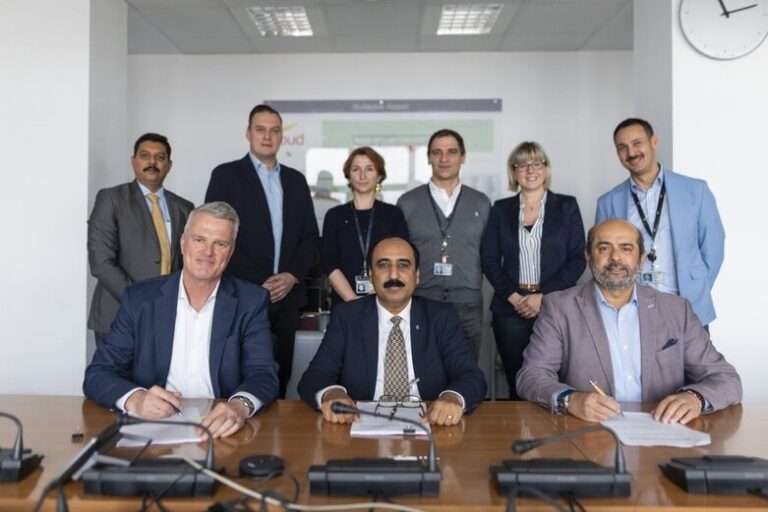
Signing the deal to digitally revolutionize cargo operations at BUD. Image: Meantime Communications

First came the cargo strategy, then the physical infrastructure, and now – with an ever-increasing number of air cargo customers serving the gateway, Budapest Airport has partnered with Kale Info Solutions to implement its Airport Cargo Community System (ACS). A choice that other airports in North America, India, UAE, and Turkey have already opted to take with proven success. Kale has even been recognition by the United Nations for its “innovative approach to trade facilitation,” the press release underlines. Kale’s next-generation cargo community platform facilitates paperless operations and comes with many features centered around air cargo’s developing business requirements. It streamlines information exchange between the different cargo handlers and integrators operating at the airport. Whereas in the past, they used separate IT systems for data collection, reporting and transmission to the airport and the relevant authorities, leading to error-prone, time-consuming double/parallel-date entry, now Kale’s ACS system streamlines the information in a single source giving stakeholders enhanced visibility and transparency, real-time tracking and monitoring of cargo movements, and automated regulatory compliance checks.

József Kossuth, Cargo Director for BUD, commented: “Budapest Airport aims to become the main cargo hub in the Central and Eastern European region. We are on the right track, as the dedicated development of the BUD Cargo City in recent years has provided world-class infrastructure, which, combined with excellent connectivity and a tight-knit cargo community, is attracting more and more partners. We are now the fastest growing airport in the region in terms of cargo volume, as we handled a record 201,306 tons in 2023 with +48.5% increase compared to 2019. The introduction of the new Airport Cargo Community System adds an important innovative feature to BUD’s profile, further strengthening the hub function of the airport. The ACS will serve as a centralized platform, facilitating seamless communication and data exchange among all stakeholders involved in the cargo handling process.” Vineet Malhotra, Co-Founder, and Director of Kale Logistics Solutions, stated: “We are excited to partner with Budapest Airport in introducing our ACS, which will play a pivotal role in optimizing cargo operations and enhancing overall efficiency. As a leading technology provider to airports worldwide, we are proud to bring our expertise and best practices to this collaboration, ensuring the highest standards of service and innovation. Through this collaboration, we aim to set new benchmarks in cargo handling and contribute to the continued growth and success of Budapest Airport, as a key logistics hub in Europe.”

DB Schenker is now GDP-compliant at 157 stations

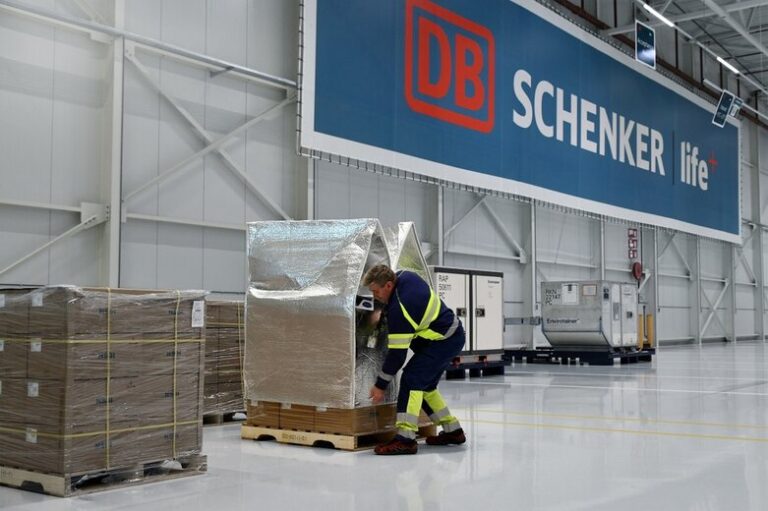
Thermal cover being added to protect pharmaceutical products. Image: DB Schenker/Ton Paulissen

Just like you expect a McDonald’s burger to look and taste the same wherever you are in the world, you would also hope for the same high level of operational quality when it comes to pharmaceutical supply chain logistics. Particularly in the case of commodities that greatly impact the health of patients around the world. DB Schenker recently completed Good Distribution Practice (GDP) standards certification at 157 of its stations. DB Schenker is now one of the world’s largest GDP-compliant logistics networks, and can cover 80% of the world’s healthcare flows with these certificates – particularly across the most important markets for the global trade of medical goods: the Americas, Europe and Asia. And it plans to have over 180 of its stations certified within the next twelve months. With this seal of approval that denotes the company’s commitment to excellence and regulatory compliance, DB Schenker secures greater standing and is clearly equipped to the global pharmaceutical industry’s growing requirements. Its in-house Global Healthcare Quality Management System addresses the Good Distribution Practices for medicinal products for human and veterinary use and related active substances as set out by the European Union (EU) and the World Health Organization (WHO), and ensures compliance through its internal Directive Healthcare Quality Management.

“When DB Schenker started the implementation process for certification, the first goal was to define a global standard valid for all transport modes. This made the GDP certificate suitable. The comprehensive certification ensures that the process, infrastructure, and staffing comply with the stringent requirements of the pharmaceutical industry, using this ideal approach across all business units. After a station is awarded certification following successful completion of an internal certification process, a risk-based re-audit is performed based on continuously measured KPIs. This is repeated at least every 3 years to ensure the highest quality is maintained,” the release details.

Veronique Dameme, Head of Global Vertical Market Healthcare at DB Schenker, said: “At the end of every healthcare supply chain there is a patient. That’s why we ensure that medical products are stored and distributed in accordance with the highest standards. The successful GDP certification of our facilities marks a significant milestone on our roadmap and shows our ongoing pursuit of excellence in pharmaceutical logistics.”

Menzies Aviation’s Recite Me makes it easier to apply for jobs

For a more inclusive, barrier-free recruiting process. Image: Menzies

Recite Me is a software company that aims for break down barriers online to make websites accessible to everyone. It was founded in the UK in 2009 and has since worked with many established companies, assisting them in facilitating all kinds of online processes. Menzies Aviation is the latest to partner Recite Me and has chosen to focus on making its recruitment processes more accessible. Recite Me’s website has this to say about Recruitment: “Everyone should have the opportunity to find their dream job. Discover hidden talent and recruit from a larger talent pool by providing assistive technology. Support your potential candidates who may be disabled, visually impaired or who speak English as a second language, with tools to use your website effectively.” Within such an internationally active company as Menzies Aviation, English as a second language is definitely a large topic. Hence, with Recite Me, existing and potential employees visiting Menzies’ Global Careers Hub now have access to an on-demand live translation feature capable of handling more than 100 languages, including 65 text-to-speech and styling options. They can also customize the page to suit their requirements, using a large variety of tools on the Recite Me assistive toolbar, which include a screen reading functionality, multiple reading aids, and customizable styling options.

This assistive technology supports Menzies’ diversity strategy and opens up opportunities to a greater spectrum of the workforce, ultimately leading to greater diversity and inclusivity within the company.

Juliet Thomson, Chief People Officer, Menzies Aviation, explained: “Ensuring that everyone can access our Global Careers Hub in an inclusive way and that best suits their needs is vital to maximizing the strength and diversity of our workforce. We’re proud to have embraced Recite Me’s innovative assistive technology, which will improve accessibility for anybody wanting to build their career at Menzies.” Ross Linnett, Founder and CEO, Recite Me, said: “It is important to provide an inclusive online experience, where everyone can use our digital world in a way which best suits their needs. As more organizations provide accessibility tools online, those who face online barriers can access information and services hassle-free. The digital world must be accessible for all.”

MST welcomes Malaysia Airlines’ weekly freighter

From the 13APR24, weekly Malaysia Airline flights will carry cargo to and from Maastricht Aachen Airport. Image: Meantime Communications

Malaysia Airlines has opted to put its cargo eggs into two baskets, it seems – to the benefit of Maastricht Aachen Airport (MST). MST has become the second Dutch airport for the airline’s cargo services from Kuala Lumpur. It already flies to Schiphol Amsterdam Airport (AMS). At the same time, MST is only the second airport in Europe served by Malaysia Airlines. From this month on, Malaysia Airlines will operate a scheduled weekly flight, deploying a “relatively fuel efficient and quieter” Airbus A330F on the route. The year has started well for MST. It welcomed Royal Jordanian Airlines back in JAN24, with its new fleet, and now Malaysia Airlines is the second business win. The airport puts its success down to the recent strategic investments and renovations that were carried out by its two shareholders: RSG (40%) and the province of Limburg (60%). Together, they invested EUR30 million in a new runway (completed last year), and another EUR40+ million are flowing into further infrastructure and hardware upgrades to the airport. Investments that stand it in good stead to deal with possible further fall-out from a slot-limited AMS, around the corner. Jonas Van Stekelenburg, Chief Executive Officer (CEO), MST, said: “This is an important opportunity for MST, as since Royal Schiphol Group (RSG) invested in 40% of the airport last year, we have seen our operations consistently growing. Our new runway and close partnership with AMS are among the many reasons we can offer MH a great option to fly inbound and outbound cargo to and from. Our location, high-performing team, and efficiency are widely known to attract cargo flights, but being part of RSG is accelerating our growth and popularity within Europe as a top cargo destination.”

Challenge Technic exercising expansion techniques

Growing to the Challenge. Image: Challenge Technic

Challenge Group’s maintenance subsidiary, Challenge Technic, has a shopping list of activities scheduled for 2024, as it grows to match its expanding customer portfolio. Among those customers is its own peer, Challenge Airlines, which welcomes new aircraft to its fleet, and thus requires more maintenance flexibility and facilities. A total of three new planes are due, hence Challenge Technic is looking to open a new line station and A-Check line in hangar, and will be recruiting new staff to manage the increased workload. But its customers growth is not limited to in-house. Challenge Technic has already welcomed one external new partner this year, with the addition Leav Aviation GmbH since 01MAR24. The airline’s two A320s are maintained at Challenge Technic’s Cologne/Germany hangar. Another two customers additions are already lined up – in total, nine more aircraft awaiting maintenance.

Infrastructure and digitalization are also on the books. The company hints at the inauguration of a new, large hangar this month, able to hold a B747, but does not reveal where. And it continues on its digital transformation, focusing on a new, activity-based system this year. Sustainability initiatives are also ongoing. These include investments in electric vans, waste recycling programs in three countries, and energy-saving measures at all line stations.

In just six years, Challenge Technic has become an established player on the MRO (Maintenance, Repair, and Overhaul) scene and counts more than 35 airlines as its customers, providing MRO services “with passion, precision, and fair pricing,” the release emphasizes. CEO and Accountable Manager, Erlingur Petur Ulfarsson explains: “Challenge Technic focuses not on being the cheapest, but on maximizing flight hours for clients, ensuring minimal turnover thanks to its stellar reputation. Challenge Technic’s expansion in 2024 is a testament to its unwavering commitment to excellence, customer satisfaction, and sustainability, reinforcing its position as a leader in the aviation maintenance sector.”

Ardian sells Staci to bpost

Belgian postal service provider bpostgroup has acquired Staci (100%), a fulfilment and logistics services specialist registered in the Parisian suburb, Pontoise. Seller is French private investment house Ardian that purchased Staci in 2019, together with some other minor stakeholders. The deal, valued 1.3 billion euros, will enable state-owned Belgian Post to strengthen its position in Europe and secure market shares in the APAC region as well as in North America.

Different names, common goal: business success – picture: courtesy Belga / Staci

The days when state postal services defined themselves primarily as deliverers of letters and small items, are largely over. Today, they are increasingly moving into the business of multichannel logistics and distribution solutions, including B2B, B2C, D2C and e-commerce. Hardly any other company embodies this transformation from letter carrier to full service provider more vividly than Deutsche Post. It bought the U.S. express service DHL in 2000, and now operates internationally under its name.

The Dutch postal service (Posterijen, Telegrafie en Telefonie) pursued a similar strategy when it took over the Australian express service provider TNT in 1998. However, the plan did not materialize. Today, TNT is part of FedEx and the logistics division, TNT Logistics, has been renamed Ceva Logistics, which belongs to the French multinational shipping company CMA CGM.

“The Staci acquisition catapults bpost to the next level” – Chris Peeters
Next postal candidate to strive for higher goals is the Belgian bpostgroup. By acquiring Staci, it embarks on an expansion spree with the ambition of opening up new markets and further strengthening existing business areas. Chris Peeters, CEO of bpostgroup, explains the logic behind the Staci purchase: “The contemplated acquisition […] is fully in line with the strategic choices bpostgroup had already made and presents the potential for a robust B2B-service offering. Also, bpost in Belgium can expect extra volumes in its last-mile-delivery network. Moreover, this transaction promises growth, sustainable employment, and enduring value creation.”

bpost emphasizes that Staci’s service portfolio complements that of its own subsidiaries, Active Ants and Radial, and amplifies its existing activities. It will gain immediate access to special know-how and technology of B2B, e-commerce and benefit from successful initiatives lifting the traditional brick-and-mortar businesses to the next level. As a welcome addition to the deal, bpost gets access to Staci’s portfolio of clients in many sectors, including Fast Moving Consumer Goods (FMCG), retail, pharmaceutical, health, cosmetics, industrial, energy, financial services, catering, and public services. Above all, bpost expects that the acquisition accelerates the ongoing transformation of its business model in its traditional Belgian home market, by accelerating processes.

Strategic change
Chris Peeters comments: “I am convinced that with the contemplated acquisition of Staci, we will be ready for robust growth. The B2B logistics sector, including in Belgium, holds immense potential. Our collaboration with Staci will bring us expertise, innovation power, and customer insights, enabling us to craft a complete customer-centric offering tailored to their needs. With this strategic change, we aim at possessing the assets, potential, and ambition to excel as an international logistics player, securing a sustainable future for our company and employees.”

No job-axing, promises bpost
bpost emphasizes that the management team and all employees of Staci will remain on board, so that the group can continue to rely on their expertise and experience. After the transaction closing, Staci CEO Thomas Mortier will become member of the executive committee of bpostgroup and will lead the new business unit 3PL.

The Belgian Post Group plans to pay the transaction by using bridge financing upon closing combined with a portion of its own cash. The transaction is subject to prior communication and consultation with the relevant employee representatives, and is expected to close in fall 2024, depending on green light from the relevant competition authorities.

China invests heavily in drone industry

Drones can be used in multiple ways, for both civilian and military purposes. The latter is demonstrated day after day by Russia’s war against Ukraine. China has now announced its intention to provide the equivalent of USD 70 billion for the development of a ‘low altitude economy’. A gigantic chunk of money.

China is building various models of smaller drones such as the FimiX8 Mini to scan landscapes – courtesy China-Gadgets…

The volume of the market segment of low-altitude aerial vehicles [operating below 1,000 meters], grew by almost 34% last year, reaching a financial volume of USD 70 billion. Market experts forecast it will more than double by 2026. This estimate is based on an analysis from a research institute linked to Beijing’s Ministry of Industry and Information Technology (MIIT), and published last week.

Sun Wensheng, Deputy Director of the Department of General Affairs at the Civil Aviation Administration of China (CAAC), stated that the regulator intends to “continuously improve support services for low-altitude flight activities, including plan approval, air traffic management, meteorological services, communication and surveillance.”

Powerful driving force
The project is outlined in a nine-page guideline for the general aviation industry presented by the MIIT in cooperation with other agencies. The scheme reveals government intentions to provide considerable start-up assistance to pave the way to launching commercial applications in sectors such as urban air transport, drone food deliveries, emergency rescue, and logistics supplies, in general. “By 2030, a new development model for general aviation, characterized by high-end, intelligent and green features, will be established,” the guideline announces. It goes on to say: “General aviation equipment will be fully integrated into production and life, becoming a powerful driving force for economic growth.”

Bright future of drone applications
“In China, civilian drones have pioneered industry-wide adoption in sectors such as agriculture, fishery, forestry, animal husbandry, and aerial photography,” stated Luo Hongjiang, from the civil aviation regulator during a briefing last week. He went on to say: “Logistics services of drones have expanded into urban commercial areas and communities. The airworthiness certification process for eVTOL aircraft is steadily advancing, and the future prospects of drone applications are bright.”

… but also large combat drones, like the WZ-7 “Soaring Dragon” –  courtesy: Future Zone

Dual-use considerations
The USD 70 billion project runs under the collective term ‘General Aviation’. Possibly a deliberate name that sounds harmless in order to emphasize the civilian nature of the scheme to the outside world, to avoid raising and spreading mistrust. In a country that keeps its true plans under wraps, it fits that military considerations are not mentioned anywhere. However, experts suspect that the entire plan is of dual-use character, i.e. the high investments in drones also serve to build up a powerful drone infrastructure for the Chinese military, which is under the command of China’s Central Military Commission. Just this March, a large Chinese drone was discovered in the airspace of Taiwan – a country that China regards as part of its own territory and wants to annex – by force if necessary.

Spotlight on… Julia Knecht-Ostwaldt, COO and CargoCoach

0

CargoForwarder Global’s ‘Spotlight On…’ series aims to highlight the many different functions involved in ensuring that cargo flies from A to B safely, efficiently, and on time. Every week, another person in the industry explains what they do, what brings them to our industry and why, and what advice do they have for those considering a career in air cargo. This week, we hear from STRIKE Aviation Group’s COO, Julia Knecht-Ostwaldt (JKO).

COO and CargoCoach. Image: Julia Knecht-Ostwaldt

CFG: What is your current function? And what are your responsibilities?

JKO: My responsibilities include those of a COO, alongside exhibition and event planning, cargo operations, and optimizing workflows and SOPs. In January each year, we select the important events that we as STRIKE Aviation Group want to participate in, planning around 10 events per year. In regard to the day-to-day job, it is my responsibility to optimize the daily workflows using those AI and IT systems on the market designed to help maintain the increasing duties with same number of staff, using automation to support the team as much as possible.

In my additional function as Board Member of the Federation of Airline GSA Geneva, I am involved in pushing forward items that the board is heavily working on, and where you can expect to see updates coming this year.

CFG: What does a normal day look like for you? Or is there such a thing?

JKO: Every day is different to the previous day – that makes it so nice and never boring. It is definitely not a nine-to-five job and certainly not a job that is carried out only on weekdays. You need to be available to reply to mails and WhatsApp at any time of the day, but nevertheless this gives you the flexibility that you are not fixed to a certain location. You can get the work done anywhere in the world and work remotely.

CFG: How long have you been in the air cargo industry, and what brought you to it?

JKO: I started in forwarding in 2003 and changed to the GSSA world in 2006. I was introduced to forwarding by a friend and he connected to the matching company where I was able to start my carrier as trainee. Whilst I very much enjoyed the job, working with end customers was not really my passion, so I decided to change sides and work as GSSA, where my customers, the freight forwarders, are well educated in the area of logistics.

CFG: What do you enjoy most about your job?

JKO: The variety of things which need getting done. And since I also want to give guidance to everyone who is passionate about the air cargo industry, I recently launched CargoCoach. The concept was on my mind for quite some time. The idea is to offer all sorts of information on loadability, industry related language and other important points – all from a single source and just a click away.

CFG: Where do you see the greatest challenges in our industry?

JKO: The mostly man driven fixed boundaries. By that, I mean that if you are a woman in a male-dominated industry, you need to grow your self-confidence to overcome hassles and boundaries. Successfully mastering these, gains you respect and a name in the industry. That said, our industry should open to more flexibility, and we should learn from other industries.

CFG: What advice would you give to people looking to get into the air cargo industry? Any particular training they should aim for?

JKO: Start in Forwarding to learn the aviation basics and change to an airline or a cargo GSSA to discover and see a wider picture. As long as you are an open-minded person and you are willing to learn, this can be performed at any skill level and as an on-the-job training.

CFG: If the air cargo industry were a film/book, what would its title be?

JKO: Get infected! Live Aviation Life.

Thank you for sharing your insights, Julia.

If you would like to share your personal air cargo story with our CargoForwarder Global readers, feel free to send your answers to the above questions to cargoforwarderglobal@kopfpilot.at We look forward to shining a spotlight on your job area, views, and experiences.

FAA plays hardball with Boeing

Washington’s Federal Aviation Administration (FAA) has tightened its grips on Boeing. The regulator is undertaking much tougher audits following a blowout on a B737 MAX in January, blamed on assembly failures. It imposed a production cap of 38 jetliners a month and announced stepping up factory checks at the manufacturer’s Renton plant.

The FAA announced that it  will up its Boeing inspections significantly  –  picture: CFG/hs

The FAA’s patience with Boeing has ended. Repeated technical glitches with the B737 MAX in the recent past, blatant production errors and sloppy technical controls by Boeing’s own experts have alarmed the authority. It came under increasing criticism itself and was accused by aviation experts and media of treating Boeing too leniently. Now the wind has changed. Gone are the days when technicians and safety experts from the aircraft manufacturer were allowed to carry out the final inspection of passenger and cargo aircraft themselves and only had to provide the FAA with documentary evidence of the results of the final technical and operational checks.

Increasing budget gap
The reduction in the monthly production rate that has now been ordered, is tearing a big hole in the manufacturer’s coffers. Frame makers get paid for their jetliners upon delivery. The underlying production rate dictates the pulse of an industrial system feeding thousands of aerospace suppliers worldwide. Hence, Boeing’s production slowdown is expected to ripple through the airline industry, with carriers scrapping flights from their schedule or prolonging existing jet leases to meet demand.

In addition, any prolonged output slump has potential repercussions for engine maker CFM International, co-owned by newly standalone supplier GE Aerospace and France’s Safran. As sole engine supplier for the MAX, CFM gets paid for the turbines once a fully assembled aircraft is delivered to an airline and not when aircraft parts are handed over to Boeing or, in case of Airbus jetliners, to its European rival.

Falling further behind Airbus
With FAA ordering Boeing to sharply cap MAX production, enabling Washington’s inspectors to check if industrial operations are working smoothly, Boeing falls further behind its arch-rival. In the single-aisle category, Airbus already has a comfortable lead which will now be extended.

News agency Reuters cites Rob Morris, Global Head of Consultancy at Cirium Ascend, who said that 11 MAXs were finished by Boeing in February, following 13 in March. The rate peaked around 38 a month in mid-2023, Cirium data shows.

Airbus, in contrast, produced an average of 46 jets a month of its competing variant A320neo in the first quarter, Morris said.

Boeing customers getting nervous
Due to the string of mishaps that have severely damaged Boeing’s reputation, and led to a management shakeup, some airlines are considering canceling earlier orders and switching to Airbus models. But it is not all is running smoothly at the European aircraft manufacturer, either. Hit by supply chain disruptions, the production rate of the A320 variants could not be ramped up as quickly as originally announced by management.