flydubai is diversifying its business mission and starting dedicated freighter operations next month. From 01OCT26, three Boeing 737-800 freighters will be joining its fleet through a wet-lease agreement with SolitAir, complementing its own passenger fleet of 98 Boeing 737 aircraft. Each freighter offers up to 23 tons of cargo capacity per flight. This is the first phase of the airline’s transition to becoming a full-service logistics provider under the management of Mohamed Hassan, flydubai’s SVP, Airport Services & Cargo, and Rashid Albashri, VP, Cargo at flydubai. The cargo space on offer will increase further with the delivery of 30 Boeing 787 Dreamliners, and flydubai Cargo plans to combine scheduled freight operations with flexible charter solutions across its growing network, in future. From 2029 on, the airline will also consider passenger-to-freighter retrofits.
Operating a fleet of three Boeing 737-800 freighter aircraft. Image: flydubai
The new freighters are due to begin operation in time to cover the fourth quarter peak, this year, offering main-deck cargo capacity to and from flydubai’s hub at Al Maktoum International Airport (DWC), where they benefit from dedicated airside infrastructure and direct multimodal access via Dubai South. flydubai Cargo will provide charter and scheduled freighter services to over 125 destinations across Africa, Central Asia, the Caucasus, Central and Southeast Europe, the GCC, the Middle East, South Asia, and Southeast Asia. It aims to transport specialized cargo such as pharmaceuticals, perishables, live animals, dangerous goods, express shipments, and aerospace parts, with flight frequency set to increase as demand and capacity grow.
Ghaith Al Ghaith, Chief Executive Officer at flydubai, announced: “Dubai has established itself as one of the world’s most connected hubs for e-commerce, trade and logistics, and its ambitions under the Dubai Economic Agenda D33 continue to create new opportunities for businesses to reach global markets. The launch of dedicated freighter operations marks an important step in flydubai’s evolution and reflects our commitment to supporting Dubai’s vision through enhanced trade connectivity and logistics capabilities. By building on the strength of our network and expanding our cargo offering and list of codeshare and interline partners, we are creating new pathways for businesses to move goods more efficiently, access new markets and contribute to economic growth across the region and beyond.”
Hamad Obaidalla, Chief Commercial Officer at flydubai, added: “Since 2009, flydubai has opened more than 100 underserved markets and expanded regional connectivity. As trade requirements evolve, our partners require guaranteed main-deck capacity, flexible scheduling and specialized handling. Establishing DWC as our freighter hub, gives our commercial partners direct access to Dubai’s world-class logistics ecosystem, backed by tailored products designed for high-value and sensitive cargo.”
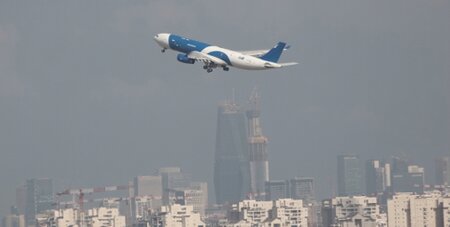
Israel Aerospace Industries (IAI) has successfully completed the first flight of its converted Airbus A330-300 P2F (passenger-to-freighter) aircraft, a key step in the certification process for its new A330-300BDSF (Bedek Special Freighter) program. This maiden flight, during which the aircraft’s performance and systems were assessed across various operating conditions, signifies the completion of major structural modifications and thorough ground testing, conducted by IAI’s Aviation Group.
Maiden flight of A330-300BDSF (Bedek Special Freighter). Image: IAI
The A330-300BDSF is designed to serve regional and medium-haul freight routes and offers room for up to 30 ULDs and up to 61 tons in payload capacity. Notable design features include an electric cargo loading system and a streamlined cargo flow layout. Its main deck cargo door, positioned toward the front of the aircraft, allows for quicker loading and unloading, helping cut turnaround times and boost operational efficiency.
IAI has been in the business of narrowbody and widebody passenger-to-cargo conversions for almost half a century and offers an increasing conversion portfolio. It was the first company to earn an STC for the 777-300ER conversion and continues work on the 777-300ERSF, 767-200/300, and 737-700/800 platforms. With the A330-300BDSF, the aircraft modifier cements its status as one of the few companies capable of performing sophisticated freighter conversions on both Airbus and Boeing widebody jets. It is also expanding its global network of conversion facilities, to meet rising demand from airlines, lessors, and cargo carriers.
Guy Bar Lev, IAI President and CEO, commented: “This milestone reflects IAI’s continued investment in advanced aviation technologies and industrial and engineering capabilities, while strengthening our position in the global air cargo market. The A330-300BDSF program further expands our broad conversion portfolio and reinforces IAI’s ability to provide long-term, flexible and reliable solutions to customers worldwide.”
Yaacov Berkovitz, EVP and GM of IAI’s Aviation Group, said: “The successful completion of the first flight marks another important step in expanding IAI’s widebody conversion capabilities and advancing the A330-300BDSF program toward certification and commercial service. Leveraging decades of engineering expertise and operational experience, we are delivering a highly capable and competitive solution designed to address the evolving needs of the global cargo market. IAI approach is designed around the customer’s requirement for quick entry into service, supporting accelerated operational readiness and earlier revenue realization.”
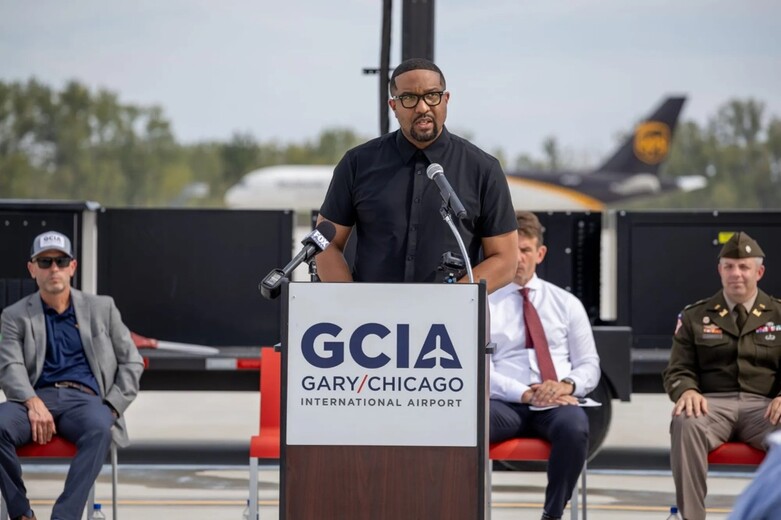
There’s a new freighter-friendly kid on the cargo airport block, over in Chicago. In addition to O’Hare (ORD) and Rockford (RFD), Gary (GYY) has joined the throng. It celebrated the official completion of phase one of its US$ 24 million Cargo Campus on 08SEP26. The ribbon was ceremoniously cut, and Gary/Chicago International Airport (GCIA) now offers a 223,000 m² (55 acres) cargo area including a concrete logistics apron with eight wide‑body parking positions, as well as fuel, utility and environmental infrastructure. Funding came from a mix of sources: US$ 10+ million from the state of Indiana, US$ 13 million from the FAA, and US$ 1 million from a regional development initiative. Construction began in late 2024 and was finalized during the summer, this year. While Gary might be quite a bit smaller than one of the world’s busiest cargo airports, O’Hare (ORD), and Rockford (RFD), which has seen accelerated growth over the past few year s and is now in the U.S. top 15 cargo airport, it does offer an alternative option – particularly to those involved in e-commerce, for example. Its largest customer to date (since 2020 and following a recent lease extension), is UPS.
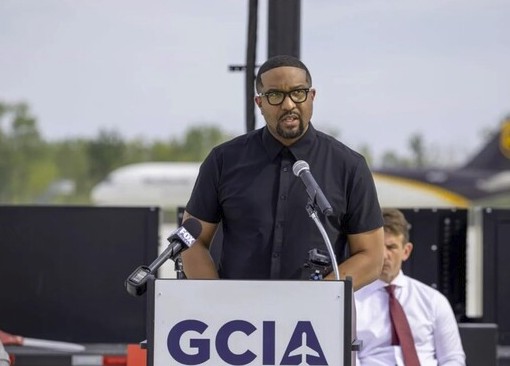
Gary Mayor, Eddie Melton at the GCI air cargo campus inauguration. Image: Dimitri Jones
City of Gary Mayor, Eddie Melton, announced: “Today’s milestone is a testament to what we can achieve through strong federal, state, and local partnerships. The completion of this state-of-the-art cargo campus elevates Gary’s role as a premier logistics hub in the Midwest. We are building the critical infrastructure necessary to attract world-class operations and drive sustained momentum for the City of Gary.”
Dan Vicari, Executive Director of GCIA added: “Today’s ribbon cutting marks a transformative moment for the Gary/Chicago International Airport and the continued evolution of our air cargo operations. […] The completion of this new 55-acre cargo campus positions the airport extremely well for continued growth, creating new opportunities for current and future airport users while reinforcing our role as a vital economic engine for Northwest Indiana.”
Michael Bruening, Chief Airport Engineer of Indiana Department of Transportation (INDOT), stated: “Indiana’s transportation network depends on strategic investments that strengthen connectivity, improve efficiency and support economic growth. The completion of this cargo infrastructure project enhances one of Indiana’s most important aviation assets and helps position the airport for future growth in freight, logistics and business development throughout the region.”
Awery Aviation Software is continuing the expansion of its management team. Last week, CargoForwarder Global reported that Gianluca Marcangelo had been appointed Executive Vice President of Global Sales. This week, the air cargo sales and technology company has announced that Cornelia Korsch has joined Awery as its Global Development Director, both for Awery as well as its digital air cargo quoting and booking platform, CargoBooking. Her responsibilities include attracting more airlines and capacity to the booking platform, and driving adoption among the freight forwarding community.
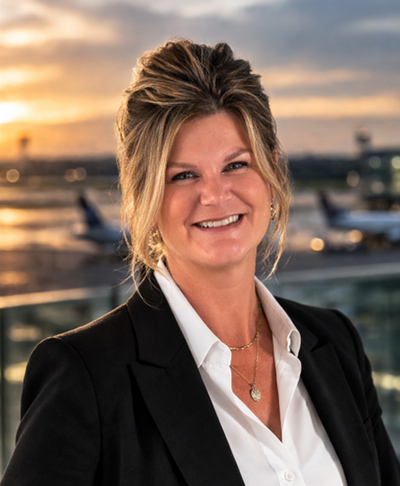
Cornelia Korsch is Awery’s Global Development Director. Image: Awery
Cornelia Korsch’s air cargo career began in Hamburg in 1990, and includes a solid two-decade stint at Cargolux Airlines in sales and reservations, followed by AirBridgeCargo Airlines LLC until 2022 in sales and business development (also digital), and then WebCargo by Freightos, in global airline partnerships and air cargo technology.
Cornelia Korsch said: “CargoBooking combines smart, AI-powered tools with a simple and efficient booking experience, making it easier for airlines to put their capacity in front of forwarders and for forwarders to find and book the capacity they need. I’m looking forward to bringing my experience with airlines and technology providers to CargoBooking and working across the air cargo community to help them reach more customers and maximize the opportunities that digital distribution can offer.”
Vitaly Smilianets, Founder and Chief Executive Officer, Awery, commented: “This is an exciting period of growth for CargoBooking, and we’re delighted to have Cornelia on board to support and further drive that momentum. Cornelia understands what airlines need from a digital booking platform, and that insight will be invaluable as we bring more carriers onto CargoBooking, giving forwarders greater choice and access to more capacity.”
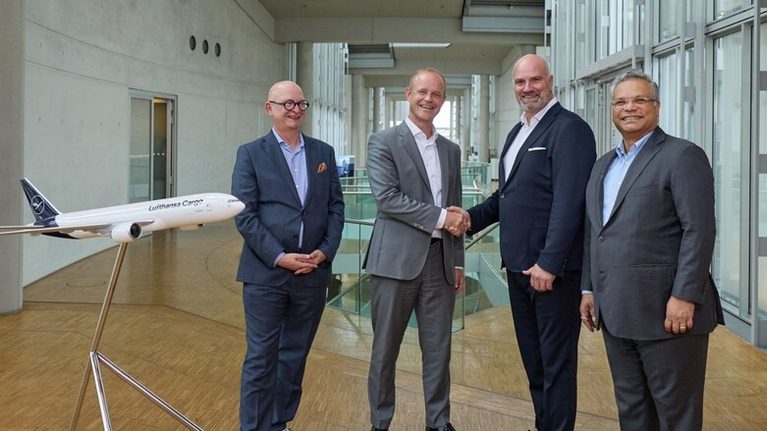
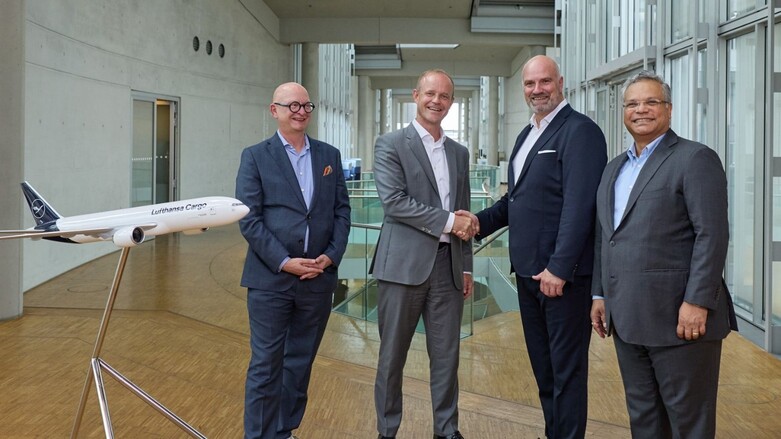
“In the 100th anniversary year since the founding of the first [sic] Lufthansa, its freight subsidiary, Lufthansa Cargo, is setting the course for sustainable growth in the coming decades and positioning the company for a successful future,” the press release states, going on to announce the acquisition agreement signed between the air cargo airline and the 60-year-old handling company, LUG aircargo handling GmbH, until now, a subsidiary of Dettmer Group. The signing took place on 07SEP26, and will make the cargo handler’s 400 staff and 50,000 m² of warehouse and 18,000 m² of office/infrastructure space part of Lufthansa Cargo to 100%. The cargo airline has done this in order to have “greater capacity and flexibility for cargo handling in the home market”, and the move is “one of the key pillars of Lufthansa Cargo’s growth strategy and is intended to create the infrastructural foundation for future profitable growth and further strengthen the company’s competitiveness.” Seems sensible to insource handling in the heart of its operations in Frankfurt once again, at least in part. This time it is gaining a company with a great deal of experience and serving a number of international airlines. The press release does underline that the acquisition will not change anything for the existing customers of either company, because LUG aircargo handling GmbH will continue to operate independently, but also explains that “Lufthansa Cargo will gain immediately available, additional handling capacity within Germany”, particularly with the view to the LCCevo program that is still underway. The acquisition still needs to go through the required antitrust and regulatory approvals.
From left: Torsten Heitmeier, COO Dettmer Group; Frank Bauer, COO LCAG; Andreas Niemeyer, CEO Dettmer Group; Ashwin Bhat, CEO LCAG. Image: Lufthansa Cargo
Though it contains no direct quote from Dettmer Group, the seller is said to “welcome the planned transaction and believes the company is well-positioned for further growth under Lufthansa Cargo’s ownership.”
Frank Bauer, Chief Operating Officer of Lufthansa Cargo, explained: “In an increasingly volatile market environment, we want to become more flexible, more efficient, and more resilient for our customers. That is why we are making targeted investments in our infrastructure in our home market in Germany, to set the course to provide an even better offering for our customers and achieve profitable growth – this is a win-win situation for both companies. We will continue to stand for ‘Enabling Global Business’ for Germany as an export nation and across our entire global network.”
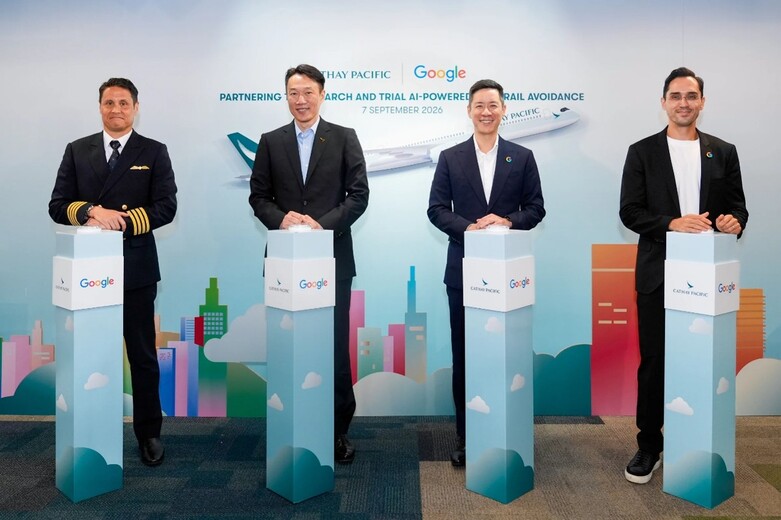
Cathay Pacific and Google have launched a partnership to study contrails and their role in aviation’s climate impact. Cathay is the first Asian-Pacific airline to collaborate with Google in trialing its AI-powered contrail mitigation technology, and indeed the first airline in the world to test contrail avoidance on ultra-long-haul flights.
From left: Cpt Tony Pringle, Cathay Pacific Line Operations Manager, Lawrence Fong, Cathay Director Digital and IT, Michael Yue, MD and GM, Google Hong Kong, and Kemal Armada, Product Manager, Climate & AI, Google. Image: Cathay Pacific
The contrails or condensation trails following in the wake of aircraft travelling at high altitude, form when planes fly through cold, humid air. Often, they quickly disappear, yet some remain and spread into cloud cover that traps heat. These lingering contrails may contribute roughly a third of aviation’s overall climate footprint, according to research, and therefore they, like CO₂ emissions, should be studied in greater detail. Cathay is actively working to improve its environmental impact – be it through fleet modernization, SAF, other operational efficiency initiatives, or collaboration with Google to support the scientific understanding of contrails. It uses Google’s AI-based predictive models, satellite imagery, and intelligent weather forecasting to identify zones likely to produce contrails, giving dispatchers and pilots the information needed to adjust altitude – similar to how they already avoid turbulence. These forecasts are integrated into Cathay’s in-house Electronic Flight Folder system, using onboard Wi-Fi to deliver real-time updates to pilots.
In late 2025, a trial began that targeted over 100 flights, of which more than 80 actually flew avoidance routes; Google estimates these cut contrails’ warming effect by about 40%. The Hong Kong–Singapore route was especially effective, generating over half of the trial’s total climate benefit through small altitude tweaks.
Encouraged by these results, the companies – joined by nonprofit Contrails.org – are moving into a larger second phase across Cathay’s Asia and transpacific network, aiming to build a stronger evidence base to guide future airline practices and policy decisions industry-wide.
Lawrence Fong, Director Digital and IT, Cathay, declared: “Aviation needs solutions to address climate change, and AI is accelerating that progress. This partnership combines Cathay’s operational expertise with Google’s world-class AI capabilities to tackle complex sustainability challenges at scale. At Cathay, we believe innovation should deliver tangible and meaningful impact, and this collaboration sets a new benchmark for leadership in our industry.”
Michael Yue, Managing Director and General Manager, Google Hong Kong, detailed: “At Google, we believe AI has the power to help address complex environmental challenges and our partnership with Cathay Pacific is a prime example of this in action – researching how predictive AI can be deployed in live operations to help address the climate impact of contrails with today’s aircrafts and today’s fuel. This work reflects our ongoing commitment to developing sustainable solutions that deliver lasting impact, and we’re excited to expand our trial with Cathay Pacific and continue contributing to open climate science together.”
Air France-KLM and Lufthansa Group are the two active bidders competing to acquire up to a 49.9% strategic stake in TAP Air Portugal (TAP) as part of the Portuguese government’s ongoing privatization process. International Airlines Group (IAG), a third contender, withdrew. When Air France-KLM and Lufthansa Group submitted their binding offers in JUL26, the Portuguese government spoke of two proposals that differ only in minor details. Consequently, the Portuguese Assessment Commission opened a final negotiation round so that both groups can amend their bids.
The deadline for this is 31DEC26. The government then plans to announce which of the candidates it will start exclusive sales negotiations with. The outcome will not only determine TAP’s future place in European airline consolidation, but also which cargo technology and data ecosystem the carrier ultimately joins.
Lisbon as a South Atlantic hub
Air France-KLM and Lufthansa Group have both identified Lisbon Airport (LIS) as strategically important to their bids, with Air France-KLM positioning it as its Southern European hub and Lufthansa Group emphasizing its role as a South Atlantic hub. Its geographic position provides strong access to markets in the Americas and Africa. TAP held an 11% share of the EU–South America market in 2025, according to Lufthansa Group, ranking fourth behind IAG (20%), Air France-KLM (17%), and LATAM (13%). For Lufthansa Group, TAP would strengthen a comparatively weak South Atlantic position: including ITA Airways, the group held a 9% share of the EU–South America market in 2025. Air France-KLM, by contrast, already held 17% of the market, making it the second-largest player behind IAG’s 20%.
Air France-KLM’s cargo platform integration
TAP would bring more than network reach. Its cargo business operates a distinct technology and data ecosystem, which would have to be integrated with that of the successful bidder. In 2005, Air France-KLM cargo customers were offered one contact, one contract, and one network, while Air France and KLM still retained two operational systems: one associated with Paris-CDG, and the other with Amsterdam-Schiphol. After Air France and KLM combined, cargo operations moved toward a common commercial technology environment. In 2018, Air France KLM Martinair Cargo completed the rollout of AFLS, bringing booking, offers, pricing, rating, capacity, and revenue management, flight planning, and AWB control into a common commercial platform.
Lufthansa’s ITA Airways integration and process mining
Lufthansa Group has followed a phased approach to airline integration. ITA Airways is already undergoing integration into the group, with full organizational and financial integration expected after Lufthansa Group increases its stake from 41% to 90% in early 2027. Customer-facing changes moved faster, and Lufthansa Cargo began marketing ITA Airways’ freight capacity on selected routes in JUN25, expanding this to almost all its belly capacity by OCT25. Lufthansa Cargo uses Celonis Process Sphere, where the AWB sits at the core of its Object-Centric Process Mining (OCPM). A central data model connects Customer Booking, Handling and Customer Service with Revenue Accounting. The objective is to evaluate end-to-end cost efficiency, process compliance, and quality.
Digital ecosystems will need to speak to each other
Lufthansa Cargo handles its capacity with IBS iCargo, while AFKLMP Cargo relies on Accenture Freight & Logistics (AFLS). TAP’s main cargo-management application is CHAMP Cargospot Airline. TAP also connects directly with cargo.one, WebCargo, and CargoAi. TAP says these platforms provide real-time pricing, capacity, quotes, and bookings, with CargoAi bookings reaching TAP through APIs. Digital interactions generate different types of commercial data. Completed bookings show what customers actually purchased, while data from searches, route enquiries, availability requests, capacity checks, and booking attempts can potentially reveal demand even when customers do not ultimately book. The latter can be particularly valuable for demand mining, as these signals could support revenue optimization through a better understanding of demand patterns and booking behavior. Operational data can reveal shipment irregularities, process deviations, and handling bottlenecks. Proper integration of TAP’s digital ecosystem could therefore affect how much value the successful bidder derives from its investment.
The data value behind TAP
Whichever bidder acquires a stake in TAP will have to deal with a cargo technology environment different from its own. The challenge will be not only to connect these systems, but to preserve TAP’s historical commercial and operational data, and make it usable alongside the buyer’s existing data. The value of TAP may, therefore, lie not only in its aircraft, hub, slots, and network, but also in the commercial and operational data accumulated across its cargo business, and the successful bidder’s ability to integrate and mine it. In addition to its interest in TAP, Air France-KLM is also looking north. The group intends to increase its stake in Copenhagen-based SASfrom 19.9% to 60.5% by the end of the year, thus adding another airline to its empire.
Four months after he left Etihad to take on a leadership role at the ground handling company, Frankfurt Cargo Services, a subsidiary of Worldwide Flight Services (WFS), Thomas Schürmann, sees his new role from an unusual dual perspective. Having managed the global cargo operations across passenger and freighter stations for Etihad, he now represents the ground handler serving the airlines. Speaking to CargoForwarder Global at the recent Frankfurt Air Cargo Conference, Schürmann said closer cooperation, integrated processes and faster decision-making will be crucial if Frankfurt is to maintain its position in an increasingly competitive handling market.
Schürmann took over as Managing Director Germany of FCS in APR26, returning to the ground-handling side of the industry where his career originally began. Before joining FCS, he headed Cargo Operations & Delivery at Etihad Airways and was responsible for all international stations. That background, he said, has made the differences between airline and handler priorities particularly visible. “Ground Handlers often face very local challenges – staffing, replacement of personnel and making sure operations work consistently at individual stations,” Schürmann said.“For the airline, the focus is much more to have a stable and reliable handling solution over the long term across an entire network.” Neither side, however, can solve the next generation of challenges independently. For Schürmann, cooperation remains the central issue.
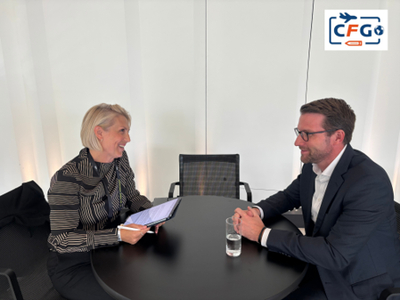
The author spoke with Thomas Schürmann in Frankfurt at the fringes of the recent Air Cargo Community Conference – picture: CFG
Competition is more than speed
FCS is Frankfurt Airport’s largest airline-independent cargo handler, with more than 700 employees handling roughly over 650,000 tons annually for more than 30 airlines, according to current company information. Asked where the company’s competitive advantage lies, Schürmann did not single out speed or automation. ”FCS’ competitive advantage is that we are globally connected through WFS and the broader SATS Group network and locally rooted at Frankfurt. Here in Frankfurt, the most important factor is collaboration,” he said. “Frankfurt is a very competitive environment, but nevertheless it is important that the various stakeholders collaborate to ensure Frankfurt Airport remains a cargo hub of choice and the air cargo community at Frankfurt Airport allows for that:” Specialized handling is becoming increasingly important within that competition, particularly pharmaceuticals. One of Schürmann’s first major projects after taking office, was the opening of the expanded Pharma Center of FCS in MAY26. The CEIV- and GDP-certified facility is almost 3,300 m² in size, and quadrupled the FCS-managed temperature–controlled handling space. It allows entire pallets to be built and broken down inside controlled environments, covering both 15-25°C and 2-8°C temperature ranges.
Pharma capacity – but no overcapacity?
With airports across Europe investing heavily in temperature-controlled logistics, the obvious question is whether too much pharma infrastructure is being built. Schürmann does not currently see that risk in Frankfurt. “The issue is not overcapacity. What matters is integrating the entire process chain,” he said. A larger refrigerated warehouse alone is of limited value if shipments leave controlled conditions between acceptance, storage, build-up and aircraft delivery. That argument fits Frankfurt’s wider pharma strategy. The airport says around 200,000 tons of pharma and healthcare cargo are handled annually, supported by more than 22,000 m² of temperature-controlled space and 14 CEIV-certified service providers.
What can Frankfurt learn from Abu Dhabi?
Schürmann’s years in the Gulf also allow him a direct comparison between two very different cargo environments. If he could transfer one characteristic from the Gulf to Frankfurt, he said, it would be decision-making speed. That does not mean that he considers Frankfurt operationally slow. Quite the opposite. “In the actual handling process, Germany can be extremely fast,” he said.“Where we need to become more dynamic, is in the speed at how we respond to change and make decisions.” It is an important distinction. Frankfurt handled around 2.1 million tons of cargo in 2025, up 1.1% year on year. Its challenge, therefore, is less about proving that it can move freight efficiently than ensuring that infrastructure, regulation and processes evolve as quickly as the competitive environment around it. For Schürmann, the lesson from working on both sides of the handling contract appears straightforward: airlines and handlers may approach operations from different directions, but neither can afford slow decisions when the cargo market itself is accelerating.
Do performance indicators tell the whole story? Can it be that an organization reports the truth, yet leadership only sees a segment of reality? CargoForwarder Global’s guest author, Irma van Buuren, Executive Advisor and Founder of Executive Control, explores what happens when the numbers are right, but the picture is incomplete.
Strategic decisions are only as good as the picture they are based on. The numbers are strong. Processes are in place, responsibilities are clear and KPIs are green. Audits close without major findings. The organization appears to be under control. And sometimes it is. But what if the picture is accurate and the decision is still based on an incomplete understanding of reality? Not because anyone is misleading leadership. Not because the data is wrong. But because the performance that executives see, may be produced by a system larger than the organization they believe they are governing. Strategy is not about confirming what happened yesterday. It is about shaping what happens tomorrow. And that requires understanding what today’s performance actually depends on.
Are your KPIs telling the full story? Image: Irma van Buuren
The organization on paper
Every organization has a formal structure: business units, functions, processes, contracts, suppliers, accountabilities and reporting lines. These structures create clarity and make organizations governable. Performance is then reported through familiar measures such as revenue, EBITDA, service levels, customer retention, productivity and safety. Each tells us something. Together, they create a picture. But that picture is not the organization itself. A KPI tells you what happened, but not necessarily what had to happen for it to happen. A process describes how work is supposed to flow, but not where people intervene when it does not. An accountability structure tells you who owns a responsibility, but not necessarily who the organization depends on when execution becomes difficult. A strong financial result tells you what the business produced, but not necessarily what it had to absorb to produce it.
When performance hides dependency
Good performance is particularly convincing. Yet, a business may depend on a small number of people who know how to navigate complexity. A critical process may work because experienced managers recognize problems before they enter the reporting system. A customer relationship may remain strong because someone continuously connects functions that are formally separate. None of this necessarily represents poor management. It may be evidence of a highly capable organization. But it raises an important question: Is performance being produced by the operating model or by the people compensating for its limitations? That distinction may not matter while conditions remain stable. However, it matters enormously when leadership changes those conditions.
Every strategy contains assumptions
Every strategic decision rests on assumptions. A transformation assumes the organization can absorb the change. An acquisition assumes historical performance can be carried into the combined organization. A growth strategy assumes the operating model can absorb additional volume. A technology investment assumes technology will replace the work it is intended to replace. These assumptions may be reasonable. But they are still assumptions. Historical performance can tell you that something worked. It cannot, by itself, tell you why it worked or whether it will work again. This becomes particularly important when organizations change ownership. Financial and legal due diligence can establish that the contracts exist, customers are real, financial statements reconcile and EBITDA is there. But one question remains difficult to answer: What is actually producing the performance your future is underwriting? A business can have excellent financial results and still depend on relationships concentrated in a few individuals. It can have well-documented processes and still rely on knowledge that was never documented. These dependencies do not necessarily appear in financial statements or organization charts. Yet they can determine whether historical performance survives a transition. Change the leadership. Remove key people. Integrate the business. Replace a supplier. Introduce a new system. Increase the volume. The organization may remain largely the same on paper. But the conditions producing its performance may have changed completely. The numbers were not wrong. The assumption was incomplete.
What was invisible becomes consequential
Most organizations do not discover hidden dependencies on a dashboard. They discover them through consequences. A transformation takes longer than expected. A customer relationship weakens after a key person leaves. A new system requires more manual intervention than planned. A restructuring creates unexpected coordination problems. A cost reduction produces service deterioration. The usual response is to look for the problem. Was the strategy wrong? Was implementation poor? Did someone fail to execute? Sometimes the answer is yes. But sometimes the system producing the outcomes was never understood in the first place. The dependency was already there. The organization had simply been performing well enough to conceal it.
Seeing performance differently
Executives do not need to become operational experts. Nor does the answer lie in replacing performance reporting with more reporting. When performance matters, leadership needs to understand not only what the organization produces, but what the organization depends on to produce it. That is a different form of visibility. It becomes particularly important before changing the conditions on which performance depends.
The truth — but is it the whole truth?
The danger is not that the numbers are false. It is that they can be completely true and still support a misleading conclusion. An organization can report strong performance while carrying significant dependency. It can appear scalable while relying on capability that does not scale. It can look ready for transformation while depending on conditions the transformation is about to remove. That is why executives should ask: Do we understand what our performance actually depends on? And: What would happen if we changed the conditions that make that performancepossible? Those questions do not challenge the numbers. They put the numbers into context. Because strategy does not fail only when the decision is wrong. Sometimes it fails because leadership made a perfectly rational decision about an organization it could see, while the performance it was relying on was being produced somewhere beyond the picture.
The numbers may tell the truth. But if leadership does not understand what the truth depends on, it may still be making decisions based on nothing but the truth it can see.
By Irma van Buuren
Independent Executive Advisor
Irma van Buuren is the Executive Advisor and Founder of Executive Control, with extensive aviation industry experience. Having worked at the intersection of strategy, governance and operations in complex collaboration environments, she brings an executive perspective to the conditions and dependencies behind reported performance.
Automation in air cargo is moving beyond conveyors, storage systems and ULD handling. Increasingly, software is deciding where cargo should go, when it should move and which process should come next. Yet the physical reality of air freight – irregular shipments, incomplete data and constantly changing requirements – continues to set limits to full automation. CargoForwarder Global (CFG) spoke with Björn Ussat (BU), Director Airport Logistic Solutions at Lödige Systems GmbH, at the Air Cargo Conference in Frankfurt on 02SEP26, about Cargo Direct, the role of experienced cargo staff, and why flexibility may ultimately matter more than achieving the highest possible level of automation.
Björn Ussat, Director Airport Logistic Solutions at Lödige Industries, courtesy of company.
CFG: Lödige Industries has been active in airport logistics for decades and today equips major cargo hubs around the world. Mr. Ussat, you, too, have been closely involved in the development of automated cargo solutions for many years. How has the role of Lödige Industries changed during that time?
BU: The core task has remained the same for 30 or 40 years: moving large volumes of cargo through a terminal reliably and quickly. What has changed is the complexity and speed of implementation. Projects that once took six or seven years may now need to be completed in three years or less, while standards and customer requirements have become much more detailed. Software has also fundamentally changed our role. Today, a system must do more than move a pallet from A to B. It needs to know where cargo should be stored, when it will be required and which process step should follow. We have therefore evolved from an equipment supplier into a provider of integrated material-flow and process-management solutions.
CFG: Air cargo still loses valuable payload and volume because ULDs and pallets are not always built to their optimum capacity. Cargo Direct can already combine shipment, weight and volume data for build-up planning. Is the logical next step for Lödige Industries, a system that tells the operator exactly how a ULD should be packed, and would you develop such a solution yourself or integrate technology from specialized partners?
BU: Technically, that would be a logical next step. The main obstacle, however, is data quality. We still see too much incomplete or inaccurate shipment information. If dimensions, weight, center of gravity or other characteristics are unreliable, a fully automated build-up instruction cannot be reliable either. ONE Record and similar initiatives are important, but implementation across the market remains inconsistent. That is why our systems increasingly verify data such as weight and dimensions inside the terminal itself. Whether a technology is developed by Lödige Industries or integrated from a specialist partner, is secondary. What matters is that it creates operational value. Even the best packing algorithm is of little use if the underlying data is wrong or the investment does not provide a convincing business case.
CFG: With Cargo Direct, Lödige Industries is moving beyond equipment automation towards process automation, with the software determining the next optimal step for individual cargo units. Does this mean that operational decisions traditionally made by experienced cargo staff will increasingly be taken over by software?
BU: Software can already take over or support many routine decisions, such as storage allocation, retrieval sequencing and choosing the most efficient process route. The limitation appears when the digital model meets physical cargo. Air freight is extremely variable: boxes, machinery, dangerous goods, pharmaceuticals, oversized or irregular pieces. A system may calculate the ideal position on a ULD, but it may not know whether packaging can carry weight, whether it is distorted or whether the actual center of gravity differs from the declared data. Experienced cargo staff recognize many of these issues immediately. The more standardized the process, the easier it is to automate. The more irregular the cargo, the more valuable human judgement remains.
CFG: Cargo Direct is intended to provide the foundation for future AI-assisted optimization. Looking five to ten years ahead, which operational decisions inside an air cargo terminal do you expect AI to take autonomously and where should human control remain indispensable?
BU: AI will become much stronger in areas such as storage allocation, sequencing, resource planning, retrieval priorities and cargo routing. It should also be able to predict bottlenecks and adjust processes dynamically. Humans will remain essential when exceptions occur or when the physical characteristics of cargo are not fully reflected in the data. There is still no universal robotic solution capable of handling every possible cargo configuration. I therefore expect a hybrid model: AI will increasingly plan and optimize, while people remain responsible for exceptions, physical judgement and situations where flexibility matters more than standardization.
CFG: Highly automated terminals promise greater efficiency, but they also create new dependencies on software, connectivity and centralized equipment. What happens if a critical system fails during peak operations and can a cargo terminal actually become too automated?
BU: The risk is not only technical. Automation can be introduced faster than an organization can absorb it. New systems change responsibilities and job profiles and therefore require substantial management changes. Technically, resilience has to be built into the terminal from the start. That means redundant equipment, alternative process routes and different IT levels. If an external interface fails, the terminal should still be able to track and move cargo locally. A process that can only be performed at one highly specialized point creates vulnerability. Flexibility and alternative routes are therefore as important as automation itself.
CFG: Large-scale automation requires substantial investment, while cargo volumes and customer requirements can change quickly. At what point does automation become economically compelling for a terminal and where do you see the risk of overinvesting in technology that may not deliver the expected return?
BU: There is no universal threshold. The key question is what problem automation solves – whether that is throughput, space, reliability, labor availability or peak capacity. The mistake is to automate simply because the technology exists. Cargo terminals operate for decades, while markets and shipment structures can change very quickly. Covid demonstrated how rapidly cargo patterns can shift. That is why flexibility must be part of the return-on-investment calculation. The best system is not necessarily the one with the highest degree of automation, but the one that combines productivity with the ability to handle tomorrow’s cargo as well as today’s.