Ryan Keyrouse, Managing Director of Rotate – courtesy: LinkedIn
For the group of digital experts which grew from four to five members in 2023, and now includes Cargo Digital Factory, Wiremind Cargo, CargoAi, Rotate, and CharterSync, 2023 was a year of coordination and joint communication/presence at events. Cédric Millet, President of CargoTech applauded the many successes its members had in 2023: “Success happens with change. CargoTech is a one-stop-shop offering the best possible digital solutions for every air cargo business process. The aim of our products and services is to increase efficiency, improve revenues, or decrease costs, and generally to accelerate the digital transformation within the cargo industry. For that, we bring together cargo business and technology experts so that our digital solutions are created by air cargo knowledgeable people for the airfreight industry. Our drive for innovation is endless, and looking back at 2023, CargoTech had many successes and proved the relevance of its model.” Among those are CargoAi’s CargoWALLET for easy online booking payments, Wiremind Cargo’s Revenue Optimization suite (CargoStack Optimiser) with launch customer Qatar Airways Cargo, and Rotate’s Live Capacity product and co-development projects with Etihad Cargo and Cathay Cargo, for example.
Despite the difficult market situation in the air cargo industry this year, companies have been looking for digital support: “Customers have been increasingly interested in our solutions, as the desire to make better commercial decisions is relevant in every market circumstance,” claimed Ryan Keyrouse, Managing Director of Rotate, and this was similarly confirmed by Nathanaël de Tarade, CEO of Wiremind Cargo: “we got an increasing number of inquiries about our products, and our customers are more and more knowledgeable on what they want, what can be achieved, and are helping to push the boundaries of what can be done.” 2024 will see solutions making use of large language models to bring greater process efficiencies and automation, and a focus on greater transparency and visibility. “CargoTech fosters collaboration between its member companies on 3 levels: commercial, technical, and strategic. We […] want to do more on the technical side […] to optimally leverage the benefits from our CargoTech ecosystem,” Cedric Millet stated, summarizing: “2023 was the year of the coordination. 2024 will be the year for the synergies: commercial, technical, products. And of course, it will be another year of innovation, but that goes without saying.”
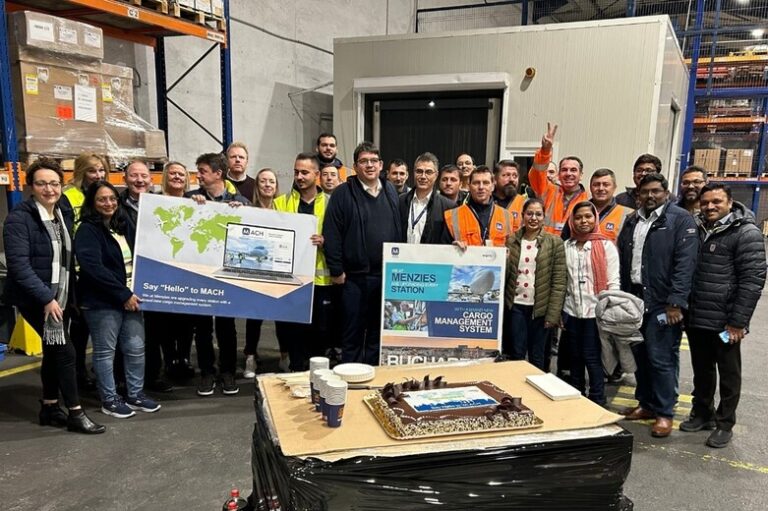
Bucharest is the first Menzies Aviation station to go-live with MACH. Image: Menzies/Wipro
MACH stands for Menzies Aviation Cargo Handling (MACH) cargo management system and the result of a year-long collaboration with Wipro to seriously upgrade the handler’s cargo management processes. A combination of Wipro’s technology and Menzies’ air cargo operations expertise, MACH is “a pioneering, end-to-end cargo management system [set] to transform Menzies operations across the network.” It offers an easy-to-use, modern user interface (UI) and because it is cloud-based, can be accessed “from anywhere, anytime and on any device, providing real-time insights and data.” Menzies’ team at Bucharest Otopeni Airport (OTP) in Romania, celebrated the first successful launch on 12DEC23. Ten more locations will have followed by the end of Q1/24: Macau/China, Wellington, Christchurch and Auckland in New Zealand, Sangster Intl. and Kingston Jamaica in Jamaica, Ontario, Vancouver, Calgary in Canada, Amman in Jordan. All other Menzies stations will receive MACH by the end of 2024. It operates from a ‘single source of truth’ which automatically transfers across the system, leading to improved data accuracy. MACH seamlessly integrates to other systems, resulting in simpler, more standardized processes. It generates bespoke solutions where required, creating and automating checklists for specific tasks. Warehouse staff receive customized training relevant to their role.
Beau Paine, Global Head of Cargo, Menzies Aviation, stated: “It is said, technology is best when it brings people together and we are very proud of the accomplishments of our team and Wipro over the last 12 months. We can’t wait to accelerate the implementation plan in continuing to roll out MACH across the wider network in the months to come.”
Rory Fidler, VP Cargo Technology, Menzies Aviation, added: “In just 13 months, we have achieved an incredible feat, which has been underpinned by hard work. From a six-page briefing document to five million lines of code, 3,000 test scripts and more, we are excited to develop a truly innovative platform for the Menzies Cargo Network.”
Subha Tatavarti, Chief Technology Officer, Wipro Limited, concluded: “In partnership with Menzies, we built a modern, scalable solution that will not only cater to one of the world’s leading cargo handlers, but will open the door to building an industry-changing aviation platform. We look forward to our continued success with Menzies.”
Valuables are safe in WestJet Cargo’s ‘Freight Knox’. Image: WestJet Cargo
Safe’Air is the name of the new WestJet Cargo valuables shipment product which has been designed to ensure that all such cargo is protected from theft or pilfering. Planned to go live in JAN24, initially between Canada and the US, Safe’Air is the airline’s cargo solution for the transport of high value cargo such as banknotes, jewelry, precious metals and stones, and other highly valuable items, and will offer reliable, secure, and discrete logistics. Starting out between Toronto Pearson International Airport (YYZ), Calgary International Airport (YYC), Vancouver International Airport (YVR), and Los Angeles International Airport (LAX), Safe’Air’s availability will soon be extended to all other stations in the WestJet network. These will be launched in priority of customer demand from next year.
Developed in close collaboration with freight forwarders specialized in transporting valuable goods, the product is aimed at customers in the banking, luxury goods, high-end technology, and pharmaceuticals industries, as well as those needing to send confidential documents. Dedicated security measures have been put in place to prevent tampering, pilferage, and unauthorized access. They include third-party oversight, direct supervision, secure storage protocols, and the use of specialized security containers which all comes with a unique serial number and are sealed using premium, individually numbered metal seals. Security agents escort the valuable cargo which is transported separately to and from the aircraft.
Kirsten de Bruijn, Executive Vice-President, Cargo at WestJet, explained: “Our commitment to excellence extends to every area of our business, from network to operations to anticipating and meeting the needs of our customers. The trust and market demand that our dedicated cargo operations have garnered in just half a year, have also led to increasing demand for a dedicated valuables product. We have therefore been hard at work establishing our very own WestJet to both operationally safeguard those high value shipments entrusted to us, and commercially ensure that we always deliver on our promises.”
Nawal Mir, Product Manager at WestJet Cargo, revealed: “Our product has been meticulously designed with the utmost emphasis on security and efficiency. Every step of the valuable handling process has been painstakingly analyzed, potential risks identified, and measures implemented to mitigate them. [The result is:] all hands on deck, all eyes on the ball, and absolutely no loopholes allowed. We’ve created a true ‘Freight Knox’ service at four of our stations and will roll it out to other destinations as soon as we are certain they are ready and capable of delivery.”
Pablo Canales is Managing Partner – CEO Americas GSA – credit: LinkedIn
ECS Group’s strategic aim of achieving full coverage across the Americas just took a large step forward its acquisition of Americas GSA. It now numbers 16 countries in its Americas set-up and with Americas GSA, has gained significant presence across Central America. The new countries in ECS Group’s network are Bolivia, Costa Rica, El Salvador, Guatemala, Nicaragua, and Panamá, complementing its existing network of Argentina, Brazil, Canada, Chile, Colombia, the Dominican Republic, Ecuador, Mexico, Peru, and USA. The acquisition agreement, signed on 29OCT23, brings Americas GSA’s staff of 42 in its 13 branch locations together with ECS Group’s existing workforce of more than 80 local experts across Latin America. The established GSA has long-standing contracts with renowned airlines such as LATAM Airlines, MAS, Turkish Airlines, Lufthansa, Swiss, Korean Air, and Ethiopian Airlines, and thus increases the group’s airline portfolio to more than 40 airlines.
Pablo Canales, Managing Partner – CEO of Americas GSA, explained: “Our vision is to become one of the largest air cargo GSAs in Latin America, not just in terms of network, but specifically as the GSA of choice for comprehensive international solutions delivered with local finesse. This partnership with ECS Group brings together a highly professional air cargo organization with a strong global vision, and an established team with in-depth knowledge of the Latin-American market and close relationships with the largest customers in the region. Within this new alliance, Americas GSA will be able to offer even higher quality service, more opportunities tailored to the specific needs of our partners, airlines, and customers, and enjoy a firm technological and financial foundation on which to continue growing.”
Adrien Thominet, Executive Chairman of ECS Group, commented: “Americas GSA not only greatly augments our coverage in Central America, significantly adding to our strong network of committed, local air cargo experts operating across the continent, but since it shares a very similar corporate culture and likewise places great value on professional expertise, it offers a highly promising basis for solid organic growth. [Our]aim is to offer the ultimate in GSSA services across every country in The Americas: from Canada to Chile […] We see significant synergies in terms of business, digital initiatives, and service offerings, and look forward to positive developments in our newest region, as we head into the new year. ECS Group warmly welcomes Americas GSA!”
(From left) Hactl CEO, Wilson Kwong, ATL CE, Dr. Angus Cheung, with govt and CAAC officials. Image: HACTL
1000 guests came together in the Hong Kong Asia World-Expo on 14DEC23 to witness the signing of a collaboration agreement between Dr. Angus Cheung, CEO of Aerovision Technology Limited (ATL), and Wilson Kwong, Chief Executive of Hong Kong Air Cargo Terminals Limited (Hactl). Michael Wong Wai-lun, Deputy Financial Secretary of HKSAR Government and Cui Xiaofeng, Deputy Administrator of Civil Aviation Administration of China (CAAC) were also present. The agreement will see Hactl’s SuperTerminal 1 be equipped with ATL’s patented intelligent cargo thermal detection system, making it the first in the world to deploy the innovative technology designed to ensure the safe handling of air cargo and aviation safety. A huge step in the heart of Lithium Battery transportation. The system combines advanced thermal imaging technology, thermodynamics, fluid mechanics, data analytics, and artificial intelligence, to enable real-time temperature monitoring of different cargo materials in various environments and swiftly identify and alert to any abnormal conditions, thus helping to prevent potential fire risks.
Richard Wu, Deputy Director-General of Civil Aviation Department (CAD), stated: “Hong Kong International Airport is one of the busiest cargo and passenger airports in the world, with air cargo volume consistently ranking among the top globally for years. CAD shoulders the dual roles of aviation safety promoter and regulator. It has always encouraged the air transport logistics industry to be risk-based and is pleased to see locally invented innovative technology being adopted to further enhance the safety and reliability of air cargo handling in relation to the growth of e-commerce in Hong Kong.”
Angus Cheung, CEO of ATL, commented: “Many thanks to the Civil Aviation Department for providing important direction on this innovative research and development project. The collaboration between ATL and Hactl is exemplary [and] important in maintaining Hong Kong’s position as the world’s busiest air cargo airport and will also set the new standard for safe handling of air cargo in future.”
Wilson Kwong, Hactl’s Chief Executive, said: “Hactl’s SuperTerminal 1 is the single largest air cargo terminal globally and an essential part of Hong Kong’s air cargo industry. We are committed to continuous development through the adoption of innovative technologies. This collaboration with ATL will introduce new cargo thermal detection technology to our terminal, further improving the reliability of cargo inspection, contributing to aviation safety, and strengthening the operational resilience of our terminal. It also sets a new benchmark for the air cargo industry.”
…claims the Miami-based cargo carrier. It has just inked an agreement with Manestream to transport show jumping, race and other competition horses between Brussels and Miami. The number of horses transported varies from week to week, depending on the show or racing event in Florida. However, there are usually four. Yet sometimes even more equines are flown across the Atlantic each month.
Lucas Porter, Director Manestream Logistics – images: company courtesy
It is an alliance between an established airline hat has been in the market for 50 years and a ewcomer that was only founded in 2022. However, fresh approaches, even in the air transportation of high-performance horses, can be inspiring. This holistic service offer is such an example: “We provide one point of contact, one bill, and put an emphasize on lasting client relations and excellent horse care,” says Lucas Porter, Director Manestream, describing his company’s approach. Apparently, it was so convincing that Amerijet decided to join forces. This can be considered an accolade and is by no means a matter of course, as there are quite a number of companies, whether in Europe or North America, that offer all-round service and care packages for horse transportation. Anyone who doubts this should take a look at the Horse-Inn at Liège Airport or the Animal Lounge at Frankfurt Rhine-Main.
Perfect service Just recently, 24 mustangs landed in FRA coming over from North America. The animals were emaciated and in danger of starving to death because they were underfed by their previous owner. In contrast, horses flown by Manestream and Amerijet do not face such fate. “They are looked after from minute one, and enjoy a perfect service,” says Lucas Porter. The caretaking already starts when a horse is picked up from its home stall. Even before the equine is trucked to BRU Airport, the Dutch branch of Manestream arranges the entire paperwork, checks the lab results and the validation of the vaccination documents. Once all this is done, the horse is boarded and is accompanied by a groom during the flight.
IATA provides clear and strict rules for the transportation of animals by air: When accepting consignments of live animals, carriers are responsible for ensuring the in FRAin FRAconformity of various factors such as:
Appropriate containers or stalls, the environmental conditions in these compartments – ventilation rate and direction of airflow, heating or cooling arrangements, in-flight care, availability of storage facilities on the ground, and trained ground staff. This is IATA criteria that Manestream is familiar with. “Each horse is safely accommodated and accompanied by a groom throughout the journey to ensure a safe and comfortable flight,” the company assures in a press release.
Manestream horses have plenty of legroom and sufficient hay in their stalls during flight.
Preventing operational hiccups Before signing their pact, Amerijet was checked by the experts from Manestream. “Having closely analyzed the carrier’s possibilities to move horses from Europe to Miami, we were interested in the potentials that Amerijet provided due to their days of operation and the flexibility in managing horse bookings,” explains Porter. He goes on to say: “As shipping horses can present some operational challenges or unexpected changes, it is essential to work with individuals and a carrier that can understand and offer operational flexibility.”
This was reflected by Tim Spillane, Director Cargo Operations at Amerijet International Inc. “Recognizing that each equine shipment is unique, Amerijet offers customized solutions tailored to the specific needs of our clients. Whether it’s a single horse or an entire stable of top-level equine athletes, Amerijet can accommodate a wide range of requirements. We are proud to be recognized as a premier carrier by Manestream Logistics.”
Although horse transports between the EU, North America and back, are the most common shipment routes, flights to Mexico or the Caribbean Isles are no exception, states Porter. It always depends on tournaments and events. Overall, however, South Florida is the Mecca for equestrian sport, especially when the weather over in Europe becomes cold and frosty.
The cargo community of Maastricht Aachen Airport (MST) has set up a local branch of Air Cargo Netherlands (ACN). Apparently, hopes are high that a new permit will enable the full 2,750 m use of its runway by January 2025, which would make the airport more attractive to cargo operators.
Arjan Hage heads the local branch of Air Cargo Netherlands in Maastricht – photo: private
The recent developments at MST prompted the initiative to bring the cargo community together, says Arjan Hage, Managing Partner at Maastricht Logistics Services (MLS), who pulled the cart in the set-up.
“The companies wanted to unite by setting up an organization. After all, we have the network. When we learned that Air Cargo Netherlands also wanted to do something in Maastricht, we went to talk to them. This led to a local branch, with its own structure.”
Mr. Hage acts as the president of the local branch, which has a 6-member board representing all the trades of the cargo industry. He is convinced that the recent developments at the airport will make it attractive to cargo carriers again.
The same vision prevails with the airport operator which, since October last year, is 40% owned by Schiphol Group, the remaining 60% being controlled by the Province of Limburg.
Runway use restriction On 08JUN23, MST officially joined the group. One month earlier, the airport had triggered off its runway renovation, which was completed on 01JUL23. It is 2,750 m long, but the present operating license only allows the use of 2,500 m.
This restriction is still an obstacle for the airport’s cargo traffic development, but a brighter future is in the making, says Manager Marketing & Communications, Hella Hendriks: “We have delivered a new license application, which should allow us to use the runway over its full length as from January 2025.”
According to Ms. Hendriks, the runway was used over its full length in 2018-2019, thanks to an exception granted by the then-responsible Minister under the license at the time. Within the on-going revision of the Dutch airport policy, the operating license had to be withdrawn, leading to the restriction being reinstalled. The new ‘airport decision’, as the license is now called and which has recently been presented, should make way for the definitive full-length use of the runway.
Accomodating Schiphol flights Ms. Hendriks thinks that MST certainly has a role to play in air cargo, since it is the only other Dutch airport that can handle freight.
Hella Hendriks is Manager Marketing & Communications at Maastricht – company courtesy
CFG: Do you think that part of that traffic could come from carriers for which no slots are left at Schiphol?
HH: We think that some parties are willing to come to Maastricht.
CFG: Even with Liège Airport at your doorstep?
HH: We are convinced that these parties will prefer our airport, as it is in the same airport and customs system as Schiphol.
Sharp drop in volumes Airlines serving Maastricht are Air One, Emirates Cargo, Turkish Cargo, Aerotranscargo, and Zimex. Services offered are Bogotá-Miami-Maastricht-Istanbul; Maastricht-Istanbul; Dubai-Lilongwe-Johannesburg-Nairobi-Maastricht- Zaragoza-Dubai; Dubai-Eldoret-Nairobi-Maastricht-Zaragoza-Dubai; London; Hongkong, and Muscat.
For 2023, preliminary forecasts show a volume of 35,000 tons of flown cargo, with more or less the same amount for trucked freight. Ms. Hendriks admits this would represent a sharp drop compared to the 108,218 tons of flown freight and 11,610 tons trucked in 2022. “In the first place, this is due to the global volume decline, to which we are more vulnerable as our volumes are relatively small and relatively sparsely spread over the different airlines. Secondly, you mustn’t forget that our runway was closed for two months.”
Air freight continued growing at Hungary’s Budapest Airport (BUD) in 2023. Consequently, BUD is one of the very few airports in Europe whose cargo throughput increased in 2023 (+3%). Unless ice, snow or fog paralyzes Ferenc Liszt International in the last days before the end of the year, the volumes handled will exceed 200,000 tons: a new record in the more than 70-year history of BUD. The main reason for this is because the cargo business is right there at the top of the management’s agenda.
Not only cargo CEO Jozsef Kossuth, but BUD’s entire Cargo Team is pleased with the throughput in 2023 that’s becoming apparent – photo: CFG /hs
So, it is understandable that the cargo team consisting of CEO, Jozsef Kossuth and his colleagues, Vivien Gyenge-Márkus and Adrian Palagy, is proud when revealing the predicted 2023 figures. After all, crossing the 200,000-ton mark feels rather like breaking through a sound barrier.
BUD overtakes VIE According to BUD, its growth is based on three main sources: The construction and expansion of the Cargo Center and apron areas, the rapid upswing of the e-commerce business in Hungary, and the ongoing investments of foreign companies in the country.
And where there is industry, there is cargo business. What pleases Mr. Kossuth and his team most, is that BUD overtook Vienna for the first time ever – measured in tons. In NOV23, Vienna handled 21,969 tons, while Budapest reports 22,206 tons – a marginal difference, but psychologically very important.
Whether this trend will continue, remains to be seen. But there are signs of a changing of the guard here, after years of Vienna being the main gateway for cargo in Central and Eastern Europe.
e-commerce is a key driver of growth An indication underlining this tendency, is the rapid growth of integrator services at BUD, leading to high e-commerce throughput. It has now achieved a share of up to 30% of the total air freight handled at BUD, Mr. Kossuth estimates.
As for the whereabouts of the shipments, Jozsef says the following: “It is difficult to judge accurately, but we can say that roughly 25-30% of the airport’s cargo flows are linked to e-commerce activities. Now, more than half of the airport’s cargo traffic is non-Hungary originating or destined, but instead comes from other countries in Central and Eastern Europe or is destined to customers located there.” The manager points out that, as an increasing number of firms decide against reinvesting their profits in China and opt to invest in production plants in Southeast Asia or Eastern Europe instead, this strategic shift benefits Budapest, enabling the airport to become the leading regional gateway for cargo throughput in Central Eastern Europe.
Focusing on special cargo in 2024 Finally, he points to a new cargo community system, a ‘flagship project’ as he says. According to the scheme, managers of cargo airlines and integrators, members of the ground handling community, forwarding agents, customs officials and airport officials sit at the meeting table to streamline processes and further enhance the customer experience.
BUD’s Cargo helmsman also indicates that, in 2024, his management will put its focus increasingly on special cargo: the air transport of live animals, temperature critical products such as pharmaceuticals, and on setting up tailored supply chains for components needed for the production of e-vehicles.
Sounds like a lot of work for Budapest’s Cargo team.
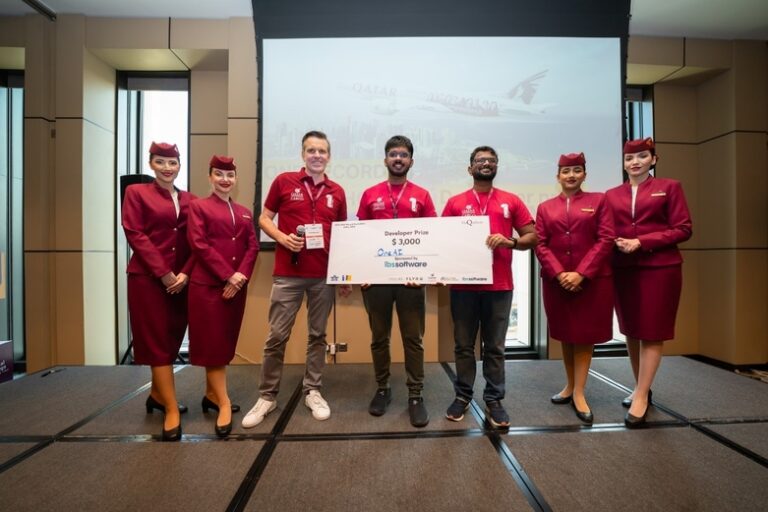
… state Unisys managers, Sabari Ramnath and Amith KK [KK is his full family name – HS], in this EXCLUSIVE. Their point: Emerging technology is helping air cargo innovation take flight. Both experts were recently recognized for integrating AI and digital cargo booking systems to streamline communication efficiency between airlines and freight forwarders. The Unisys team from Bengaluru, Karnataka State, won the IATA ONE Record 2023 Hackathon Developer Prize, after competing in the around-the-clock event sponsored by Qatar Airways Cargo and held 24-26NOV23 in Doha, Qatar.
Unisys executives Sabari Ramnath (SR), third from right, and Amith KK (KK), standing next to him proudly present the prize won at IATA Cargo’s Hackathon held in Doha – credit: IATA Cargo.
The stunning formula overarching their presentation reads: “Air Cargo Booking is not just a screen; it is a conversation.”
CFG: At Unisys, you create products that drive the air cargo industry to the next level by leveraging cutting edge technology. What relevance did the recent hackathon have for this project?
SR: Our concept’Air Cargo Booking through conversation’ received widespread acceptance from industry leaders, leading us to win the ‘IATA One Record Developer Prize’.
To illustrate this:Before the digital revolution, freight forwarders and airlines primarily communicated through phone calls for inquiries and bookings. This method allowed for more personalized interactions, fostering relationships and tailor-made solutions for specific needs.
With the advent of technology, the air cargo industry transitioned to digital platforms to streamline processes. However, this shift brought challenges. Despite their efficiency, digital systems often struggled to capture the depth and richness of communication found in verbal exchanges. The nuances, context, and understanding present in these conversations were difficult to replicate through screen inputs like fields, buttons, and labels.
KK: So, the new formula should be: “Air Cargo Booking is not just a screen; it is a conversation.” The process isn’t merely a transactional system, but a dialogue between parties. It encompasses more than data input and confirmation receipt. It involves understanding unique requirements, addressing concerns, and building relationships – elements vital in conversation, but potentially lost in a purely digital transactional process.
CFG: How did you tackle the problem you mentioned earlier? Please elaborate on your approach.
SR: In the realm of Artificial Intelligence (AI), this transformative solution automates conversations tailored precisely to the preferences of freight forwarders when engaging with airlines. This technology revolutionizes Air Cargo Booking, transforming it from a static screen into an engaging dialogue.
Conversational AI facilitates a more natural and human-like interaction with the IATA ONE Record booking server. Instead of rigid fields and buttons, this technology fosters dynamic and adaptable conversations. It replicates the personalized experience of direct conversation by understanding nuances, context, and preferences, delivering meaningful responses through integration with the ONE Record server.
KK: Furthermore, Generative AI has the capability to generate tailored responses and engage in dialogues specific to customers’ needs and inquiries. Leveraging extensive datasets from cargo systems, manuals, and online resources, Generative AI comprehends and addresses customer queries accurately, providing nuanced and customized answers aligned with the unique requirements of freight forwarders. Moreover, this technology streamlines the completion of compliance documents by employing advanced fact extraction techniques, automatically populating forms based on documents possessed by the end user.
CFG: You also developed a technological solution to simplify the more than complex pet booking system. Can you elaborate further?
KK: As previously mentioned, we utilized a complex pet booking scenario to demonstrate how modern technologies such as Conversational AI, Generative AI, and IATA ONE Record standards could simplify the booking process.
Transporting pets via air involves navigating complex government regulations, airline policies, health requirements, specific kennel criteria and more, often overwhelming pet shippers. However, modern technology offers a solution. Hence, we harnessed the power of Agentic Generative AI enabled by Large Language Models (LLMs), to streamline the pet booking process.
SR: Our innovative approach employs Retrieval Augmented generation, seamlessly matching questions with relevant, accurate answers, simplifying the pet booking journey for users. Understanding the challenge of document submission, we’ve revolutionized the process by utilizing cutting-edge fact extraction techniques, reducing redundant efforts in completing compliance documents by automatically populating forms from the user’s existing documents. All these capabilities are compounded by the ability of the LLM agent to derive real-time information from various Cargo APIs, to do everything from checking flight availability to executing bookings and generating pre-filled compliance documents.
This solution not only simplifies the process, but also enhances airline customer satisfaction which, in turn, drives increased business. To experience our concept and prototype firsthand, watch the below video showcasing a seamless, interactive, and user-friendly pet booking experience that sets new industry standards. Note: Click this image to watch the video.
Video to be slotted in right here, Source: Unisys, India
CFG: What’s your next course of action following this Hackathon?
SR: We leveraged this hackathon as a litmus test, gauging resonance, problem-solving capabilities, and the viability of our solution. The invaluable feedback from diverse perspectives – teams, mentors, sponsors – fuels our enthusiasm and confidence. Winning the prize reaffirms the strength of our concept. Now, our sights are set on transforming this validated idea into a remarkable product that solves real problems.
As we close the CargoForwarder Global editorial year on the same day as the entire industry literally took off for the first time over a century ago, (17DEC23 marks the 120th anniversary of Orville and Wilbur Wright’s first flight at Kitty Hawk, North Carolina, US), we take a look at the journey ahead and what the drivers – or in this case, pilots – are behind the industry’s continuous development and growth.
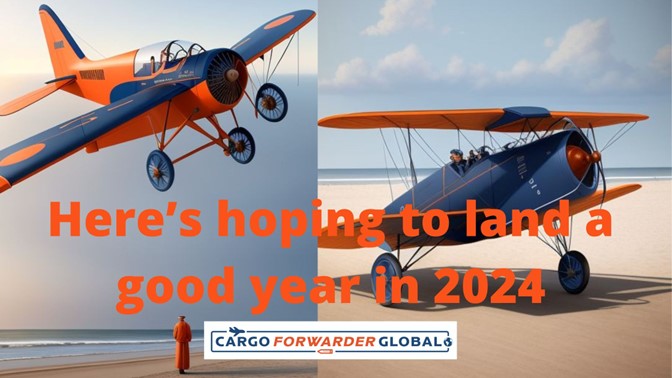
When you ask AI to recreate the Wright’s first flight in 1903… Image: Perchance.org/CFG
Amazing, isn’t it, when you look back at how far we have come? That first flight took just 12 seconds over a “range” measuring a whole 36.5 meters in length – practically half the length of an entire B777F aircraft, these days. And when was the last time you measured anything flight-related in seconds? An online cargo-booking perhaps?
A history of growth In those 120 years, the aviation industry – and air cargo industry, in particular – has grown into an enormous, complex and yet well-functioning web in which every day around 100,000 flights carry passengers and cargo to all ends of the earth. The air cargo industry alone will have generated around USD 135 billion in revenues by the end of this year, despite difficult market circumstances. And IATA predicts that it is on an upward trajectory again in 2024, expecting airfreight volumes to grow 4.5%, particularly during the second half of the year. More conservative estimates lie at between 1-3%. Either way, growth (revenue expectations aside), is forecast. Growth is success.
“Success happens with change” Quoted in a CargoTech press release last week, Cédric Millet, President of CargoTech, talking about the year ahead, said: “Success happens with change.” He goes on to predict that, for CargoTech, at least, “2024 will be the year for synergies: commercial, technical, products. And of course, it will be another year of innovation, but that goes without saying.” This prediction is likely to fit the industry as a whole, and CargoForwarder Global looks forward to reporting on every one of those developments across all air cargo stakeholders.
Change comes through communication The basis for all those developments, however, is communication. “Cargo is a people business” is a cargo statement uttered at some point during every cargo conference. And while, in past decades, those ‘people-relationships’ have mostly been bilateral – between airlines and forwarders, airlines and ground handlers, airlines and road feeder companies, forwarders and shippers, etc., the positive shift more recently is to one of a more comprehensive communication platform, as seen by the cargo communities – most recently in MST (see our separate report in this newsletter) – that are forming and developing, as well as the CargoTech digital expertise pooling initiative, or – also published last week: the Memorandum of Understanding between Pharma.Aero and the Cool Chain Association (CCA) to harmonize pharmaceutical/perishable cargo logistics processes, for example. As Stavros Evangelakakis, CCA Chairman of the Board put it: “We believe that we can achieve so much more through cross-industry collaboration than we ever could working independently in silos.” And that is precisely the point. Through communication, industry stakeholders can spot weak links, develop measures to improve their processes, offer increased visibility, reduce safety/performance risks, minimize waste, and come to a more resource-efficient outcome overall. “If you want to go far, go together” as the old African proverb states.
Artificial communication That increased collaboration and communication is not least thanks to digital developments and companies increasingly pursuing digital transformation strategies. The industry, after years of being an old grandad clinging on to software developed in the Seventies, has finally entered a more golden decade of change, which began just before the pandemic and was then greatly accelerated by it. Silver linings, and all that. For sure, it still has a long way to go, but the growing number of Hackathons and partnerships between SaaS providers or pilots with ambitious airlines, GSSAs, ground service providers and other air cargo companies, are testament to positive progress.
The trick is to ensure we don’t swing completely the other way without thinking. In a recent AI panel discussion, one cargo airline representative said that she was having to ask her sales colleagues not to rely on ChatGPT for every single customer communication. Convenient, when a computer does the work for you, but you should still keep an eye on the ‘thinking’ that it does. A case in point, are the images AI generated for CFG to illustrate that very first flight of the Wright Brothers exactly 120 years ago, today. On the surface, with no prior knowledge, these are almost feasible outputs – yet make yourself a coffee and settle down to pinpoint all the errors in those images. And those are the ‘best ones’ from a whole selection of often very strange results.
Authentic and balanced communication Which brings us on to the next point when it comes to communication. AI can only work with what it is fed with, and that should be balanced, representative, authentic, real, and correct industry information. The same goes for communication both within our industry and outside. Air cargo needs strong voices and advocates to governments, the general public, customs, civil aviation authorities, etc. Let 2024 be the year that those associations created to represent the industry – in the first instance IATA, TIACA, and FIATA, visibly work together and show their presence to the industry and at each other’s events. This appeared lacking for much of 2023, and the air cargo industry must not be relegated to the back row again, after having had its brief spotlight moment in 2020-2022. Please do more.
And to all event organizers in 2024: Please make a concentrated effort to promote gender balance in your panels and presentation agendas. Whilst a good start was made in some events in 2023, it would appear that this is still more by chance than engineering. Please consult the WAL – Women in Aviation and Logistics expert database and reach out to WAL directly if you are still at a loss: https://womeninaviationandlogistics.org/experts/
Transparent and honest communication On a positive note: CargoForwarder Global looks forward to two developments in particular in 2024. On the one hand, seeing how the newly formed Cargo Collective will fare in attracting and encouraging young talent to and within in the air cargo industry. This will work by showing the industry as it really is, highlighting its value in the global economy, and pointing out all the very different career paths that are possible here.
On the other hand, following my critical Awards article written in JUL22, I have been asked to become a Supervisory Panel member of the Air Cargo Week World Air Cargo Awards 2024, together with other neutral peers, and first ideas have already been exchanged in establishing a solid, qualitative reputation and a more transparent process. So, there is hope that Awards will be made great again in the years to come.
Make Press Relations Great Again, too On CargoForwarder Global’s Wish List for 2024, is a return to more reciprocal support and closer press relationships. A recent Cision Germany survey found that 70% of journalists prefer onsite press events. Many large airlines used to successfully offer these in the past and fostered good, long-standing press relationships as a result. More recently, press appears to have become a one-way street, with media simply becoming a rush to see who can copy/paste an available PR first, to secure ‘real-time’ publication. Press is more than that, and at CargoForwarder Global, we place great store by helping to communicate developments in the industry in an open, honest, and unique fashion. What we would greatly appreciate is true, supporting partnerships: Advertise with us, invite us to press events, keep us in the loop as to developments, and be quick to answers our questions when we have them. We are in this industry together and want to see it flourish.
New Year, New Website Positive Change through Communication is the title of this piece. CargoForwarder Global’s motto for 2024 is Communication through Positive Change. Why? Because we have been working on our own little digital transformation and plan to start the new year with a new look website. Keep an eye out for it and let us know what you think!