
Home Blog Page 192

Aircraft converter group hit by supply shortages

0

Orders for passenger to freighter conversions of Airbus A330s and A321s are piling up at ST Engineering and its subsidiary, Elbe Flugzeugwerke (EFW). The sad story is that they can only be processed at a snail’s pace. Why? Because there is a shortage of components, and suppliers are not keeping up with contractually promised deliveries of aircraft parts. There is little hope that this will change for the better soon.

The order books of the Singaporean-German group are filled to the brim, but production is not keeping up with demand. A bizarre situation and unique in the history of both companies. Originally, 14 A330s were scheduled to be converted from passenger to cargo aircraft at EFW’s Dresden plant this year. Yet, the reality looks bleak: “We will hardly manage more than eight P2F conversions by the end of 2022,” says Wolfgang Schmidt.

Aircraft converters are hit by grave supply chain disruptions
As VP Sales, Marketing & Customer Support, Airbus Freighter Conversions & MRO at EFW, he ought to know best. The reason for his pessimistic forecast is that there are simply too few components to work off the orders. The executive delivers a striking example: “We purchase rivets from a contractual supplier. But he can’t deliver the next batch until – believe it or not – September 2023.”

“Disastrous situation”
So, ST Engineering and EFW will have to wait almost a year for the next delivery. Until then, however, P2F conversions cannot stop just because rivets are missing. Yet, switching to other suppliers is extremely difficult and faces many administrative obstacles. Understandable, because due to security reasons in aircraft manufacturing, every component, whether it is a bolt, nut, rivet, or cable, must come from a certified supplier which is liable for its products. “And certifications take an awful lot of time,” Mr. Schmidt knows from experience.
The lack of components and aircraft parts is a “total disaster,” he says. It causes grave production delays. The extent of the deficiencies is illustrated by this figure: 11,000. That is the average number of parts needed for P2F conversions. Since all components are meticulously documented, aircraft are the most transparent means of public transport ever built.

Third-party solutions
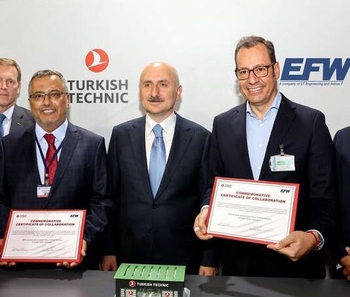
How ST Engineering and EFW can overcome the persistent shortage of components is an open question. Material pooling with MRO providers such as Lufthansa Technik, Singapore Airlines Engineering, for instance, might be one option to easy the squeeze. Another is the outsourcing of work packages to external providers. As was done on Friday (07OCT22), when EFW and Turkish Technic (TKT) signed an accord, enabling TKT to become the first MRO company to provide third-party conversion solutions for EFW’s A330P2F program.
“We have a growing P2F order book which mirrors a strong market demand for Airbus freighter conversions, with the A330P2F program being increasingly considered as the preferred next-generation platform in the medium to widebody category,” states Jordi Boto, CEO of EFW. “Through our collaboration with Turkish Technic, which has deep experience in maintaining Airbus aircraft, we will ensure meeting our customer commitments in a robust manner.”

Packed orderbook
According to information obtained by CargoForwarder Global, the combined P2F order book of ST Engineering and EFW comprises almost 200 aircraft: more than 90 A321P2Fs and 100+ for the larger A330 variant. Manager Schmidt speaks of “huge backlogs” his company is facing.
After all, in addition to Dresden and Singapore, subsidiaries based in China and the USA, are also involved in conversion projects. This increases the chances of gradually reducing the backlog. However, in Mobile, Alabama, only one conversion has taken place so far. And Turkish Technic speaks of Q3, 2023, before the first A330P2F converted jetliner will roll out of its production shop at Istanbul Airport.

More third-party providers might join the club
It can be expected that similar to Turkish Technic, more external converters might step in, joining ST Engineering and EFW’s bandwagon.
The statement of Prof. Ahmet Bolat, Turkish Technic Chairman of the Board, delivered during the signing ceremony might motivate them. When asked about the new industrial partnership between TKT and EFW, the executive said: “We are happy to cooperate with EFW in their A330P2F program. Passenger-to-freighter conversions require a combination of industry-leading expertise, structural skills, and operational excellence. With extensive know-how and close collaboration with suppliers, we are always well equipped to provide technical services and solutions for our customers. We look forward to expanding our partnership further with EFW.”
AerCap and EFW ink major P2F conversion order

0

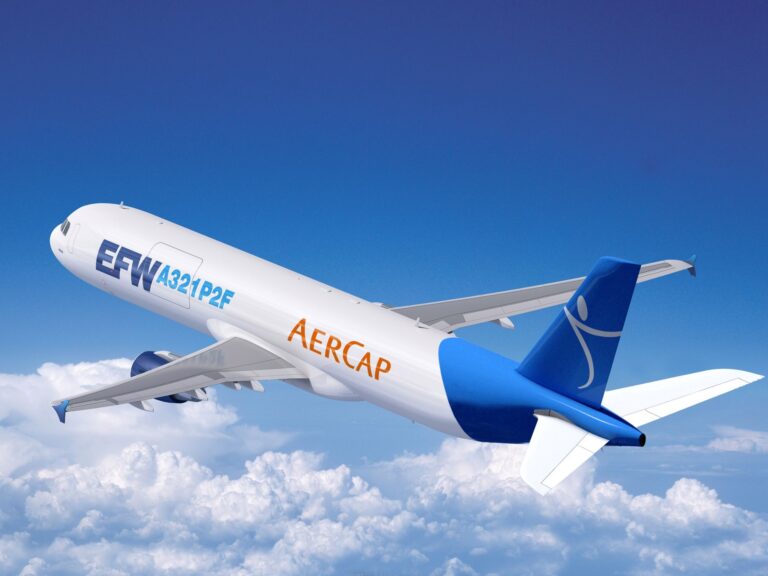
Lessor AerCap Holdings N.V. (AerCap) has placed firm orders for 15 Airbus A321P2F aircraft conversions and an option for another 15 A321P2F conversions with Elbe Flugzeugwerke (EFW). Dublin-based AerCap is the world’s largest owner of the A320 family of aircraft. So the feedstock for the conversions will come from the lessor’s own portfolio of jetliners.

Triggered is the deal by the burgeoning market demand for freighters, including smaller ones like the P2F converted A321. Touching the performance, converter EFW points out that the A321P2F is a next-generation freighter and the first in its size category to offer containerized loading in both the main deck (up to 14 full container positions) and lower deck (up to 10 container positions). With a gross payload capability of up to 28 metric tons (about 61,800 lbs) and a range of more than 2,300 nautical miles (about 4,260 kilometers), “the A321P2F is the ideal narrowbody freighter aircraft for express domestic and regional operations,” highlights Elbe Flugzeugwerke in its announcement. Therefore, it can be expected that most of the AerCap A321P2Fs will be seen in DHL, UPS, ASL, or FedEx colors one day. However, the name of the future operator or operators, in case it’ll be more than one, is not revealed by AerCap.

Will DHL be the operator?
“Extending the life of our A321 fleet will complement the Cargo portfolio and meet the strong demand from our diverse customer base, from which we’ve seen a significant appetite for this freighter,” said Rich Greener, Head of AerCap Cargo. He went on to say: “The A321 freighter is the best-in-class and most fuel-efficient aircraft to replace the B757-200 freighter. This transaction is in line with our cargo portfolio strategy of diversifying our fleet with improved economics and returns. We look forward to working with the EFW team on this program and thank them for the trust they have placed in AerCap.”
This statement is likely to fuel speculation that DHL Express is the future operator. This is because the Integrator’s fleet of Leipzig-based B757 freighters is approaching the operational age limit and needs to be replaced by more modern and fuel-efficient freighter aircraft. But there is no confirmation for this.
“We are glad that we may finally announce the agreement with AerCap on this volume order for A321P2F conversions,” says Jordi Boto, CEO of EFW. “Our young A320P2F family programme has gone from strength to strength and gained traction very quickly in the market with a dozen aircraft already in operation.”
Presumably, converter EFW will not really care about the livery displayed on the fuselages of A321s following their upcoming new lives as freighters. “We are glad that we may finally announce the agreement with AerCap on this volume order for A321P2F conversions,” says Jordi Boto, CEO of EFW. “Our young A320P2F family program has gone from strength to strength and gained traction very quickly in the market with a dozen aircraft already in operation.”

Growing network of Airbus P2F converters
EFW’s A321P2F program is developed in collaboration with ST Engineering and Airbus, with EFW holding the Supplemental Type Certificate and steering the overall conversion program as well as marketing & sales efforts.
To meet the rising demand for freighter conversions, ST Engineering and EFW have set up new conversion sites in China and the U.S. to ramp up total conversion capacity for all their Airbus P2F programmes comprising the A330P2F, A320P2F and A321P2F. Because of fast growing demand and limited own capacity the company.
In addition, they started conversion programs with third party MRO companies. So recently done for A330P2F programs with Istanbul-based Turkish Technic.

Exclusive – Schenker und Lufthansa Cargo go for 300

0

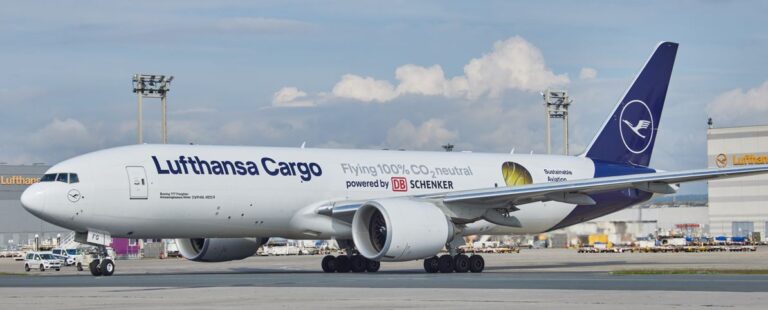
The joint freighter flights operated by DB Schenker and Lufthansa Cargo, and powered by Sustainable Aviation Fuel (SAF), will be continued during the upcoming winter schedule. Tomorrow, (14OCT22), the 150th of these SAF flights will depart from Shanghai Pudong (PVG) and arrive at Frankfurt Rhine-Main Airport (FRA) later that day. In a way, it is a double anniversary, because the logistics heavyweight is also celebrating its 150th birthday this year.

According to data captured during the last winter timetable, on average, 174 tons of fossil fuel burn were saved per flight on the FRA-PVG sector thanks to SAF usage. This added up to a net reduction of 20,250 tons of greenhouse gas emissions from the end of OCT21 to 27MAR22, when the winter flight schedule ended.
In the upcoming half-year flight period, it will be even more because, since Russia’s assault on Ukraine 24FEB22, all western aircraft have to circumvent Russian airspace on sectors linking Europe and the Far East, which prolongs flights by 1.5 to 2 hours each. Therefore, CO2 savings in the upcoming winter schedule are expected to significantly exceed the figures from a year ago, where 14,175 tons of CO2 emissions were saved thanks to the burn of SAF instead of traditional kerosene.

Ongoing commitment
It is also noteworthy that third parties have meanwhile jumped on the bandwagon by supporting the Schenker-Lufthansa Cargo SAF initiative. The first to do so was Finnish IT producer, Nokia, which has committed to regularly contribute 10 tons of freight per flight traveling from Shanghai to Frankfurt, willing to pay the higher SAF price per consignment. As things stand, this is three to four times the price of fossil fuel-based rates, increasing the cost of air cargo transports. Similar support comes from Schenker’s major Chinese customer, Lenovo, which has even booked 20 tons of capacity for its own goods on the weekly SAF flights jointly operated by Schenker and Lufthansa Cargo from PVG to FRA.
Particularly important for the SAF project and the involvement of further supporters, is that Schenker and Lufthansa Cargo have decided to continue their joint mission at least until the end of MAR23 – the third prolongation since the flights began.

150 flights are only a pleasing interim result
This is emphasized by Achim Martinka, VP DACH & Key Account Management at Lufthansa Cargo, who hopes for an even longer period of joint SAF flights: “We are very pleased that, thanks to DB Schenker’s ongoing commitment, we have reached this important milestone for our joint CO2-free flights. The topic is of key priority for both companies and is driven by our full conviction. This is why we also quickly decided to extend this important sustainability project, setting possible obstacles aside. Both of our commitments are long-term and are to be expanded where possible. In this respect, we look forward with confidence to the next 150 flights and hopefully many more to come.”
300 SAF flights: Schenker executive, Thorsten Meincke did not want to go that far, but the Global Board Member for Air & Ocean Freight at DB Schenker, also praised the SAF initiative by emphasizing the benefits for the CO2 footprint of those customers who decide to come on board: “Since spring 2021, our unique SAF full charter helps customers to make their supply chains more sustainable. Now, the 150th CO2-neutral flight covered by SAF is already taking place! What a great achievement in our company’s 150th anniversary year. We will celebrate the twofold anniversary by extending our successful partnership with Lufthansa Cargo,” the manager stated.

SAF: It’s now time to act
What he did not say but might have thought: Those players who today decide to use SAF for their air transports, are likely to have market advantages in the future, because SAF is a scarce commodity, and fossil fuel will become significantly more expensive in the near future triggered by stricter environmental laws.
Lufthansa Cargo is Schenker’s largest partner in SAF usage, but not the only one. The logistics company committed to purchasing a significant number of SAF credits from Singapore Airlines to provide its customers with SAF options to reduce the carbon footprint of their individual supply chains. And more deals are just around the corner: “In order to drive the green transition of our industry, we have several further SAF-related initiatives in the pipeline,” an executive said.
However, he did not want to comment on when this will happen, and which further partners might be involved.