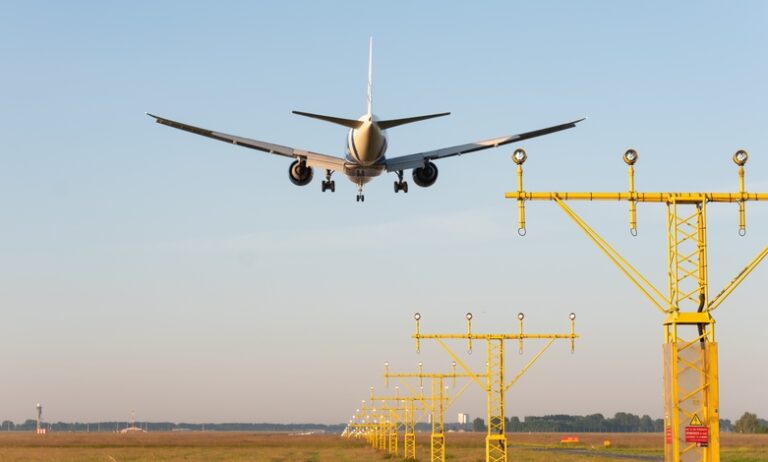
The aim of this initiative is to secure the infrastructure for the use of green hydrogen, so that the planned fleet of Airbus aircraft, which will use hydrogen as a power source in future, can be refueled at a large number of airports. Hamburg Airport is one of the first European airports, alongside Paris CDG, to join this alliance. Other partners are airports in Japan, New Zealand, and Singapore.
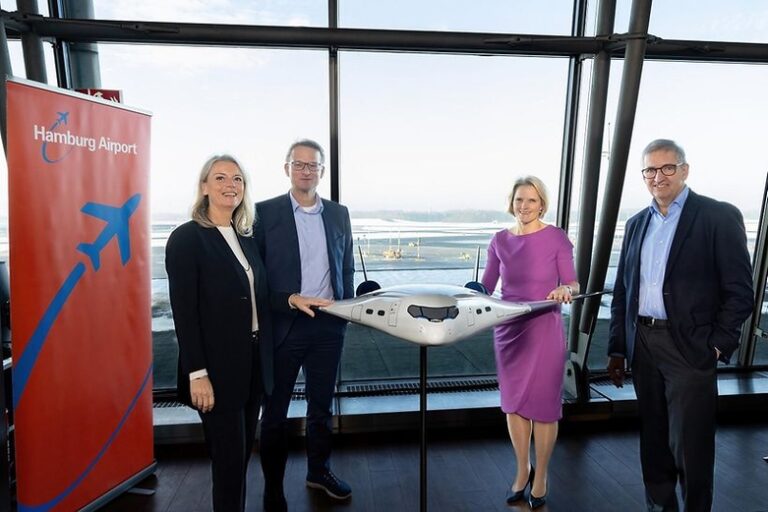
Teaming up for an H2ecosystem (L > R): Karine Guenan, Airbus / Christian Kunsch, HAM Airport / Nicole Dreyer-Langlet, Airbus / Michael Eggenschwiler, HAM Airport – courtesy: HAM
The project focus is of paramount importance: to establish a global airport and aviation ecosystem based on hydrogen. Measured against this, the event last Friday (01DEC23), on the Top Deck of Terminal 2 at Hamburg Airport’s snow-covered terminal, was rather matter of fact and atmospherically sober. Four leading aviation managers – two male, two female – signed an agreement to usher in a new era of clean flying. No music. No infotainment. No long speeches. Just coffee and tea and some snacks. Period. After 20 minutes, the official part of the event was over. Probably a short-duration record for such an important project. Given its significance for climate protection, it would have deserved a priority slot on the agenda of the climate conference currently taking place in Dubai.
H2 is the future of socially accepted flying It is a truism that passenger and air freight traffic must drastically reduce CO2 emissions. Synthetic fuels in combination with aerodynamic optimization of aircraft, contribute to this, but they are only a transitional solution for clean flying. The only real way to leave the era of fossil propulsion systems behind, is green flying, i.e. using environmentally neutral hydrogen.
First step: Setting up tailored ground infrastructure At the event in Hamburg, Nicole Dreyer-Langlet, Vice-President Research & Technology Germany, Airbus, confirmed the frame maker’s ZEROe ambitions. Under this project name, a hydrogen-powered passenger aircraft is to be developed and used by airlines from 2035 onwards. Until then, the airports will have to be equipped with the necessary infrastructure. “Only when there is a sufficiently large network of hydrogen airports, will the airlines order the corresponding aircraft and plan utilizing H2 aircraft,” emphasized Michael Eggenschwiler, CEO HAM Airport. “As the first German airport within the global H2 network, Hamburg Airport is also investing in its future role as an important air transportation hub,” added the executive.
Complemented by H2 powered aircraft The city was chosen by Airbus developers to establish an H2-based ecosystem for several reasons. Every second Airbus of the A320 family, including the new, long-range A321XLR, is produced at the local Airbus plant, the second largest worldwide after Toulouse. It is also home to Lufthansa Technik’s headquarters and – located directly opposite – Airbus’ global center for MRO services and material supplies.
However, Airbus has not yet decided which aircraft model the Group intends to launch to start into the age of hydrogen. It will probably be a turbofan propelled aircraft capable of accommodating 100 passengers and covering a range of around 1,800 km. By 2040, the Group plans to produce a larger model for up to 250 passengers, capable of operating 3,700 km.
And what role will air freight play in these plans? On average, cargo contributes between 10% and 15% to the profitability of a flight route. “We always consider technical solutions for carrying air freight with every new development of an aircraft type, including the future hydrogen aircraft,” assured Karine Guenan, Vice President ZEROe Ecosystem at Airbus.
H2 powered aircraft will cover regional routes first Aviation experts are convinced that H2 is the future propulsion energy source, particularly for smaller aircraft to start with. Accordingly, the HAM management kicked off a ‘Baltic Sea Region Project’ in MAY23, to secure the supply of green hydrogen from production to the fueling of aircraft or airport ground support equipment, as well as test operations. This pact includes 16 partners and 24 associated organizations, located around the Baltic Sea, e.g.: Finavia, Swedavia, Lithuanian Airports, Riga Airport, and Tallinn Airport. The project complements the H2 agreement on a regional level, now signed by Hamburg Airport and frame maker, Airbus.
Data Quality is often criticized or seen as an obstacle to shifting to Artificial Intelligence (AI) solutions. “Garbage in/garbage out” as Ashok Rajan (AR), Senior Vice President – Global Head – Cargo & Logistics Solutions at IBS Software, politely paraphrased it, is often the comment encountered in discussions or panels on the topic. Yet is that really still the case in air cargo? CargoForwarder Global (CFG) wanted to know from a man who has been on the pulse of digital developments for the past 25 years. A virtual fireside chat, courtesy of online web-conferencing, looked at AI (and human) evolution.
Humans and AI will evolve together. Image: IBS Software/Perchance.org/CFG
CFG: How clean is data these days? Is that the first hurdle to AI application, and how can change management be encouraged in companies?
AR: Everybody loves an outcome and few care about how you get to the outcome. It takes a lot to get there, however, and the biggest hurdle is data. Missing, incorrect or incomplete data hinders unleashing the full potential of AI. However, cleanliness has come a long way in the last few years helped by that fact that companies have invested in standardized systems and platforms that have enforced cleaner data.
Whilst the one push is a technical one, a change in mindset and the improved perception of value of data is also required. Clean data must be given the same importance as issuing an accurate invoice, for example. No company or customer would accept an incorrect invoice. Data quality needs to be lifted to that same level of awareness, and the topic needs to become part of stakeholder conversations – between airlines, handlers, customers, and others in the chain. It should also be part of executive reviews; how good is our data? How much value are we making out of this data? Data quality has to go up, and it is moving forward. We are no longer at the garbage in/out state. We have moved far beyond that, but still have some way to go.
The approach companies had a few years ago still, was to see how they could allow customers to tender cargo first, and only looking at data at a later stage. Also, systems 10 years ago did not validate data rigorously. Because iCargo and similar newer generation data systems now insist on a far higher standard of data quality since they have to work with it, this is pushing for better quality from the start. And with that, quality awareness in increasing. The next leap will come with mental change. My recent experience is that when Heads of Cargo see the opportunities that come with clean data, this awareness has then influenced mindset changes in the broader organization.
CFG: Where are the barriers when it comes to AI? How does IBS help to overcome / or how does it address multiple messaging standards in the industry?
AR: Quality of data continues to be biggest barrier to really taking the power of AI. Added to that, is the fact that AI-related stuff tends to happen in silos in companies. While companies are now starting to have digital strategies, what is also needed, is an overall data strategy. There is currently still a lack of a coherent strategy across the organization, and data is still something of a specialized subject. There is a shortage of qualified talent who can make sense of data, and this challenge will remain until you have tools that can abstract the complexity and quality. Not enough of the right kind of talent is currently being put onto the topic, however.
From an IBS perspective: we have been trying, in our own software, to insist on the right quality of data. Very little bad data is let in. This slows processes down to begin with, perhaps, but good data is the outcome. We also try to make it bad-data-proof. iPartner, for example, is a set of platforms that sits between systems of the ground handler – who are effectively an extension of the airline and the airlines themselves. Whereas, previously, communication would be via archaic FBL messaging, iPartner Handler enables rich connectivity. Similarly, iPartner Customer, too – offers deeper connection across new age platforms, marketplaces and ONE Record. An API First approach builds bridges with better quality of data and information exchange, instead of relying on an old messaging standard as the only means of data information.
CFG: How can and does AI support quality in processes?
AR: Quite simply: clean input drives clean processes and leads to clean outputs. AI also helps when starting to automate processes that are manual in nature; it takes the human error element out of the equation, and it improves processes by pointing people in the right direction and automating repetitive “scripts”.
CFG: How long has AI been part of IBS Software solutions – where – and what is planned for 2024?
AR: I don’t look at AI as an independent topic, – it is simply a more intelligent way of working with data, and data has been part of our DNA from the start. How we work with data has evolved into different shapes, such as Blockchain, Big Data, Analytics, etc. AI is a natural evolution of this. Currently, what we have done at IBS, is to increase the focus on AI in all our products. We now have a horizontal AI center of excellence, getting the right talent to work on our models. Our cargo line of business takes what this horizontal does and makes it relevant for cargo. Our Revenue Management system in collaboration with Korean Air, is one of the first solutions using AI. Similarly, we are putting our platforms on AI data boosters. For example, booking with an AI booster will enable upselling, offering the right price recommendation. AI should become part of day-to-day operations in everything we do, as we move from data capture to intelligent systems.
We also now use AI in our own processes – for example in development and recording. We work with Microsoft CoPilot, which enables much of the repetitive work to be pre-done, enhancing our own productivity.
CFG: AI versus human relationships – is it a competition or complement to human interaction?
AR: As you wrote in one of your articles: People make you successful.
We sometimes underestimate the human capacity to evolve. 40 years ago, people went on strike because they feared job losses when computers began. And Hollywood often exaggerates the AI vs Human situation. Yet, what will happen is collaborative intelligence where AI and humans work and evolve together. We will learn to make better use of the tools produced. Just like in a Formula 1 race: the best combination is the right driver with the best machine, not an average driver with a great machine or a great driver with an average machine. It’s when both come together, that it results in a win – and it will always be like this.
Therefore, this myth that AI will become more intelligent and take over is just a Hollywood idea. No, we [AI and humans] will both get more intelligent, and we will find better value, too, as manual processes are automated.
CFG: What are the fears about AI, in your experience?
AR: The fears are not the ones portrayed in the movies centered around AI. [Laughs]
Rather they are concerned with the biases in decision making. For example, if companies potentially have a bad way of selling cargo, then AI learns it and does same.
And a fear of implicitly trusting the black box. You send something into the system and something else goes out, which you then don’t question. I fear the adaption to ‘That’s what the machine told me.’ Collaborative intelligence comes into play here; don’t say you’re not responsible for what comes out!
We need to evolve with AI and understand it. It should not be allowed to simply go off on its own – we must actively work towards improving it, at all times. So, ensure that AI is doing the right things and make it improve in the direction you want.
These are the challenges, certainly, but don’t be scared of something taking over the world, as film producers often like to portray as the outcome of AI.
CFG: And wherein lies the excitement? For example, is there such a thing as ChatGPT for air cargo?
AR: My team would love to have ChatGPT in air cargo, reducing thousands of screens into one! [Laughs.]
These are things that evolve. What would be an exciting outcome, is if (or when) the freight industry becomes a truly digital enterprise, and everyone can be connected seamlessly. One where prices are a true reflection of market, where AI can reduce ground time and lead to other, greater efficiencies. The steps towards all this, are exciting as we encounter many shiny, new tools along with way, such as Blockchain, for example: a solution looking for a problem – not the other way around. The stages moving us in this direction, are where the excitement lies.
CFG: As a participant in the recent IATA ONE Record HaQathon in Doha, what is your take on Hackathons?
AR: What hackathons do, is keep the conversation alive. We have an IBS Cargo Forum every 6 months, which features a dedicated track on ONE Record. As a group, together with airlines and handlers, we can move this initiative forward. We are active in our own community, too. ONE Record needs to become part of daily conversation – moving one step at a time towards genuine value-add and driving processes, rather than simply another Cargo XML and ‘old stuff in new bottles’, as it were. Everything in Doha was aligned to value extraction rather than pushing standards.
And that is what AI and digitalization should all be about – not about implementing a standard, but about changing the way we operate – in terms of the right business. Does this help to ensure clean data? That is the first win and the basis for allowing us to truly operate seamlessly as opposed to half-blind.
CFG: Thank you, Ashok, for your insights and your time!
The FAA has found that all Boeing 747 variants from the B747-100 to the B747-8 are inadequately protected against lightning strikes. This applies both to passenger and cargo versions of the highly successful model built by the U.S. manufacturer. In a directive (DOC: FAA-2023-2228 / AD-2023-01095-T), the U.S. regulator, Federal Aviation Administration (FAA), has now instructed all operators of the aircraft to inspect lightning protection features in the fuel tanks of all B747 variants.
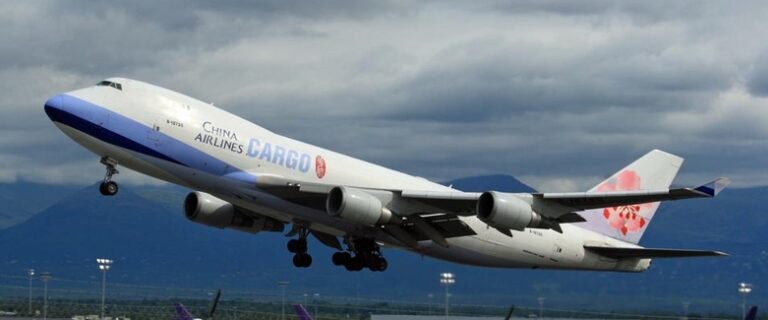
Up to 500 Boeing747 variants are still in services or stored at airports, like this aircraft belonging to Shanghai-based China Cargo Airlines – company courtesy
The directive was issued following reports from Boeing that lightning protection components in the engine fuel systems of this aircraft are degrading faster than expected. As consequence of this warning, the FAA has informed all B747 operators that this is “an urgent safety issue, as all lightning protection features of the fuel supply system now have evidence of compromise.” FAA’s document further reads: “The lightning protection features for the engine fuel feed system could fail without being detected [during routine checks, HS].” Flights at an altitude between 8,000 and 12,000 meters are particularly affected.
Explosions cannot be excluded The risk involves components designed to prevent sparks in the fuel tubes that penetrate the B747’s fuel tanks. During inspections, Boeing technical experts detected that the “bonding jumpers”, responsible for creating safe paths for electricity, are failing at an excessive rate. The malfunction of these components could result in a lack of lightning protection, which, combined with flammable fuel vapors, might cause fuel tanks to explode. “This cannot be excluded,” warns the FAA.
The Airworthiness Directive comes into effect on 15DEC23. Operators of B747s will have 90 days to inspect their passenger variants and 120 days for the cargo versions. Further inspections must be carried out annually.
Almost 500 B747s are still in service or mothballed at airports The FAA’s directive is considered a final order, indicating the urgency of the situation. It applies to a total of 211 B747 aircraft registered in the U.S., and hundreds of B747 variants registered elsewhere, from the aging B747-100 variant to the modern B747-8.
In total, there are 495 B747 aircraft in service or stored worldwide, with Atlas Air Worldwide Holdings and its affiliates, particularly Polar Air, operating the largest fleet, consisting of 56 units. Other U.S. carriers with considerable B747 fleets include UPS (41), Kalitta Air (24), and National Airlines (8). In Europe, Cargolux is a main operator of B747 freighters. Further east, Silk Way West Airlines relies on Jumbo freighters, so do Cathay Pacific, Japanese carrier ANA Cargo, Emirates SkyCargo, and Air China Cargo, to name but a few.
The inspection that has now been ordered, also affects the last two jumbos built and delivered by frame maker Boeing: B747-8 freighters delivered to Atlas Air in FEB22, and operated under an ACMI contract by logistics giant, Kuehne+Nagel.
The new president, Javier Milei, wants to privatize the national airline and place it in the hands of the approximately 12,000 employees. The result would be a publicly owned company as established by Eastern European states during the era of the Soviet Union. The fact that these public firms were not productive and failed to cover their costs, has probably not yet come to the ears of the newly elected Pampa populist and Trump supporter. In any case, alarm bells began sounding at the management of Aerolíneas Argentinas after Milei’s electoral victory was officially announced.
“Nothing that is done by a state can be considered efficient,” trumpeted Milei time and time again during his sometimes bizarre electoral campaign. Only hours after winning the election, he declared in the presidential villa, Casa Rosada, in downtown Buenos Aires, that he wants to put his words into action, by laying the fate of Aerolíneas Argentinas and the energy company YPF into the hands of their employees. “YPF has to be privatized, like Aerolineas. They have an exorbitant number of political posts. That doesn’t work that way,” declared Argentine’s new leader.
Under state control for 15 years According to Milei, Aerolíneas Argentinas currently reports losses of USD 2 million per day and accumulates liabilities of USD 8 billion. In this sense, Milei pointed out that “Aerolíneas is one of the most scandalous cases. It should not be in the hands of the State, then it will never be financially sound. Hence, I am going to privatize it,” he declared. The debt-ridden airline has been under state control since 2008. It previously belonged to the Spanish Grupo Marsans and became a member of the SkyTeam alliance and its freight arm SkyTeam Cargo, in 2013.
And he added: “Let’s discuss the methodology: the company is expensive, and it is absolutely unfair because the deficit is paid by those who cannot fly, for the benefit of those who do fly and those who belong to the company. Besides, there is a network of unions. So, I’ll hand over the airline to the employees, and it will be their responsibility to manage it properly or fail.”
Fleet renewal at stake According to market experts, these considerations are based on an ideology of market liberalization and could turn out to be extremely risky. “Without strong investors, the intended expansion and modernization of the fleet cannot be financed,” an expert told CargoForwarder Global. The same applies to the ground and cabin service, and the network for passenger and cargo transportation cannot be expanded because experience shows that each additional route takes a year or even longer to become profitable.
Presenting the latest financial results, Pablo Ceriani, CEO of the national carrier, pointed out that the airline is still in the red, but has successively reduced its losses following the covid pandemic. He said that today’s Aerolíneas is a more efficient company, generating direct and indirect income, benefiting staff and clients. “This, we achieved by opening new routes, flying more, and incorporating new business units.”
A strategy that might come to a halt once the far-right populist Javier Milei is sworn in.
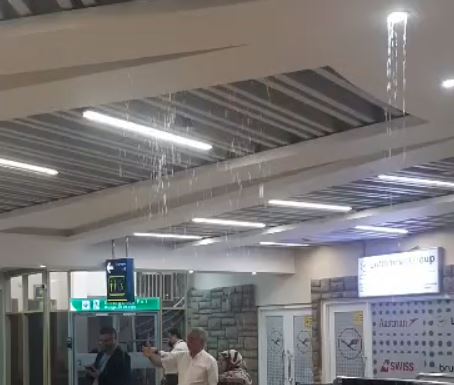
Inside the airport: masses of water wherever one looked. Check-in personnel, officials on duty at Jomo Kenyatta International Airport (JKIA), and hundreds of passengers rushed out of the terminals to prevent getting soaked. Was it torrential rain that had collected and penetrated through the roofs and was now splashing down into the international departure terminals 1C and 1E? Or was it a broken water pipe that had triggered the torrents? This is currently being investigated – at the highest political level in Kenya.
“If it goes on like this, we’ll soon have a seaport here and no longer an airport,” a horrified and soaked passenger who had just rushed through Terminal 1C on her way to the departure gate, said sarcastically.
Hundreds of travelers eager to fly off and others that had just arrived at the neighboring Terminal, were facing the same situation. Water everywhere. Meanwhile, Cabinet Secretary, Kipchumba Murkomen has formed a committee to investigate JKIA’s flooding, including the state of the infrastructure of Kenya’s major airports – particularly Jomo Kenyatta and Kisumu International, located at the shores of Lake Victoria. The group of controllers will be headed by Walter Ogolla, Director Kenya Airports Authority (KAA).
A neutral investigation is requested Critics object that this personnel decision calls into question the neutrality of the commission. It would have been better and, above all, more credible to assign this task to an independent expert, claimed a member of the opposing party, Azimio La Umoja. In the presidential election on 15AUG22, Azimio La Umoja was only narrowly defeated by the winner, the United Democratic Alliance, with a difference of 1.46% of the vote.
Was corruption in play? Following Murkomen’s committee announcement, Nairobi Senator, Edwin Sifuna demanded answers by the investigators as to why JKIA was twice hit by floods within a timespan of just 5 years. The controllers should also provide the names of the contractors involved in the maintenance of the two airports, he urged. In addition, he asked the committee “to provide the identities of public officers who certified the construction and maintenance works as completed, outlining the actions taken against those responsible for the certification of poor workmanship,” Mr. Sifuna stated, indirectly indicating corruption practices.
Opaque contractual situations
Policymaker Murkomen, who is responsible for transportation in Kenya, blamed former President Uhuru Kenyatta’s regime for the leakages, claiming the contractor brought on board by the previous administration did a shoddy job. “Over the 10 years [of Kenyatta’s ruling, HS], JKIA has suffered inadequate facility and infrastructure upgrades,” Murkomen complained. So far, the government has not published who the general contractor for the construction of the airport building was nor which companies were awarded contracts.
Calamities are nothing new to JKIA The ingress of large volumes of water into parts of the terminal complex last week, was not the first debacle that has hit JKIA. On 07AUG13, a fire engulfed the airport, forcing the suspension of international passenger flights and choking a main travel gateway to east Africa. Although many international passenger flights were diverted to Mombasa and some other airports, the blaze stranded thousands of travelers at NBO. Shippers of temperature critical perishable produce, mainly flowers, feared for their export-driven business, a leading source of foreign currency earnings for Kenya alongside tea exports and tourism.
However, last week’s flooding only affected the air freight business marginally. Cargo is handled in a separate area of JKIA, a few hundred meters away from the passenger terminals. Only lower deck transport capacity was temporarily down due to the diversion of most international passenger flights.
Dubai hit by heavy rainfall as well Over at the United Arab Emirates, multiple flights had to be cancelled last Friday (17NOV23) due to heavy rain and thunderstorms. Thirteen inbound flights had to be redirected to other airports, while six outbound flights were cancelled, a speaker of Dubai Airports told local agencies. The airport operator advised passengers to use the Dubai Metro, check traffic updates and give themselves plenty of time to reach Dubai International Airport, in addition to checking for flight updates online. There is no official information on whether cargo flights were also affected by the extreme weather conditions. In the meantime, the torrential rainfall has stopped, and climatic conditions have returned to normal.
An intriguing question popped up on TIACA’s LinkedIn feed in the run-up to its recent Executive Summit: “Are you under 40 and headed to the #ExecutiveSummit2023? Want to make your mark within the air cargo industry?” It headed an invitation to a “Cargo Collective” evening event on 06NOV23, hosted by Sara Van Gelder, Michelle Lawrence, and Sam Quintelier, and told of a mission “to inspire the next generation and empower the future of air cargo”. By all accounts, the evening was a complete success. So, what exactly is the “Cargo Collective”? CargoForwarder Global wanted to know, and asked the three founders to put their explanation into writing. Here it is:
Meeting for the first time at the Cargo Collective in Brussels, 06NOV23. Image: Cargo Collective
Uniting the future of Air Cargo In a move to foster inclusivity and diversity within the air cargo industry, Cargo Collective has recently launched with a mission to empower individuals from a wide range of backgrounds, who are new to the industry. This initiative marks a significant step towards breaking down barriers and creating opportunities for the next generation. The idea for the initiative was born in the wake of the last Air Cargo Forum in Miami and has since then ripened in the heads of its founders, Sara Van Gelder, Michelle Lawrence, and Sam Quintelier. One year later, it was time to go live!
Representation and empowerment “Our mission is to, on the one hand, empower individuals from diverse backgrounds, who are new to the industry or under-represented,” says Sara Van Gelder. “Through a global community of members and partnerships with industry events, we want to provide the support and networking opportunities necessary to grow personally and professionally. On the other hand, we want to actively collaborate with industry events, by sharing ideas on how they can help lower the barriers for the next generation to attend events and build their network. We could help the organizations with attracting alternative speakers and attendees who can bring new views, fresh ideas, and more diversity”.
The air cargo industry has long been perceived as a sector with limited accessibility, especially on the management and executive level. This is often dominated by individuals with specific backgrounds and experience. Recognizing the need for change, Cargo Collective aims to remove those barriers and provide a platform for young people from diverse backgrounds to enter and thrive in our industry.
Inclusivity and community “Our focus is on inclusivity; so, to not only be opening doors for newcomers, but also actively working to create an environment that values and celebrates differences.” says Michelle Lawrence. “By fostering a culture of diversity, the organization believes that it can contribute to a more innovative, dynamic and future-proof air cargo industry.”
Cargo Collective’s primary goal is to empower individuals who are new to the air cargo industry by providing them with the necessary support and mentorship. We understand that entering a new field can be challenging, especially for those who may not have traditional pathways into the industry. So, having a platform of likeminded people can make a crucial contribution to your development.
“A key aspect of Cargo Collective is recognizing the power of having a community fostering professional growth and development.” says Sam Quintelier. “Through Cargo Collective, we want to create a supportive network where individuals can connect, share experiences, and learn from one another.”
Introducing the industry to potential talent “When launching Cargo Collective, we were armed with a set of initial initiatives but while we brought forward some well-thought-out ideas, we understand the importance of creating a space where the voices of our future members can shape the narrative.” Sam goes on to say. “Yes! We really aim to avoid smothering them by going for a bottom-up approach, encouraging members to actively contribute their ideas, inputs, and requests.” adds Michelle. “One of the first initiatives includes a short video series where we feature some of our members’ individual stories on why they are attracted to, and stay, in our industry. By sharing their stories, we aim to attract talent. We are also thinking about public speaking coaching sessions, on- and offline debate sessions, a communal calendar to facilitate in-person meetings at industry events, etc.”
“We believe that the true strength of our collective lies in the diversity of perspectives and experiences within our community. By embracing an open dialogue, Cargo Collective seeks to create a dynamic and responsive environment that evolves in sync with the needs and aspirations of its members, ensuring that the initiatives undertaken truly resonate with the diverse voices within the air cargo industry.” Sara concludes.
Everyone welcome! The group predominantly consists of individuals under the age of 40, however, it warmly welcomes individuals of all ages who share a passion for the cargo industry and are eager to contribute their unique perspectives as mentors and contributors. A diverse membership base is one of its greatest strengths.
Cargo Collective’s launch could be a turning point in our industry, signaling a commitment to change and progress. By empowering individuals from diverse backgrounds, it is not only contributing to a more inclusive industry but also unlocking untapped potential and talent. As Cargo Collective takes flight, it brings with it the promise of a more vibrant, dynamic, and equitable air cargo industry for all.
Sara Van Gelder, Michelle Lawrence, and Sam Quintelier
Editor’s note: Those wanting to know more about Cargo Collective, are encouraged to either leave a comment below, join the Cargo Collective LinkedIn page: https://www.linkedin.com/company/air-cargocollective/, and/or contact the three founders via LinkedIn message.
With the integration of the 19th B767-300 Boeing converted freighter (BCF) into its fleet, the airline is once again growing its transport capacity. Compared to the pre-corona period in 2019, this is an increase of 70%. Due to this latest addition to its fleet, the carrier cements its role as the largest cargo airline group in South America.
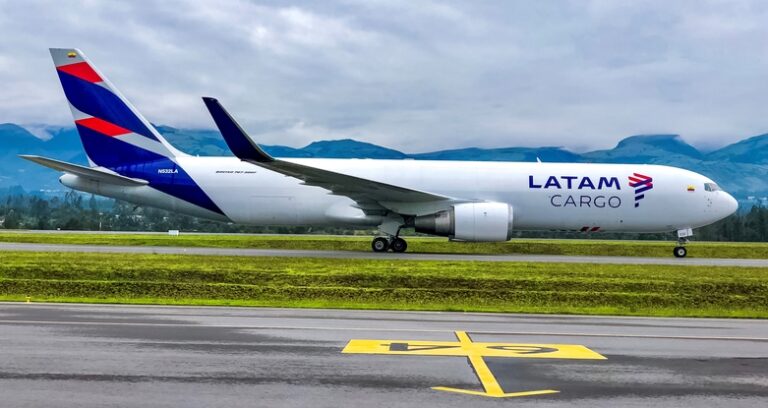
LATAM Cargo welcomes that there will be no slot reductions in AMS in the near future – picture of B767 freighter: company courtesy
According to the management, cargo operations will concentrate on flights between South and North America during the current peak season and until Valentine’s Day 2024 (14FEB24), thus supporting the export of fruit products and flowers harvested in Chile, Ecuador, and Colombia. However, during the upcoming summer flight schedule starting 31MAR24, the focus will shift towards strengthening long-haul operations from South America to Europe and parts of North America.
B767F is knighted by LATAM Cargo Regarding its fleet of B767 freighters, the Santiago-based carrier claims that these conversions are “theideal aircraft for operations in the regions currently served by LATAM Cargo, due to its efficiency, versatility, and transport capacity” and fit the market needs.
The arrival of the 19th freighter reflects LATAM Cargo’s commitment to customers and its focus on maintaining a sustainable, long-term operation. “This growth plan was structured collaboratively, with the aim of connecting the region’s export and import industries through a broad and reliable offering. At the same time, we considered the inherent volatility of air cargo and thus focused on efficiency, diversification, and flexibility. While the industry faces challenging times, we are pleased to have access to this new aircraft to take advantage of opportunities in the territory,” comments Gudny Genskowsky, Senior VP of Network and Alliances for Cargo at LATAM.
New passenger flights to London Further to this, the management revealed to CargoForwarder Global that it will launch new passenger services from Lima to London and back the same way, ending in Santiago de Chile. The route will be served five times per week, with B787-900 aircraft. This Boeing variant can accommodate between 12 and 15 tons of cargo in its holds, depending on passenger luggage. The initial flight is scheduled for 03DEC23. “We will market the capacity of the passenger aircraft ourselves,” states Jorge Carretero, Sales Director Central Europe.
Concerns about Schiphol flights Touching the European network of the carrier, Jorge said that, for the time being, LATAM Cargo does not intend to add a new EU destination to its routing. Currently, Amsterdam (AMS) and Frankfurt (FRA) are served daily with B767F, supplemented by twice-weekly landings at Brussels (BRU) and Liège (LGG), respectively. All AMS flights take-off to FRA, from where they cross the South Atlantic, serving different stations in South America, such as Sao Paulo or Curitiba, for instance.
The manager confirmed that Schiphol is the carrier’s main European hub due to the flower business and the geographical nearness of the Dutch flower auction, Royal FloraHolland, in Aalsmeer. “Our customers prefer Amsterdam as a location for importing their flower shipments from South America. A reduction in slots would have been detrimental to our route policy and product strategy.” He adds to this, however, that FRA is of equal importance for the airline’s cargo business where other products dominate.
AMS slots cuts are off the table The manager reacted with relief to the Dutch government’s decision not to limit the number of flights for the time being. “This should put this issue off the table for the time being, and with it the need to rethink our routing,” he said when asked. Originally, The Hague wanted to reduce the number of slots from 500,000 to 452,000 annually for reasons of noise and environmental protection. Roos Bakker, Cargo Partnership Director Schiphol Airport, reconfirmed these plans to CargoForwarder Global at the recent TIACA meeting in Brussels (06-08NOV23).
Now, however, the Dutch government has made a U-turn following interventions by the USA and the EU Commission. Both claimed that the intent did not meet the „balanced approach” process. It demands from governments to consult affected parties to discuss and identify different solutions to reduce aircraft noise and CO2 emissions prior to intervening in the slot scheme. Hence, LATAM Cargo and other cargo airlines serving AMS can relax for the time being, unless Schiphol imposes a ban on night flights as alternative to slot cuts.
What a bitter slap in the face for the Dutch government! The Hague was forced to postpone its plan to reduce the number of flight movements at Schiphol Airport from 500,000 annually to 452,000 as originally intended. This will apply from 31MAR24 until further notice. Both the U.S. and the EU undermined the legal basis for their stop signal, much to the satisfaction of Air Cargo Netherlands (ACN).
Slot cuts at SCL are off the table for now – courtesy Amsterdam Airport
The decision to keep things as they are for the moment, was communicated by a letter from the Minister for Infrastructure and Water Management, Mark Habers, to the Second Chamber. The politician reminds of the fact that his decision was already the subject of legal action by both KLM and IATA, including a cassation appeal, the result of which is not to be expected before the second term of 2024.
Government has put slot cuts on the backburner On top of this, both Canada and the U.S. have expressed their concern about the capacity reduction at Schiphol. In a letter dated 02NOV23, the American DoT issued an order making clear that the continuation of the plans for capping movements, without following the so-called ‘balanced approach’, would be regarded as a violation of the EU regulation and the U.S.-EU Air Transport Agreement of 2007.
The said approach implies that noise reduction cannot be enforced by merely capping movements. Before doing so, the enforcing authorities have to prove that they have also tried all other options and demonstrate that these have not worked.
The U-turn taken by the Dutch government regarding the intended slot cuts was communicated by a letter from the Minister for Infrastructure and Water Management, Mark Habers, to the House of Representatives (Second Chamber). In his note, the politician reminds of the fact that his decision was already the subject of legal action by both KLM and IATA, including a cassation appeal, the result of which is not to be expected before the second term of 2024.
U.S. retaliation In the eyes of the U.S., capacity reduction would be unfair, discriminatory, and anti-competitive. Washington has made it clear that the order of 02NOV23 would be the first step in a series of counter measures.
It stipulates that Dutch airline companies must share their flight schedules in advance with the U.S. authorities. Further counter measures could be a second step. These views, which are actually a threat, were repeated and explained during a Special Joint Committee meeting under the U.S.-EU Air Transport Agreement on 13NOV23.
Secondly, also on 13NOV23, Mr. Hamers received a letter from EU Transport Commissioner, Adina Vălean, who expressed her extreme concerns about the balanced approach not being followed. This would enable the European Commission to start an infraction procedure against The Netherlands for violating the EU regulation.
ACN advocates broadly supported scheme Air Cargo Netherlands (ACN) is happy that the Schiphol cap has been put on hold. “Earlier, we already made it clear that the chosen path to noise reduction at Schiphol is not the right and most efficient one,” ACN says in its comment. “The parties involved must now avoid standing back-to-back. We must collaborate towards a quieter and cleaner air transport. This mission remains firm and could be part of the broadly supported Sustainable Aviation Table [ms: a collaboration platform bringing together the airports, airlines, knowledge institutes, fuel producers and the manufacturing industry.]
ACN further commits itself to the protection of a number of slots for cargo aircraft at the leading national airport. “A strategic protection which has also been inscribed into Schiphol’s 8-point plan. Because, even without the cap, the demand for slots at Schiphol exceeds the availability, which may lead to a repression of cargo aircraft.”
Not to be forgotten, is the fact that Mr. Habers is part of a caretaker government. On the eve of the parliamentary elections in The Netherlands on 22NOV23, the issue will be moved to the agenda of the new government.
It has almost been 100 years since airlines began transporting animals. Today, there is a fast-increasing number of travelers who want to take their pets with them. Exact figures are not known but they are in the millions. The booking process is cumbersome for pet owners, indicates Unisys expert, Sabari Ramnath (RS). It takes perseverance on their part to get green light from airlines to take their animal companion with them. We spoke with Unisys’ Bengaluru, India-based Senior Manager – Travel & Transport Solutions, at the fringes of the recent TIACA Executive Summit in Brussels, Belgium, to delve deeper into this subject.
Modern technology such as ChatGPT in combination with Optical Character Recognition (OCR), could help to set hurdles aside for passengers to take their pets with them, states Unisys executive, Sabari Ramnath – photo: private.
CFG: Booking and boarding a flight is easy – for a passenger. But not if the “guest” is a pet. Why?
RS: IATA offers a manual giving pet owners basic advice. But the entire process is very complicated. That said, the latest technologies such as Artificial Intelligence, Natural Image Processing Recognition, and Optical Character Recognition (OCR), could help to set hurdles aside and allow travelers to take pets with them, this way saving time, costs and avoiding hassle. The pet topic is becoming more pressing, given the rising number of travelers that value taking their pet with them.
This is made even more difficult by the fact that, in addition to the international framework, national regulations must also be observed, which often differ substantially from one another. In other words, the topic is extremely complex.
CFG: The pet topic is becoming more pressing, given the rising number of travelers that value taking their furry or feathered friends with them. Is this a global issue or does this apply to some countries in particular?
SR: Pet ownership is surging worldwide, exceeding a billion pets globally. In the U.S., Brazil, the EU, and China alone, households account for over half a billion pets. Moreover, over half of the world’s population is estimated to have a pet at home. This rise in global pet ownership intersects with the increasing number of global travelers, emphasizing the global demand for pet transportation.
In the aftermath of Covid-19, there has been a notable uptick in pet ownership, fostering an emerging ‘pet parents’ phenomenon, where pets are embraced as integral family members. With this shift, pet parents are increasingly unwilling to leave their pets behind while traveling, choosing instead to bring them along on their journeys. This shift represents a significant trend, highlighting the growing inclusion of pets in global travel plans.
CFG: Sabari, you claim that AI and modern technology such as ChatGPT in combination with Optical Character Recognition (OCR), could help to allow passengers to take pets with them, this way saving time, costs and avoiding hassle. Could you describe this option in detail and in understandable language, because not every traveler is an AI expert.
SR: Pet transportation, particularly by air, presents significant challenges due to diverse government regulations and airline policies. The extensive requirements, including health certificates and various kennel specifications, can overwhelm pet owners. However, advancements such as Generative AI and Machine Learning algorithms help streamline the process. These innovations guide pet shippers accurately through the necessary documents and compliance requirements, resembling the interactive process of querying ChatGPT and receiving answers.
Moreover, sophisticated tools like OCR and microchip scanners simplify document preparation by extracting information from microchip certificates or pet passports, significantly reducing effort, and eliminating hassles in pet transportation. Additionally, IoT technology empowers pet owners to monitor their pets’ comfort during travel in real-time, tracking humidity, stress, and CO2 levels using IoT devices. This ensures continuous comfort for pets throughout the journey.
CFG: How can Unisys help to ease the requirements for taking animals on board aircraft?
SR: During the early internet boom, we developed CargoPortalServices.com, a comprehensive platform for airlines and freight forwarders to seamlessly communicate and collaborate on air cargo transportation needs. This platform offers functionalities such as bookings, AWB capture, and tracking, even for pet shipments. Throughout our journey, we have continuously used technology to support our customers in air cargo transportation.
As technology advances, we are now embracing Artificial Intelligence, Machine Learning Algorithms, and OCR to transform the booking process on CargoPortalServices.com. This initiative focuses on modernizing the booking procedures, particularly for specialized shipments like pets, aiming to simplify what can often be a complex process.
Some pets, like these three dogs, fly first class on board AA, claims a promotional poster published by American Airlines – Courtesy AA
CFG: Are there any statistics available on how many of the animals travel with an implanted chip and how many do not?
SR: While not all countries enforce mandatory pet microchipping, there’s a growing trend in microchipping due to concerns about pets getting separated while abroad. Currently, all European Union (EU) Member Countries, the U.S., and the majority of countries have made microchipping mandatory for air travel.
CFG: It requires readers at airports capable of capturing the data from microchipped dogs, for example. Are the airports equipped with them or are there gaps?
SR: There are multiple types of microchips, each operating at different frequencies (125kHz, 128 kHz, and 134.2 kHz), and their acceptance varies by country, necessitating multiple reader devices at airports capable of capturing data stored within these chips. Due to variable reader availability, there may be gaps in implementation. As a result, not all airports globally, consistently have these readers available or operational, potentially leading to inconsistencies in scanning and retrieving data from pet microchips.
CFG: Sabari, we will keep this topic on our radar since an increasing number of travelers want to take their pets with them. Thank you for your valuable explanations.
AI might not form part of everyone’s processes in air cargo right now, but it is certainly on everyone’s lips – whether they have good things to say, or bad. The Digital Innovation panel at TIACA’s Executive Summit was unanimous in its opinions. Moderated by Michelle Lawrence (Airline Services International), it featured Air Cargo Belgium’s Freek de Witte, Raft’s James Coombes, Nallian’s Sara Van Gelder, cargo.one’s Simson Demmer, and CHAMP Cargosystem’s Stéphane Noll. They discussed data monetization, the role of AI in replacing human tasks, and the challenges and opportunities in adopting AI within the air cargo industry.
AI’s Concept Art idea of an intelligent air cargo employee using AI. Image: Perchance.org – AI Photo Generator/CFG
The panel began by exploring the ethical considerations of data monetization. Freek de Witte emphasized the necessity of having a robust data infrastructure before reaping financial benefits. Simson Demmer added the perspective from a software company, highlighting the value of creating added value and selling it. “No one works for free and of course we want to profit,” he underlined, pointing out: “Data gets more value the more people touch it. Data is here for us to share, and we can work with it in different manners.” What happens is a certain ‘democratization’, was his opinion: “At cargo.one, whether small or large, you can access the same data.”
Incentivize and safeguard data James Coombes stressed the importance of safeguarding data and addressing the misconceptions about its value: “As a company that processes a lot of data, we would never share or compromise data. Data and data-aggregation and who gets to profit from that data is often misunderstood: individuals overestimate data value on an individual basis, and underestimate its aggregative value.” Aggregated data is worth far more in value, he said. However, “you have to provide an incentive to gain data and earn the right to that data. You need to provide a service!” was his message. This was agreed by Stéphane Noll, who also underlined the importance of governance in handling industry data – particularly anonymization as a key strategy for obtaining market data for benchmarking and improvement. Demmer concurred: “Data in itself has no value. It’s what you do with that data to support business that counts. Sara Van Gelder summarized: “You need to be the expert and ensure that data stays under control.”
Should we use digital to remove people? The discussion then shifted to the role of digitalization and automation in the air cargo industry, especially concerning job displacement. Stéphane Noll highlighted the distinction between digitization (removing paper) and digitalization (removing steps). Freek de Witte expressed concerns about the younger generation’s perception of a return to paper, and emphasized the need to embrace automation to stay competitive: “More and more people grow up digital and smart, so a return to paper is the best way to scare they away again,” he admonished, referring to those companies still struggling to remove paper processes from their business operations. Sara Van Gelder agreed, advising: “Replace what you can by automation and digital solutions. If we don’t do it, we would be non-competitive as other industries are replacing repetitive jobs by robots and AI.”
Man and machine James Coombes stated that Raft, as an AI-focused entity, aims to understand and automate logistics steps intelligently. He outlined the goal of fully automating the shipment lifecycle for freight forwarders, emphasizing the need for industry-wide investment and time commitment. “Understanding what humans do at a basic level in order to automate on digital level is a learning processes [and now is a] brilliant time to do it. The industry struggles to attract talent because people are used to different technology. If you can automate, you can dramatically change the industry. Put in the investment and time!”
Demmer pointed out: “We don’t want to BE the machine, we want to RUN the machine. It is both exciting and scary as we are all moving to higher value tasks, new skillsets, new innovative ways.” Fundamentally, however, the air cargo is still human-centric industry based on business relationships and trust. “It is NOT YET a black box and will not work without humans!” he concluded. The panel also acknowledged the importance of critical thinking, with Stéphane Noll cautioning against overestimating the current capabilities of AI in this regard. Coombes agreed: “Critical thinking is emotions which AI doesn’t do yet. This industry is full of relationships, and they clearly won’t disappear.”
Challenges and Considerations in Adopting AI Addressing concerns about the challenges of adopting AI, a question from the audience highlighted issues related to technology choices, legacy IT systems, and the financial burden of implementation, and the lack of process and data quality. James Coombes responded by emphasizing the difficulty of adoption and behavior change, advising “Make sure everyone is going into transaction with eyes wide open and knows that there is process to get there,” and ensuring a transparent process: “We show ROI and how we measure it, and constantly check this as we go through projects.” The other panelists highlighted the importance of small, measured steps, experimentation, and budget allocation for AI experiments. They collectively underscored the need for collaborative, open, and innovative approaches to AI adoption, stressing the importance of partnerships, integration, and sharing successful experiences to foster industry-wide advancement.
Data Challenges in Large Organizations An audience member raised a crucial issue regarding the digitalization and digitization challenges in large organizations within the cargo industry. One such challenge is the multitude of systems across the different stakeholders, making collaboration difficult. Another big problem, addressed by an audience member, was the lack of data and data quality: “If you don’t have data or it is on paper, forget about AI!” he said. James Coombes acknowledged today’s reality: “We are a victim of multiple standards. You need to get the data first before you can get into the really cool stuff. So many shiny things that you can do, but there’s a real basic problem – data comes in in all these different types and formats, and that needs to be tackled first.”
Human Factor: Bridging the Gap between Technology and People The discussion concluded with a reflection on the human factor in AI adoption. Sara van Gelder and Simson Demmer stressed the importance of effective communication, incentives, and diversity in addressing the perceived threat of AI. Sara Van Gelder explained: “We need to understand that all stakeholders have a different level of digital maturity. Our end goal is a smart digital network. We need to help all of our customers to reach that, step by step.” Demmer highlighted the need for a diverse audience to push critical thinking and innovation, emphasizing that success lies in combining knowledge and expertise. And diversity, Sara Van Gelder pointed out: “We can complain as much as we want that it is an old boys’ club, but things are changing,” she said, explaining the need for diversity at every level, as a more diverse audience will ensure faster success.
In summary: the journey toward a fully AI-integrated air cargo sector requires collaboration, transparency, and a commitment to continuous learning and improvement, the panel agreed.
That continuous learning applies to AI, too. In asking it to create images for this article, it is evident that AI is highly maritime-biased and does not yet recognize air cargo containers or air cargo processes in general. It requires clean, correct, and abundant data to deliver its full potential.