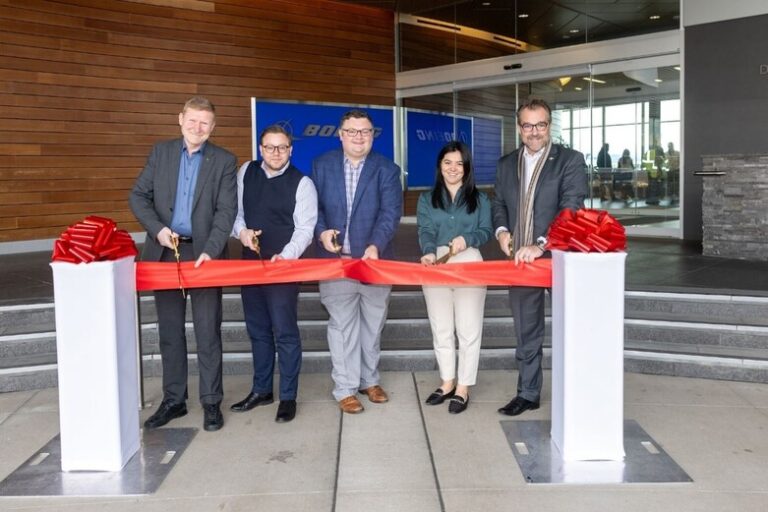
Atlas Air Worldwide Holdings, Inc subsidiary, Atlas Air kicked off the new year with a happy event: the delivery of a fourth new Boeing 777 freighter that it will operate for MSC Air Cargo (the virtual airline fraction of MSC Mediterranean Shipping Company SA, launched at the end of 2022). This means increased weekly air cargo services, including its successful first commercial flight from Hong Kong (HKG) to Dallas/Fort Worth (DFW). The first of the four B777 aircraft under ACMI (aircraft, crew, maintenance, and insurance) contract that Atlas Air operates for MSC Cargo, was delivered in NOV22. Freighters two and three in JUL23 and NOV23, respectively. This fleet of four modern freighters which can cover the greatest distance in comparison to other freighters, allows Atlas and MSC Cargo to offer a cleaner, quieter, more cost and fuel-efficient service, with a possible uplift of 107 tons per flight.
A new plane is always a good reason to smile. Image: MSC Mediterranean Shipping Company
Richard Broekman, Chief Commercial Officer and Head of Sustainability, Atlas Air Worldwide, commented: “The delivery of this fourth 777 Freighter that we are operating for MSC, marks an incredibly exciting milestone of our long-term strategic partnership. We value our partnership and look forward to building upon our relationship with MSC as the company continues to grow its air cargo solution for its customers.”
Anders Matikka, Vice President, Air Cargo, MSC, said: “This latest 777 Freighter delivery represents a pivotal moment and significant milestone for our company as it marks the completion of our first set of aircrafts in partnership with Atlas Air. This new and enhanced fleet will empower us to elevate our offering, ensuring enhanced support for our valued clients and a stronger presence in the market.”
When it comes to a less negative environmental impact in air cargo, every little bit helps – and that can be anywhere along the logistics chain. In Silk Way West Airlines’ case, the focus in this particular milestone, is on operation in the cockpit. It has chosen to adopt Electronic Flight Bag (EFB) solutions developed for the aviation industry by Essen, Germany-based Logipad. The company’s software has been developed with the aim of increasing efficiency and safety in aviation operations, and provides crews with access to real-time data and critical information and resources. Given the fact that all this information is available at the touch of a screen button, this greatly reduces the amount of, or need for, hard-copy paper versions of those documents.
Finger on the pulse of tech for good. Image: Silk Way West Airlines
Not that Silk Way West Airlines has partnered with Logipad, it will also benefit from more efficient, environmentally friendly process. The decision to adopt Logipad solutions was taken as an action within the airline’s sustainability strategy as well as its focus on digital transformation.
Wolfgang Meier, President of Silk Way West Airlines, summarized: “Joining the Logipad community is a significant milestone in our journey towards a global sustainable future. By introducing a paper and wood-saving program, we not only streamline our logistics processes but also contribute to environmental conservation. Silk Way West Airlines is dedicated to making responsible choices that benefit our planet and the communities we serve.”
Adriaan den Heijer, EVP Air France-KLM Cargo and Managing Director Martinair Image: AFKLMP Cargo
Swiss pharma supply chain technology company, SkyCell, has been chosen by Air France KLM Martinair Cargo to provide and enhance its ULD tracking and visibility. As the airline group’s preferred unit load device (ULD) tracking partner, SkyCell will deploy its state of the art, built for purpose IoTs across Air France KLM Martinair Cargo’s ULD fleet, thus enabling real-time visibility into its ULD operations. That visibility is shown on the software company’s SkyMind platform. Thanks to the deployment of innovative readers and tags combined with state-of-the-art technology, SkyMind is able to illustrate what is happening with the ULDs and where they are along the journey. This information enables Air France KLM Martinair Cargo to proactively tackle and irregularities and work more efficiently that it has been able to in the past, when tracking and tracing was a much more manual and complex process. Efficient processes naturally also mean significant operational and cost efficiencies, and hence greater customer satisfaction overall.
Adriaan den Heijer, EVP Air France-KLM Cargo and Managing Director Martinair, explained: “We’ve decided to invest in the latest asset tracking technology with SkyCell. A new technology solution called SkyMind has been developed. Implementing state-of-the-art tracking devices to locate our ULDs will not only enable us to track our assets but will also significantly enhance our operational quality. Real-time ULD tracking will enable us to address the issue of ULD losses, whether by ground handling partners or our valued customers, and will ensure seamless movement of cargo. With improved ULD management, we can optimize our operations and deliver exceptional service to our air cargo industry partners.”
Nico Ros, CTO and Co-Founder SkyCell, announced: “We’re excited about our partnership with Air France KLM Martinair Cargo, as we establish a new standard in technology for Air Cargo’s ULD (Unit Load Device) management. This achievement is made possible through our close cooperation with Air France KLM Martinair Cargo and the integration of SkyMind, our IoT-driven visibility platform with specialized ULD management. The partnership marks a major transformation in the airline industry towards automation, with a strong focus on efficient ULD management, streamlined dispositioning and improved asset utilization.”
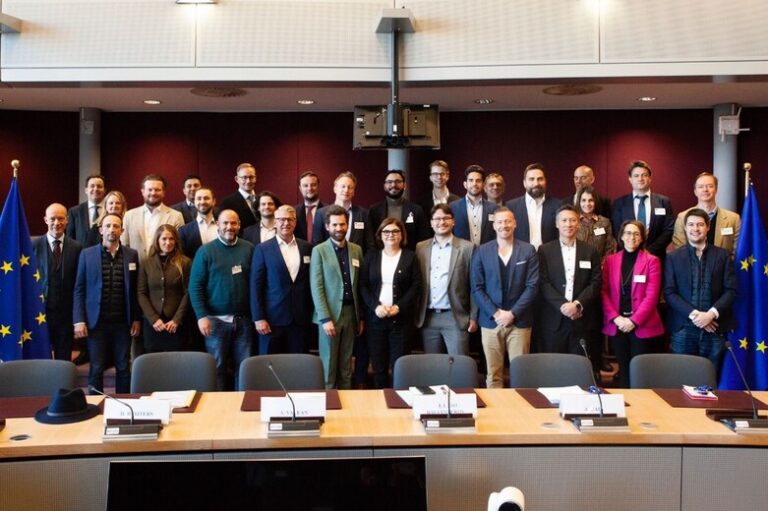
“You’ve got to be in it, to win it,” is a popular phrase when it comes to competitions and lotteries. “You’ve got to be in it, to change it” could be a valid adaptation when it comes to driving change and smoothing the path for innovation in mobility. A new taskforce is setting out to do this and Dronamics is among its members. The cargo drone airline has joined forces with 15 other European private mobility companies (a mix of influential unicorns and startups: Aura Aero, Bolt, Cabify, Carto, EVBOX, EV Connect, Fastned, Flix, Lilium, MaasGlobal, Nevomo, Otiv, Volocopter, Voi, Virta), to launch the EU Future Mobility Taskforce. The initiative was announced after a joint meeting with the European Commissioner for Transport, Adina Vălean.
At the launch of the EU Future Mobility Taskforce. Image: Dronamics
The taskforce, brainchild of Bolt and Cabify, sets out to unite the EU’s mobility innovators (focused on cargo, air mobility, shared mobility, EV charging, maglev, rail, transport innovation and deep tech) and collaborate in providing information and guidance to EU policymakers for the next legislative mandate, thus accelerating efforts and ensuring continued European leadership in global transport innovation. First step is a comprehensive report on members’ requirements and recommendations, due for presentation to Commissioner Vălean this Spring. Mobility must be made more sustainable, affordable, and connected, yet its innovators often face outdated and fragmented regulation, a lack of enforcement, market entry barriers, or barriers to accessing finance and data accessibility.
Commissioner for Transport, Adina Vălean, announced: “Today [11JAN24], marked the launch of the EU Future Mobility Taskforce, where 16 CEOs and Founders from Europe’s top private mobility unicorns and startups joined forces. In a dynamic meeting, we delved into the needs of our transport innovators and explored ground-breaking initiatives like Drone Strategy 2.0 and future Hyperloop regulatory frameworks. The European Union is boosting financial support for transportation innovators and startups through Horizon Europe cluster 5 and EIT Urban Mobility. The European Innovation Council, with a EUR 10 billion budget, is calling on transport entrepreneurs to apply.”
Svilen Rangelov, Co-Founder and CEO, said: “As Europe’s cargo drone airline, we are delighted to be part of the EU Future Mobility Taskforce, working with fellow mobility innovators and unicorns. Middle-mile deliveries by cargo drones have a significant potential for the European as well as the global economy at large, enabling faster, cheaper, and green goods mobility, [and are] key to advancing the European Commission’s Sustainable and Smart Mobility Strategy.”
Astral Aviation has appointed Euro Cargo Aviation to act as its cargo GSA in Europe, USA & UAE, and Take Off Aviation as its cargo GSA for South Africa. The Kenyan airline announced the Global Sales Partnership Agreement which came into effect with 01JAN24, earlier this month. The two entities are responsible for marketing the Astral Aviation’s cargo capacities to potential clients, businesses, freight forwarders, and other stakeholders. They published the following statement: “Euro Cargo Aviation and Take Off Aviation are delighted and immensely proud to represent Astral Aviation as its Cargo GSA. Our collaboration with Astral Aviation marks a significant milestone for our organization as we join forces to enhance our business endeavors, leveraging our collective decades of expertise in the dynamic African market. Together, we are poised to achieve new heights, fostering growth, and delivering unparalleled value to our clients. This collaboration underscores our commitment to excellence and innovation in airfreight services to Africa, and we look forward to a successful and mutually beneficial journey ahead with Astral Aviation.”
Sanjeev Gadhia, Astral Aviation’s CEO, added: “We look forward to our partnership with Euro Cargo Aviation, who will act as an extension of our esteemed company, representing its cargo services, driving sales, ensuring operational efficiency, and maintaining customer satisfaction for its scheduled and charter network from Europe, USA & UAE, which will be directed towards Astral’s strategic hubs in Dubai and Nairobi, while Take Off Aviation will promote Astral in South Africa. We are confident of Euro Cargo’s professionalism, expertise, and neutrality to represent us in three of the key markets and look forward to a new partnership.”
Since 01JAN24, Michael Zach is Vienna International Airport’s new Head of Ground Services. He succeeds Franz Spitzer, who is partially retiring after almost three decades in the employment of Flughafen Wien AG.
Michael Helm new Ground Services head at VIE. Image: Flughafen Wien AG
Zach, who is now responsible for cargo, baggage, and ramp handling, alongside aircraft de-icing, has been with the airport since 2006, and comes over from Sales, Finance and Cargo within its Handling Services division – a post he held since 2018. His other previous positions include Managing Director of the City Airport Train, Managing Director of Business and General Aviation and the VIP Terminal. Vienna Airport’s press release lauds his many achievements and years of management experience in various leadership roles, and reveals that, in his new position, he now heads the largest division of Flughafen Wien AG, which employs 1,400 staff.
Julian Jäger and Günther Ofner, members of the Management Board of Flughafen Wien AG, agreed: “Michael Zach is the ideal choice for the position of Head of Ground Services – he will continue the airport’s successful course. At the same time, we would like to thank Franz Spitzer for his dedication and commitment to our airport, which he has played a key role in shaping for many years. We wish him all the best for this new chapter in his life.”
Michael Zach, Head of Ground Services at Flughafen Wien AG, commented: “Since 2018, I have been able to help develop ground handling at Vienna Airport together with Franz Spitzer. I am very pleased to now have the opportunity to assume overall responsibility for ground handling services at the airport and to continue the successful cooperation with my colleagues here.”
The clock is ticking over the UK, as the industry prepares for the final migration to CDS (the Customs Declaration Service). This is the HMRC’s new system for the processing of customs declarations, and since the HMRC’s migration timeline for inventory-linked exports requires air freight exports to begin in early February (ocean = early March), the Agency Sector Management (ASM) and the British International Freight Association (BIFA) jointly held a webinar to help answer any questions businesses may have in preparing their migration. (Companies are given three months to migrate from the moment HMRC gives them the go-ahead. Any exceptions to this are subject to strict conditions.) Not only did a record number of traders attend the webinar, but ASM and BIFA also noted that the number of traders accessing the HMRC test environment, Trader Dress Rehearsal (TDR), had also increased. TDR allows users to practice submitting CDS export declarations, thus become better prepared for the real-life transition to the new tool.
Robert Windsor, Member Policy and Compliance Director, BIFA Image: Meantime Communications
Steve Parker, BIFA Director General, revealed: “Around 50% of the trade association’s corporate members were in attendance [at the webinar], which demonstrates their commitment to being prepared for this latest change.”
Sharon Greer, ASM General Manager, explained: “The seminar was organized to help address any concerns those members and users may still have about their readiness to complete the final switch to the new system, and to provide companies with advice and guidance about the implementation process. We have already witnessed the benefits of running sessions like these, for example following our previous CDS webinar we have seen a significant reduction in the numbers of traders leaving MUCRs unclosed – a previously common problem which was contributing to preventing a smooth migration to CDS. This highlights the importance these webinars play in providing clear guidance to those who need it.”
Robert Windsor, BIFA’s Member Policy and Compliance Director, added: “The seminar provided an important update on the final preparations businesses need to make in order to ensure that their final migration to CDS for exports is successful; and delivered indicative timelines for the implementation. It also enabled us to reiterate the message that due to the tight timelines for HMRC to de-commission CHIEF, the timeframe for its closure for export declarations will be much shorter than for imports. The key is practice. Implementation of CDS imports has shown the benefits of users spending as much time as possible in testing the new system, as well as the need to liaise with their software suppliers to ensure full connectivity with government systems.”
The 01JAN24 saw Tobias Burger become COO Air and Sea at logistics heavyweight, Dachser, and Roman Mueller assume the role of its Managing Director of the Asia Pacific Region. Both executives are tasked with driving the agent’s growth in East Asia and worldwide. In the Far East, the company’s emphasis is on pushing its China+1 strategy forward, confirmed leading manager to CargoForwarder Global.
Tobias Burger succeeded Edoardo Podestà, becoming Dachser’s new head of Air and Ocean Freight – photos: credit Dachser
Mr. Burger succeeds Edoardo Podestà, who retired after serving Dachser for more than 20 years; the last four of which as head of its air and ocean business. Hong Kong-based Podestà was responsible for the agent’s Asian business since 2003, and significantly contributed to the company’s growth over the past four years as COO Air & Sea Logistics, applauds Bernhard Simon, Chairman of the Supervisory Board at Dachser. Since Mr. Podestà announced his retirement plans very early, Dachser’s top management was able to thoroughly prepare the succession process and operational handover at the top of the Air & Ocean field of business.
In-house solutions In appointing Burger and Mueller, the Dachser executive board has placed the new responsibilities on the shoulders of two of its own long-standing employees who both have extensive company knowledge. Upon announcing Edoardo Podestà’s successor, Dachser’s helmsman, Simon commented: “With Dr. Tobias Burger, we now have an experienced logistics strategist at the helm of our Air & Sea Logistics organization, who has a deep and holistic understanding of the complex challenges facing the global logistics markets now and in the future.”
Multitude of tasks Mr. Burger holds a doctorate in business administration. He began his career as a strategy consultant at Siemens Management Consulting, joining Dachser in 2009. After working in controlling and strategy development, Burger was given responsibility for Corporate Governance. At that time, he was already overseeing the strategic development of the global air and sea freight network. Burger was appointed Deputy Director Air & Sea Logistics in 2019, becoming Podestà’s right-hand man. During this time, he took up the role of global sales manager for the air and sea freight business. In 2021 and 2022, Burger successfully led the ASL EMEA business unit’s operations as Managing Director.
Roman Mueller is new head of Dachser’s Asia Pacific Region.
Roman Mueller, who joined Dachser in 2008, held various leading positions including Managing Director of ASL Korea and Head of Sales ASL APAC, in which he demonstrated exceptional leadership as well as strategic vision, states a Dachser release. Prior to his promotion, he led several key projects as Deputy Director ASL APAC. According to Dachser, he actively shaped the region’s strategic direction and advanced the logistics company’s presence in Asia. The company’s press release, announcing Mueller’s appointment, will officially be published tomorrow (15JAN24).
Basic strategic considerations According to Dachser CEO, Burkhard Eling, the agent’s main impetus for future growth will come from business activities in Asia and the Americas. “By closely interlinking intercontinental transport with our efficient European overland transport network, we want to offer our customers a comprehensive solution for groupage services around the world. This Global Groupage offering, delivered by an integrated network with comprehensive contract logistics capabilities, definitely calls for a powerful air and sea freight organization with a global presence,” he exclaimed.
In an earlier speech, Eling pointed out that geopolitics is becoming a game changer for supply chain management. “Our customers are under massive pressure to change their sourcing structures. Among other things, they now need to reposition themselves regionally and increase their warehousing.” At the same time, this also means: “If logistics expenditures increase, this will be reflected in costs and service concepts.” However, this does not put globalization into question, he stressed. “There will always be sourcing on a global scale, but the framework conditions have become much more complex and complicated.”
In addition to pressing environmental issues, criteria such as scarce resources in terms of energy, real estate and personnel, are increasingly getting on the radar of politics and business. The question of what role values play as a strategic compass in an uncertain world, is also being asked more frequently.
Boeing and the increasing number of MAX incidents send their regards. If there are technical problems with an aircraft or even minimal safety-relevant issues are spotted, some media switch to alarmism. After all, this increases the number of clicks, and their brand ends up at the top of Google or other search machines. This is also the case here.
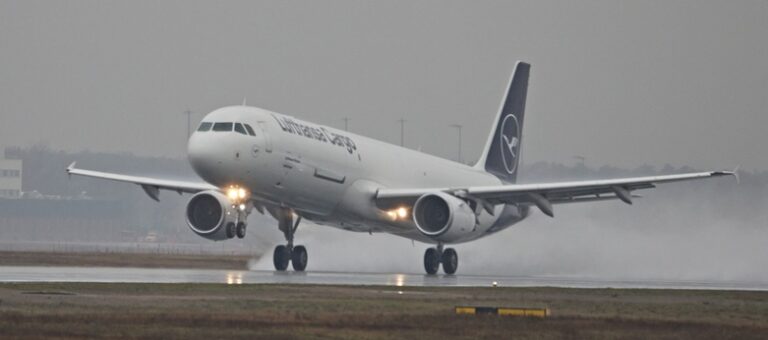
Two of the four A321 freighters operated by LH CityLine on behalf of Lufthansa Cargo are currently being repaired due to cracks – courtesy LHC
Here is what happened: A tiny crack was discovered on the aft section of one of the freighters in Lufthansa Cargo’s A321P2F four-unit sub-fleet. This occurred during one of the obligatory technical checks, i.e. during a routine inspection. As a result, the three remaining freighters of this Airbus type which belong to Lufthansa Cargo’s regional fleet, but are operated by the Group’s subsidiary, City Line, were also immediately inspected. The outcome: a similar problem was discovered on a second freighter. Consequently, the aircraft was promptly taken out of service to rule out any risks and enable the damage to be rectified.
Only minor effects on the regional network So far, so normal. It is currently unclear how long the repairs will take. According to Nicole Mies, Lufthansa Cargo’s Head of Communications, her company expects the first aircraft (D-AEUC) to be repaired within the planned layover time. She did not deliver any time estimate as to how long the fixing and overhauling process of the second aircraft might take. Both freighters are now being repaired with only a very limited number of flights needing to be cancelled, leaving little impact on Lufthansa Cargo’s regional European network. This is currently even less of an issue since freight volumes are always relatively low at the start of a new year. Ms. Mies went on to say that the cracks had resulted from a weight shift affecting the aircraft, since a heavy new cargo door had been installed in the rear section of the fuselage to enable the fast loading and unloading of shipments. Asked who will foot the bill for the repairs – whether this will be the lessor, Lufthansa Cargo, the converter, or an insurance company – she remained tight-lipped, stating that “Lufthansa Cargo does not provide any information on financial matters.”
One aircraft, many lives The above-mentioned D-AEUC freighter has had an eventful history. It initially belonged to the Air Berlin fleet and was subsequently passed on to the Austrian subsidiary, Niki, when Air Berlin bit the dust. After that, it was bought by Lufthansa and operated by Lufthansa subsidiary, Eurowings. Finally, it was sold to San Francisco-based lessor, Babcock & Brown Aircraft Management (BBAM), which had it converted into a freighter in Singapore by the local conversion company ST Aerospace and Airbus. Since spring 2022, Lufthansa Cargo has been operating the leased aircraft on scheduled services within its regional network, which also includes North Africa. This also applies to the three other leased A321-P2F freighters. To conclude: compared to the massive Boeing 737 MAX problems mentioned before, these two routinely discovered cracks should not be a real cause for any alarmism.
AeroLogic: FRA flights have been upped Asked about the role of freight carrier AeroLogic, a DHL Express/Lufthansa Cargo JV (50/50%), Ms. Mies said that the former work-sharing model had been abolished. Originally, the Deutsche Post subsidiary used AeroLogic’s B777-F exclusively on weekdays for services originating and ending in Leipzig, its largest global hub. On weekends or public holidays, however, Lufthansa Cargo utilized the capacity of the AeroLogic B777F fleet for its own purposes, with flights beginning and ending at its home base, Rhine-Main Airport. This logical but somehow relatively rigid operational model was already skipped back in 2019, Ms. Mies confirmed, resulting in a shift of some of the freight carrier’s B777F flights from Leipzig to Frankfurt. Yet, this operational adjustment has never been officially communicated to date.
The rightwing Meloni government which took power in OCT22, intends to privatize key Italian service providers. This would be a breach of her program presented during the electoral campaign. In Meloni’s appearances and speeches, the party leader of the far-right Fratelli d’Italia party placed great emphasis on securing existing state assets and infrastructure in logistics and transportation. However, now she has made a U-turn. In addition to the Poste Italiane, she also plans to partially privatize the State Railways, Ferrovie dello Stato, as declared last week.
The Italian Postal Service operates four B737-400 freighters – credit: Poste Italiane
The State should control what is of strategic interest, but this does not mean it should close the door to private investors or attractive market initiatives, Ms. Meloni pronounced at a recent press conference. On this occasion, the head of State identified two logistical heavyweights that her government is willing to open up to private investors: Poste Italiane and Ferrovie dello Stato.
Eying private investments The Italian Postal Services already includes private capital since investors hold 35.74% of the company’s capital shares. The other owners are the Finance Ministry (29.26%) and the Cassa Depositi e Prestiti, which is controlled by the Ministry of Finance, holding 35% in Poste Italiane. Hence, either the savings bank or the Finance Ministry would have to sell parts of their shares, perhaps even both. So far, Meloni has not revealed any detailed plans about the greater involvement of private capital advocated by her government.
Large network, aging freighters Poste Air Cargo, the aviation arm of the Italian postal services, would also be affected by the intended partial privatization. From its hubs at Brescia Montichiari Airport and Rome Leonardo da Vinci-Fiumicino Airport, it serves a domestic network that includes Cagliari, Olbia, Catania, and Palermo, among other cities, and thus ensures fast mail and parcel transportation between the northern and southern parts of Italy with night flights. Poste Air Cargo operates a fleet of four Boeing B737-400 P2F converted aircraft, with an average age of 25.3 years. In view of the aging aircraft, the rollover of the fleet is becoming a pressing issue. Hence, the higher the proportion of private stakeholders at Poste Italiane, the more financially advantageous the fleet rollover will be for the state budget.
A welcome windfall Compared to Italy’s Postal Service, the situation of the Italian railroads is much more complex, as all companies that are part of the Ferrovie dello Stato Group are entirely public. It remains unclear which parts of the railway group the Meloni government wants to sell, and what share Rome wants to keep. An “Il Sole 24 Ore” report speculates that between 4.7 and 6.7 billion euros could be cashed in by the Italian State, if 49% of Ferrovie dello Stato and up to 30% of Poste Italiane are sold to private investors. Money that is much needed in view of the high national deficit.