Home Blog Page 124

Etihad Cargo converts A350F options into firm orders

0

The Abu Dhabi-based carrier decided to activate a purchase option signed in 2022, for three additional A350 freighters. This brings the total number of this aircraft variant ordered by EY to ten units. Management cited the increasing transport demand for e-commerce shipments from the Far East as the key reason for the move.

Currently still an animation: A350F operated by Etihad Cargo at the earliest in two years from today – credit EY

According to Airbus, Etihad will receive its first A350F in 2026/27 as the freighter is still being tested. Deliveries will run until the beginning of the next decade. Until then the carrier’s freighter fleet will consist of 15 all-cargo aircraft, CEO Stanislas Brun told U.S. agency Freight Waves. This he confirmed to media at TIACA’s Miami-held cargo trade show.

At the 2021-run Dubai Air Show, U.S. lessor, Air Lease Corporation, became the launch customer with an order for seven A350F to be delivered around 2026.

As things stand, Etihad won’t be the first commercial operator of the twin-engine airliner. It will be Singapore Airlines, instead, which purchased seven freighter aircraft at the 2022 Singapore Airshow, with deliveries planned to start in 2026.

Commonality drops costs
The 71 m-long cargo variant is capable of flying 8,700 km nonstop when fully loaded with 109 tons. That is an extra payload of 5 tons compared to the B777F. Etihad’s A350F fleet will be powered by Rolls-Royce Trent XWB engines, which reduce fuel consumption and greenhouse gas emissions by 20% compared to its direct competitor, the Boeing 777F, claims Airbus. Commonality with other Airbus variants is another savings factor, substantially cutting training times for pilots flying sister aircraft models. Etihad operates a mixed fleet consisting of Boeing and Airbus variants. In addition, Airbus’ management also mentions lower landing and navigation charges, better aircraft availability, and optimized engine transportation. All these contribute towards lower costs compared to Boeing’s B777F.

The expansion of the freighter fleet is part of Etihad’s long-term strategy to secure the growth of its cargo business and improve operational efficiency. This development is supported by new technologies such as Airbus Skywise Health Monitoring, which provides real-time data for maintenance, and the Flight Hour Service (FHS), which enables optimized fleet maintenance.

e-Commerce as main driver
Etihad Cargo and global express delivery service provider, SF Express, recently signed a Memorandum of Understanding (MoU) to expand and tighten their collaboration by creating a logistics joint venture. Initially, their deal had an 18-month term. Their enlarged pact provides for shared capacity offered by Etihad Cargo and SF Airlines jetliners, enabling enhanced connectivity between Abu Dhabi and Ezhou, China. In addition to this, increased demand led both airlines to increase the flight frequencies between their two main bases and to introduce a new freighter service linking Shenzhen and Abu Dhabi.

Interesting to mention is that the new venture agreed between both parties does not aim to operate as an airline, but plans to establish an identity and shape a product focused on the trade route linking China and Abu Dhabi.
The future’s coming – like it or not!

0

That was the message driven home by Germany’s best-known futurologist and director of Europe’s largest trend research institute, 2b AHEAD, Sven Gábor Jánszky, at a future-oriented evening hosted by Vienna’s Chamber of Commerce and Industry, this week. One of the provocative statements he made was “If your employees have not yet come to you with an idea of how to increase their department’s productivity by 300%, then you don’t have sufficient competence in your team.” The technology is there. The future is open to those who realize that and implement it.

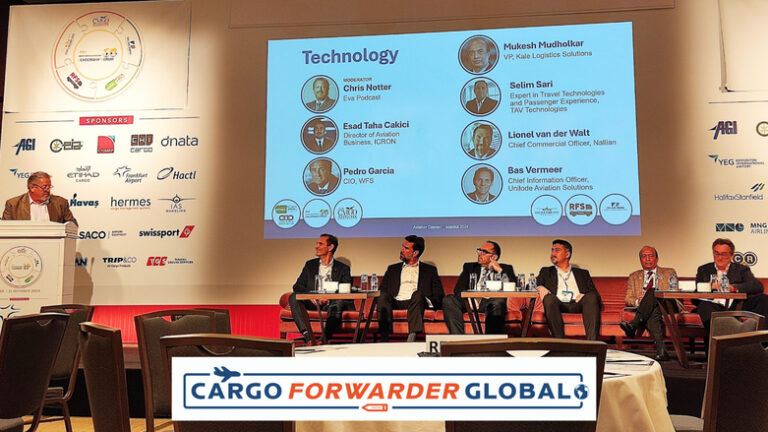
Notter’s Technology Panel Boy Band. Image: CFG/bg

That the technology is there in air cargo, was also acknowledged and discussed in detail at the ACHL Technology Panel in Istanbul, last month. Moderator, Chris Notter, first introduced his “boy band for the subject matter”: Bas Vermeer, CIO at Unilode Aviation Solutions, Mukesh Mudholkar, VP of Kale Logistics Solutions, Lionel van der Walt, CCO of Nallian, Esad Taha Cakici, Director of Aviation Business at ICRON, Pedro Garcia, CIO of WFS, and Selim Sari, Expert in Travel Technologies and Passenger Experience at TAV Technologies. He then summarized the direction of the panel: “There’s a lot of tech-dumping at the moment.” Good concepts aimed at improving productivity and efficiency, but work needs to be done on adoption: “We need to embrace the people aspect of change. How do we make people more receptive to tech?

Tackling adoption challenges
Despite significant advances in technology and AI, adoption remains a sticking point. Bas Vermeer highlighted Unilode’s efforts to track Unit Load Devices (ULDs) using advanced trackers and readers, enhancing visibility. However, adoption bottlenecks persist. On the one hand, getting people to change their way of working. Another large limitation within the air cargo industry is its fragmentation. “Even with the best tech, you don’t cover everywhere outside your network. How do you assign ramp, truckers, planes?” Vermeer said, emphasizing the importance of integration into daily processes for ground handlers and airline operators. And then there is the issue of service providers or GHAs handling different airlines, and thus split processes – perhaps manual for some airlines, and digital for others.

And is it the same tech each time? Lionel van der Walt echoed the sentiment, stressing simplicity and collaboration. “There is so much technology around and it is getting really complex. We need to create SIMPLE solutions and interfaces. We need to be speaking more with stakeholders – especially the people on the ground – to help them do their work better,” he urged.

Balancing innovation and cost
Optimization technologies are critical for growth, but cost and scalability pose challenges, explained Selim Sari. “Complex algorithms depend on significant computing power, which impacts costs for operators,” he said, adding that collaboration and scalability are key to reducing expenses and improving efficiency.

Esad Taha Cakici noted that AI optimization offers opportunities to redesign business models. “It’s not just about doing things faster but about fundamentally changing how we operate,” he said, advocating for a strategic approach to integrating AI into core business practices.

Bridging the gap: training and change management
A recurrent theme was the need for better training and change management. “Rolling out new systems with a single training session and a couple of ‘champions’ isn’t enough,” van der Walt cautioned. Continuous training and structured support are essential to ensure employees understand the benefits of new technology and feel equipped to use it effectively.

Pedro Garcia added, “If a strong operating model isn’t established within three months, the technology dies. It’s crucial to have clear support and knowledge transfer from the start.”

Motivation and engagement also play a pivotal role. According to Vermeer, effective change management depends on three factors: Means (the technology must work), Method (a clear process), and Motivation (incentives for users). Mukesh Mudholkar stressed the need to empower employees. “New tech helps only if people see how it adds value to their role,” he said.

Real-world applications
Several success stories illustrated the potential of technology to drive efficiency. Vermeer pointed to lessons from the pharmaceutical industry, where creating common languages and systems fosters collaboration across supply chains. Van der Walt highlighted landside optimization at airports, where tools like slot capacity management and booking systems enhance transparency and reduce operational stress. “These tools translate tech into day-to-day benefits, like better work-life balance and minimized overtime,” he explained.

Mudholkar emphasized the importance of user-friendly innovations, citing operational modules for mobile devices that streamline data collection and invoicing. “Everything we do should be as simple as a click of a button,” he said.

Looking ahead
The panel concluded with optimism about the future of air cargo technology. As AI adoption accelerates, Cakici predicted a shift in roles and benefits. “The most controllable environment in the airline business is ground operations. Using clean data and AI can help differentiate flight characteristics and streamline turnaround times,” he said.

Sari added that AI could address rising chaos at airports, solving key performance issues and improving overall efficiency.

The overarching message was clear: technology is a powerful enabler, but its success hinges on engaging the human element. With thoughtful change management, continuous training, and a focus on user-centric solutions, the air cargo industry can harness technology to drive meaningful progress.

Chancay becomes Peru’s lifeline to China

0

The picture says more than a thousand words: Peru’s President, Dina Boluarte, clasps the right hand of her guest from Beijing, Xi Jinping, with both hands. The occasion for the warm-hearted welcome gesture last week was the opening of the deep-water port of Chancay, located around 80 km north of Lima, from which both sides expect enormous benefits. Much to the annoyance of the USA.

Peruvian President, Dina Boluarte welcomes Chinese President, Xi Jinping at the government palace in Lima. Courtesy AFP

Yet U.S. or European companies could have built the port on their own initiative. For years, Peru courted investment to realize the project. Without success until Cosco knocked on Lima’s doors and opened its wallet. Since the sealing of the deal in 2021, the Chinese state-owned shipping company has invested US$ 3.56 billion in the project. The funds allow Cosco to control 60% of the port’s operating company and guarantee the exclusive use of the megaport for 30 years. From a Peruvian perspective, the deal pays off: Chancayis expected to generate US$ 4.5 billion in annual revenue and create over 8,000 jobs. Yet, there are risks lurking. The Chinese might base warships there to spread their military influence in the eastern Pacific, and the future Trump administration could impose high punitive tariffs on imports from China discharged in Chancay.

Constant growth expected
In the initial phase, one million TEU is expected to be handled annually, which is to be successively increased to 5 million steel boxes. The port will reduce the sailing time of Cosco vessels between Shanghai and Peru from 35 to 23 days. With a depth of up to 17.8 meters, it is the first deep-water port on the Latin American Pacific coast to be controlled by a Chinese state-owned company.

While at the global level, countries such as those of the European Union, Canada, and the United States, have been implementing measures to curb China’s advance, Beijing has consolidated its control over strategic sectors in the Andean country.

Peru’s China-built Chancay Port cuts shipping times between the two nations by a third. Image: Cosco

China is in control of Lima’s critical infrastructure
In FEB24, Peru approved the purchase of Enel Distribución Peru and Enel X Peru by state-owned China Southern Power Grid International (HK), thus ceding total control of electricity distribution in its capital city Lima, to Beijing. “China wants to be Latin America’s switch, and Peru has become the paradigm of that effort,” Peruvian political analyst and economic journalist, Paolo Benza told Reuters. Beijing’s regime is taking advantage of the gaps left by western companies, turning its state-owned conglomerates into “voracious buyers of consolidated assets,” he added. The direct investment in key sectors allows China to increase its influence in the region through which it can continue to expand its geopolitical power, Benza warned.

… and in a strong position in the mining industry
Beijing’s advance in Peru’s electricity sector complements its growing control of the country’s mining sector, the main engine of the Peruvian economy. According to Peru’s Ministry of Energy and Mines (Minem), Chinese companies produce around 25% of copper and 100% of iron ore, accounting for some 20.8% of total investment in mining. However, these investments have not generated equitable or sustainable development. “On the contrary, it has led Peru to depend on China and has exacerbated social tensions and environmental hiccups,” writes Diálogo Americas in an essay.

With China as the largest copper consumer, absorbing about 50% of world demand, and Peru as the second largest producer (2.6 million tons in 2023. In comparison, Chile produced 5 million tons) China’s state-backed conglomerates view the country as fertile ground on which to consolidate their influence. “Unlike other commercially driven companies, the objective of Chinese investors is not an immediate return, but the fulfilment of strategic goals, which allows them to act more aggressively in politically unstable countries like Peru,” warns Diálogo Americas.

Will the China-first policy pay off for Peru?
In this context, there are also plans to build a rail link across the Andes from Chancay harbor to Brazil, financed and operated by Chinese companies. The central aim is to increase the maritime transport of raw materials from South America’s hinterland to China with industrial and finished products flowing in the opposite direction afterwards. In the meantime, however, the alarm bells are getting louder in Latin America, warning against President Boluarte‘s cozy relationship with China. It will not bring Peruthe hoped-for economic upturn in the medium term, but will instead lead the country into a growing, neo-colonial dependency on Beijing, critical voices increasingly declare.

Spotlight on… Anne Ndungu, Freight Load Master, Swissport

0

CargoForwarder Global’s ‘Spotlight On…’ series takes a look behind the scenes of the many different functions involved in keeping the air cargo industry moving. Once all shipments have been handled correctly on the ground, the next step is ensuring that they will fly safely. Freight load masters work out the best load fit for the individual flight and oversee that this is carried out accordingly. Next to safety and security, speed plays a key role, as flights have schedules that they need to adhere to. Anne Ndungu (AN), Freight Load Master at Swissport in Nairobi, Kenya, takes us through her responsibilities, and shares her views and advice on the air cargo industry.

A blend of preparation, real-time problem solving, and constant communication. Image: Anne Ndungu

CFG: What is your current function and company? And what are your responsibilities?

AN: In my current role, I hold dual responsibilities as both a Freighter Load Controller and a Turnaround Coordinator at Swissport Kenya Ltd.

As a Freighter Load Controller, my primary duties include calculating the weight and balance of cargo, verifying cargo documentation, and coordinating the loading process to ensure that all cargo is safely secured and compliant with aviation regulations. I also manage the handling of special cargo, such as hazardous materials or perishable goods, ensuring that it’s loaded according to strict safety guidelines.

As a Turnaround Coordinator, I oversee the efficient turnaround of the aircraft, managing the crew movement both landside and airside, working with ground teams to ensure that all required services such as refueling and catering are completed within the allocated timeframe. I also monitor the aircraft’s condition and ensure that all safety checks are performed before flight departure.

Aside from operations, I am also a Cargo Trainer providing training and guidance to employees in the company, ensuring that they are properly trained in the safe, efficient, and compliant handling, storage, and transportation of cargo.

CFG: What does a normal day look like for you? (Or is there such a thing?)

AN: Each day is different, but in essence it is a blend of preparation, real-time problem solving, and constant communication, ensuring that aircrafts can load, unload, and depart within planned schedules while maintaining safety and efficiency.

CFG: How long have you been in the air cargo industry, and what brought you to it?

AN: I have been in the air cargo industry for 16years. As a child, I loved watching planes maneuvering in the sky and imagining the vast journeys they were making across the globe. While in school, I had the chance to visit an airport cargo terminal, and I was amazed at how efficiently goods were managed and moved around the world. That experience made me realize how much goes into air cargo and sparked my desire to work in the industry.

CFG: What do you enjoy most about your job?

AN: What I really enjoy most is seeing the whole process come together from start to finish. There’s a lot of planning involved, from ensuring the Load Plan is accurate to making sure all necessary equipment is in place, and then overseeing the actual loading/unloading. When everything goes according to plan and the freighter departs on schedule, there’s a real sense of accomplishment. It’s satisfying to know that I played a role in something that is essential, by satisfying the customer and bringing revenue to the company.

CFG: Where do you see the greatest challenges in our industry?

AN: The number of dedicated freighters (aircraft built specifically for cargo) is limited, which normally makes capacity planning difficult during periods of high demand (e.g., the peak Valentine’s and Mother’s/Father’s Day seasons). The industry struggles to meet the increased need for space, leading to major delays and cancellations.

CFG: What advice would you give to people looking to get into the air cargo

industry? Any particular training, they should aim for?

AN: Regardless of gender, anyone entering the air cargo industry needs to understand the fundamentals. Building a solid knowledge base is essential for growth, and there are many ways to get started. For example: learning the basics of air cargo operations and getting familiar with key technology trends.

CFG: If the air cargo industry were a film/book, what would its title be?

AN: ‘The Cargo Run’. In the context of air cargo, ‘run’ speaks not just to speed, but to the journey – an ongoing race that never stops, as cargo is transported to every corner of the globe.

Thank you, Anne, for your answers!

IBS Software’s 23rd ICF concludes in Bangalore

0

IBS Software hosted its 23rd edition of the IBS Cargo Forum (ICF) in Bangalore on 19-21NOV24. Bringing together over 200 delegates, including customers, business and technology leaders.The event focused on driving innovation and shaping the digital future of the air cargo industry.

Ashok Rajan welcomes ICF participants. Image: IBS Software

Key discussions revolved around next-generation technologies, data analytics, and strategies for successful collaborations. Workshops and sessions explored practical applications of the iCargo platform, developments in analytics tools, and the implications of the IATA ONE Record standard for air cargo. The forum highlighted how IBS Software continues to invest in iCargo, enabling 36 global airlines and handlers to streamline operations, from sales and handling to revenue management.

A hallmark of the forum is the collaborative engagement of the iCargo community, whose insights influence the platform’s evolution. Since its inception in 2012, the ICF has been a biannual cornerstone event for fostering innovation and partnerships in the air cargo sector. IBS revealed that the next one will be held in Dubai.

Somit Goyal, CEO, IBS Software, explained: “The IBS Cargo Forum underscores our commitment to innovation and collaboration within the air cargo community. By bringing together leaders and visionaries from leading global and domestic airlines, we are addressing the challenges of today and paving the way for a more efficient and sustainable future, together. Our ongoing investments to the iCargo platform and eco system reflects our dedication to empowering our customers with the technology they need to become successful in the digital future of air cargo business.”

Ashok Rajan, Senior Vice President & Head of Cargo & Logistics Solutions, IBS Software, added: “ICF convenes every six months. The event brings together the whole iCargo customer community of airlines and handlers under the IBS Software Cargo Forum banner for face-to-face interaction and engagement. ICF also enables customers to engage in discussions that shape the future of digital tools for air cargo businesses. Currently, iCargo handles around 50% of the world’s air-cargo and we remain excited and committed to supporting this community and fostering collaboration, so all airlines can leverage technology, enhance operational efficiency and improve customer satisfaction.”

Freightos and e2open partner to make bookings easier

0

On 21NOV24, Freightos announced the success of a beta testing phase and its subsequent official integration of the WebCargo by Freightos booking and payment platform with supply chain software provider, e2open’s Transport Management System (TMS). The result? All customers using e2open’s can now access Freightos’ real-time booking and visibility tools directly out of the TMS, thus speeding up their workflows, improving their productivity, and reducing the risk of errors that may occur in more manual processes. Crane Worldwide Logistics will be one of the first to test Freightos’ rate, capacity and shipment management functionalities out of e2open.

Making it easier to book air cargo directly out of e2open’s TMS. Image: Freightos

Megan Kelley, VP of Enterprise Applications at Crane, commented: “The integration between Freightos and e2open will be a game changer for us. It will cut down on manual entry and give our team real-time access to rates and bookings within the TMS, helping us respond faster to client needs and eliminate the back-and-forth that used to slow us down. This collaboration between WebCargo and e2open makes the tech side of logistics extremely easy and user friendly for all supply chain companies.”

Pawan Joshi, EVP, Products and Strategy at e2open, said: “Integrating the WebCargo by Freightos platform into our TMS helps forwarders to work smarter. With real-time access to dynamic rates and the ability to instantly book air cargo, they can focus on what matters most – getting shipments to customers on time, without the hassle.”

Zvi Schreiber, Founder and CEO of Freightos, stated: “Partnering with e2open realizes another aspect of Freightos’ mission to bring international shipping into the 21st century, using digitalization to make it faster, more cost-effective, and more transparent for the organizations that literally move the world. We’re proud to deliver better cargo pricing and booking to our global forwarders wherever they work, whether it’s through our APIs for their own systems, with integrations to third party solutions, or on our platform. We’re proud to partner with e2open, expanding our mutual reach to make cargo booking more seamless.”

Adrien Thominet appointed to TIACA Board

0

TIACA and ECS Group announced this week, that Adrien Thominet, Executive Chairman of ECS Group, has been appointed to the TIACA Board of Directors, where he will represent global GSAs. He once again succeeds previous ECS Group Chairman, Bertrand Schmoll, this time in his TIACA function. Schmoll served on the TIACA Board for five years, significantly contributing to the association’s transformation, for which he was recognized and thanked during the recent TIACA annual Board dinner. For both ECS Group and TIACA, the appointment means seamless continuity in GSA representation.

ECS Group continues to represent GSAs on TIACA Board. Image: Lemon Queen

Thominet’s air cargo experience reaches back to 1995, when he first joined ECS Group as Commercial Manager. He became COO in 2011, CEO in 2017, and Executive Chairman in 2021. “Under his leadership, ECS Group has become the world’s largest GSSA, recognized for its commitment to operational excellence and forward-thinking strategies,” ECS Group’s release emphasizes, going on to point out: “Through this appointment, ECS Group reaffirms its commitment to leadership and collaboration within the air cargo sector. Thominet’s role on the TIACA Board will help advance initiatives that drive innovation, sustainability, and efficiency across the supply chain.”

TIACA’s press release pointed to a further Board opening, inviting interested candidates to contact the TIACA Secretariat: “The association currently has a Board seat open for a representative from the Shipping category. Additional seats may become available as current Board terms end.”

Steven Polmans, TIACA Chairman, underlined: “The Board is very purposeful when selecting new Board members as we must have a clear representation across the industry to ensure all issues our industry is facing are addressed. Adrien Thominet is a great leader who has had plenty of experience at a leading global GSSA. We look forward to working with him and we are sure he will have plenty to contribute.”

Adrien Thominet, Executive Chairman of ECS Group, stated: “Being appointed to TIACA’s Board is a great privilege. TIACA plays a critical role in uniting the global air cargo community to tackle challenges and foster innovation. Representing GSAs provides an opportunity to actively contribute to the sustainable growth and modernization of our industry.

Qatar Airways Cargo and MASkargo launch strategic partnership

0

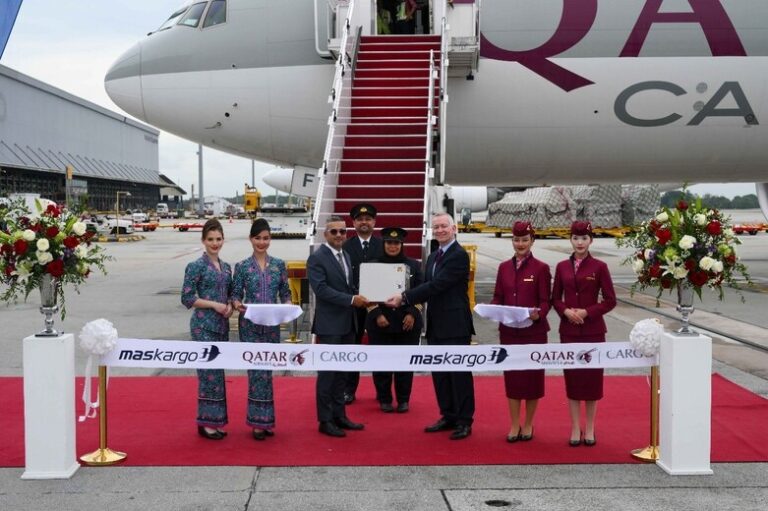
Qatar Airways Cargo and MASkargo have launched a new strategic partnership to enhance global cargo connectivity and operational efficiency. Following a Memorandum of Understanding (MoU) signed in JUL24, the partnership leverages the strengths of both airlines’ networks and fleets, expanding cargo offerings for customers. Now, since 01OCT24, the strategic collaboration, has already facilitated the movement of 2,400 tons of cargo, including 600+ tons of perishables and 130 tons of pharmaceuticals. Qatar Airways Cargo now operates Boeing 777 flights from Doha to Kuala Lumpur twice weekly, adding over 200 tons of weekly cargo capacity. MASkargo’s Airbus A330 freighters further support connectivity to Sydney and Melbourne with 75 tons of weekly capacity and a fast, 8-hour connection in Kuala Lumpur.

Celebrating the launch of a new strategic cargo partnership. Image: Lemon Queen

Strategic hubs at Hamad International Airport and Kuala Lumpur International Airport provide seamless connections and advanced handling facilities. This agreement enables MASkargo to access key markets in Europe, the GCC, Levant, and Africa, while Qatar Airways Cargo benefits from expanded reach in Australia, New Zealand, and East Asia. The partnership also bolsters Malaysia’s export market by connecting products to more global destinations.

Mark Drusch, Chief Officer Cargo at Qatar Airways Cargo, said: “As the world’s leading global air cargo carrier, this partnership with MASkargo is a testament to our commitment to providing exceptional service and tailored solutions while expanding our global network through sponsorships. By combining our strengths, we are able to offer our customers enhanced connectivity and efficiency, ensuring their products reach global markets in optimal condition. We are excited about the opportunities this collaboration brings and remain committed to setting the standard for excellence in the air cargo industry.”

Mark Jason Thomas, MASkargo Chief Executive Officer, added: “Today marks an exciting step forward for MASkargo as we join forces with Qatar Airways Cargo to create a truly interconnected global cargo network. This partnership represents a significant advancement in MASkargo’s mission to connect our customers to the world with increased speed and efficiency. With this partnership, MASkargo is now better positioned than ever to serve as a bridge between Southeast Asia and key international destinations. This alliance with Qatar Airways Cargo strengthens our infrastructure and capacity, empowering us to support the regional economy and facilitate the movement of high-demand goods to a larger global market, furthermore, setting new standards in cargo transportation.”

LCAG’s time:matters strengthens ties with Shenzhen Airport

0

Lufthansa Cargo’s subsidiary, time:matters GmbH, has solidified its partnership with Shenzhen Airport Group Co., Ltd., focusing on enhancing logistics handling services. This collaboration, centered on the growing cross-border e-commerce industry in the Guangdong-Hong Kong-Macao Greater Bay Area, is expected to meet increasing demand for air transport to Europe. 

All aboard for the MoU signing in Frankfurt, last week*. Image: Lufthansa Cargo

Since JUL24, Lufthansa Cargo has operated scheduled freighter flights between Shenzhen and Frankfurt twice a week, leveraging the logistics strengths of both hubs to serve the expanding e-commerce sector. Shenzhen Airport, a key player in the region, has experienced a notable surge in air transport volumes. 

Further strengthening the partnership, time:matters Courier Terminals GmbH signed a Memorandum of Understanding (MoU) in Frankfurt last week, with the International Cargo Centre Shenzhen (ICCS). Jointly operated by Lufthansa Cargo and Shenzhen Airport Group since 2004, ICCS has been pivotal in delivering high-performance cargo services. The MoU represents a commitment to a forward-looking relationship, enhancing logistics capabilities and reinforcing the collaboration between the two companies. This partnership highlights their shared focus on meeting the growing demands of international e-commerce logistics.

Ashwin Bhat, CEO of Lufthansa Cargo, declared: “With the International Cargo Centre Shenzhen (ICCS) having delivered high-quality cargo handling services for the past 20 years, this collaboration represents a forward-looking partnership in the logistics industry, further enabling global business.”

Wong Ching Hao Ben, General Manager of Shenzhen Airport International Cargo Terminal Co., Ltd., commented: “It’s the highlight of ICCS overall corporate development strategy, which is in line with Shenzhen Airport Group’s strategy and China’s national strategic planning of the Greater Bay Area.”

Bernhard zur Strassen, CEO of time:matters GmbH, added: “The handling services and drive for innovation of both time:matters and ICCS complement each other ideally, with time:matters offering fastest freight handling at highest process quality on routes that run via our Courier Terminals in Frankfurt (FRA) and Shanghai (PVG), amongst others. This collaboration is expected to bring mutual benefits for both parties, and further strengthen our global growth path in the logistics industry.”

*Complete list of names in photo from left to right: Lars Krosch (COO time:matters GmbH), Dong Zhengli (Deputy General Manager of Shenzhen Airport Logistics Development CO., LTD), Ying Xuemin (Chairman of Shenzhen Airport Logistics Development CO., LTD), Lin Xiaolong (General Manager of Shenzhen Airport Group), Heike Woerner (Head of Business Development LCAG), Ashwin Bhat (CEO LCAG), Bernhard zur Strassen (CEO time:matters GmbH), Jenny Peng (Senior Manager Sales & Marketing of ICCS), Wong Ching Hao Ben (General Manager of ICCS), Eric Schmandt (Director Operations time:matters Courier Terminals GmbH), Stefan Fölsing (Managing Director time:matters Courier Terminals GmbH).

VIE reports significant growth in cargo handling

0

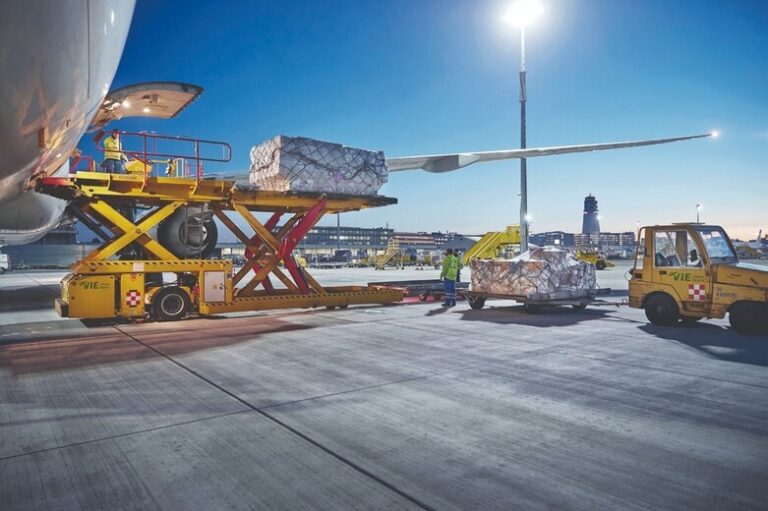
Vienna Airport continues to see strong growth in cargo operations, with 216,360 tons of cargo handled from JAN-SEP24 – an impressive 20% increase compared to the same period last year. Both flown and trucked air freight contributed to this positive trend. Belly cargo on passenger aircraft was a key driver, rising by 45% to 90,692 tons during the nine-month period. The third quarter saw particularly robust performance, with cargo volumes reaching 75,242 tons, up over 25% year-on-year. SEP24 alone recorded 18,094 tons of airfreight, marking a 25% increase compared to the same month in 2023.

Double-digit growth all the way. Image: Vienna Airport

This growth has been fueled by strong market demand for air freight and additional flight connections, boosting capacity. Recent service expansions include Qatar Airways Cargo’s weekly flights between Vienna and Doha, launched in SEP24, and the return of Hainan Airlines to Vienna in MAY24. VIE states that its continued success in cargo handling highlights its strategic importance as a logistics hub, and shows that it is meeting increasing demand and strengthening its position in the global air freight market.

Julian Jäger, joint CEO and COO of Vienna Airport, said: “Vienna Airport continues to expand its position as a central cargo hub: With our modern infrastructure and high service quality, we are creating optimal conditions for fast and efficient cargo handling. The increasing number of airlines that have chosen us as a reliable cargo location and, in particular, the 45% growth in belly freight, confirm our importance as a key logistics hub between Europe and Asia.”

Michael Zach, Senior Vice President Ground Handling & Cargo Operations of Vienna Airport, exclaimed: “It is very pleasing that we were able to record growth in SEP24 for both freight-only flights and belly freight on passenger aircraft as well as trucking. The expansion of connectivity through new flight connections and additional cargo flights demonstrates the importance of the airport as a strategic hub in the region. The strong growth shows that we can respond to the needs of international logistics in a dynamic market environment and act as a reliable partner for cargo customers.”