Home Blog Page 175

Silke navigates 1.7 million boxes across the globe

On 01APR24, Silke Lehmköster took over the role as Senior Director Fleet Management at shipping line, Hapag-Lloyd. This makes the 37-year-old manager one of the highest-ranking female executives in global shipping. Ultimately, she is responsible for the condition of the shipping company’s 258 vessels and leased units. A huge responsibility that involves a wide range of tasks.
Even as a young child, she wanted to pursue a career in seafaring, despite growing up as a diplomat’s daughter in land-locked Austria. And yet, she did just that in 2007, when she began studying industrial engineering in Bremen. Three years later, after successfully completing her studies, she started her nautical career at Hapag-Lloyd in Hamburg. Ms. Lehmköster has big shoes to fill at the shipping company. Her predecessor is Richard von Berlepsch, a logistics veteran and icon of the maritime world.

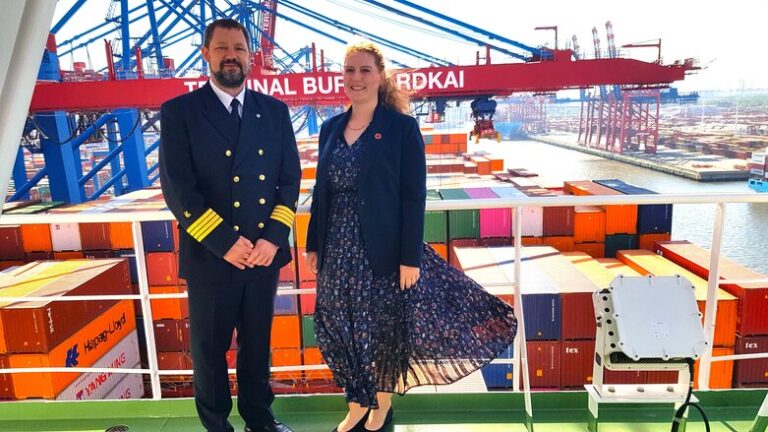
Silke Lehmköster and Berlin Express captain Alexander Meier on board Hapag-Lloyd’s huge boxship  –  photo CFG/hs

New approaches

What will she do differently to her famous predecessor? She was asked at a press event held on board the giant Berlin Express, the 399-meter-long flagship of the Hapag-Lloyd fleet. Like its three sister ships, it can transport up to 23,664 teu per trip. “My colleague, Mr. von Berlepsch, got to know the maritime shipping world in different times than I did. Formerly, a vessel used to be a self-contained world. In contrast, today, all processes are transparent thanks to advanced digitalization, even if the captain is still in charge, of course.” In the case of her employer, this means that all crew members can use Starlink’s satellite internet to get in touch with relatives, friends or other people when desired or needed. “This increases the well-being of the seafarers on board,” says Maximilian Rothkopf, COO of the shipping company.
Enabling access to this kind of communication channel also creates new tasks for fleet management. The same applies to sustainability, says Silke Lehmköster: “Environmental aspects such as the reduction of greenhouse gas emissions are much more important than they used to be; after all, Hapag-Lloyd’s goal is to achieve net zero by 2045. Coordinating and harmonizing these various aspects of our overarching Hapag-Lloyd strategy is part of my remit,” she explains.
Her range of tasks also include retrofitting older container ships which have to be equipped with modern technology in order to comply with the stricter statutory environmental regulations if they are to continue to be used.

Diversity strategy

Although she obtained her captain’s license in 2018, and was also in command of an Hapag-Lloyd ship, her new navigation bridge is a room in Hapag-Lloyd’s Hamburg headquarters, with a view of a nearby lake, but not the ocean. Next week, she will welcome the newbuilt Singapore Express, a 23,664 teu sister ship of the Berlin Express, the fifth of this class operated by Hapag-Lloyd.
Silke Lehmköster’s appointment as fleet director is part of the Hapag-Lloyd diversity strategy. She joins Donya-Florence Amer, who was appointed Chief Information Officer (CIO) of the shipping company on 01FEB22. And since 01MAY24, Stefanie Confurius has become Head of Global Human Resources. Three women in three important management positions: Hapag-Lloyd is becoming more female.
Shortly before introducing Mrs. Lehmköster to the media, the Executive Board of Hapag-Lloyd invited the press to join a Teams Call entitled: ‘The Red Sea Crisis – Will the Suez Canal become dispensable’?

Maritime supply chains have overcome the Houthi shock

The unanimous opinion of the experts was that the Suez Canal will not become superfluous, despite the onset of habituation effects. Their names: Alan Murphy, Founder and Head of Sea Intelligence, Singapore, Rolf Habben Jansen, CEO Hapag-Lloyd, Hamburg, and Thorsten Meincke, Board Member Air & Ocean Freight, DB Schenker, Hamburg.
The experts confirmed that, following a short period of uncertainties, the maritime supply chains between East Asia and Europe around Africa are now very stable, However, maritime transports on this trade lane have become more expensive due to higher fuel burn and additional sailing time of between one week and ten days. “The safety of our crews is a priority. Passing through the Red Sea and possibly being shelled by the Houthi regime is not an option for us,” emphasized Hapag-Lloyd CEO, Rolf Habben Jansen.

When will the Red Sea nightmare end?

As a side effect of the longer voyages, there is a shortage of containers because the rotation of steel boxes takes between 2 to 4 weeks longer compared to passages through the Suez Canal. DB Schenker executive, Thorsten Meincke, pointed out that India is suffering most because the trade lanes have shifted further south due to the circumnavigation of Africa, with container ships largely bypassing the Subcontinent.
Touching decarbonization, Rolf Habben Jansen said that the problem is the ongoing shortage of green fuels. DB Schenker executive, Meincke, announced that Schenker had just signed a first shipping contract with a major customer based on biofuel – “for the company’s entire transport volume”, he added without revealing his client’s name. Alan Murphy of Sea Intelligence believes that it is possible to charge higher rates for goods transported using biofuel. There are clear indicators that the market is ripe for this, he emphasized. Finally, when asked how long the Red Sea Crisis will last, opinions differed. While Murphy expects a longer-lasting phase, Meincke and Habben Jansen were somewhat more optimistic. “I believe that the Red Sea crisis will be over before December 2024,” said the Hapag-Lloyd boss, committing to a specific date.
Swiss WorldCargo faces change of leadership

At Swiss WorldCargo, the cargo division of Swiss Air Lines, the search for a successor to Head of Cargo, Lorenzo Stoll, has begun. A few days ago, the executive announced his intention to leave the airline at the end of July 2024, after a total of 11 years with the company. He will take on a management position in the healthcare sector.

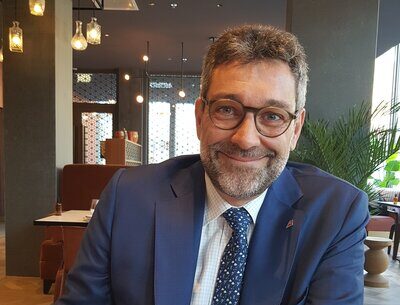
Lorenzo Stoll decided to take on a new role outside aviation – photo: CFG/hs

Innovative product structure

As Stoll will remain in charge of the Cargo division for another three months, it is a bit premature to pay tribute to his three years as Head of Cargo. However, one innovation that was introduced under his leadership and rolled out worldwide can already be highlighted: the modular product structure introduced on 01JUL23, providing cargo customers with more flexibility and tailored booking opportunities. The commodity-focused service offers the market a broad range of targeted solutions that cater to individual needs.
“From high-value goods to temperature-sensitive shipments and everything in between, we handle every commodity with expert care and precision. At Swiss WorldCargo, we extend the same level of quality and dedication to all types of shipments, ensuring excellence across our entire product portfolio. I’m very excited about our new offer structure, as I believe that it will bring added value to our customers thanks to the enhanced customization opportunities that come with it,” stated Mr. Stoll when introducing the flexible product structure in mid-2023.

Market expansion

This multiple-choice process of product decision-making will always be associated with Stoll’s name even after his planned departure from the company. This also applies to network expansions. Destinations such as Denver, Manchester, Bogotá, Washington D.C., Seoul, and Toronto were added to the flight schedule during his term, complementing the global network and opening up new markets for the carrier’s freight business.
Under Lorenzo’s reign, the division’s sustainability efforts were driven forward. This includes investments in SAF, a master lease agreement signed by Sonoco ThermoSafe and Swiss World Cargo for the deployment of a temp-controlled bulk shipping container, and the introduction of a lightweight active container. The latter is the result of a pact signed by the carrier’s cargo division, Swiss Airtainer and B.P.L. – Biotech & Pharma Logistics.

Treating the media as partners, not enemies

From a media standpoint, it should be mentioned that the executive is known for his open, collaborative, and professional approach to journalists. Internally, he is valued for his authentic and transparent style of communication and his effort to put Cargo in the spotlight, for instance at trade shows or industry events, a leading member of the Cargo team told CargoForwarder Global.
Especially at the beginning of his time as Head of Cargo, he benefited from the foundations laid by his predecessor, Ashwin Bhat, together with the entire staff. This proved to be particularly robust and flexible during the Covid pandemic. After the outbreak of Covid-19, the team hit the ground running, acted fast and got into crisis management mode in just a few weeks. In fact, cargo demand was high and the division’s response to market needs was fast.

Collective effort

The passenger seats of some of the B777-300ER passenger jetliners were removed so that hygienic materials, vaccines, face masks and other protective items could be accommodated in the cabins of the aircraft, in addition to the lower deck compartment. These flights were operated under unique and challenging circumstances. It was a collective effort by the entire staff of Swiss WorldCargo, even though the overall responsibility lay on the shoulders of helmsman, Ashwin Bhat. Ashwin’s legacy was driven forward when Lorenzo Stoll joined the Cargo division in 2021, leading it out of crisis mode step by step, and achieving the highest contribution ever to Swiss in the company’s records since its founding on 31MAR2002.

Dubai to build Airport of the Future by 2050

A vision of the aerotropolis. Image: Government of Dubai

It used to be countries outdoing each other by building the highest skyscrapers. Dubai has already done that, and the stakes have now been moved to having the largest airport. When you have the space (80% of the Emirate is desert), and the cash – AED 128 billion [EUR 32 billion], you’re already ahead of the game. Last week, Sheikh Mohammed bin Rashid Al Maktoum, Vice President and Prime Minister of the UAE and Ruler of Dubai, approved the Dubai Aviation Engineering Projects’ designs for the new passenger terminal at Al Maktoum International Airport. The Airport of the Future is set to become the largest in the world once it is fully operational. It will be able to handle an annual passenger capacity of 260 million, but more interesting for CargoForwarder Global readers is the fact that more than 12 million tons of cargo are the planned handling capability. The airport will eventually cover an area of 70 km², and is being designed with the projected growth for the next 40 years in mind. The first phase should be completed within the next 10 years.

Sheikh Mohammed said: “Al Maktoum International Airport will […] be five times the size of the current Dubai International Airport, and all operations at Dubai International Airport will be transferred to it in the coming years. The airport will accommodate 400 aircraft gates and feature five parallel runways. New aviation technologies will be employed for the first time in the aviation sector. As we build an entire city around the airport in Dubai South, demand for housing for a million people will follow. It will host the world’s leading companies in the logistics and air transport sectors. […] Dubai will be the world’s airport, its port, its urban hub, and its new global center.”

Sheikh Ahmed bin Saeed added: “It is expected that the first phase of the project will be ready within a period of 10 years, with a capacity to accommodate 150 million passengers annually. […] While embracing sustainability, Al Maktoum International will strongly contribute to mitigate environmental emissions, aligning with the UAE’s vision for a sustainably built environment. Its integrated approach is targeted to leverage local resources and climatic conditions achieving exemplary efficiency targets and sustainability goals. AMI aims to achieve a LEED Gold Certification.” There is, however, no mention of SAF in the official communication to date.

Happy 20th Birthday, Jettainer

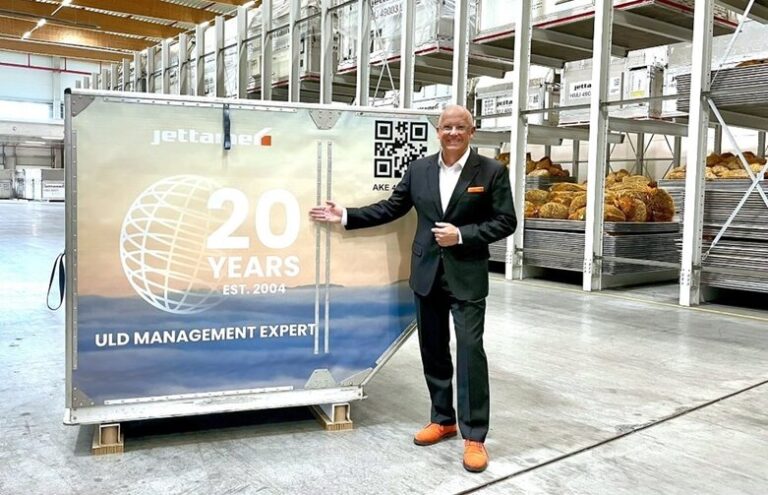
20 years of boxed success. Congratulations to Thomas Sonntag and his team – image: Jettainer

27APR04 saw the creation of a Joint Venture between Lufthansa Cargo and TrenStar Inc. Operations began near Frankfurt Airport, with a ULD fleet of roughly 27,000 units. Two years later, Jettainer became a fully owned Lufthansa Cargo subsidiary. Today, Jettainer’s ULD fleet has grown to a six-digit figure, and it manages containers for “some of the largest and most reputable airlines” out of over 500 international locations, and operating at 15 major hubs in Asia, the Middle East, Europe, and the Americas. The latter saw the founding of Jettainer Americas Inc. in 2014 – a subsidiary serving customers in North, Central and South America, with teams in Dallas, Chicago, Miami, New York, Philadelphia, and Los Angeles. In 2017, an expert team and a Temperature Control Competence Center were inaugurated in Abu Dhabi for the global management of temperature-controlled containers. Last year, the company restructured, placing dedicated General Managers in key locations across the Middle East, Africa, the Indian Subcontinent, Europe and Asia, responsible for ensuring operational efficiency and customer relationship management. Innovations include in-house IT solutions, JettWare and JettApp – “the industry’s first ULD management app,” – which streamline ULD management for Jettainer and its customers. Sustainability, too, plays a large role: Jettainer designs ever-lighter ULDs (and pallet nets and Squair timber alternatives), significantly reducing their tare weight. The first lightweight container was launched in 2009. In 2019, ‘skypooling’ was launched – a ULD sharing platform to solve the problem of over- and understock.

Thomas Sonntag, CEO of Jettainer, said: “Over the past two decades, Jettainer has transformed from a modest operator into a leader in the industry, we extend our gratitude to our customers, partners, and employees for their unwavering support and dedication. This milestone underscores the exceptional quality of our services and the innovative strength of our team. […] We selectively focus on digitalization that has a tangible impact, ensuring that they deliver real value to our customers. [Innovations such as] tracking sensors that indicate that Bluetooth Low Energy (BLE) might only be a bridging technology. APIs are one solution to smartly work with data to enhance service value and operational efficiency. We already have several interfaces in operation with our customers and partners. Adopting the IATA ONE Record standard for all areas of ULD management is a pivotal next step that Jettainer is preparing to undertake. We remain committed to further shaping the future of air transport logistics with our forward-thinking solutions.”

Kales seeks CEIV Pharma certification

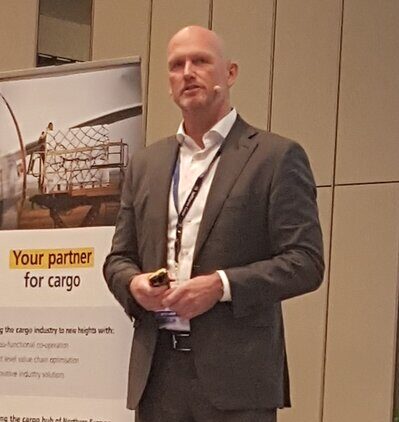
Being the first GSSA to be CEIV Pharma certified makes Kales’ Chief Sebastiaan Scholte feel proud – photo: CFG/hs

Once certified, Kales will be the first GSSA worldwide to achieve this special recognition by the International Air Transport Association (IATA) following a two-year phase in which all pharma processes are monitored, documented, and thoroughly checked.  

The CEIV Pharma program is a trusted mark of quality and excellence in the handling of time and temperature critical pharmaceuticals, meanwhile achieved by many companies around the globe, including airlines, airports, ground handling service providers and freight forwarders. It is proof that the certified companies maintain product integrity.

“We are pleased to welcome Kales Airline Services on being the first General Sales and Service Agent (GSSA) to embark on the CEIV Pharma certification,” states IATA in a release.

“GSSA play an important role in representing airlines mainly in terms to commercialize air freight capacity, to supervise complex local operations and administration services. Kales’ commitment to improving quality and services across their operations through CEIV Pharma sets a positive example for the industry and demonstrates their strong commitment to excellence. We look forward to supporting Kales as they start their journey towards achieving CEIV Pharma Certification.” Sebastiaan Scholte, CEO Kales Airline Services replied: “I am proud that we will be the first GSSA to be CEIV Pharma certified. GSSA’s play a very crucial role in the air cargo supply chain. We are very pleased to have this important certification for pharmaceutical shipments to even better serve our airline, forwarding and shipper’s customers.”

Singapore Airlines joins WebCargo

Boeing 777-300ER of Singapore Airlines  –  courtesy: SIA

Singapore Airlines is that latest airline to publish its cargo capacity on WebCargo by Freightos, thus expanding booking options in and across Asia and WebCargo’s Asian footprint at the same time. Asia is a fast-growing market. WebCargo saw more than twice as many bookings from Asia origins between Q4 2022 and Q4 2023, and more and more users are coming to the platform as digitalization incases in the region. With a significant carrier such as Singapore Airlines, this trend will accelerate. Singapore Airlines operates a fleet of seven Boeing 747-400F freighters and more than 190 Singapore Airlines and Scoot passenger aircraft. Over 120 destinations are on offer at real-time rates for real-time air cargo bookings. Top Asia-Pacific destinations are Singapore, Hong Kong, Australia, Indonesia, Thailand and Vietnam.

Marvin Tan, Senior Vice President Cargo, Singapore Airlines, commented: “Singapore Airlines’ partnership with WebCargo expands our reach to new markets, and provides our customers with a seamless user experience when they search, book, and track their shipments in real time. This enables us to better serve our customers by responding even more swiftly to their evolving needs.”

Manel Galindo, Chief Revenue Officer of Freightos, state: “We’re thrilled to work with Singapore Airlines.  Their commitment to digital innovation aligns perfectly with WebCargo’s mission to provide seamless and efficient booking solutions for the air cargo industry and allows us to double down on the recent surge in bookings from Asia. This collaboration will enhance the booking experience for thousands of freight forwarders and will ultimately make world trade smoother.”

GW goes Greenland Project

Still miles to go – image: Gebrüder Weiss

It is not the first time that Gebrüder Weiss supports an out-of-this-world type project. There have been others such as the Mars Analog Mission AMADEE-24 of the Austrian Space Forum (OeWF) where Gebrüder Weiss transported equipment to Armenia, for example. This time around, it is “The Greenland Project” climate expedition, and Gebrüder Weiss is poised to keep interested parties updated via its social media channels over the coming months. The logistics package envisages Gebrüder Weiss transporting the equipment for a month-long scientific expedition in Greenland, aimed at learning new insights as to why the Greenland glacier is melting. “The results of the expedition, which will be analyzed in more detail at the University of Sunshine Coast in Australia, hold global significance. They will be shared with researchers from all over the world, contributing to our collective understanding of climate change. The aim of the month-long expedition is to gain valuable insights into the connections between the temperature fluctuations in Greenland in recent decades and the further effects on the global climate,” the release states. As one of the world’s largest ice regions, Greenland is the obvious favorite when it comes to researching climate change. Should kick-off in Croydon on 30APR24. Two scientists, a medical doctor, and a photographer are lined up for the funeral.  The team will cover a around 600 kilometers (373 miles) on skis, each with a sled in tow.

Wolfram Senger-Weiss, CEO of Gebrüder Weiss, said: “As one of the world’s leading logistics service providers, we also see it as our duty to support selected research initiatives such as the Greenland Project. The purpose of the expedition is to gain insights into climate change that will help us make smart decisions for our future.”

Niklas Marc Heinecke, photographer, and co-founder of ‘The Greenland Project,’, stressed: “As our research essentially focuses on the climate and glacier melt, we feel it is important for it to be as climate neutral as possible. Conducting an expedition on foot into this fragile ecosystem enables the measurements to be taken in a much more environmentally friendly way than would be possible by helicopter, and with a greater degree of accuracy than would be possible by satellite. We can rely on dependable equipment in this inhospitable environment thanks to the support of Gebrüder Weiss.”

ECS Group to benefit from Rotate’s live capacity data

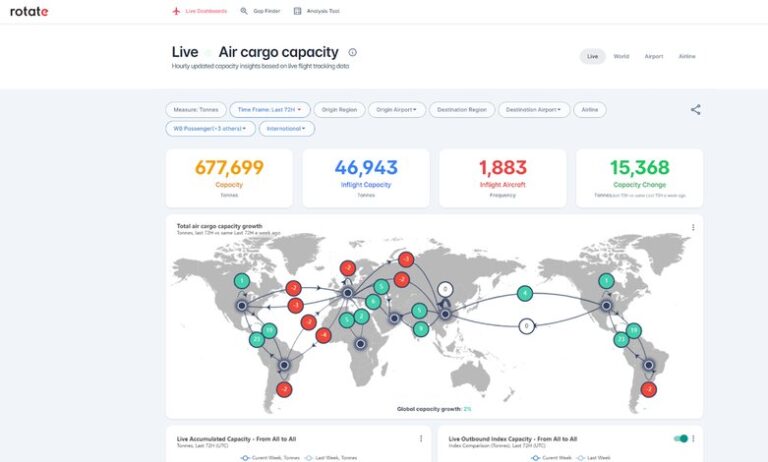
A full picture at a glance. Image: Rotate

ECS Group has opted for Rotate’s Live Capacity data product to ensure it benefits fully from its strategic growth potential, and that it maintains its position as leading GSSA. “Rotate’s Live Capacity provides real-time data on market trends and capacity fluctuations enabling quick adaptation to changing conditions in a highly competitive air cargo market,” the release explains. The real-time capacity data and market insights are fed into ECS Group’s own in-house business intelligence system, Apollo. The result is useful data the enables users to spot new interline partnerships, optimize airline customers’ networks, and react quickly to market changes dynamics in terms of pricing strategy.

Strategic Growth and Technological Innovation were the two main objectives behind ECS Group’s decision to partner with Rotate, and Rotate delivers the insights to achieve these. For example, it provides: real-time capacity monitoring, dynamic route optimization for freighters, an interactive dashboard, and alerts and notifications regarding capacity changes. ECS Group can use the information to capitalize on emerging opportunities, adjust pricing strategies, and proactively mitigate risks.

Cédric Millet, Chief Strategy and Digital Officer of ECS Group, underlined: “When tendering for digital innovation, only the best pass the test. In Rotate, we simply found the best-in-class capacity data product on the market. Real-time data is crucial for our Market Intelligence System as it enables responsiveness to market changes. Our teams can thus take better, proactive, and informed decisions in terms of pricing or interline opportunities, for example, leading to improved revenue optimization of the capacity we manage on behalf of our airline customers. And for ECS, that ultimately results in higher customer satisfaction and long-term business growth.”

Ryan Keyrouse, Chief Executive Officer of Rotate, stated: “The air cargo industry is fast-moving and the need for up-to-date information in today’s market is critical. High-quality and real-time insights into every market in the world, allow ECS to respond quickly to changing market conditions. Our partnership with ECS Group, with its highly innovative mindset and clear digitalization strategy, will allow us to further improve our products and meet the needs of the industry. We have a strong focus on integration and user adoption and are therefore working with ECS users to construct use-cases based on real-time data that will help them with their daily decisions. We look forward to building a long-term and valuable partnership with ECS.”

Qatar Airways and UNHCR continue their partnership

UN High Commissioner, Filippo Grandi (left) and Qatar Airways Group CEO, Engr. Badr Mohammed Al-Meer, ink pact – courtesy QR.

Just days after inviting pres and customers to see the new Animal Center in Doha, Qatar Airways announced that it has renewed its partnership with the UN Refugee Agency (UNHCR) and supports communities in need. The agreement signing ceremony was attended by Qatar Airways Group Chief Executive Officer, Engr. Badr Mohammed Al-Meer, (who gave a speech), and the UN High Commissioner for Refugees, Mr. Filippo Grandi, alongside the UNHCR’s Representative to the State of Qatar, Mr. Ahmed Mohsen, and Qatar Airways, Chief Cargo Officer, Mr. Mark Drusch. The two have agreed an extension of another two years, taking the partnership through to 2025. The agreement supports the shipment of relief items to the most vulnerable refugees and internally displaced people worldwide. Already over the past two years, Qatar Airways Cargo collaborated closely with UNHCR, helping to get humanitarian aid to where it is most needed. The new partnership agreement foresees Qatar Airways providing 400 tons of free tonnage to UNHCR, helping those in need in through the distribution of crucial aid supplies. The airlines 28 freighters are on standby. “By working with Qatar Airways, UNHCR has wide access to deliver life-saving support including water, medical care and hygiene materials to keep refugees, internally displaced people, and host community members safe around the world,” the release states.

Qatar Airways Group Chief Executive Officer, Engr. Badr Mohammed Al-Meer, stated: “We are proud of what we have accomplished through our relationship with UNHCR over the past four years, which has helped support displaced communities around the world. We look forward to the significant renewal of our partnership and in continuing to aid those who are most vulnerable. Qatar Airways Group is committed to fulfilling its humanitarian role by helping refugees and internally displaced people worldwide.”

Ahmed Mohsen, UNHCR’s Representative to the State of Qatar, said: “We highly appreciate this vital partnership and are proud to renew it for two additional years, which reflects Qatar Airways’ solid commitment towards supporting our humanitarian efforts, in terms of delivering essential relief items to those most in need. Since establishing our partnership with Qatar Airways in May 2020, amid a critical time during the emergence of Covid-19, Qatar Airways has lent us a helping hand to support refugees and displaced communities with vital relief items and medical supplies.”

Spotlight on… Janina Meininger, Business Development Manager at CHI Deutschland Cargo Handling.

0

Welcome Back to CargoForwarder Global’s ‘Spotlight On…’ Series: Exploring the Appeal of the Air Cargo Industry Through Stories of Young Talent. Today, we’re talking to Janina Meininger, Business Development Manager at CHI Deutschland Cargo Handling.

Janina Meininger: “a broad network is crucial in our industry.” – Photo: private

CFG: What brought you to the air cargo industry? How did you discover it?

JM: I´ve always had a passion for aviation and entered the aviation industry in 2016 when I started the dual study program B.A. Aviation Management in cooperation with Fraport AG at Frankfurt Airport. Besides my experiences in general aviation, my perception of air cargo was quite limited. It was during my time at Frankfurt Airport that I developed an interest for the air cargo industry and therefore did my masters degree in Global Logistics. During my studies I had the opportunity to connect with the right individuals, paving the way to my current role as Business Development Manager at CHI Group.

CFG: Why would you recommend others to join?

JM: From my experience, our industry offers the opportunity to work in an international environment and to benefit from the diversity of a multicultural workplace. Additionally, the air cargo industry is known for its fast-paced work environment, which presents ongoing new challenges and ensures that things never get dull. Given that many companies in our industry have a global presence, it also enables international rotation programs for those who are passionate about travelling.

CFG: What strategies do you propose for raising the awareness of our industry and to make it more attractive to individuals with no prior experience in Air Cargo?

JM: Given the nature of the air cargo industry being mostly invisible when it comes to attracting new talent, I believe there are several actions that individual organizations can take to enhance their attractiveness and visibility. Firstly, companies may establish partnerships with educational institutions such as universities, colleges, and vocational schools in form of specialized programs, internships, and workshops. Moreover, highlighting the company’s range of career opportunities empowers candidates to find positions that align perfectly with their skills and interests. Additionally, offering rotation programs and traineeships allows young talents to gain practical experience across various areas of the company. Lastly, companies may offer competitive benefits and perks such as opportunities to work internationally, gain experience in different countries, flight benefits, and international mobility programs. These offerings can motivate to choose the air cargo industry and foster long-term commitment among employees.

CFG: What strategies do you propose for integrating individuals with no prior experience in Air Cargo?

JM: In my opinion, Training, Traineeships and Networking are effective strategies to integrate individuals with no prior experience into the air cargo industry. Training is crucial to give insights into specific processes, so called “basic cargo trainings” can help to provide orientation within the industry by teaching the basics of the industry. Traineeships enable young people to explore different facets of the respective company and to find the right department for themselves, while also gaining an understanding of basic processes and ideas. A positive example how networking can help to integrate individuals with no prior experience in Air Cargo is the initiative of the Air Cargo Community Frankfurt e.V. with their YACE initiative. YACE (Young Air Cargo Executives) supports young individuals in navigating the complex world of air cargo and in connecting with like-minded peers from other air cargo companies.

CFG: What are the most important skills needed in air cargo?

JM: I believe that flexibility is a critical requisite in our industry, given that air cargo operations operate around the clock and extend the typical nine to five workday. Furthermore, knowledge in multiple languages is relevant, as our operations involve collaboration with colleagues and stakeholders from all around the world. Additionally, the ability to adapt to the fast-paced environment of our industry is crucial. As already noted, our industry is dynamic and frequently presenting new challenges that require quick adaptation and problem-solving skills.

CFG: Where do you find support doing your job? Any training / networking / mentoring you would recommend?

JM: At CHI Group, I am fortunate to work closely with the senior management of which some view themselves as mentors and dedicate lots of time to my development and support me in my career path. This commitment greatly motivates me to excel daily. Additionally, networking events provide an opportunity for me to engage with like-minded people and broaden my connections. In my opinion a broad network is crucial in our industry, as most challenges necessitate the collaboration of different stakeholders.

CFG: What do you do, when you’re not working in air cargo?

JM: One passion of mine is traveling, which allows me to experience adventures and explore new cultures, people and landscapes. I particularly enjoy international cuisine, to always try new things and challenge my taste buds. Additionally, I do really enjoy cycling in my everyday life to clear my mind after a hectic day.

CFG: Janina, thank you for your time and the input.