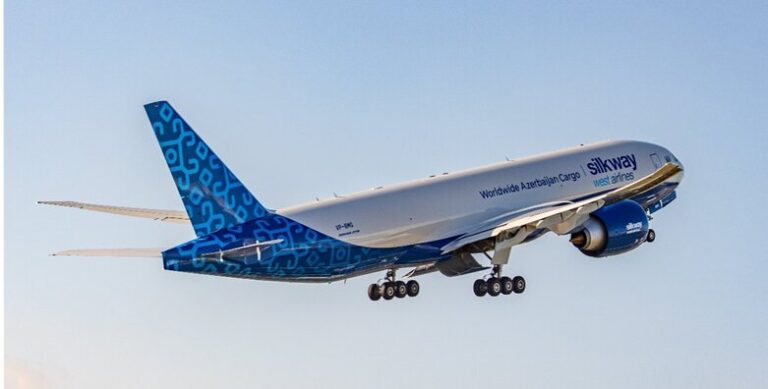
You can never have enough of a good thing, particularly if it is modern and eco-friendly. Silk Way West Airlines has thus recently amended its purchase order with Boeing and added yet another Boeing 777 Freighter to its fleet renewal shopping list. The original contract, signed in APR21, included five Boeing 777 freighters, of which two have already been delivered to the airline. The new addition will be delivered in 2025, and the remaining three will come into the fleet by 2027. “With its advanced technology the Boeing 777 Freighter is renowned for its environmental performance, offering reduced emissions and lower fuel consumption compared to other freighter aircraft. This plane is equipped with innovative features and technologies that enhance operational efficiency whilst reducing environmental impact. From its lightweight composite materials to its advanced aerodynamics, the Boeing 777 Freighter sets new standards for sustainability in air cargo transportation,” the release proclaims.
And another, makes 6… Image: Silk Way West Airlines
Zaur Akhundov, President of Silk Way Group, declared: “At Silk Way West Airlines, we are committed to sustainability and reducing our environmental impact. The purchase of this additional Boeing 777 Freighter aircraft is a testament to our ongoing efforts to operate responsibly and minimize our carbon footprint. We are proud to partner with Boeing to further renew our fleet and contribute to a greener future for the aviation industry.” Paul Righi, Boeing Vice President of Commercial Sales and Marketing for Eurasia, said: “The unmatched capacity, range and efficiency of the Boeing 777 Freighter will help Silk Way West Airlines expand its world-class cargo operations. As the airline continues to build its modern freighter fleet, we are proud to be a part of the journey and provide Silk Way West Airlines with the best solutions to support its future growth.”
Ryan Keyrouse appointed new CEO of Rotate. Image: Rotate
The rotation at the air cargo software and strategy consulting company took place the start of this month. With effect 01MAR24, co-founder Ryan Keyrouse became CEO of Rotate and its other co-Founder, Gert-Jan Jansen stepped down from the post. Jansen remains on the board in the function of Executive Director and Senior Advisor for client engagements. Ryan Keyrouse has more than 20 years of experience in air cargo, with over 50 air cargo strategy consulting projects across 30 countries under his belt. He worked for Boeing and KPMG before joining Seabury Cargo as its Managing Director in 2010. In JUN22, Ryan Keyrouse and Gert-Jan Jansen co-founded Rotate, stating their “mission to ‘turn data into action’ by developing and providing software products, strategy consulting and market data designed to empowering airlines, airports, and other air cargo companies in their commercial decision making.” Today, the company is active on two continents and employs 35 professionals.
Gert-Jan Jansen explained: “We always envisioned a seamless transition in leadership when the time was right. With the remarkable growth we’ve experienced in just 18 months, thanks to Ryan and the larger leadership team, the time for this change is now. As co-founder, I remain committed to contributing to Rotate’s continued success and am excited about the future we’re shaping together.”
Ryan Keyrouse commented: “Over the last two years, Rotate has established a robust foundation. The focus was on building the strongest team in air cargo for building data and software products, and expanding our capabilities with strategy consulting. Our products have garnered significant interest among our expanding customer base. Our focus now is on execution and ongoing innovation in collaboration with our partners – both those in industry and the other members of CargoTech.” [CargoTech is a body of air cargo digital specialists committed to providing innovative solutions to drive digitalization within the air cargo industry. BG.]
Silk Way West Airlines joins the UN Global Compact Initiative. Image: Silk Way West Airlines
The Azerbaijani cargo carrier, Silk Way West Airlines, announced on 12MAR24, that it has joined the UN Global Compact Initiative. The voluntary pact was launched in 2000 to encourage and support international businesses in adopting sustainable and socially responsible policies and providing transparency on their progress. The airline’s press release illustrates: “As part of its commitment to the UN Global Compact, Silk Way West Airlines pledges to integrate the principles of sustainable development into its core operations, aspiring to contribute meaningfully to the United Nations’ Sustainable Development Goals as part of the broader 2030 Agenda for Sustainable Development. The airline is set to leverage its industry acumen to foster advancements in sustainable aviation, recognizing its critical role in promoting sustainable development globally.”
Silk Way West Airlines has stated that it will now embark on a transformative journey, aligning its operations and strategic decisions with the moral and ethical framework of the United Nations, and making use of the knowledge and potential collaborations with the broad range of industry and sector representatives involved in the initiative.
“Such partnerships are aimed at driving collective action towards common sustainability objectives,” it says, detailing: “the airline will gain unparalleled access to a suite of corporate sustainability tools and resources, and is now poised to refine its approach to environmental conservation, social responsibility, and ethical governance.”
Wolfgang Meier, President of Silk Way West Airlines, said: “Adherence to the principles of the UN Global Compact offers a standardized framework for our corporate responsibility. It paves the way for the airline to systematically approach, implement, and communicate its sustainability strategy, ensuring alignment with universal benchmarks and best practices.”
Pathfinder offers tracking transparency to customers. Image: Lemon Queen
ECS Group’s Pathfinder, a web-based track and trace solution developed in-house by its Cargo Digital Factory in AUG19, has now been made available as a separate software service option for interested airline customers whether or not they already have an ECS Group GSSA contract. Pathfinder has been continuously developed and now includes features such as in-flight geolocation (map view) and notifications to customers. Corsair is the first of the airlines to make use of Pathfinder’s comprehensive tracking solution and is thus in a position to provide its customers with total, real-time shipment status transparency. A decision, the airline says has not only enabled more efficient internal processes with regard to resources and costs, but also resulted in improved customer satisfaction and greater confidence.
Jean Ceccaldi, Managing Director of AeroCargo by ECS Group, explained: “This is the first time we are implementing Pathfinder as an add-on option to our GSSA contract, and not only as part of the TCM package. We are proud that one of our oldest, and certainly among the most consistent customers can now enjoy the full benefit of our best-in-class tracking solution. We have been the exclusive GSSA for Corsair since 1986, and that is an exceptional record within ECS Group. Long may it continue.”
Adrien Chauvière, Cargo Manager at Corsair, detailed: “The need for complete shipment journey visibility has skyrocketed in importance in recent years. Our customers want to know where their shipments are at any given time and expect us to deliver at least the same standard of information that they are used to when privately ordering goods online. The situation in the air cargo industry is still very fragmented and until we switched to Pathfinder, much of our tracking process was carried out by phone or email. The process was largely manual, time-consuming, and far from seamless, let alone capable of providing real-time information. Of all the possible alternatives on the market, Pathfinder stood out as the best option with the best design. It lives up to the excellent software quality we are used to from ECS Group’s Cargo Digital Factory solution suite. All Corsair destinations – including our trucking-only locations – are uploaded in the system. Pathfinder has proven to be an additional element of confidence for our customers and has greatly increased customer satisfaction.”
11 dnata stations are now IATA CEIV Lith Batt certified. Image: dnata
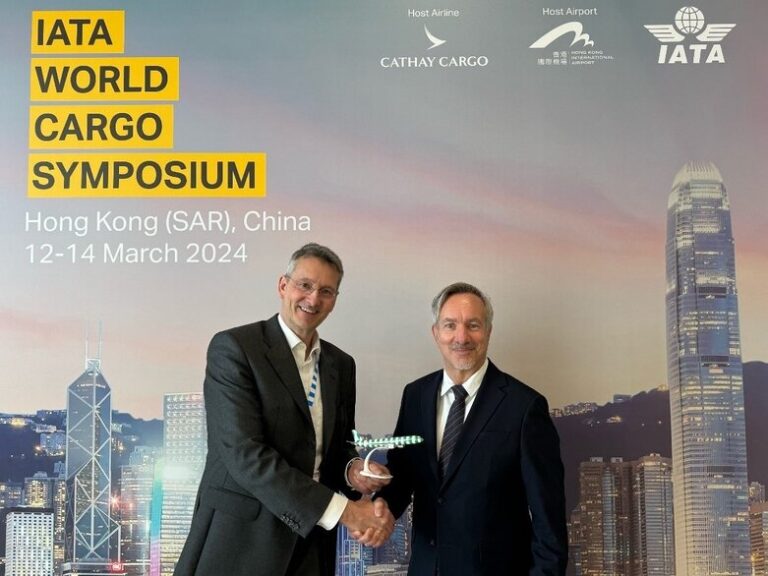
A handful of airlines are already IATA CEIV Lithium Battery certified. Now dnata has become the first ground services provider to join them in certification. dnata was handed the official certificate for 11 of its international stations at the World Cargo Symposium in Hong Kong on 12MAR24. The entire validation process was completed in less than a year, despite the rigorous audit system. 11 stations took part, with those in Australia and Pakistan becoming the first to complete the assessment phase. Singapore, Belgium, the UK, and the UAE followed shortly afterwards – all of them celebrating premieres, since no other ground services provider has yet certified its operations. The IATA CEIV validation is a visible stamp that tells customers of dnata’s dedication to the highest safety standards and regulations throughout its operations when it comes to handling potentially hazardous materials. It has also invested heavily in training and process improvements in the handling of dangerous goods.
This is not the first time that dnata has led the way among its peers when it comes to Dangerous Goods handling. It was the first global air services provider to adopt IATA’s Dangerous Goods Autocheck (DG Autocheck) platform for the acceptance of dangerous goods shipments, in 2021 and two years later, in DEC23, it was further accredited with IATA’s Corporate Certification for competency-based training and assessment (CBTA) for Dangerous Goods.
Guillaume Crozier, Senior Vice President, UAE Cargo and Global Cargo Strategy at dnata, commented: “We are pleased to achieve IATA’s CEIV Lithium Battery accreditation, a testament to our commitment to safety and compliance. This recognition underscores our ongoing efforts to maintain the highest standards in the handling of dangerous goods, ensuring the safety of our operations and the satisfaction of our customers.”
Brendan Sullivan, IATA’s Global Head of Cargo, said: “The volume of air shipments containing lithium batteries is rising. Ensuring these items are transported safely and efficiently is a top priority for the industry. Key to this is complying with regulatory changes and the integration of best practices in lithium battery handling across the supply chain. This is why CEIV Lithium Batteries was established.We commend dnata for being the first Ground Handling Agent to achieve CEIV lithium battery certification across its network of 11 hubs. This accomplishment not only benefits dnata’s customers by guaranteeing their shipments are handled with utmost efficiency and safety, but also sets a quality benchmark for the industry.”
Thilo Schäfer (left), Condor, and Martin Kraemer, DoKaSch are all smiles. Image: DoKaSch
When it comes to passenger aircraft, catering is cargo, too. At least on those routes where the destination may not be able to offer flight catering or not to the required standard. Those destinations call for an oversize lunch box. And that now comes in the shape of a very special ULD, developed by German ULD specialist, DoKaSch. The introduction and launch of that special container, which is an AKE LD3, was announced at the World Cargo Symposium in Hong Kong on 12MAR24.
Launch customer, German leisure carrier Condor, which was involved in its design, is the first to benefit from the “DoKaSch Cater Cage”, as the ULD is called. Up to 12 half size trolleys or a mix of half- and full-size trolleys, along with additional catering boxes and oven racks can be stored in the catering ULD. The release stipulates that the ULD “may be individually customized to the specific requirements of each airline. Trolleys are well secured so the catering items inside are kept in place securely.” The new ULD gives the flexibility to offer catering on flights to/from destinations where the airline may not have a contracted airline partner, or only flies seasonally, or where local caterers are not up to par. It ensures that fresh food is kept fresh and fit for purpose on the return journey.
Martin Kraemer, Vice President Sales & Marketing at DoKaSch, said: “Our catering ULD is a perfect solution to ensure all components for the return-catering are kept nicely in place. Beside food items, also dry goods, pillows, blankets or magazines can all be stowed in the ULD. This ensures a perfect passenger experience on the return flight.”
Nicola Burger, Head of Catering at Condor, described the collaboration: “Together with DoKaSch, we were able to customize the ULDs to fit Condor’s needs. This allows us to securely and flexibly store trolleys and meal containers, ensuring that our high-quality products and accompanying onboard equipment can be safely unloaded at the destination. This saves time and simplifies the logistics process.”
Thilo Schaefer, Head of Cargo, added: “Once again, the collaborative effort between the airline and DoKaSch has resulted in an excellent product.”
Amar More, President, Kale Info Solutions. Image: Kale Info Solutions
ACI-LAC, otherwise known as The Airports Council International – Latin America and Caribbean, in full, last week announced that it welcomed Kale Info Solutions as a new member. Established in 1991, the ACI’s intention is to ensure standards in airport operations, providing support for a secure, stable, efficient and environmentally compatible airport system. It collaborates with leading organizations and ACI-LAC now has over 80 members operating more than 328 airports in 41 countries from the Latin-American and the Caribbean. Since digital innovation and transformation goes a long way towards improving efficiency, quality and safety, the partnership with Kale forms an excellent basis for development.
Dr. Rafael Echevarne, Director General at ACI-LAC, said: “We are thrilled to welcome Kale Info Solutions to the ACI-LAC family. The addition of Kale, with its extensive experience and global success, aligns with our commitment to advancing the air cargo sector through cutting-edge technologies and collaboration. We look forward to a fruitful partnership that will contribute to the growth and development of air cargo operations in the region.” Amar More, President of Kale Info Solutions, commented: “Excitement fills us as we anticipate collaborating with the Latin America and Caribbean region with our partnership with ACI-LAC WBP to usher in a transformative era through digitization and cutting-edge technologies. Our goal is to establish a dynamic forum where organizations recognize the potential of digitization, share a collective vision, and elevate air cargo operations into a realm of increased agility, sustainability, security, and technological advancement.”
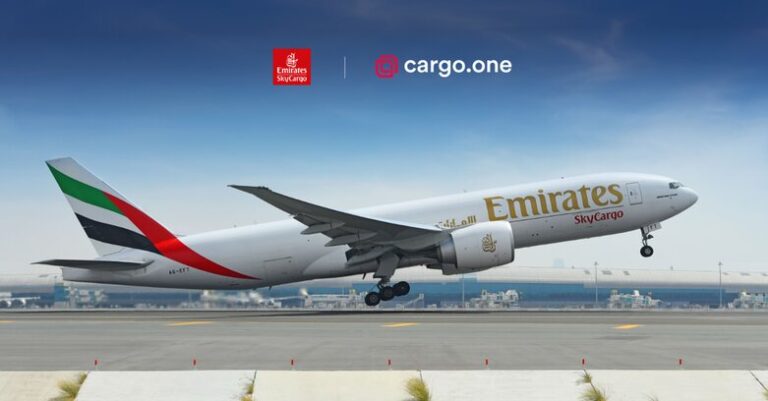
Giving customers digital booking flexibility. Image: cargo.one
All good things come in threes. For Emirates SkyCargo, this is the addition of cargo.one to its digital marketplace options. The carrier began the rollout of its network capacities last week, offering cargo.one users the options to book four of its products: Emirates Fresh, Emirates Fresh Breathe (both perishables solution variations), Emirates Airfreight Priority for urgent shipments, and its general cargo service: Emirates Airfreight. Customers are shown real-time space availability, tariffs and contract rates, and can access the airline’s schedule. Starting out in certain European countries first, Emirates SkyCargo will then also be made available to users in the Americas, Africa, the Far East and Australasia. “cargo.one now contributes to Emirates SkyCargo’s digital status in the market, with its seamless booking experience and reach to 15,000 freight forwarders in every corner of the world,” the release states, going on to say: “The new channel cements Emirates SkyCargo’s presence on three of the biggest digital marketplaces, providing more choice and flexibility for global customers.”
Moritz Claussen, Founder & Co-CEO, cargo.one, commented: “The addition of Emirates SkyCargo’s global connectivity to cargo.one will equip thousands of forwarders with enhanced resilience from even more daily services on many key trade lanes, as well as a number of exciting new destinations throughout Africa and the Middle East. The combination of Emirates SkyCargo’s vast services and cargo.one’s great efficiencies is a valuable proposition, and one that reflects just how critical digital booking now is for forwarding success in every market.” Jeffrey van Haeften, Senior Vice President Cargo Commercial Worldwide, Emirates SkyCargo, explained: “Digitalization is a key way that we help the world work better, providing flexible and convenient options for freight forwarders to seamlessly access Emirates SkyCargo’s world-class product and services. In turn, by streamlining our quotations and bookings, we enable our teams to focus on providing outstanding customer service, which is the cornerstone of our brand. We will continue to invest in digital solutions and partnerships such as cargo.one to enhance the experience for our customers and expedite the movement of goods all over the world.”
Marie Seco-Köppen is Cargo iQ’s new ED. Image: Cargo iQ
After 26 years at the helm and 50 years in the business, Lothar Moehle who has been with Cargo iQ since the very beginning, will be stepping down from his function as Executive Director and heading into well-deserved retirement in JUN24. In his stead, Marie Seco-Köppen will take on the title of Executive Director in MAY24. She has a solid, 20+ year background in global air freight and currently chairs Cargo iQ’s Master Operating Plan (MOP) Working Group. Seco-Köppen comes over to Cargo iQ from Im3pact AG, a consultancy for global transportation, and will put her experience in delivering air freight process improvements and digitalization to good use.
Along with the management change announced at the World Cargo Symposium on 13MAR24, Cargo iQ also revealed that it was introducing a tiered membership program and a KPI performance scorecard in the coming months. Piloted by Cargo iQ Board members such as KLM Cargo and Kuehne+Nagel, the new initiatives should further drive quality in the air cargo industry. Based on their level of implementation and reporting conformance, members will be ranked as Bronze, Silver, or Gold. The new scorecard being designed to support forwarder-carrier and carrier-ground handling agent relationships, will measure certain Cargo iQ Milestones including its key KPI, Notified for Delivery (NFD). It should serve to provide greater transparency and dialogue.
Seco-Köppen commented: “This new chapter promises to be exciting, and I am looking forward to engaging with the Board and members to further extend Cargo iQ’s unique cross-stakeholder quality program. In our fragmented industry, quality standards and digitalization remain crucial to attain increased performance visibility, which is required to remove redundancies and jointly drive-up service consistency for the shipper.”
Lothar Moehle stated: “Cargo iQ is taking the next step in driving quality in our industry by engaging members in two initiatives that put implementation transparency at the heart of the process, as well as ensuring all stakeholders have clear KPIs against which they can measure success and define improvements. The scorecard system will be open for all air cargo stakeholders who engage with Cargo iQ members to use to measure the quality of their partner’s service, but also their own performance.”
The sharp decline in freight rates after the end of the pandemic, has left a clear mark on the shipping company, Hapag-Lloyd. This is evidenced by the annual report tabled last Thursday (14MAR24), at the company’s headquarters in Hamburg. Revenue halved compared to 2022, dropping to just under 17.8 billion euros. Profit fell even more steeply, slipping from 17 billion euros in 2022, to 3 billion euros in the past financial year.
Hapag-Lloyd’s headquarters in downtown Hamburg, inaugurated in 2003, stands for tradition and modernity – photos: CFG/hs
Although the transport volume remained stable at 11.9 million standard steel boxes, freight rates declined by almost 50% year-on-year. Hence, customers had to pay only 1,500 euros on average to ship a 20-foot container. The downward trend intensified towards the end of last year, seen by the negative EBIT posted by Hapag-Lloyd in Q4, 2023. An alarming signal as a quarterly loss has not happened since 2016. On the positive side: the yearly report shows a decrease in greenhouse gas emissions. Fleet modernization measures and other initiatives led to savings of 800,000 tons in comparison to the previous year.
Third-best year ever Despite the decline in profits, the Hapag-Lloyd management was content with the 2003 annual results. It was the third-best year in the history of the shipping line, which currently operates a fleet of 278 vessels, emphasized CEO, Rolf Habben Jansen. His contract has been extended to 2029. At first glance, it is astonishing that Hapag-Lloyd’s consolidated profit was even higher than the consolidated EBIT of 2.5 billion euros. “Because we generated a positive financial result thanks to our high liquidity,” illustratedCFO, Mark Frese.
The shipping company will pay stockholders a dividend of 9.25 euros per share, subject to approval by the supervisory body. The City of Hamburg holds a 13.9% stake in Hapag-Lloyd and can expect a cash flow of 225 million euros (1.5 billion 2022). At Kuehne+Nagel and the Chilean shipping company, CSVA, the dividend is more than twice as high. Both hold around 30% in Hapag-Lloyd. Other shareholders are Qatar Holding (12.3%), and Saudi Arabian Public Investment Fund (10.2%). Only 3.6% of the shares are in free float.
Sailing around Africa the only option While fuel prices remained at stable level, the shipping company has incurred considerable additional costs due to the longer sea routes going around the Cape of Good Hope. These prolonged voyages, compared to a Suez Canal passage and operated since the beginning of this year following massive Houthi shelling of merchant ships, were the only option for safety reasons. “The lives of our crew members are much more important to us than a longer journey time of seven days,” argued Mr. Habben Jansen. The Houthi attacks in the Red Sea and the Gulf of Aden, pushed freight rates up again. It is currently unclear how long this situation will last and what impact the enlarged sea route will have on business figures. In any case, the longer transport routes mean a cost disadvantage for Western shipping companies, as Chinese competitors such as Cosco, continue to use the Suez Canal. They are not being shot at by the Yemenite Houthi regime.
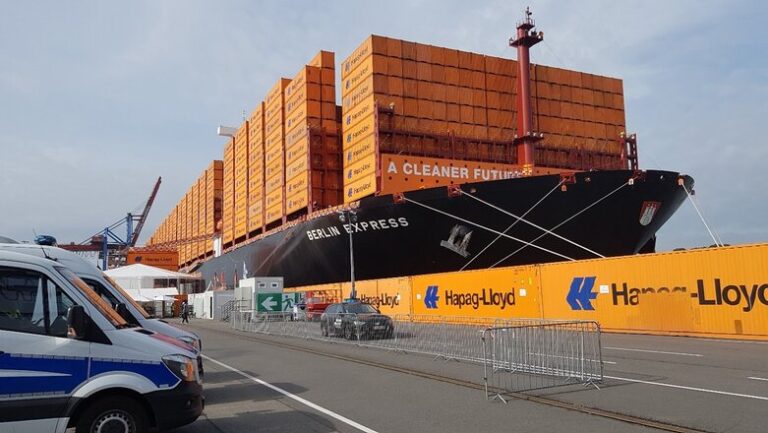
New hub and spoke system is coming When asked about the partnership with Danish shipping giant, Maersk, marketed as ‘Gemini’, Habben Jansen said that this link will be “anenabler for quality, schedule reliability, and accelerated decarbonization.” A hub and spoke system is being set up to increase the efficiency of transportation. Large ships such as the Berlin Express (23,700 TEU), will transport the steel boxes between key ports along their intercontinental routes such as Singapore, Jeddah or Tangier on the West-East-West sectors. There, the shipments will then be transferred from the big vessels to smaller ships that will cover the final leg of the boxes’ voyage, calling at ports such as Antwerp, Wilhelmshaven, or in the case of Singapore hub, harbors in Vietnam, for instance.
Vessels of the Megamax class, such as the Berlin Express (23,600 teu), form the backbone of the hub and spoke system planned jointly with Maersk. H-L has ordered a total of 11 units – CFG/hs.
No integrator intentions Addressed by CargoForwarder Global, the CEO emphasized that, unlike other major shipping companies, Hapag-Lloyd does not intend to become an integrator. “That is why we will not use Maersk Air Cargo’s freighter fleet capacity for our own shipments,” he clarified. For marine feeder services, Hapag-Lloyd will probably need an additional number of ships in the range of 5,000 to 6,000 TEU, he announced. The exact requirement still needs to be determined and depends on the market situation, he said.
The company’s ‘new kid on the block’, as Habben Jansen called the 2023 incepted Terminal business unit, “got off to a good start.” But he declined further investments during the next two year since prices have increased substantially. In mid-term, however, Hapag-Lloyd intends to acquire new assets, this way growing its self-managed and controlled port infrastructure. “We will continue to grow in our new Terminal and Infrastructure business, as well as our share and portfolio of hinterland transports,” Mr. Habben Jansen assured.
2024 is going to be challenging For the current financial year, Hapag-Lloyd forecasts the Group EBITDA to be in the range of 1 to 3 billion euros and the Group EBIT to be in the range of minus 1 to 1 billion euros. However, this prediction remains subject to considerable uncertainty given the volatile development of freight rates and geopolitical challenges. Due to the multiple global crises “we expect to see an overall decrease in earnings in 2024. As part of our Strategy 2030, we will be focusing even more intensively on quality and sustainability. At the same time, we will also need to reinforce our top 5 position on the global market and realize improvements in terms of cost efficiency and productivity,” Mr. Habben Jansen rounded off.