
Shipping line, Hapag-Lloyd, has been in the headlines of news agencies, business publications, and other media recently, due to three topics: Hapag-Lloyd’s disappointing Q1 2026 financial results. Secondly, a high-profile symposium on war and peace at sea. Thirdly, recognition of the scholars who published their latest findings, including a project in Colombia that was awarded a prestigious prize by a five-member jury for its successful holistic approach. We begin the trilogy with the shipping company’s sobering financial performance in Q1, 2026.
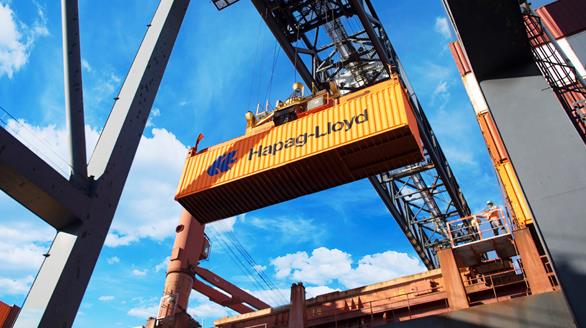
During the first three months of this year, Hapag-Lloyd slid into the red. According to figures released on Thursday (14MAY26), the world’s fifth-largest shipping company posted a loss of EUR 219 million from 0JAN26 to 30MAR26. This sharply contrasts the results achieved in the same period of last year, that ended with a profit of EUR 463 million.
Multiple causes
Falling freight rates, the closure of the Strait of Hormuz, time and fuel consuming sailing around the Cape of Good Hope on journeys between the Far East and Europe, fast rising bunker prices as well as general geopolitical turmoil weighed heavily on the Hamburg-based box carrier. The consolidated EBIT was sobering, documenting a loss of EUR 134 million, while net income after taxes showed a loss of EUR 219 million versus gains of EUR 665 million, a year ago.
In contrast, at 3.2 million TEU, cargo volume in Q1 2026 remained virtually unchanged from the previous year. In particular, the blockade of the Strait of Hormuz – for which there is currently no end in sight – has disrupted logistics supply chains and resulted in significant additional financial burdens. According to CEO Rolf Habben Jansen, four of the shipping company’s container ships are still trapped in the Persian Gulf, incurring additional costs of USD 50 million per week and even more. Since 02MAR26, the strait has been effectively closed to commercial shipping due to the Iranian military’s naval blockade, a situation further exacerbated by a U.S. counter-blockade.
Blockade and no end in sight
Based on the USD 50 million per week cited by the Hapag-Lloyd helmsman, the shipping company has incurred costs of approximately USD 200 million by the end of MAR26 for ship personnel, fuel supplies, cargo securing, and, above all, insurance premiums. Extrapolated to the present date, this amounts to more than USD 300 million.
Offsetting these amounts against the quarterly loss likely makes the presented income statement more palatable to management.
Profitable business unit
Moreover, the revenue and EBITDA for the ‘Terminal & Infrastructure’ business segment showed a clearly positive trend in Q1. This was achieved through volume increases in India and, above all, Latin America, as well as the full consolidation of the container business of the Indian J M Baxi Group. Accordingly, revenue and EBITDA for this segment rose significantly in Q1.
Despite the overall disappointing first quarter of 2026, and weak earnings, the Executive Board is sticking to its annual forecast announced in FEB26: Consolidated EBITDA of USD 1.1 billion to USD 3.1 billion and consolidated EBIT in the range of between USD 1.5 billion and USD 0.5 billion are still expected.
At the same time, the Hapag-Lloyd Executive Board emphasized the continuation of strict cost management as well as the commitment to the planned merger with the Israeli shipping company, ZIM, despite concerns from the local union and some critical voices from Israeli politicians.