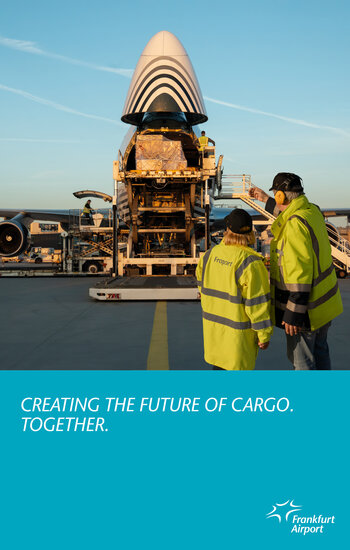

Every week, CargoForwarder Global’s ‘Spotlight On…’ examines a specific section of the air cargo industry through the eyes of someone working there, to illustrate the many different careers it offers. One important link in logistics are cargo handlers – the operational backbone of the air cargo industry. Positioned at the critical interface between airlines, freight forwarders, and supply chains, they manage the loading, unloading, storage, and documentation of goods moving through airports. Cargo handlers are responsible for the seamless flow of shipments from the forwarder to the airline, and vice versa, ensuring regulatory compliance, dangerous goods safety, and temperature integrity, while maximizing aircraft capacity through precise ULD build-up. Aliaa Almetwally (AA), Project & Continuous Improvement Manager, FCS, takes us through her role and shares her experience and advice for those looking to join the air cargo industry.

CFG: What is your current function and company? And what are your responsibilities?
AA: I am the Project & Continuous Improvement Manager at FCS Frankfurt Cargo Services GmbH. I joined in January 2024, at a point when Continuous Improvement had just been introduced at FCS and was still very much in its early days – operating as a consulted, advisory function rather than as an established department. My mandate has been to grow it from there into a structured CI function with its own identity, methods, and rhythm. My focus is clear: remove waste, increase productivity, and create cost-saving initiatives through digitalization, automation, and innovation. In practice, that means bringing Lean Six Sigma into our daily routines through Gemba walks, 5S and Kaizen, building the Operations Library of Standard Operating Procedures, driving automation and AI projects that take repetitive workload off the team, and shaping a performance management approach grounded in facts and continuous measurement. I also coach and train colleagues on CI tools and report to both local management and global headquarters, which keeps me close to the bigger picture across the network.
CFG: What does a normal day look like for you?
AA: In cargo, ‘normal’ is a relative term. My day usually starts with a daily sync meeting with my CI team, where we align on what is on each person’s plate and remove blockers early. After that comes the daily business review call, where I set priorities for the day, give updates on running initiatives, and align with operations on what they need from CI. The rest of the day is a mix of workshops, root cause analyses, AI projects, training, SOP reviews, automation projects, and stakeholder alignment locally and globally. There is always something unexpected that reshuffles priorities, and that variety is exactly what keeps the role exciting.
CFG: How long have you been in the air cargo industry, and what brought you to it?
AA: I joined the air cargo industry in January 2024, so just over two years ago. Before that, I spent close to three years at Amazon as a Continuous Improvement Manager, and my career originally started in mechanical and industrial engineering. What brought me to air cargo was the combination of operational complexity, time-criticality, and global impact. Few industries demand such precise coordination between people, processes, and technology – and that is exactly the environment where Continuous Improvement creates the most value. I wanted to apply my engineering and Lean background somewhere every minute and every kilo really matter, and air cargo delivers that every single shift.
CFG: What do you enjoy most about your job?
AA: I am a result-oriented person, so what drives me is impact: seeing waste actually disappear from a process, productivity going up, and cost-saving initiatives turning into real outcomes on the floor. What makes it even more rewarding is that none of these results happen alone. I enjoy delivering them with the team, because when people are involved from the beginning, they take real ownership, and that shared accountability is what makes improvements stick. Coaching colleagues through change and watching them grow into CI champions in their own right is, on a personal level, the most fulfilling part of what I do.
CFG: Where do you see the greatest challenges in our industry?
AA: I see three challenges that are deeply intertwined. First, digitalization and the smart use of information – our industry generates an enormous amount of operational knowledge every day, but turning it into actionable insight, and integrating AI in a meaningful way, is still a journey for many handlers. Second, knowledge transfer – experienced cargo professionals carry an incredible amount of tacit know-how, and without proper standards, training, and documentation, we risk losing that as the workforce changes. And third, the combined pressure of capacity growth, sustainability, safety, and regulation, which calls for genuine cultural and process change, not just new technology. From where I stand, Continuous Improvement is the connective tissue between all three.
CFG: What advice would you give to people looking to get into the air cargo industry?
AA: Be curious, and do not be afraid to start on the floor – operational understanding is the foundation everything else builds on. On the formal side, the IATA courses (Cargo Introductory) are a great way to pick up the industry’s language and standards quickly. I would also strongly recommend a Lean Six Sigma foundation, at least Yellow or Green Belt, because process thinking is highly transferable in this environment. An openness to digitalization and AI is becoming increasingly important too. And finally, invest in soft skills: communication, change management, and stakeholder management. Cargo is ultimately a people business that happens to move freight.
CFG: If the air cargo industry were a film/book, what would its title be?
AA: ‘The Invisible Network – Around the World Before Sunrise.’ Most people never see what it takes to move a shipment from A to B overnight, but behind every parcel, every pharma container, every piece of mail, there is an intricate, time-critical choreography of people, machines, and data. Part thriller, part documentary – and definitely with a sequel.
Thank you very much, Aliaa.
If you would like to share your personal air cargo story with our CargoForwarder Global readers, feel free to send your answers to the above questions to cargoforwarderglobal@kopfpilot.at We look forward to shining a spotlight on your job area, views, and experiences.