Monday 01JUL24 sees Lionel van der Walt take up his role as Chief Commercial Officer (CCO) over at cargo IT Services and IT Consulting expert, Nallian. Based in Raleigh, North Carolina, USA, he has been called in to drive the company’s growth strategy and expansion – in particular across North America, a region he knows well from his time as Global Chief Commercial Officer and CEO Americas at PayCargo, as well as from when he was President at Cargo Network Services (CNS) in the U.S. He now joins Nallian over from Raft, where he was Chief Growth Officer. He has, in the past, held various leadership roles at the International Air Transport Association (IATA), worked at South African Airways, been an air traffic controller and served in the South African Air Force.
A known face now on the Board of Nallian. Image: Nallian
Van der Walt brings a great deal of international experience, having lived and worked in South Africa, Europe, the United Kingdom, and the Americas, along with a solid background in the logistics and supply chain industry. He is well known in the air cargo industry for his talents in driving innovation, encouraging market adoption, and building strategic partnerships.
Jean Verheyen, CEO of Nallian, said: “Lionel’s appointment comes at a pivotal time for Nallian, as we continue to expand our footprint in the global market. His extensive experience, network and strategic vision will be instrumental in accelerating our growth trajectory and delivering exceptional value to our customers, starting in the U.S. where we already work with leading players such as Dallas Fort Worth International Airport and Menzies in Los Angeles.”
Mr. van der Walt commented: “I am thrilled to join the talented team at Nallian and contribute to the company’s continued success. I am excited about the opportunity to lead Nallian’s commercial efforts and drive growth in key markets, particularly in North America, a region with immense potential for growth. I look forward to working closely with our customers and partners to deliver innovative solutions that address their evolving needs.”
CargoAi says it is setting a new standard for digital booking solutions in the market with the launch of its latest Allotment feature: Batch Pre-Booking & Batch Allotment. Its users now have the option to automate otherwise time-consuming and tedious manual tasks. The new feature simplifies and automates the pre-booking and allotment booking process for general cargo shipments and is available for reservations on more than 40 airlines across 130+ countries. Transforming this process into a digital one goes a long way to reducing the potential for errors, and it enables freight forwarders to smoothly secure space in batches on flights for more reliable and quicker shipment transport. The press release emphasizes that the entire batch allotment upload process is reduced to seconds from previously days spent waiting for confirmations from multiple airlines. The feature creates instant booking confirmations. It has already been adopted by several small and large forwarders. The plug & play solution is easily integrated into existing processes and has shown to reduce the operational workload for allotment bookings by up to 99%. Aside from speeding up the process, the new features also offers autonomy and flexibility through direct online booking management, as well as traceability thanks to real-time shipment status updates.
Making digital things easy. Image: CargoAi
Maxime Boucher, Chicago Export Gateway Manager at Flexport, confirmed: “We have been using the CargoAi Pre-Booking and Allotments feature since March 2024. This has simplified our pre-booking process, and we get automatic acceptance confirmation on our bookings, ultimately saving time for our operations. We also no longer have to remember to chase confirmation on pre-bookings.”
Matt Petot, CEO of CargoAi, commented: “Our new Allotment feature represents a significant leap forward in our mission to digitize and simplify the air cargo booking process. By automating space bookings, we are not only saving time for our users but also increasing their operational efficiency. This is a game-changer for large and medium-size freight forwarders who heavily rely on regular and reliable cargo space.”
China’s anger has faded. It arose after the Peruvian government withdrew its promise to grant the Chinese state-owned shipping company, Cosco, the exclusive rights to use a new deep-water port not far from Lima. The reason given to the investor: Exclusive operational rights for Chancay Puerto would hamper free competition and favor Cosco one-sidedly. Now Peru’s President, Dina Boluarte, made a political U-turn, again granting Cosco exclusivity, once the mega port is operational.
Ms. Boluarte’s behavior is reminiscent of King Henry IV’s supplication and penance to Pope Gregory VII in Canossa in 1077 A.D. As a result of a massive dispute, the pope had excommunicated the king from the church. So, Henry IV went to Italy and begged the pope to end the papal ban on him, which he did.
Peru’s President Dina Boluarte and China leader Xi Jinping met in Beijing and decided to deepen their cooperation – photo: courtesy Presidencia
Beijing applauds Today, Canossa is in China, more precisely in Beijing. That is where the Peruvian politician met ruler Xi Jinping on Friday (28JUN24), having previously visited Huawei’s industrial complex in Shenzhen. During the subsequent press conference, she announced that former legal and political objections have been dropped and Cosco would be granted exclusivity for the port as originally promised by her administration. As soon as her notification was out, Beijing applauded loudly. Located about 75 km north of Peru’s capital, Lima, Chancay has been popular with tourists and the birds that migrate every year to and from North America. This has changed radically since construction work on the huge commercial port and adjoining industrial zone began.
Transforming trade flows Once operational, the deep-water port is intended to be a gateway for China on the Pacific side of South America. It is expected to transform trade flows between the subcontinent and China by slashing travel times for container vessels. “We’ve seen a number of acquisitions of ports by Chinese companies in the past, but this is the largest that I know of in the Latin American region,” Margaret Myers, Director of the Asia and Latin America Program at the Inter-American Dialogue, a think tank in Washington, DC, told the public radio station ‘The World’.
Benefitting China’s interests She went on to say that the new mega port will become a key link between China and Latin America. “In the case of Peru, a lot of this trade would be in copper but also goods from a wide range of other countries, potentially including agricultural products from Brazil.” Myers reminded that the Belt and Road initiative is a tool to secure China’s energy and food supply. The construction of Chancay Port is expected to cost USD 1.3 billion, mainly financed by Cosco and Chinese banks. The first container ship is scheduled to moor in November when Peru hosts the Asia-Pacific Economic Cooperation Leaders’ Summit. This is a fitting occasion for the official inauguration of Chancay Port. Observers expect that the project will increase the tensions between China and the USA.
Partnering with Huawei This is also likely to apply to another decision by President Boluarte: The contract, signed in Shenzhen, granting Chinese telecom giant, Huawei, the right to train thousands of Peruvians in new communication technologies. The president’s office speaks of 20,000 young professionals and entrepreneurs from small and medium-sized enterprises, who will be trained in new technologies developed by Huawei, especially in AI. Prior to departing for China, Ms. Boluarte told state-owned newspaper, China Daily, that her visit was “paving the way for greater investment and cooperation” with China in key sectors such as infrastructure development, digital transformation, artificial intelligence, clean energy, and people-to-people exchanges. According to Fudan University’s Green Finance and Development Center, the Latin American country was granted USD 2.9 billion in 2023 – the third highest total, worldwide. The decisions announced by Ms. Boluarte during her China trip can be explained against the backdrop of these financial ties – local critics speak of one-sided dependencies at Peru’s expense.
This change in personnel was already apparent: the new Head of Budapest Airport is François Berisot. He is a long-standing management member of the French Vinci Airport Group and, for the past five years before moving to Hungary, was Head of Nikola Tesla Airport in Belgrade, Serbia, which is part of the Vinci consortium. Meanwhile, Menzies Aviation, too, has announced its intention to take over the ground handling company Airport Services Budapest (AS Budapest).
The personnel change at the top of Budapest Airport Zrt. was preceded by a change in the ownership structure. AviAlliance withdrew and sold its majority stake of 55.44% to the state-controlled Hungarian Corvinus Zrt. (80%) and the French co-investor Vinci Airports (20%) (See also: https://cargoforwarder.eu/2024/06/16/avialliance-sells-budapest-airport/ ). With its withdrawal, it was also clear that the previous CEO, Kam Jandu, who had been appointed to the position by the AviAlliance, would have to vacate his desk.
Francois Berisot becomes new CEO of Budapest Airport, succeeding Kam Jandu from the AviAlliance – courtesy: BUD Airport
Major expectations The Hungarian Minister of National Economy, Márton Nagy, spoke of a historic change in ownership as a result of the transaction, following almost two decades of developments driven by commercial considerations and limited state influence. The new airport owners expect that François Berisot, in his role as Head of Ferenc Liszt International Airport, will contribute to increasing the airport’s operational efficiency, expanding commercial opportunities, and promoting infrastructure projects.
Menzies extends its footprint at BUD – Courtesy: Menzies Aviation
Consolidating ground handling activities Meanwhile, Menzies Aviation also announced that it has taken over ground handling agent, AS Budapest, for an undisclosed amount.AS Budapest offers its airline customers a range of ground and air cargo services, as well as aviation security and lounge services. As part of the new agreement, which is subject to regulatory approvals, AS Budapest will transfer all existing contracts and assets to Menzies Aviation Hungary Kft. AS Budapest employees will be offered employment agreements with Menzies Aviation Hungary Kft, as their new employer.
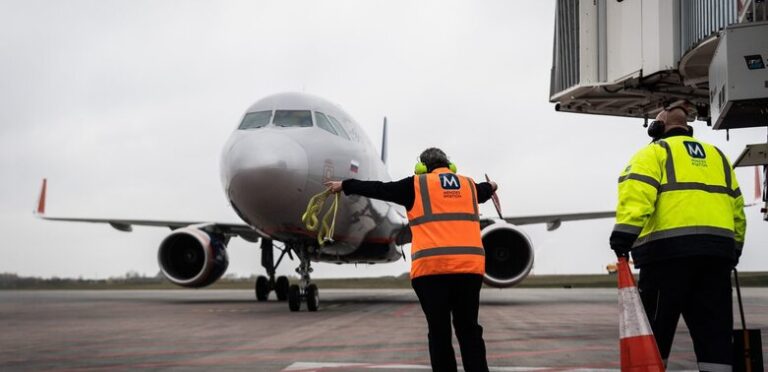
Menzies promises high quality combined with operational excellence Speaking about the agreement, Miguel Gomez Sjunnesson, EVP Europe at Menzies Aviation, said: “Joining forces with AS Budapest not only extends our footprint at BUD airport, but also marks the next step in our European growth journey. AS Budapest has a long track record and strong client base, and we look forward to combining this with our international expertise and extensive reach at more than 297 airports in 65 countries. Together, we are committed to enhancing the experience for our airline customers, airport partners, and passengers traveling to Budapest, ensuring high quality services and operational excellence.” Menzies Aviation’s premises at Budapest’s Airport (BUD) Cargo City were expanded earlier this year, following a multi-million-dollar investment. Capacity was extended from an annual 49,000 tons to 85,000 tons, and available warehouse space increased from 4,000 m² to 7,000 m².
CargoForwarder Global’s ‘Spotlight On…’ series makes a point of illustrating the many different functions involved in transporting air cargo from A to B. Cargo has always been and will continue to be a people business, but there is no denying that Artificial Intelligence (AI) is increasingly beginning to play a role at various points along the shipment journey. The trigger for this week’s Spotlight candidate came from an announcement earlier this month, that Zoom CEO, Eric Yuan, wants to clone himself as a Digital Twin CEO so that he can send his digital version to meetings or have it go through and answer his emails, whilst he instead enjoys quality time at the beach.
Will that extreme application become standard across the board of most companies some day? (And it is, mind you, a more than ironic suggestion coming from the very same person who commanded his staff return to the office, post-pandemic, because he feels that remote work doesn’t allow people to build as much trust or be as innovative – but that’s another story…) Whereas the Digital Twin CEO concept throws up a whole array of liability, consequence and trust questions, when it comes to Air Cargo, AI is already capable of reading emails and AWBs, and is being put to excellent use in forecasting, load-planning or pricing to name just a few possibilities. The opportunities for automation, greater efficiency and better control, are many. CargoForwarder Global fed the Spotlight questions to ChatGPT, to get AI’s view on its capabilities and its learned advice. It promptly edited the original questions and offered the following results within a matter of seconds:
What will his/her/their role be, in future? Digital Twin CEO? Image: Canva/CFG
CFG: Current Function and Company, and Responsibilities AI: I am ChatGPT, a large language model created by OpenAI. My primary function is to assist users by providing information, answering questions, generating creative content, and supporting various types of communication. While I don’t work for a traditional company, I operate within OpenAI’s framework to offer valuable assistance across numerous domains, including air cargo.
CFG: What Does a Normal Day Look Like for You? AI: Since I am an AI, I don’t experience days like humans do. My activity is determined by user interactions, and I am always ready to assist whenever needed. There isn’t a “normal” day for me in the conventional sense—each interaction can be vastly different depending on the user’s needs.
CFG: Experience in the Air Cargo Industry AI: While I don’t have personal experience, I have been trained on a vast amount of information about the air cargo industry. My knowledge includes logistics, industry trends, regulations, and best practices. This allows me to provide informed responses and advice based on the extensive data I’ve been trained on.
CFG: What I Enjoy Most About My Job AI: What I “enjoy” most, from a functional perspective, is being able to assist users effectively. Helping people solve problems, understand complex topics, and find the information they need is the core purpose of my design.
CFG: Greatest Challenges in the Air Cargo Industry AI: Based on the data I’ve been trained on, the greatest challenges in the air cargo industry include:
Regulatory Compliance: Navigating various international regulations and customs requirements can be complex and time-consuming.
Sustainability: Reducing carbon footprints and finding eco-friendly solutions are increasingly important.
Technology Integration: Implementing and upgrading technology systems for better tracking, efficiency, and security.
Capacity Management: Balancing supply and demand, especially during peak times or unforeseen disruptions.
CFG: Advice for Entering the Air Cargo Industry AI: For those looking to get into the air cargo industry, I recommend:
Education: Pursue studies in logistics, supply chain management, or aviation management.
Certifications: Obtain certifications like the International Air Transport Association (IATA) certifications or other relevant logistics credentials.
Networking: Join industry associations and attend conferences to build connections.
Experience: Gain practical experience through internships or entry-level positions in logistics or related fields.
Technology Skills: Develop skills in relevant technologies like warehouse management systems (WMS), transportation management systems (TMS), and data analysis.
CFG: Title for the Air Cargo Industry as a Film/Book If the air cargo industry were a film or book, a fitting title might be “Global Lifelines: The Story of Air Cargo”. This title reflects the critical role air cargo plays in connecting the world and facilitating the global movement of goods.
Thank you, ChatGPT, for your honest and almost human-like input.
Nearshoring is a major issue for the logistics company. Instead of expanding towards the Far East, QCS has set up stations in Eastern Europe over the past two years. The company had planned with them becoming profitable after three years, yet they have already achieved this now, says company boss, Stephan Haltmayer, in an exclusive interview with CargoForwarder Global. And he announces further branches.
While he says this, the Austrian firm, Team Global Logistic Spedition GmbH, becomes part of the QCS Group. “We applied for the name change, today (28JUN24),” announces Mr. Haltmayer. In future, the Vienna Airport-based company will be called Quick Cargo Service Austria GmbH. Its CEO, Norbert Heuber, will continue to manage the company as he has done since 2006. He expects significant synergy effects in the handling of the business because of the entry of QCS. As far as its market position is concerned, the focus is on air freight matters. Mr. Heuber stresses that his company is well positioned. “We have a very flat hierarchy, our cost structure is very competitive, we handle orders quickly and flexibly, and we are profitable,” are his key messages.
The old boss is also the new one: Norbert Heuber will head Quick Cargo Service Austria GmbH – photo: company courtesy
Vienna remains a turntable for cargo With the takeover, QCS is filling a widening gap in the Austrian freight forwarding sector. Since the takeover of cargo-partner by Nippon Express a year ago, local logistics companies have reported a significant exodus of employees from cargo-partner, which has weakened the company’s previously strong position on the Austrian domestic market, according to various sources. And Norbert Heuber even speaks of a “brain drain” happening at cargo-partner. According to Stephan Haltmayer, Vienna is still the turntable for air freight in Eastern Europe, although Budapest has recently gained significant market share in terms of traffic and tonnage. QCS also has a branch there, as well as in Poland, Slovakia, and Romania.
Gaining access to Koper comes next The next step is to connect Slovenia. The Mediterranean port of Koper is located there, through which QCS wants to handle sea freight traffic generated in Southern Europe or bound for the region. “We are in advanced talks with a local company about a takeover,” states the manager, without revealing names or details. The Czech Republic is also on his company’s expansion list. “The local industry, especially automotive (Skoda), has a strong position from which we would like to benefit.” To date, QCS has handled cargo shipments to and from the Czech Republic via its branch in Nuremberg. Once these steps are accomplished, the family-run logistics player, which this year celebrates both its 50th anniversary and the 90th birthday of its Founder, Dieter Haltmayer, on 02NOV24, will then enter a consolidation phase. “Soon we will be able to offer the market one-stop shopping solutions across Europe,” says Stephan Haltmayer.
Forwarding agents are under increasing pressure At the same time, he mentions that the traditional forwarding business has become more difficult in recent years. Easy-to-use electronic booking portals are progressively capturing parts of the business so far managed by established logistics players, without offering accompanying services. In addition, integrators are increasingly gaining ground to the disadvantage of traditional forwarding agents. As to the market situation, only e-commerce continues to grow, whereas traditional industrial goods have stagnated, especially in Germany. The country is over-bureaucratized and is falling behind other economies due to its high costs and partially outdated infrastructure. QCS is therefore considering relocating relatively simple forwarding activities to more cost-effective countries, such as the Philippines. At the same time, natural fluctuation will be used to reduce costs and encourage employees to work remotely for the same reason.
The Swiss subsidiary of Riege Software is expanding its product portfolio. Jeanne Graf, the new Managing Director of the branch, is responsible for driving ahead digital innovation. Ms. Graf will take up her new position on 01JUL24. Key areas of responsibility such as the development of new customs modules based on the Passar system for imports and exports of air freight shipments, the strengthening of sustainability initiatives, and the deepening of customer relationships, are listed high up on her agenda.
Graf has been with Riege for some time and was responsible for a variety of tasks before the Riege management appointed her Managing Director of the Swiss subsidiary based in Meerbusch near Dusseldorf, Germany. When asked about the ethical values that she represents and expects from her colleagues, she says: “For me, sustainability and respect are two very significant values that Riege Switzerland will continue to pursue in the future. Open communication at eye level with customers and employees will be my strength.” Coming from forwarding and product management,her professional focus is now on strengthening customer relationships, conducting market analyses, and becoming more familiar with the details of financial issues.
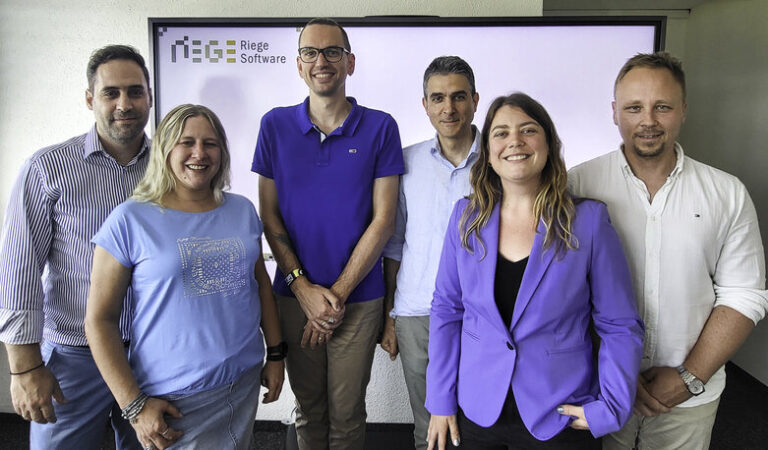
Jeanne Graf (2nd from right) and her Riege Switzerland Team – photo: company courtesy
Challenging task Due to the broad range of business activities, the requirements of Riege’s customers differ substantially. This applies above all to pharmaceutical logistics, which is one of the main topics its Swiss subsidiary is currently focusing on. “We analyze special market requirements and, in close cooperation with our customers, we develop tailored solutions fitting their needs,” Jeanne Graf says.
CH NCTS goes… For this reason, Riege Switzerland has also hired an own software developer, who will work the specifics of the applicable Swiss import, export and transit regulations into modules and integrate them into Scope’s current software architecture. According to Ms. Graf, this has already been accomplished for transit traffic.
…Passar comes Following the successful launch of the Passar Transit Module, Riege Software Switzerland is now focusing on electronic solutions for Export and Import. The outdated customs communication module, edec Export, will be switched off on 31DEC25 and replaced by the new Passar Export Module. This will be done on an EU-wide level to speed up the flow of imports and exports and simplify customs clearance, making processes more transparent. To accomplish this demanding task, Riege is closely collaborating with experts from the Federal Office for Customs and Border Security – FOCBS, Jeanne Graf emphasizes. Riege is a provider of innovative electronic services for the logistics and air freight industry but is also a commercial company that charges for its services. When asked about prices for the use of its software solutions, Ms. Graf remains tight-lipped. This depends on many factors such as the frequency of use, is all she says.
Making CO2 footprint transparent In addition to enhancing Scope, Riege’s bread and butter tool, Ms. Graf emphasizes that sustainability is similarly high on her agenda. In cooperation with the Swiss provider, CarbonCare, a CO2 calculator has already been added to Scope. This visualization enables the precise verification of each individual shipment’s environmental footprint. This adds transparency so customers can decide which transport solution is the most suitable for them in terms of climate protection, states Ms. Graf. Incidentally, remote working and traveling to the office near Zurich Airport by bike instead of using a private car, also contribute to lower greenhouse gas emissions, she points out.
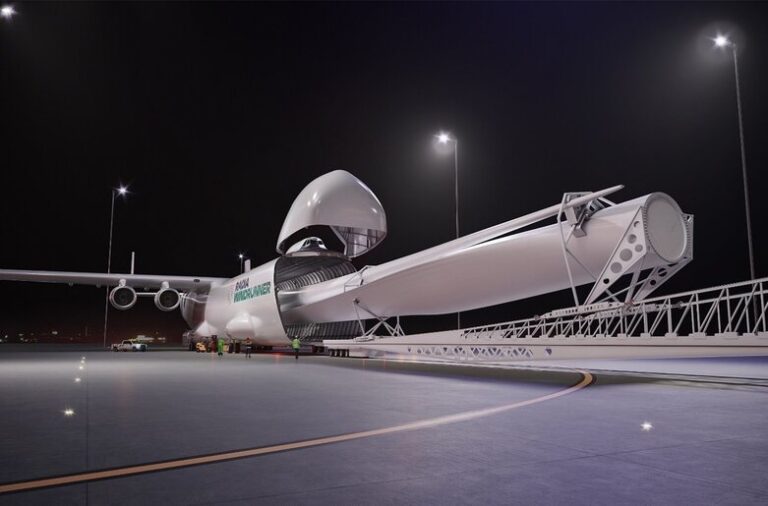
The world’s largest aircraft is being custom-built to carry a very particular type of cargo: wind turbine blades. With its 108-meter length, Radia’s WindRunner, once it comes into operation in 2027, will dwarf even the much-mourned, previous record-holder, the destroyed Antonov AN-225 Mriya. That 6-engined Ukrainian work of aviation art measured a ‘mere’ 84 meters in length, in comparison.
I must admit, when I spotted the World Economic Forum (WEF)’s 1.56-minute LinkedIn video on energy company, Radia’s WindRunner project, my first thought was a dismayed “Why did they pass up on the perfect opportunity to call the aircraft ‘BladeRunner’?!” But then I expect there are possibly copyright issues on the name, and people might anyhow get the wrong message. After all, it is not a dystopian future that this plane is being developed for, but a greener one, as it will facilitate the construction and maintenance of far more efficient wind farms for cleaner energy. And the WindRunner will, itself, be powered by Sustainable Aviation Fuel.
Large enough to transport a 105-meter-long blade. Image: Radia
Bringing offshore possibilities onshore The World Economic Forum’s JAN23 White Paper on ‘Securing the Energy Transition’, states that to reach net zero by 2050, investments in clean energy need to triple from the current USD 1.2 trillion a year to USD 4.4 trillion a year by 2030. Radia’s ‘Why Wind’ section on its website, illustrates that the fastest-growing option for green energy, is Onshore Wind. “Wind energy can meet this [24/7/365] need for consistent low-cost clean energy. It achieves this because it combines a relatively high capacity factor with low-cost power. This makes it great for traditional grid as well as non-grid applications such as data centers, and for the production of green molecules such as green hydrogen, green ammonia and sustainable aviation fuel. It will play a major role in all these applications,” it explains, going on to forecast that “as much as USD 10 trillion will be spent on onshore wind through 2050, making GigaWind the largest energy transition opportunity in the world.”
Too big for the road Large is the key word here, not just in scope, but also physically. Today’s onshore wind turbine blades, which have doubled in size and capacity in just the last couple of decades (growing from around 40 meters in length at the start of the Millennium, to circa 70 meters, now), already pose major road transportation problems. There are many impressive, almost incredible videos online of turbine blades being carefully driven around bends, up hills and over bridges. Exceedingly valuable cargo (an average-sized commercial wind turbine can set you back around USD 2.6 million to USD 4 million), and one that requires painstaking journey planning. As Mark Lundstrom, Founder and CEO of Radia, points out: “Today, turbines are simply too big to get under bridges, through tunnels, around curves, and that’s why blades are typically limited in the 70-meter range or so onshore, whereas offshore, they’re well over 100 meters in length. Eiffel Tower-sized machines. We [will] enable the movement of gigantic blades to onshore locations with an aircraft.”
Bigger is better Founded in Colorado, US, in 2016, Radia is promoting the implementation of GigaWind turbines, bringing the kind of energy production that is possible offshore, where turbines are much larger, to onshore locations. GigaWind turbines can generate over twice as much energy than typical turbines, and would thus make better use of the available land space. Yet, for these turbines to be erected, requires intelligent transport. Hence Radia’s mission to design and build the world’s largest aircraft. “It has the capability of moving an over 100-meter-long blade and landing on dirt within a wind farm. And by doing this, we will be able to create the path to the cheapest energy in the world,” Mark Lundstrom declares. The WEF video describes the WindRunner as having “12 times the volume of a B747” and being “as wide as a New York City block.” In a TIME interview with Justin Worland, Mark Lundstrom, himself an MIT aerospace engineer, reveals that the plane is being built using existing technologies in order to ease the engineering and subsequent certification process. What sets Radia apart – quite aside from the mega-proportions of the four-engined WindRunner with its 8,200 m³ volume (its maximum payload, on the other hand, is 72,575 kg), is that it is an energy company with its own air cargo fleet, come 2027. “Think of us as an energy company, but with a unique way to supersize turbines,” Mark Lundstrom concludes.
With a payload of roughly 249 kgs (550 pounds), the recently announced Air One Cargo eVTOL aircraft is an uncrewed freighter version of Air’s piloted personal eVTOL aircraft. And it has drawn much interest from potential customers in the Europe, Middle East and Africa region, and orders already having been placed. The Israeli-founded and Fort Worth, Texas-operating company reported revenues of more than USD 1 million for 2023, “mainly from early orders for the Air One Cargo vehicle. Further purchase orders have boosted Air’s revenue projections to unspecified totals for 2024 and 2025,” according to the release. Regarding the Air One passenger version, Air has currently registered 1,170 reservations. Plus, a first example of the Air One Cargo model has already been provided “to a customer based in an undisclosed country where it can be operated on a self-regulated basis under an experimental license prior to type certification,” the release reveals. The all-electric Air One Cargo will have a single-charge range of circa 95 nm, and will travel at speeds of between 87 and 135 knots. More examples of the little electric freighter are due to be delivered during 2024 and the first half of 2025.
New, uncrewed cargo eVTOL unveiled. Image: AIR
The Air One prototype is now accruing flight test hours in preparation also for its FAA type certification, which was originally planned for the end of 2024, through this may change. In FEB24, Air announced a partnership with Japan’s Nidec Motor Corporation to develop a new electric motor for the Air One aircraft.
Rani Plaut, Co-Founder and CEO of Air, said: “Venturing into this new market with the Air One Cargo is a testament to our unwavering commitment to the integration of eVTOLs into all spheres of daily life, for a variety of use cases. We expanded our offerings in response to strong market demand, and the feedback we’ve already received affirms that Air One’s robust capabilities and simple, cost-effective design make it an extremely agile platform, uniquely able to scale across different uses.”
Founded in 2018, Teleport is now Southeast Asia’s largest integrated logistics provider. At a recent media conference in Shanghai, the company committed to enabling faster and cheaper deliveries for businesses in China and Southeast Asia focused on eCommerce. Given that its network – the largest in the region – links 19 Chinese cities with 85 destinations across Southeast Asia, the airline is able to offer a competitive cost structure and great connectivity. In creating this enhanced delivery offer, Teleport plans to grow its daily parcel delivery average to 2 million parcels a day by 2025, up from 170,000 parcels per day in 2023. Forecasts predict that cross-border eCommerce will contribute almost a third of total air cargo volume by 2027, particularly to Asia (mostly Malaysia, Thailand, Indonesia, Philippines and Singapore), the U.S. and Europe, all seeking affordable Chinese goods. China’s B2C export eCommerce market is expected to double to 6.05 trillion yuan from 3.23 trillion yuan in 2022.
Pete Chareonwongsak, CEO of Teleport, speaking in Shanghai. Image: Teleport
Janson Peng, Commercial Country Head, Teleport China, announced: “Today’s standard service level for eCommerce marketplaces to move cross-border parcels from China to consumers in Southeast Asia is approximately five days. One, to one and a half days for merchants to pack their parcels to reach the warehouse, and about four days between warehouse in China to destination warehouse in Southeast Asia. We have the ability to cut down the four-day delivery time between China and Southeast Asia, to as fast as the next day, affordably. Today, we are operating at a flight frequency of 2214 flights a month – which effectively makes us number one in terms of the most flight frequency out of China into Southeast Asia cities [and we serve ] as the perfect transshipment hub to connect Chinese businesses to other major markets such as Oceania, Middle East, Europe and the US.”
Pete Chareonwongsak, CEO of Teleport, emphasized: “China and Southeast Asia today are already each other’s largest trade partners — We see this as an opportunity to contribute to this significant relationship by improving how eCommerce connects – specifically, moving parcels faster. Time-sensitive delivery between marketplaces and consumers is no longer a premium option. It is a consumer ask and we are confident of our ability to deliver between China and Southeast Asia, faster and cheaper. We have built our unique, multimodal network and hybrid fleet model, instead of a pure freighter play to move goods across Southeast Asia, to ensure that we deliver speed, at a favourable cost.”