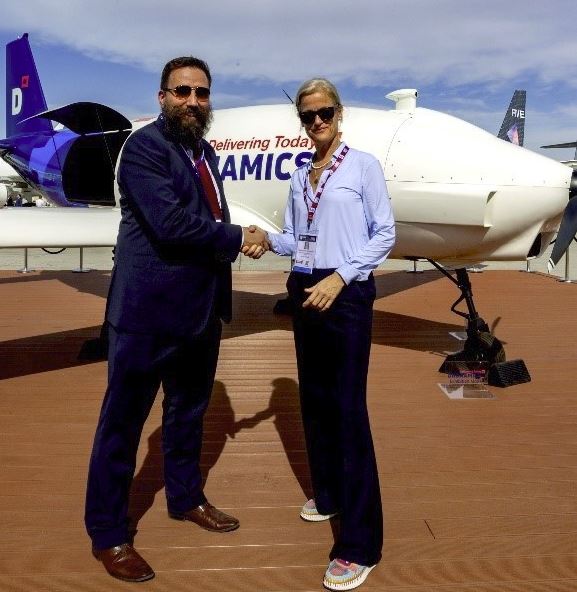
When the world’s largest international cargo carrier says yes to an interline agreement, then you’re literally starting at the top and working down. Dronamics is already making serious headway in its strategic plan to commence commercial operations from early next year (in Greece, to begin with), since it became the first cargo drone airline to obtain IATA & ICAO designator codes earlier this year. That step which puts it on an equal aviation footing with other international airlines, was the foundation to this one, now with Qatar Airways Cargo, since, as a registered and recognized airline, Dronamics may issue air waybills to enable seamless bookings with its airline partners. The signing of the world’s first cargo drone Interline Agreement with Qatar Airways Cargo, “is a crucial next step in Dronamics’ plan to establish a cargo drone airline network with worldwide reach,” the release emphasizes, going on to point out that “the partnership marks the first interline agreement between an international airline and a cargo drone airline. […] Dronamics can offer cargo services from any of its droneports, initially in Greece, to the wider Qatar Airways Cargo network – including destinations such as Singapore, China, including Hong Kong, and the United States (JFK). Qatar Airways Cargo is able to access remote locations that Dronamics serves, such as the Greek islands, on the Dronamics cargo drone network.”
One seriously big deal – Dronamics signs with world’s largest cargo airline. Image: Qatar Airways Cargo
Svilen Rangelov, Co-Founder and CEO of Dronamics, announced: “We’re very excited to have the world’s largest air cargo carrier as our partner for the first-of-its-kind interline agreement with our category-defining cargo drone airline. While currently less than 1% of global trade moves by air, the vast global reach of Qatar Airways Cargo and their world-leading capacity and service give us the perfect platform to massively expand air cargo accessibility to countless more communities worldwide, enabling same-day delivery for everyone, everywhere.”
Elisabeth Oudkerk, SVP Cargo Sales & Network Planning at Qatar Airways Cargo, commented: “As a part of our VISION 2027 5-year strategy, we are committed to remaining at the forefront of our industry by embracing new disruptive technology. It is also within our DNA to support young ambitious companies like Dronamics, and we are looking forward to seeing what the future holds for this exciting business. It is a significant milestone in the advancement of autonomous cargo drone transportation, and we are proud to be the first international airline to offer this service.”
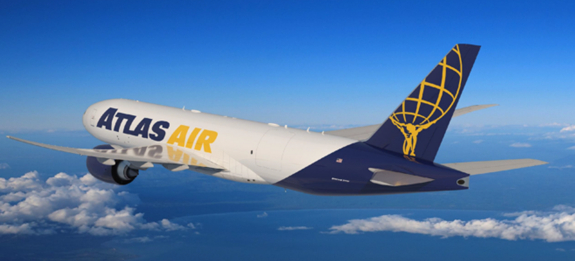
Another 777F joins the Atlas fleet. Image: Atlas Air
It is all systems go over at Atlas Air, which has been firing out press releases this week – notably one confirming the appointment of its new CFO, as well as first on 28NOV23 announcing an order for two new Boeing 777-200LRF to meet widebody freighter capacity especially from the e-commerce industry, and then on 30NOV23, publishing that it had taken delivery of one new 777F which it would be operating for MSC’s Air Cargo Solution. First to the two new 777 freighters: they are expected to be delivered in the second half of 2024. Michael Steen, Chief Executive Officer, Atlas Air Worldwide, announced: “We are excited to add these aircraft to our leading world-class fleet. These come at a time when retirements of older widebody freighters will significantly increase and when the introduction of new widebody freighter capacity will be limited. We have a deep pipeline of prospective customers interested in these 777 Freighters, and we’re confident in our ability to place them under long-term agreements.”
The 777F that it took delivery of on 30NOV23, is the third in a 2021 order of four that Atlas Air placed based on a long-term ACMI (aircraft, crew, maintenance, insurance) agreement with MSC Mediterranean Shipping Company SA. The fourth 777 expected to be delivered this month. The new freighter will complement the existing weekly service and add an additional route from Hong Kong (HKG) to Dallas/Fort Worth (DFW).
Richard Broekman, Chief Commercial Officer and Head of Sustainability, Atlas Air Worldwide, commented: “The delivery of this new 777 Freighter is a proud moment for Atlas […] We are proud to support the ongoing expansion of MSC’s air cargo solution by providing additional speed, flexibility and reliability to their existing network.” Jannie Davel, Senior Vice President, Air Cargo, MSC, added: “This latest 777 Freighter delivery accounts for a strategic addition to our MSC Air Cargo fleet, enabling us to address the market’s constantly changing demands and reinforcing our commitment to enhancing trade connections for our clients.”
Atlas Air Worldwide appointed Artem Gonopolskiy as its Executive Vice President and Chief Financial Officer, effective 01DEC23, effective confirming the position since Gonopolskiy was serving as interim CFO since 15JUN23, already. An Atlas veteran of 18 years, he will now manage the company’s finance functions: strategic financial planning, accounting, reporting, internal audit, tax, treasury, and investor relations, and continues to report to Michael Steen, Atlas Chief Executive Officer.
“We did it!” say Virgin Atlantic following the first 100% SAF flight. Image: Virgin Atlantic
Though not strictly an air cargo achievement, this aviation milestone is one to celebrate. A week after Emirates announced its first 100% SAF demonstration A380 flight (which actually turned out to be 1 of 4 engines running on SAF), Virgin Atlantic has now actually flown the world’s first 100% Sustainable Aviation Fuel commercial flight. The route: London Heathrow (LHR) to New York’s JFK Airport. The plane: a Boeing 787. The engines: Rolls-Royce Trent 1000 engines. The SAF: a unique dual blend of 88% HEFA (Hydro-processed Esters and Fatty Acids made from waste fats) supplied by AirBP, and 12% SAK (Synthetic Aromatic Kerosene made from plant sugars) supplied by Virent, a subsidiary of Marathon Petroleum Corporation. “SAK is needed in 100% SAF blends to give the fuel the required aromatics for engine function,” the release explains. The success is down to a Virgin Atlantic-led consortium of Boeing, Rolls-Royce, Imperial College London, University of Sheffield, ICF and Rocky Mountain Institute, all working together in partnership with the UK’s Department for Transport.
Shai Weiss, Chief Executive Officer, Virgin Atlantic, said: “Flight100 proves that Sustainable Aviation Fuel can be used as a safe, drop-in replacement for fossil-derived jet fuel and it’s the only viable solution for decarbonizing long-haul aviation. It’s taken radical collaboration to get here and we’re proud to have reached this important milestone, but we need to push further. “There’s simply not enough SAF and it’s clear that in order to reach production at scale, we need to see significantly more investment. This will only happen when regulatory certainty and price support mechanisms, backed by Government, are in place. Flight100 proves that if you make it, we’ll fly it.” Today, SAF represents less than 0.1% of global jet fuel volumes, and fuel standards allow for just a 50% SAF blend in commercial jet engines. However, Flight100 demonstrates the possibilities if industry and governments seriously focus on building up SAF production.
Sheila Remes, Vice President of Environmental Sustainability, Boeing, stated: “In 2008 Virgin Atlantic and Boeing completed the first commercial SAF test flight on a 747 and today we will accomplish yet another significant milestone utilizing a 787 Dreamliner. This flight is a key step toward our commitment to deliver 100% SAF-compatible airplanes by 2030. As we work toward the civil aviation industry’s net-zero goal, today’s historic journey highlights what we can achieve together.”
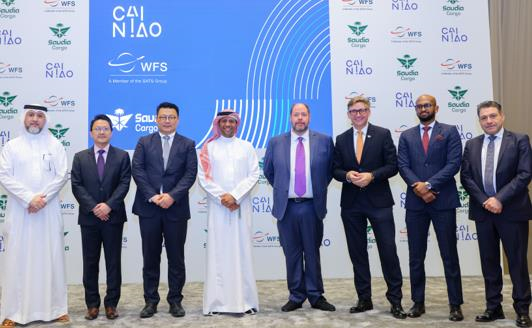
According to data published by market analyst, Transport Intelligence, in their latest Global E-Commerce Logistics Report, the global e-commerce logistics market is expected to grow by 7.9% in 2023, reaching a value of €451 billion. In view of the upsurge of global e-trade, it is not surprising that the air freight industry is experiencing an increasing trend to new collaborations, with those involved wanting to secure as large a slice of the cake as possible. The recently announced alliance between Saudia Cargo, Cainiao, and WFS, is an expression of this dynamic business segment.
L > R: Marwan Niazi, VP Commercial, Saudia Cargo / Thomas Yu, Sr. Director, Global Hub Ops and Product Development, Cainiao Group / Eric Xu, VP of Cainiao Group / Eng. Loay Mashabi MD, Saudia Cargo / John Batten CEO EMEAA, WFS/SATS / Teddy Zebtiz, CEO Saudia Cargo / Mohanned Badri, VP Ops, Saudia Cargo / Assaad Sfeir, Key Account Director, Group Commercial, WFS/SATS – courtesy: Saudia Cargo.
Online shopping is increasingly replacing the traditional brick and mortar business. A walk through the centers of many European cities, illustrates this. Plenty of stores flocked to by shoppers in the past, are now closed. E-commerce can be blamed. And things are likely to get even worse for store owners, as more and more people are using the internet to shop and have their orders delivered to their doorstep by courier companies.
Business interests converge in Liège’s warehouse What does this have to do with Cainiao, Saudia Cargo, and WFS? At first glance, nothing, but a closer look reveals – a lot. The three actors are the link between manufacturers and consumers, and their services ensure that online shoppers receive their goods as quickly, cheaply, and conveniently as possible. The close cooperation between the three companies that has now been announced, includes another player: Liège Airport in Belgium. The transportation giant, Cainiao, which was founded in Hangzhou in 2013 and belongs to the Chinese Alibaba Group, operates a large warehouse there. Saudia Cargo had its shipments handled there by Aviapartner but replaced the ground service provider by bringing in WFS. The Aviapartner successor now manages parts of the Cainiao warehouse and will significantly expand this activity by 50,000 tons per year through close cooperation with the other two partners. This is to take place from 01MAR24 onwards, when the contract concluded between Saudia Cargo, Cainiao, and WFS comes into force.
Paving the way for a seamless flow of shipments In addition to its own freighter fleet, Cainiao will use the capacity of Saudia Cargo’s freighters for the transportation of e-commerce shipments ex Hong Kong, as part of the agreement now reached between the trio. The Saudi carrier serves Liège on average eight times a week, operating B747-400F or B777F, with the HKG flights routed via Jeddah or Riyadh. Thanks to 5th freedom rights, Saudia also connects Liège with New York. “Our collaboration ensures a seamless flow of e-commerce materials from Hong Kong to Liège. With high frequency flights on our Hong Kong to Liege route via Riyadh, we have a significant capacity exclusively dedicated to Cainiao. Utilizing a meticulous process involving pre-built ULDs, we facilitate an uninterrupted supply chain, supporting Cainiao in achieving their key performance indicators,” remarks Teddy Zebitz, CEO of Saudia Cargo.
Upgrading handling practices In a statement, John Batten, CEO, Europe, Middle East, Africa and Asia (EMEAA) of SATS group member, WFS, pointed out that so far, e-commerce shipments have been processed within a traditional air cargo handling environment.With the growth projections for e-trade, the industry response must be more dynamic and tailored, he urged. “And this is what WFS/SATS aims to deliver in Liège working alongside Saudia Cargo and Cainiao,” the WFS executive stated. This three-party collaboration leverages operational excellence skills and requirements from the airline, cargo handler, and e-commerce logistics perspectives. “It will exemplify our commitment to innovation, speed, and real-time information for the future of the e-commerce logistics ecosystem.”
The deal benefits all partners similarly Eric Xu, Vice President of Cainiao Group, spoke of a win-win collaboration that willfurther reinforce Cainiao’s position as one of the world’s leading cross-border e-commerce logistics providers. “Through continuously equipping our Liège eHub with cutting-edge technology solutions, we managed to boost the efficiency of logistics operations while improving customer experience through greater transparency and traceability,” he remarked.
Incidentally, there are also numerous empty stores in downtown Liège.
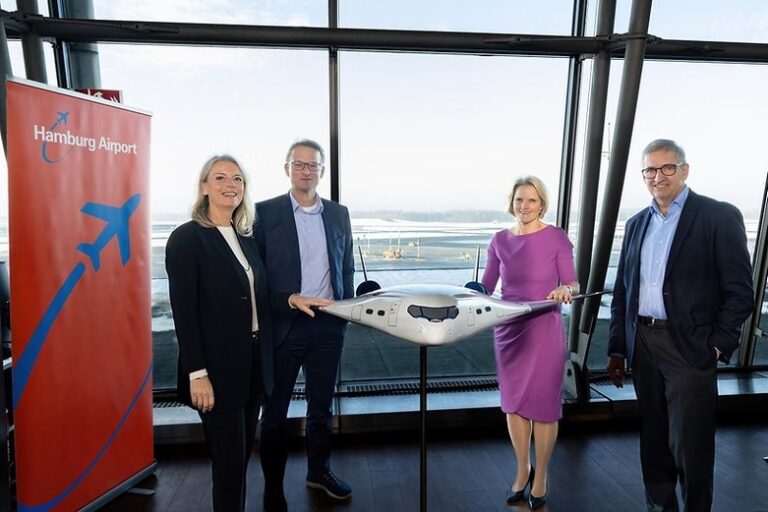
The aim of this initiative is to secure the infrastructure for the use of green hydrogen, so that the planned fleet of Airbus aircraft, which will use hydrogen as a power source in future, can be refueled at a large number of airports. Hamburg Airport is one of the first European airports, alongside Paris CDG, to join this alliance. Other partners are airports in Japan, New Zealand, and Singapore.
Teaming up for an H2ecosystem (L > R): Karine Guenan, Airbus / Christian Kunsch, HAM Airport / Nicole Dreyer-Langlet, Airbus / Michael Eggenschwiler, HAM Airport – courtesy: HAM
The project focus is of paramount importance: to establish a global airport and aviation ecosystem based on hydrogen. Measured against this, the event last Friday (01DEC23), on the Top Deck of Terminal 2 at Hamburg Airport’s snow-covered terminal, was rather matter of fact and atmospherically sober. Four leading aviation managers – two male, two female – signed an agreement to usher in a new era of clean flying. No music. No infotainment. No long speeches. Just coffee and tea and some snacks. Period. After 20 minutes, the official part of the event was over. Probably a short-duration record for such an important project. Given its significance for climate protection, it would have deserved a priority slot on the agenda of the climate conference currently taking place in Dubai.
H2 is the future of socially accepted flying It is a truism that passenger and air freight traffic must drastically reduce CO2 emissions. Synthetic fuels in combination with aerodynamic optimization of aircraft, contribute to this, but they are only a transitional solution for clean flying. The only real way to leave the era of fossil propulsion systems behind, is green flying, i.e. using environmentally neutral hydrogen.
First step: Setting up tailored ground infrastructure At the event in Hamburg, Nicole Dreyer-Langlet, Vice-President Research & Technology Germany, Airbus, confirmed the frame maker’s ZEROe ambitions. Under this project name, a hydrogen-powered passenger aircraft is to be developed and used by airlines from 2035 onwards. Until then, the airports will have to be equipped with the necessary infrastructure. “Only when there is a sufficiently large network of hydrogen airports, will the airlines order the corresponding aircraft and plan utilizing H2 aircraft,” emphasized Michael Eggenschwiler, CEO HAM Airport. “As the first German airport within the global H2 network, Hamburg Airport is also investing in its future role as an important air transportation hub,” added the executive.
Complemented by H2 powered aircraft The city was chosen by Airbus developers to establish an H2-based ecosystem for several reasons. Every second Airbus of the A320 family, including the new, long-range A321XLR, is produced at the local Airbus plant, the second largest worldwide after Toulouse. It is also home to Lufthansa Technik’s headquarters and – located directly opposite – Airbus’ global center for MRO services and material supplies.
However, Airbus has not yet decided which aircraft model the Group intends to launch to start into the age of hydrogen. It will probably be a turbofan propelled aircraft capable of accommodating 100 passengers and covering a range of around 1,800 km. By 2040, the Group plans to produce a larger model for up to 250 passengers, capable of operating 3,700 km.
And what role will air freight play in these plans? On average, cargo contributes between 10% and 15% to the profitability of a flight route. “We always consider technical solutions for carrying air freight with every new development of an aircraft type, including the future hydrogen aircraft,” assured Karine Guenan, Vice President ZEROe Ecosystem at Airbus.
H2 powered aircraft will cover regional routes first Aviation experts are convinced that H2 is the future propulsion energy source, particularly for smaller aircraft to start with. Accordingly, the HAM management kicked off a ‘Baltic Sea Region Project’ in MAY23, to secure the supply of green hydrogen from production to the fueling of aircraft or airport ground support equipment, as well as test operations. This pact includes 16 partners and 24 associated organizations, located around the Baltic Sea, e.g.: Finavia, Swedavia, Lithuanian Airports, Riga Airport, and Tallinn Airport. The project complements the H2 agreement on a regional level, now signed by Hamburg Airport and frame maker, Airbus.
Data Quality is often criticized or seen as an obstacle to shifting to Artificial Intelligence (AI) solutions. “Garbage in/garbage out” as Ashok Rajan (AR), Senior Vice President – Global Head – Cargo & Logistics Solutions at IBS Software, politely paraphrased it, is often the comment encountered in discussions or panels on the topic. Yet is that really still the case in air cargo? CargoForwarder Global (CFG) wanted to know from a man who has been on the pulse of digital developments for the past 25 years. A virtual fireside chat, courtesy of online web-conferencing, looked at AI (and human) evolution.
Humans and AI will evolve together. Image: IBS Software/Perchance.org/CFG
CFG: How clean is data these days? Is that the first hurdle to AI application, and how can change management be encouraged in companies?
AR: Everybody loves an outcome and few care about how you get to the outcome. It takes a lot to get there, however, and the biggest hurdle is data. Missing, incorrect or incomplete data hinders unleashing the full potential of AI. However, cleanliness has come a long way in the last few years helped by that fact that companies have invested in standardized systems and platforms that have enforced cleaner data.
Whilst the one push is a technical one, a change in mindset and the improved perception of value of data is also required. Clean data must be given the same importance as issuing an accurate invoice, for example. No company or customer would accept an incorrect invoice. Data quality needs to be lifted to that same level of awareness, and the topic needs to become part of stakeholder conversations – between airlines, handlers, customers, and others in the chain. It should also be part of executive reviews; how good is our data? How much value are we making out of this data? Data quality has to go up, and it is moving forward. We are no longer at the garbage in/out state. We have moved far beyond that, but still have some way to go.
The approach companies had a few years ago still, was to see how they could allow customers to tender cargo first, and only looking at data at a later stage. Also, systems 10 years ago did not validate data rigorously. Because iCargo and similar newer generation data systems now insist on a far higher standard of data quality since they have to work with it, this is pushing for better quality from the start. And with that, quality awareness in increasing. The next leap will come with mental change. My recent experience is that when Heads of Cargo see the opportunities that come with clean data, this awareness has then influenced mindset changes in the broader organization.
CFG: Where are the barriers when it comes to AI? How does IBS help to overcome / or how does it address multiple messaging standards in the industry?
AR: Quality of data continues to be biggest barrier to really taking the power of AI. Added to that, is the fact that AI-related stuff tends to happen in silos in companies. While companies are now starting to have digital strategies, what is also needed, is an overall data strategy. There is currently still a lack of a coherent strategy across the organization, and data is still something of a specialized subject. There is a shortage of qualified talent who can make sense of data, and this challenge will remain until you have tools that can abstract the complexity and quality. Not enough of the right kind of talent is currently being put onto the topic, however.
From an IBS perspective: we have been trying, in our own software, to insist on the right quality of data. Very little bad data is let in. This slows processes down to begin with, perhaps, but good data is the outcome. We also try to make it bad-data-proof. iPartner, for example, is a set of platforms that sits between systems of the ground handler – who are effectively an extension of the airline and the airlines themselves. Whereas, previously, communication would be via archaic FBL messaging, iPartner Handler enables rich connectivity. Similarly, iPartner Customer, too – offers deeper connection across new age platforms, marketplaces and ONE Record. An API First approach builds bridges with better quality of data and information exchange, instead of relying on an old messaging standard as the only means of data information.
CFG: How can and does AI support quality in processes?
AR: Quite simply: clean input drives clean processes and leads to clean outputs. AI also helps when starting to automate processes that are manual in nature; it takes the human error element out of the equation, and it improves processes by pointing people in the right direction and automating repetitive “scripts”.
CFG: How long has AI been part of IBS Software solutions – where – and what is planned for 2024?
AR: I don’t look at AI as an independent topic, – it is simply a more intelligent way of working with data, and data has been part of our DNA from the start. How we work with data has evolved into different shapes, such as Blockchain, Big Data, Analytics, etc. AI is a natural evolution of this. Currently, what we have done at IBS, is to increase the focus on AI in all our products. We now have a horizontal AI center of excellence, getting the right talent to work on our models. Our cargo line of business takes what this horizontal does and makes it relevant for cargo. Our Revenue Management system in collaboration with Korean Air, is one of the first solutions using AI. Similarly, we are putting our platforms on AI data boosters. For example, booking with an AI booster will enable upselling, offering the right price recommendation. AI should become part of day-to-day operations in everything we do, as we move from data capture to intelligent systems.
We also now use AI in our own processes – for example in development and recording. We work with Microsoft CoPilot, which enables much of the repetitive work to be pre-done, enhancing our own productivity.
CFG: AI versus human relationships – is it a competition or complement to human interaction?
AR: As you wrote in one of your articles: People make you successful.
We sometimes underestimate the human capacity to evolve. 40 years ago, people went on strike because they feared job losses when computers began. And Hollywood often exaggerates the AI vs Human situation. Yet, what will happen is collaborative intelligence where AI and humans work and evolve together. We will learn to make better use of the tools produced. Just like in a Formula 1 race: the best combination is the right driver with the best machine, not an average driver with a great machine or a great driver with an average machine. It’s when both come together, that it results in a win – and it will always be like this.
Therefore, this myth that AI will become more intelligent and take over is just a Hollywood idea. No, we [AI and humans] will both get more intelligent, and we will find better value, too, as manual processes are automated.
CFG: What are the fears about AI, in your experience?
AR: The fears are not the ones portrayed in the movies centered around AI. [Laughs]
Rather they are concerned with the biases in decision making. For example, if companies potentially have a bad way of selling cargo, then AI learns it and does same.
And a fear of implicitly trusting the black box. You send something into the system and something else goes out, which you then don’t question. I fear the adaption to ‘That’s what the machine told me.’ Collaborative intelligence comes into play here; don’t say you’re not responsible for what comes out!
We need to evolve with AI and understand it. It should not be allowed to simply go off on its own – we must actively work towards improving it, at all times. So, ensure that AI is doing the right things and make it improve in the direction you want.
These are the challenges, certainly, but don’t be scared of something taking over the world, as film producers often like to portray as the outcome of AI.
CFG: And wherein lies the excitement? For example, is there such a thing as ChatGPT for air cargo?
AR: My team would love to have ChatGPT in air cargo, reducing thousands of screens into one! [Laughs.]
These are things that evolve. What would be an exciting outcome, is if (or when) the freight industry becomes a truly digital enterprise, and everyone can be connected seamlessly. One where prices are a true reflection of market, where AI can reduce ground time and lead to other, greater efficiencies. The steps towards all this, are exciting as we encounter many shiny, new tools along with way, such as Blockchain, for example: a solution looking for a problem – not the other way around. The stages moving us in this direction, are where the excitement lies.
CFG: As a participant in the recent IATA ONE Record HaQathon in Doha, what is your take on Hackathons?
AR: What hackathons do, is keep the conversation alive. We have an IBS Cargo Forum every 6 months, which features a dedicated track on ONE Record. As a group, together with airlines and handlers, we can move this initiative forward. We are active in our own community, too. ONE Record needs to become part of daily conversation – moving one step at a time towards genuine value-add and driving processes, rather than simply another Cargo XML and ‘old stuff in new bottles’, as it were. Everything in Doha was aligned to value extraction rather than pushing standards.
And that is what AI and digitalization should all be about – not about implementing a standard, but about changing the way we operate – in terms of the right business. Does this help to ensure clean data? That is the first win and the basis for allowing us to truly operate seamlessly as opposed to half-blind.
CFG: Thank you, Ashok, for your insights and your time!
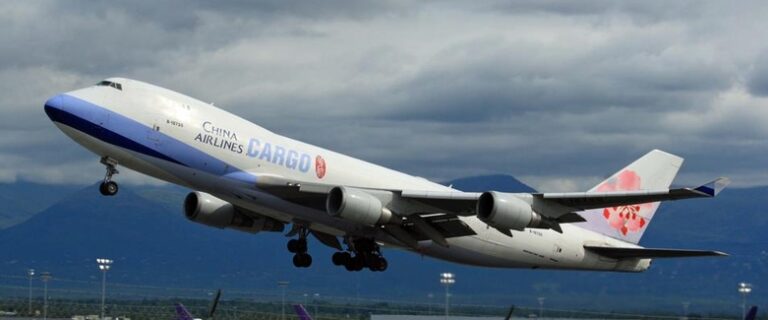
The FAA has found that all Boeing 747 variants from the B747-100 to the B747-8 are inadequately protected against lightning strikes. This applies both to passenger and cargo versions of the highly successful model built by the U.S. manufacturer. In a directive (DOC: FAA-2023-2228 / AD-2023-01095-T), the U.S. regulator, Federal Aviation Administration (FAA), has now instructed all operators of the aircraft to inspect lightning protection features in the fuel tanks of all B747 variants.
Up to 500 Boeing747 variants are still in services or stored at airports, like this aircraft belonging to Shanghai-based China Cargo Airlines – company courtesy
The directive was issued following reports from Boeing that lightning protection components in the engine fuel systems of this aircraft are degrading faster than expected. As consequence of this warning, the FAA has informed all B747 operators that this is “an urgent safety issue, as all lightning protection features of the fuel supply system now have evidence of compromise.” FAA’s document further reads: “The lightning protection features for the engine fuel feed system could fail without being detected [during routine checks, HS].” Flights at an altitude between 8,000 and 12,000 meters are particularly affected.
Explosions cannot be excluded The risk involves components designed to prevent sparks in the fuel tubes that penetrate the B747’s fuel tanks. During inspections, Boeing technical experts detected that the “bonding jumpers”, responsible for creating safe paths for electricity, are failing at an excessive rate. The malfunction of these components could result in a lack of lightning protection, which, combined with flammable fuel vapors, might cause fuel tanks to explode. “This cannot be excluded,” warns the FAA.
The Airworthiness Directive comes into effect on 15DEC23. Operators of B747s will have 90 days to inspect their passenger variants and 120 days for the cargo versions. Further inspections must be carried out annually.
Almost 500 B747s are still in service or mothballed at airports The FAA’s directive is considered a final order, indicating the urgency of the situation. It applies to a total of 211 B747 aircraft registered in the U.S., and hundreds of B747 variants registered elsewhere, from the aging B747-100 variant to the modern B747-8.
In total, there are 495 B747 aircraft in service or stored worldwide, with Atlas Air Worldwide Holdings and its affiliates, particularly Polar Air, operating the largest fleet, consisting of 56 units. Other U.S. carriers with considerable B747 fleets include UPS (41), Kalitta Air (24), and National Airlines (8). In Europe, Cargolux is a main operator of B747 freighters. Further east, Silk Way West Airlines relies on Jumbo freighters, so do Cathay Pacific, Japanese carrier ANA Cargo, Emirates SkyCargo, and Air China Cargo, to name but a few.
The inspection that has now been ordered, also affects the last two jumbos built and delivered by frame maker Boeing: B747-8 freighters delivered to Atlas Air in FEB22, and operated under an ACMI contract by logistics giant, Kuehne+Nagel.
The new president, Javier Milei, wants to privatize the national airline and place it in the hands of the approximately 12,000 employees. The result would be a publicly owned company as established by Eastern European states during the era of the Soviet Union. The fact that these public firms were not productive and failed to cover their costs, has probably not yet come to the ears of the newly elected Pampa populist and Trump supporter. In any case, alarm bells began sounding at the management of Aerolíneas Argentinas after Milei’s electoral victory was officially announced.
“Nothing that is done by a state can be considered efficient,” trumpeted Milei time and time again during his sometimes bizarre electoral campaign. Only hours after winning the election, he declared in the presidential villa, Casa Rosada, in downtown Buenos Aires, that he wants to put his words into action, by laying the fate of Aerolíneas Argentinas and the energy company YPF into the hands of their employees. “YPF has to be privatized, like Aerolineas. They have an exorbitant number of political posts. That doesn’t work that way,” declared Argentine’s new leader.
Under state control for 15 years According to Milei, Aerolíneas Argentinas currently reports losses of USD 2 million per day and accumulates liabilities of USD 8 billion. In this sense, Milei pointed out that “Aerolíneas is one of the most scandalous cases. It should not be in the hands of the State, then it will never be financially sound. Hence, I am going to privatize it,” he declared. The debt-ridden airline has been under state control since 2008. It previously belonged to the Spanish Grupo Marsans and became a member of the SkyTeam alliance and its freight arm SkyTeam Cargo, in 2013.
And he added: “Let’s discuss the methodology: the company is expensive, and it is absolutely unfair because the deficit is paid by those who cannot fly, for the benefit of those who do fly and those who belong to the company. Besides, there is a network of unions. So, I’ll hand over the airline to the employees, and it will be their responsibility to manage it properly or fail.”
Fleet renewal at stake According to market experts, these considerations are based on an ideology of market liberalization and could turn out to be extremely risky. “Without strong investors, the intended expansion and modernization of the fleet cannot be financed,” an expert told CargoForwarder Global. The same applies to the ground and cabin service, and the network for passenger and cargo transportation cannot be expanded because experience shows that each additional route takes a year or even longer to become profitable.
Presenting the latest financial results, Pablo Ceriani, CEO of the national carrier, pointed out that the airline is still in the red, but has successively reduced its losses following the covid pandemic. He said that today’s Aerolíneas is a more efficient company, generating direct and indirect income, benefiting staff and clients. “This, we achieved by opening new routes, flying more, and incorporating new business units.”
A strategy that might come to a halt once the far-right populist Javier Milei is sworn in.
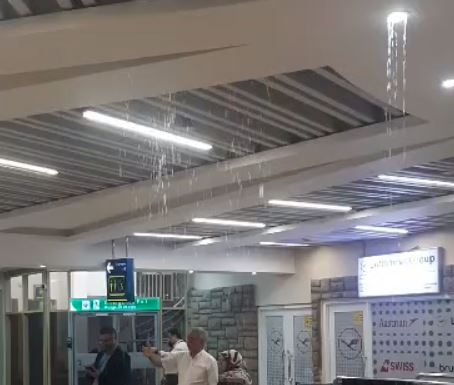
Inside the airport: masses of water wherever one looked. Check-in personnel, officials on duty at Jomo Kenyatta International Airport (JKIA), and hundreds of passengers rushed out of the terminals to prevent getting soaked. Was it torrential rain that had collected and penetrated through the roofs and was now splashing down into the international departure terminals 1C and 1E? Or was it a broken water pipe that had triggered the torrents? This is currently being investigated – at the highest political level in Kenya.
“If it goes on like this, we’ll soon have a seaport here and no longer an airport,” a horrified and soaked passenger who had just rushed through Terminal 1C on her way to the departure gate, said sarcastically.
Hundreds of travelers eager to fly off and others that had just arrived at the neighboring Terminal, were facing the same situation. Water everywhere. Meanwhile, Cabinet Secretary, Kipchumba Murkomen has formed a committee to investigate JKIA’s flooding, including the state of the infrastructure of Kenya’s major airports – particularly Jomo Kenyatta and Kisumu International, located at the shores of Lake Victoria. The group of controllers will be headed by Walter Ogolla, Director Kenya Airports Authority (KAA).
A neutral investigation is requested Critics object that this personnel decision calls into question the neutrality of the commission. It would have been better and, above all, more credible to assign this task to an independent expert, claimed a member of the opposing party, Azimio La Umoja. In the presidential election on 15AUG22, Azimio La Umoja was only narrowly defeated by the winner, the United Democratic Alliance, with a difference of 1.46% of the vote.
Was corruption in play? Following Murkomen’s committee announcement, Nairobi Senator, Edwin Sifuna demanded answers by the investigators as to why JKIA was twice hit by floods within a timespan of just 5 years. The controllers should also provide the names of the contractors involved in the maintenance of the two airports, he urged. In addition, he asked the committee “to provide the identities of public officers who certified the construction and maintenance works as completed, outlining the actions taken against those responsible for the certification of poor workmanship,” Mr. Sifuna stated, indirectly indicating corruption practices.
Opaque contractual situations
Policymaker Murkomen, who is responsible for transportation in Kenya, blamed former President Uhuru Kenyatta’s regime for the leakages, claiming the contractor brought on board by the previous administration did a shoddy job. “Over the 10 years [of Kenyatta’s ruling, HS], JKIA has suffered inadequate facility and infrastructure upgrades,” Murkomen complained. So far, the government has not published who the general contractor for the construction of the airport building was nor which companies were awarded contracts.
Calamities are nothing new to JKIA The ingress of large volumes of water into parts of the terminal complex last week, was not the first debacle that has hit JKIA. On 07AUG13, a fire engulfed the airport, forcing the suspension of international passenger flights and choking a main travel gateway to east Africa. Although many international passenger flights were diverted to Mombasa and some other airports, the blaze stranded thousands of travelers at NBO. Shippers of temperature critical perishable produce, mainly flowers, feared for their export-driven business, a leading source of foreign currency earnings for Kenya alongside tea exports and tourism.
However, last week’s flooding only affected the air freight business marginally. Cargo is handled in a separate area of JKIA, a few hundred meters away from the passenger terminals. Only lower deck transport capacity was temporarily down due to the diversion of most international passenger flights.
Dubai hit by heavy rainfall as well Over at the United Arab Emirates, multiple flights had to be cancelled last Friday (17NOV23) due to heavy rain and thunderstorms. Thirteen inbound flights had to be redirected to other airports, while six outbound flights were cancelled, a speaker of Dubai Airports told local agencies. The airport operator advised passengers to use the Dubai Metro, check traffic updates and give themselves plenty of time to reach Dubai International Airport, in addition to checking for flight updates online. There is no official information on whether cargo flights were also affected by the extreme weather conditions. In the meantime, the torrential rainfall has stopped, and climatic conditions have returned to normal.
An intriguing question popped up on TIACA’s LinkedIn feed in the run-up to its recent Executive Summit: “Are you under 40 and headed to the #ExecutiveSummit2023? Want to make your mark within the air cargo industry?” It headed an invitation to a “Cargo Collective” evening event on 06NOV23, hosted by Sara Van Gelder, Michelle Lawrence, and Sam Quintelier, and told of a mission “to inspire the next generation and empower the future of air cargo”. By all accounts, the evening was a complete success. So, what exactly is the “Cargo Collective”? CargoForwarder Global wanted to know, and asked the three founders to put their explanation into writing. Here it is:
Meeting for the first time at the Cargo Collective in Brussels, 06NOV23. Image: Cargo Collective
Uniting the future of Air Cargo In a move to foster inclusivity and diversity within the air cargo industry, Cargo Collective has recently launched with a mission to empower individuals from a wide range of backgrounds, who are new to the industry. This initiative marks a significant step towards breaking down barriers and creating opportunities for the next generation. The idea for the initiative was born in the wake of the last Air Cargo Forum in Miami and has since then ripened in the heads of its founders, Sara Van Gelder, Michelle Lawrence, and Sam Quintelier. One year later, it was time to go live!
Representation and empowerment “Our mission is to, on the one hand, empower individuals from diverse backgrounds, who are new to the industry or under-represented,” says Sara Van Gelder. “Through a global community of members and partnerships with industry events, we want to provide the support and networking opportunities necessary to grow personally and professionally. On the other hand, we want to actively collaborate with industry events, by sharing ideas on how they can help lower the barriers for the next generation to attend events and build their network. We could help the organizations with attracting alternative speakers and attendees who can bring new views, fresh ideas, and more diversity”.
The air cargo industry has long been perceived as a sector with limited accessibility, especially on the management and executive level. This is often dominated by individuals with specific backgrounds and experience. Recognizing the need for change, Cargo Collective aims to remove those barriers and provide a platform for young people from diverse backgrounds to enter and thrive in our industry.
Inclusivity and community “Our focus is on inclusivity; so, to not only be opening doors for newcomers, but also actively working to create an environment that values and celebrates differences.” says Michelle Lawrence. “By fostering a culture of diversity, the organization believes that it can contribute to a more innovative, dynamic and future-proof air cargo industry.”
Cargo Collective’s primary goal is to empower individuals who are new to the air cargo industry by providing them with the necessary support and mentorship. We understand that entering a new field can be challenging, especially for those who may not have traditional pathways into the industry. So, having a platform of likeminded people can make a crucial contribution to your development.
“A key aspect of Cargo Collective is recognizing the power of having a community fostering professional growth and development.” says Sam Quintelier. “Through Cargo Collective, we want to create a supportive network where individuals can connect, share experiences, and learn from one another.”
Introducing the industry to potential talent “When launching Cargo Collective, we were armed with a set of initial initiatives but while we brought forward some well-thought-out ideas, we understand the importance of creating a space where the voices of our future members can shape the narrative.” Sam goes on to say. “Yes! We really aim to avoid smothering them by going for a bottom-up approach, encouraging members to actively contribute their ideas, inputs, and requests.” adds Michelle. “One of the first initiatives includes a short video series where we feature some of our members’ individual stories on why they are attracted to, and stay, in our industry. By sharing their stories, we aim to attract talent. We are also thinking about public speaking coaching sessions, on- and offline debate sessions, a communal calendar to facilitate in-person meetings at industry events, etc.”
“We believe that the true strength of our collective lies in the diversity of perspectives and experiences within our community. By embracing an open dialogue, Cargo Collective seeks to create a dynamic and responsive environment that evolves in sync with the needs and aspirations of its members, ensuring that the initiatives undertaken truly resonate with the diverse voices within the air cargo industry.” Sara concludes.
Everyone welcome! The group predominantly consists of individuals under the age of 40, however, it warmly welcomes individuals of all ages who share a passion for the cargo industry and are eager to contribute their unique perspectives as mentors and contributors. A diverse membership base is one of its greatest strengths.
Cargo Collective’s launch could be a turning point in our industry, signaling a commitment to change and progress. By empowering individuals from diverse backgrounds, it is not only contributing to a more inclusive industry but also unlocking untapped potential and talent. As Cargo Collective takes flight, it brings with it the promise of a more vibrant, dynamic, and equitable air cargo industry for all.
Sara Van Gelder, Michelle Lawrence, and Sam Quintelier
Editor’s note: Those wanting to know more about Cargo Collective, are encouraged to either leave a comment below, join the Cargo Collective LinkedIn page: https://www.linkedin.com/company/air-cargocollective/, and/or contact the three founders via LinkedIn message.