Board member Pierre Dominique Prümm will leave airport operator Fraport AG on 30JUN26. Neither he nor Fraport’s press office has disclosed a reason for this surprising move. His employment contract would have remained valid for several more years, but given that his resignation takes effect shortly, insiders suspect he has received an attractive job offer from the private sector.
The company’s announcement is rather brief: “Dr. Pierre Dominique Prümm, Executive Board member of Fraport AG and Chief Technical Officer will leave the company on June 30, 2026, by mutual agreement with the Fraport Supervisory Board. The Supervisory Board thanks Dr. Prümm for his many years of service to Fraport AG and wishes him all the best and every success for the future.”
Dr. Pierre Dominique Prümm
Two decades at Fraport Prümm has been with Fraport since 2006 and has been a member of the Executive Board since 01JUN2018. His primary area of responsibility in this role was the Aviation segment, which is considered by far the most important business unit of the Group. He lost this responsibility to Dietmar Focke as part of a new division of responsibilities. Focke came from Lufthansa Cargo and was appointed Chief Operating Officer (COO) by the FRA Supervisory Board on 01May2026. Since then, he has been heading the Aviation and Ground Services divisions which had been divided until that day but were merged under his leadership. Whether the loss of the Aviation segment prompted Prümm to seek new professional opportunities outside the Fraport Group is a matter of speculation. Perhaps he was also hoping, according to internal sources, to become the successor to CEO Stefan Schulte. Schulte’s contract ends in August 2027, though an extension – even if he wanted one – is not possible due to internal labor law provisions. With Prümm set to leave and Schultes stepping down in just over a year, Fraport will need to make efforts to find suitable successors for its top deck. Good times are on the horizon for recruiters!
Well-respected executive Both internal and external voices regret Prümm’s departure. He is a manager who has been deeply committed to the air cargo sector and has always sought dialogue with the industry, according to a ground handling agent who plays a key role in Frankfurt. An airline manager praised the initiative of Prümm and his team in establishing strategic cargo partnerships with Shanghai Pudong and Bangalore airports and in driving forward the development of new areas northwest of the airport, where 150,000 square meters have been allocated for air cargo.
UAE-based logistics operator, DP World, is focusing on expanding its air cargo movements and to that end, has now also secured IATA certification for its freight forwarding operations in Panama, following on from Brazil’s certification in 2025. The certificate is awarded once IATA has assessed that a company meets all of its global standards for safe, secure, and efficient air cargo handling. This milestone achievement fits into DP World’s broader strategy of building fully integrated, end-to-end logistics solutions that connect air, ocean, and inland transport across major trade corridors. Panama is a natural fit for this ambition, sitting at one of the world’s most strategically important crossroads for global trade. Which is why DP World also recently launched a customs-bonded warehouse in Panama to improve cargo consolidation and distribution. With these infrastructural investments, customers can now enjoy greater flexibility and speed in shipment handling across multimodal supply chains throughout Latin America.
Now IATA certified to ensure correct air cargo handling. Image: DP World website
Earning the certification required a thorough assessment of DP World’s infrastructure, safety and security protocols, traceability systems, and regulatory compliance. The evaluation specifically confirmed adherence to IATA Resolution 813zz (the Cargo Intermediary Agreement for Latin America), Resolution 833 covering “Ready for Carriage” requirements, and IATA’s Dangerous Goods Regulations governing hazardous materials.
With Panama now IATA-certified, DP World can offer customers direct access to major airlines and global trade routes across the Americas – reinforcing its position as a trusted, internationally compliant logistics partner supporting regional trade growth.
Manuel Martínez, CEO of DP World in the Dominican Republic, said: “This certification reflects our continued focus on building a reliable, standardized, and highly competitive logistics platform across the Americas. Aligning our freight forwarding operations with IATA’s global standards strengthens our ability to support customers with secure, compliant, and efficient air cargo solutions that complement our broader port and logistics ecosystem.”
Volvo Autonomous Solutions (V.A.S.) and global logistics provider, DSV have launched autonomous freight operations in Texas, marking a notable milestone for self-driving freight in the United States. The partnership kicked off with the first commercial truckload hauled by the Volvo VNL Autonomous – a truck built from the ground up for autonomous long-haul operations and powered by the Aurora Driver self-driving system. Initially, V.A.S. is running autonomous transport services for DSV on the Dallas-to-Houston corridor, connecting Aurora’s terminals along one of the country’s busiest freight lanes. The trips are being integrated directly into DSV’s existing logistics flows, with a safety driver present in the cab during this early operational phase – consistent with V.A.S.’s current deployment standards.
One of Volvo’s autonomous trucks. Image: DSV
Central to the collaboration is V.A.S.’s Autona/freight solution, an end-to-end autonomous transport ecosystem that combines the Volvo VNL Autonomous truck with self-driving technology from both Aurora and Waabi, alongside the operational systems needed to manage autonomous freight at scale. V.A.S. brings substantial real-world experience to the table, having logged over one million miles in regional and local freight operations since 2023.
For DSV, the partnership demonstrates how autonomous transport can be woven into large, complex logistics networks to boost efficiency, improve asset utilization, and build supply chain resilience. Both companies share the ambition of expanding to additional lanes over time, using day-to-day operational learnings to guide responsible, performance-driven growth in autonomous freight.
Helmut Schweighofer, CEO, DSV Road, stated: “Autonomous driving is moving towards real-world operations. Our collaboration with Volvo in Texas represents a production, depot-to-depot setup. We see clear opportunities to improve safety and driver comfort, help mitigate a growing driver shortage, and unlock better asset utilization through 24/7 operations for the benefit of our customers.”
Sasko Cuklev, Head of On-Road Solutions at V.A.S. explained: “Logistics providers like DSV are an important customer group for Volvo Autonomous Solutions, and DSV is at the forefront of how autonomous transport can be applied in real logistics networks. Starting between Dallas and Houston, we plan to move freight together in a way that supports round-the-clock operations and creates a scalable foundation for adding more lanes over time.”
Qatar Airways Cargo published its latest network enhancements last week, which show that it is significantly strengthening its worldwide reach, not only in resuming operations on certain routes, but also announcing new destinations and frequency increases. Together, those changes amount to a 12% increase in cargo capacity across the carrier’s network.
The carrier is expanding its global network once more. Image: Qatar Airways Cargo
Headline additions include two new passenger destinations – Caracas, Venezuela, and Bogotá, Colombia – launching 22JUL26, with twice-weekly flights. Qatar Airways becomes the first airline to operate belly-hold cargo flights from the Middle East to both South American capitals, offering 20 tons of capacity each way per week.
On the freighter front, Boeing 777 freighter services to Vienna are recommencing, integrated in the Doha–Budapest–Vienna–Doha route. Warsaw (via Budapest) is being increased to two B777 freighter flights. Vienna grows from 4 weekly flights to 7 passenger flights per week (73 tons), plus 100 tons of weekly freighter capacity, while Warsaw now offers 273+ tons of combined weekly capacity each way. Other route resumptions further bolster the network. Helsinki returns on 25JUL26, and Tokyo Haneda on 16JUL26 – each launching with four weekly passenger flights before scaling to seven weekly from 01AUG26.
Capacity ramp-ups are happening in every region. São Paulo reaches 479+ tons of combined weekly capacity with 14 passenger flights and four freighters. Hong Kong commands a dominant 4,474+ tons weekly through 42 freighter rotations and boosted passenger services. Amman and Beirut each double their passenger frequencies to 14 weekly flights, while Dammam, Dhaka, and Kathmandu see sharp frequency increases across Asia and the Middle East.
“Strategically located at the crossroads of global trade, Hamad International Airport serves as a critical hub connecting East and West,” the carrier noted, emphasizing its position as the world’s leading air cargo carrier. All capacity is bookable via Qatar Airways Cargo’s Digital Lounge e-booking platform or through local sales teams.
The carrier was involved in the return of a piece of Hawaiian History: the ‘Ahu’ula. This is a centuries-old, traditional Hawaiian feathered cape belonging to Chief Keaoua Kekuaokalani, who fell during the Battle of Kuamo’o in 1819. Long held at the Smithsonian Institution in Washington, D.C., the cape was finally returned to Kona, Hawaii, in MAY25 as part of a broader repatriation process governed by the Native American Graves Protection and Repatriation Act – a significant moment for the Hawaiian community and its living connection to that history.
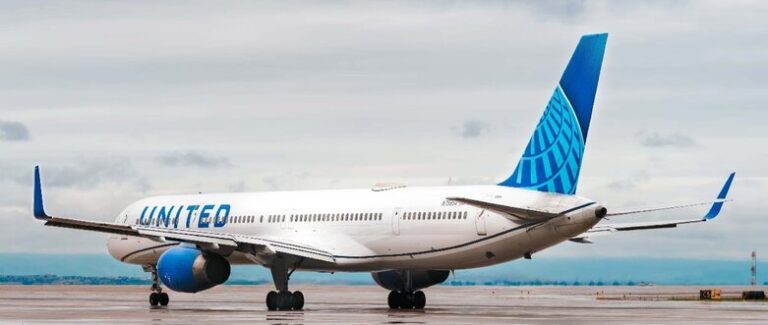
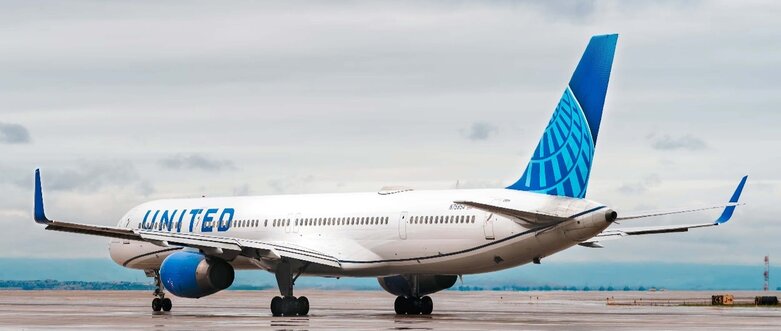
Also on board: a historically and traditionally important artifact. Image: United Airlines
Transporting the cape was never going to be straightforward. Cultural protocol was non-negotiable: the ‘ahu’ula had to travel directly to Kona on Hawaii Island, with no inter-island transfers that could introduce additional handling or risk. United Cargo was the only carrier able to deliver on that requirement, routing the shipment from Washington Dulles through Denver and onward directly to Kona – an extraordinary itinerary deliberately chosen to keep touchpoints to a minimum.
The cape traveled under United Cargo’s UASecure service, a specialized solution built for high-value and irreplaceable shipments. Real-time coordination, secure handling, and close collaboration with all stakeholders kept the artifact protected and accounted for at every stage. “UASecure was developed to manage what cannot be replaced,” noted the team – a principle that found its clearest expression in this particular shipment, where precision wasn’t simply a professional standard but a cultural obligation.
Ben Scott, Cargo Sales Account Executive at United Airlines, admitted: “We happened to have the perfect routing at the time – it fitted exactly what was needed. For protocol reasons, it was important for the shipment to go directly to Kona rather than through Honolulu. This wasn’t just another shipment. It was about returning a piece of history to where it belongs. Being part of that was incredibly meaningful. It reminded us that, at United Cargo, we don’t just carry cargo, we connect cultures and communities. Every shipment tells a story.”
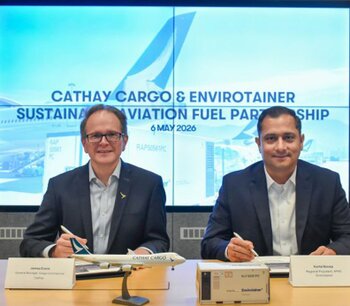
Cold chain specialist, Envirotainer, and airline, Cathay have taken a concrete step toward greener logistics, by opting for SAF on pharma shipment routes. The agreement sees Envirotainer join Cathay’s Corporate Sustainable Aviation Fuel (SAF) Program – one of Asia’s most established initiatives of its kind. Under the deal, Envirotainer commits to purchasing a minimum of 100 tons of verified emissions reduction claims, the equivalent of roughly 12,000 US gallons of SAF used within Cathay’s flight operations. Cathay’s program works by deploying certified SAF across its network and then allocating the associated environmental benefits to corporate partners according to a recognized industry attribution model. For Envirotainer, this is a meaningful way to begin tackling the Scope 3 emissions tied to its global shipments – the indirect footprint that comes from transporting temperature-sensitive medicines across continents on behalf of pharmaceutical clients.
Partnering with Cathay for cleaner skies. Image: Envirotainer
Aymeric Chandavoine, Chief Executive Officer at Envirotainer, emphasized: “Reducing emissions across our supply chain isn’t a future ambition – it’s an immediate responsibility. This partnership with Cathay allows us to actively accelerate the use of sustainable aviation fuel, proving that you don’t have to choose between sustainability and the safe, reliable delivery of life-saving pharmaceuticals.”
Kuntal Baveja, Regional President APAC at Envirotainer, commented: “Asia Pacific is more than a key market for us – it’s a region of growing focus for sustainable pharmaceutical logistics. By joining Cathay’s Corporate SAF Program, we’re taking a decisive step to reducing emissions at scale, while continuing to deliver the precision and performance our customers depend on.”
Dominic Perret, Director Cargo at Cathay, added: “We view sustainable aviation fuel as one of the most effective levers available today to support aviation’s decarbonization, but scaling it meaningfully requires more than just airlines’ efforts – it requires collaboration across the entire air cargo value chain. Through our Corporate SAF Program, we work with like-minded partners like Envirotainer to support the adoption of SAF, helping to accelerate progress towards a more sustainable future for air cargo.”
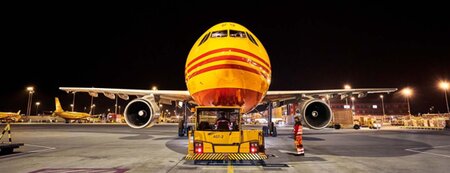
DHL Express rolled out three significant developments this spring. Launched in MAY26, across eight markets, DHL Express’ new AI-powered item identification tool is a first for the global express industry. Shippers simply photograph their item on any smartphone, and a computer vision model instantly generates a customs-compliant description – no specialist knowledge required. The result is cleaner data at the point of entry, fewer customs holds, and faster clearance. No DHL account is needed to use the feature, keeping the experience accessible to occasional shippers and high-volume customers alike. A broader market rollout is planned throughout the rest of 2026.
Busy on a number of fronts. Image: DHL Express
Dirk Olufs, EVP & Global CIO at DHL Express, said: “Computer vision is now live for customers across multiple markets, but what matters most is the impact. […]: cleaner data [,] fewer holds, faster clearance, and a better outcome for the customer.”
Enna Zarate, Senior Vice President, Digital Customer Solutions at DHL Express added: “The item description field was not a minor inconvenience – it was a critical moment where the customer experience broke down. This AI feature is a direct response to customer feedback.”
Also announced in MAY26, Heavy Weight Express (HWX) extends DHL Express’ Time Definite International portfolio to shipments up to 1,000 kg per piece and 3,000 kg per shipment – served across more than 220 countries. The service targets industries where delays carry serious financial consequences, including automotive, life sciences, technology, and energy. Dedicated Heavy Weight Priority Desks provide proactive monitoring and direct customer communication for every shipment, while all-in pricing eliminates the rate volatility that often plagues conventional air freight. With DHL managing its own aircraft, hubs, and last-mile delivery, the promise is end-to-end reliability even during periods of constrained capacity.
DHL Express CEO, John Pearson, commented: “As industries face rising volatility, increasingly complex production cycles, and significant financial exposure from delays and supply chain disruption, DHL’s ability to offer express-level speed, access to capacity and higher reliability for shipments up to 3,000 kilograms fundamentally changes the service levels that customers can expect from their logistics provider.”
Rounding off the news trio, DHL Express signed a ten-year offtake agreement with Dubai-based SAF One, securing 25,000 metric tons of unblended sustainable aviation fuel annually from a new production facility in Bahrain – the first of its kind in the Middle East. Production is scheduled to begin in 2028, contributing toward DHL’s target of 30% SAF usage by 2030. The fuel volumes will be integrated into DHL’s GoGreen Plus decarbonization offering via a book-and-claim model, allowing customers worldwide to offset Scope 3 emissions regardless of which routes their shipments actually travel.
During U.S. President Trump’s recent trip to China, Beijing agreed on the purchase of 200 Boeing aircraft, likely involving the B737 MAX 8 series. Trump himself remained vague, describing them simply as “large aircraft”, while his Chinese counterparts did not comment on a particular variant. However, it is China’s first major order of Boeing aircraft since Trump’s first term in 2017, when Beijing purchased 300 aircraft. Meanwhile, rival Airbus is celebrating an order from an African carrier.
Deal done. China agrees to purchase 200 Boeing aircraft, courtesy: reportika.com
First, regarding the Boeing deal: Despite Trump’s celebratory pose in Beijing, the U.S. aircraft manufacturer’s stock price fell following the announcement, as analysts had expected a significantly larger order volume. And there is no word on whether Boeing CEO, Kelly Ortberg – who was part of the Trump delegation – applauded the verbal agreement reached by both political leaders.
Advantage: Tianjin Market observers, in any case, did not. They had expected an order for at least 500 Boeing aircraft from the Xi Jinping government, including a significant number of wide-body jetliners from the B787 and B777 series. That did not materialize.
The negotiations took place against the backdrop of fierce competition between two industrial heavyweights. Airbus had overtaken Boeing in the Chinese market – the second largest in the world – in the second half of the last decade, and has a strong local presence by running a final assembly line for its A320 family members in Tianjin, China, since 2009. The customers for the jetliners manufactured there are primarily Chinese state-owned airlines.
High demand for new passenger and cargo aircraft Analysts estimate that the demand for new aircraft in China is enormous. Market projections from both manufacturers, updated annually, indicate that China will need 9,000 new commercial aircraft by 2045. COMAC’s own C909 and C919 models will only be able to meet a small portion of this demand, despite ramping up production. And the long-range C919 model is not expected to roll out of the Shanghai factory until 2036 at the earliest.
Almost at the same time as Boeing’s deal with China was aired, rival Airbus announced the sale of 20 narrow-body and six wide-body aircraft to Ethiopian Airlines. The aircraft belong to the A220 and A350-1000 series. The A220, originally designed by Bombardier as CSeries before the Canadian manufacturer was acquired by Airbus in mid-2018, stands out for its efficiency at high-altitude airports – a decisive feature for the airline’s hub at Addis Ababa’s Bole International Airport (ADD), built more than 2,300 meters above sea level. The lower air density under these conditions affects engine performance and lift, a challenge that the A220’s Pratt & Whitney PW1500G engines handle with an operational advantage over other models, states Ethiopian Airlines.
Largest African hub is emerging The A350-1000s offer greater passenger and cargo capacity and are capable of covering very long distances, making them ideal for serving routes between ADD and GRU, EZE in South America, or PEK and even SYD in the Far East/Oceania.
Ethiopian Airline’s fleet expansion is a key component of the airline’s strategic plan through 2035, which centers on the construction of the new Bishoftu International Airport. With an investment of USD 12.5 billion, it will feature four runways and offer a capacity of 100 million passengers per year. Upon completion, Bishoftu will be Africa’s largest hub for passenger and cargo transport. Construction began in JAN26.
This maxim has held true since the days when Albert Ballin was CEO of the Hapag-Lloyd shipping line. In him, the globalization of trade and the exchange of goods found an early and staunch advocate. That was more than a century ago. Yet it remains true today, albeit on a vastly different scale in terms of volume and scope.
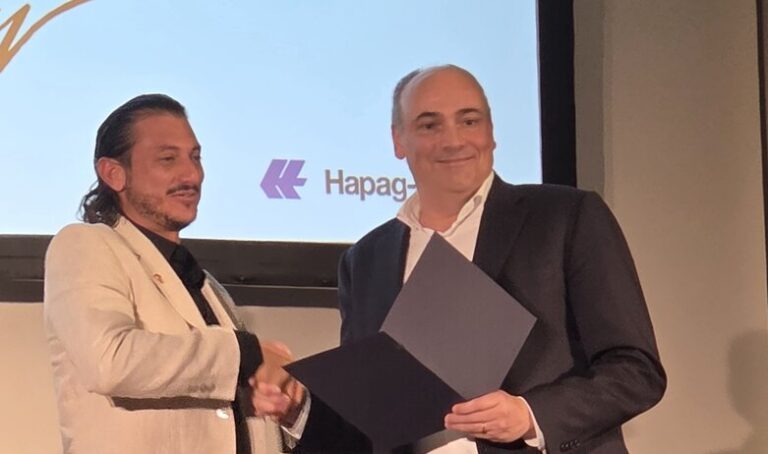
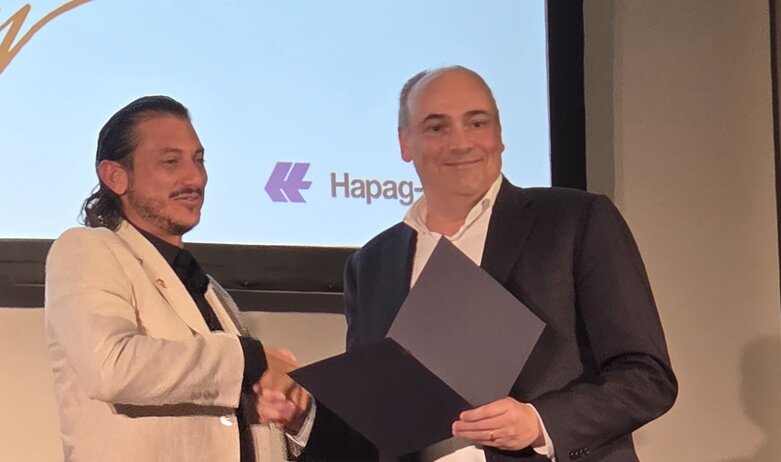
Hapag-Lloyd CEO, Rolf Habben Jansen (right) presents Pedro Salazar of Amigos del Mar with the EUR 50,000 prize for exemplary social and environmental action – photos: CFG/ac
Hapag-Lloyd CEO, Rolf Habben Jansen recalled the long-term benefits of global trade, transport and division of labor for his company in his laudatory speech honoring Pedro Salazar, Founder and Director of the organization ‘Amigos del Mar’. The Colombian self-made man and his initiative were the main recipients of this year’s Albert Ballin Award for Outstanding Initiatives that benefit many, sponsored by Hapag-Lloyd. The award came with a generous prize of EUR 50,000. In addition, three further prizes were awarded to three outstanding young female scientists for groundbreaking pioneering work.
What would the world be without the single, by far most important mode of transport: the ship? An estimated 90% of all goods are transported by sea. Without shipping, supermarket shelves would remain empty, and vital raw materials such as oil, gas, ore and others could not be transported between origins and destinations. Construction materials for hotels planned to be built on an island, for example, would never reach the intended location.
Waste as a raw material Which brings us to the topic of the ‘Albert Ballin Prize 2026’. The fact that Pedro Salazar was awarded the accolade is more a matter of chance. His original goal was to build a hotel as part of a beach club on the island of Tierra Bomba, off the coast of Cartagena, on the Colombian part of the Caribbean Sea. As he explained during the award ceremony, it was a child begging for food and beverages shortly after he had arrived at the island, that motivated him to familiarize himself with the location. For Pedro, the encounter was like a door opener to a different future. After careful consideration, he scrapped the hotel plans and founded the organization Amigos del Mar, which became deeply committed to coastal conservation and social development. A video clip played to the invitees at Hapag-Lloyd’s headquarters, clearly illustrated the multitude of initiatives the foundation has meanwhile kicked off.
Setting a positive example The video shows a group of schoolchildren heading toward the beach, some of them carrying surfboards. As the children approach the waterfront, they begin picking up empty bottles, plastics and other waste. Their efforts are part of a project called ‘Olas Paz Programa’ (Clean Wave Project), which collects and transforms plastic bottles and bottle caps into surfboard fins. “The idea was that the people of Tierra Bomba, who had never removed plastic waste from the beach or recycled the items before, would start cleaning the seafront and turn waste into durable goods,” explained Pedro Salazar. In interviews with local media, he admits that “it is difficult in communities facing other challenges, to talk about pollution and try to change their minds on environmental issues”. Meanwhilehis Amigos del Mar have become ambassadors for a cleaner environment that is worth protecting and conserving. Although there is still junk on the island, the amount has been significantly reduced. Above all, however, the commitment of his organization – supported by numerous volunteers – is setting a positive example.
The prize awarded by Hapag-Lloyd will give the Friends of the Sea further opportunities to expand their scope of action, make a meaningful impact beyond the island, and thus contribute to a more respectful approach to nature. This concern was also emphasized in the brief speech by Yadir Salazar-Mejia, Colombia’s ambassador to Germany.
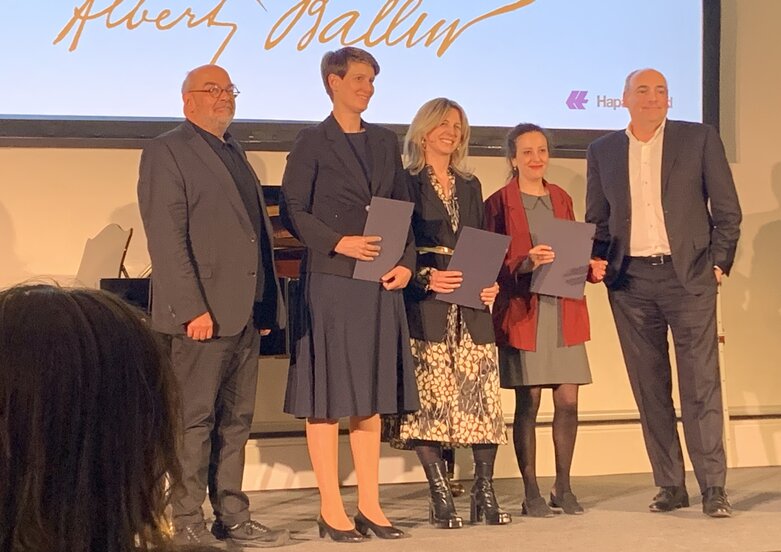
Three more prizes In addition to the main prize, three further awards were presented to young female scholars at the Ballin Symposium. Clara Baumann received an award for her in-depth analysis of Latin America’s shifting dependencies on Chinese investors, which are no longer one-sided. Bertille James examined the European Community’s relations with China between 1978 and 1989, focusing on new expectations and their impact on EC decision-making. Finally, Marlene Gärtner presented her dissertation on the role of narratives in African societies and the consequences for their migration behavior, using Cameroon as a case study. The conclusion in a nutshell: Cameroonians still view Europe as a paradise, even if not every migrant has found happiness there.
The award recipients, who each received 5,000 EUR for their outstanding scientific work (l > r): Marlene Gärtner, Clara Baumann, Bertille James. They are flanked by laudator, Professor Rainer Gries, Sigmund Freud University, Vienna and Rolf Habben Jansen, CEO Hapag-Lloyd.
Each of the award winners received EUR 5,000 for their scientific works.
Every week, CargoForwarder Global’s ‘Spotlight On…’ examines a specific section of the air cargo industry through the eyes of someone working there, to illustrate the many different careers it offers. One important link in logistics are cargo handlers – the operational backbone of the air cargo industry. Positioned at the critical interface between airlines, freight forwarders, and supply chains, they manage the loading, unloading, storage, and documentation of goods moving through airports. Cargo handlers are responsible for the seamless flow of shipments from the forwarder to the airline, and vice versa, ensuring regulatory compliance, dangerous goods safety, and temperature integrity, while maximizing aircraft capacity through precise ULD build-up. Aliaa Almetwally (AA), Project & Continuous Improvement Manager, FCS, takes us through her role and shares her experience and advice for those looking to join the air cargo industry.
Air cargo is a combination of operational complexity, time-criticality, and global impact. Image: Aliaa Almetwally
CFG: What is your current function and company? And what are your responsibilities?
AA: I am the Project & Continuous Improvement Manager at FCS Frankfurt Cargo Services GmbH. I joined in January 2024, at a point when Continuous Improvement had just been introduced at FCS and was still very much in its early days – operating as a consulted, advisory function rather than as an established department. My mandate has been to grow it from there into a structured CI function with its own identity, methods, and rhythm. My focus is clear: remove waste, increase productivity, and create cost-saving initiatives through digitalization, automation, and innovation. In practice, that means bringing Lean Six Sigma into our daily routines through Gemba walks, 5S and Kaizen, building the Operations Library of Standard Operating Procedures, driving automation and AI projects that take repetitive workload off the team, and shaping a performance management approach grounded in facts and continuous measurement. I also coach and train colleagues on CI tools and report to both local management and global headquarters, which keeps me close to the bigger picture across the network.
CFG: What does a normal day look like for you?
AA: In cargo, ‘normal’ is a relative term. My day usually starts with a daily sync meeting with my CI team, where we align on what is on each person’s plate and remove blockers early. After that comes the daily business review call, where I set priorities for the day, give updates on running initiatives, and align with operations on what they need from CI. The rest of the day is a mix of workshops, root cause analyses, AI projects, training, SOP reviews, automation projects, and stakeholder alignment locally and globally. There is always something unexpected that reshuffles priorities, and that variety is exactly what keeps the role exciting.
CFG: How long have you been in the air cargo industry, and what brought you to it?
AA: I joined the air cargo industry in January 2024, so just over two years ago. Before that, I spent close to three years at Amazon as a Continuous Improvement Manager, and my career originally started in mechanical and industrial engineering. What brought me to air cargo was the combination of operational complexity, time-criticality, and global impact. Few industries demand such precise coordination between people, processes, and technology – and that is exactly the environment where Continuous Improvement creates the most value. I wanted to apply my engineering and Lean background somewhere every minute and every kilo really matter, and air cargo delivers that every single shift.
CFG: What do you enjoy most about your job?
AA: I am a result-oriented person, so what drives me is impact: seeing waste actually disappear from a process, productivity going up, and cost-saving initiatives turning into real outcomes on the floor. What makes it even more rewarding is that none of these results happen alone. I enjoy delivering them with the team, because when people are involved from the beginning, they take real ownership, and that shared accountability is what makes improvements stick. Coaching colleagues through change and watching them grow into CI champions in their own right is, on a personal level, the most fulfilling part of what I do.
CFG: Where do you see the greatest challenges in our industry?
AA: I see three challenges that are deeply intertwined. First, digitalization and the smart use of information – our industry generates an enormous amount of operational knowledge every day, but turning it into actionable insight, and integrating AI in a meaningful way, is still a journey for many handlers. Second, knowledge transfer – experienced cargo professionals carry an incredible amount of tacit know-how, and without proper standards, training, and documentation, we risk losing that as the workforce changes. And third, the combined pressure of capacity growth, sustainability, safety, and regulation, which calls for genuine cultural and process change, not just new technology. From where I stand, Continuous Improvement is the connective tissue between all three.
CFG: What advice would you give to people looking to get into the air cargo industry?
AA: Be curious, and do not be afraid to start on the floor – operational understanding is the foundation everything else builds on. On the formal side, the IATA courses (Cargo Introductory) are a great way to pick up the industry’s language and standards quickly. I would also strongly recommend a Lean Six Sigma foundation, at least Yellow or Green Belt, because process thinking is highly transferable in this environment. An openness to digitalization and AI is becoming increasingly important too. And finally, invest in soft skills: communication, change management, and stakeholder management. Cargo is ultimately a people business that happens to move freight.
CFG: If the air cargo industry were a film/book, what would its title be?
AA: ‘The Invisible Network – Around the World Before Sunrise.’ Most people never see what it takes to move a shipment from A to B overnight, but behind every parcel, every pharma container, every piece of mail, there is an intricate, time-critical choreography of people, machines, and data. Part thriller, part documentary – and definitely with a sequel.
Thank you very much, Aliaa.
If you would like to share your personal air cargo story with our CargoForwarder Global readers, feel free to send your answers to the above questions to cargoforwarderglobal@kopfpilot.at We look forward to shining a spotlight on your job area, views, and experiences.