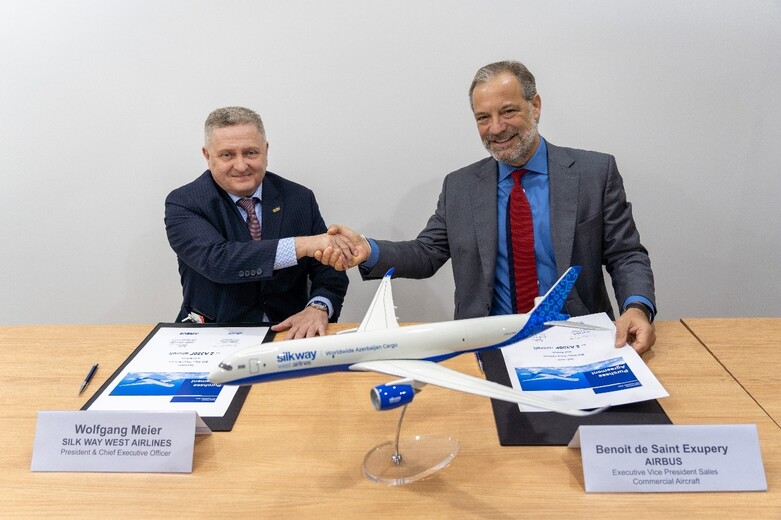
On 19NOV25, Silk Way West Airlines and Airbus shook hands and signed papers confirming the acquisition of a further two A350Fs for the airline, doubling its total order to date. The carrier had previously made history in JUN22, when it became the first operator in Central Asia and the CIS region to sign for the A350F. The move aligns with the airline’s mission to upgrade to a cleaner, greener fleet. The A350F promises a reduction in fuel consumption and cargo emissions of up to 40% in comparison to older aircraft of a similar capacity. It can carry a payload of up to 111 tons, covers a range of up to 8,700 kilometers, and stands out with having the largest main deck cargo door in the sector. Thanks to advanced materials being used to construct its airframe, the plane will have a 46-ton lighter take-off weight than its peers, and is the only freighter aircraft that will fully meet the International Civil Aviation Organization’s enhanced CO₂ emissions standards, which come into effect in 2027.
Wolfgang Meier, Silk Way West Airlines’ President and CEO (left) and Benoît de Saint Exupéry, EVP Sales Commercial Aircraft Airbus. Image: Airbus
Wolfgang Meier, President of Silk Way West Airlines, declared: “We are delighted to extend our partnership with Airbus on the A350F program. This order, bringing our total commitment to four aircraft, marks a major milestone in our company’s growth and reflects our confidence in the future of sustainable air freight. The A350F will strengthen our leading position in the global air freight market as we continue to modernize our fleet and reduce our carbon footprint.”
Benoît de Saint-Exupéry, Airbus EVP Sales Commercial Aircraft, underlined: “This repeat order from Silk Way West Airlines, the largest cargo airline in the Caspian Sea region, is a great vote of confidence at a time when the A350F is physically taking shape in our assembly lines. The A350F will ensure the airline maintains its leading position in the global air freight market and further enables its key role in developing Azerbaijan as a major global cargo hub at the heart of the Silk Road.”
In other news this week, Silk Way West Airlines and Azerbaijan’s national postal operator, Azerpost LLC, signed a memorandum of cooperation to enhance postal and e-commerce logistics. The two companies will join forces to work on international and domestic cargo delivery, mail sorting, warehousing, and logistics optimization, deploying both their expertise and infrastructure, and a joint, 12,000 m² fully-automated e-commerce terminal at Alat Free Economic Zone. Azerpost will use Silk Way West Airlines’ global network for international e-commerce and mail shipments, bringing regular baseload to the airline. Azerpost takes on last-mile delivery, sorting, and handling operations within Azerbaijan.
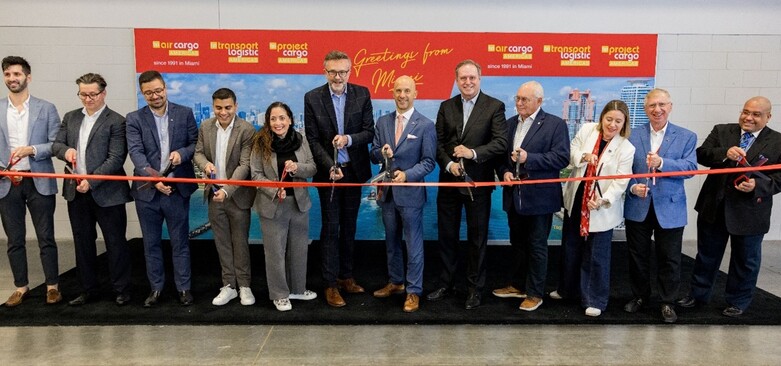
Messe München’s press department reports that the transport logistic Americas & air cargo Americas trade fair in Miami mid-NOV25, saw a total of 6,345 participants over the three days, and received much positive feedback. Held 11-13NOV25 at the Miami Beach Convention Center in Florida, the trade show attracted 143 exhibitors from 24 nations, along with an international audience flying in mainly from Canada, Mexico, Colombia, Brazil, and Argentina. “About one-third of the participants traveled from abroad. Overall, the event exceeded all expectations and established itself as a multimodal logistics trade fair in the U.S.,” the release proclaims. Around half of the exhibitors were from the U.S. For the first time, the event also included a special ‘project cargo’ area focused on heavy-lift, breakbulk, and specialized logistics, with 30 exhibitors and two dedicated sessions in the conference program. Also maritime entered the multimodal chat as a premiere, too. “The exhibition showcased a well-balanced mix of services, systems, and technologies covering road, rail, sea, and air transport. Many exhibitors presented a comprehensive portfolio, and for one in five companies, digitalization was a top priority,” the release explains. “The well-attended forums reflected the high engagement of the logistics community, offering 19 sessions with more than 70 individual presentations.”
Ribbon cutting to open the transport logistic Americas et al. Image: Messe München
Dr. Robert Schönberger, Global Industry Lead at Messe München, reported: “Many key players filled the halls. The more international the business and the more uncertain the times, the more important personal contact becomes. The working atmosphere was truly palpable. Miami has proven itself as a meeting point for the logistics community, and the trade fair served as an efficient hub for networking, with a strong focus on South, Central, and North America. These facts reinforce transport logistic Americas as the leading logistics trade show in the U.S. This trade fair has tremendous potential and will continue to grow in the years ahead. We will continue developing it with the same high standards as transport logistic in Munich. Together with our other international events, it supports global networking and knowledge exchange along international supply chains.”
AERION has positioned itself as a ‘strategic think tank transforming airline cargo management’ and is on a mission to advance the air cargo industry on all levels – from commercial to tech to operational excellence – particularly in specialized logistics. With pharmaceutical transports rapidly rising, and the complexities and regulations surrounding them also growing, a dedicated expert solution was a logical next stop, and Healthc’Air was this summer, under the direction of seasoned pharma expert, Yulia Celetaria, Global Director Pharma. AERION’s dedicated pharmaceutical arm “turns strategic vision into measurable performance,” the press release explains. It combines regulatory expertise, digital innovation, and sustainability within a single, results-driven framework under the mission of ‘Turning compliance into confidence.”
AERION Chairman, Adrien Thominet, on advancing air cargo expertise. Image: AERION
With Healthc’Air, airlines and GSAs have access to modular, scalable solutions ranging from consulting and auditing to certification support, training, and full shipment management. It follows a three-tier model: Launch, Advanced, and Trust. This allows a stepwise approach depending on the airline’s commercial goals, size, and maturity level when it comes to transporting pharmaceuticals. “Healthc’Air instills a true pharmaceutical mindset across the logistics chain from route qualification and risk assessment to training and live performance monitoring. It supports carriers in achieving and maintaining CEIV Pharma certification while integrating real-time AI tools that enhance transparency and compliance. Sustainability is equally central, with initiatives such as route optimization, reusable packaging, and partnerships promoting SAF and low-carbon warehouse operations,” the release reveals.
Adrien Thominet, Chairman of AERION, explained: “AERION was conceived as a strategic hub connecting expertise, tools, and real-world execution. With Healthc’Air, we bring this philosophy to one of air cargo’s most demanding segments. Our goal is to help airlines operate pharma supply chains that are compliant, digitalized, sustainable, and fully aligned with patient safety and operational excellence.”
Yulia Celetaria confirmed: “True pharma logistics success happens when every employee feels confident enough to give the transported medicine to their own family. That’s the standard we set, combining excellence, data intelligence, and human responsibility.”
There is no denying that the Indian Subcontinent is one of the fastest growing air cargo markets on the planet. Already today, ECS Group counts 32 regional subsidiaries in 14 Asian countries, representing over 50 airline partners. And that is set to further develop too, now, under the appointment of Girish Kunder as Regional Manager Indian Subcontinent. In addition to overseeing Globe Air Cargo and AVS’ operations across India and the other Asian markets, the responsibilities include “strengthening airline partnerships, expanding market reach, and accelerating digital transformation to drive efficiency and customer satisfaction”. The latter will be further enhanced through improved digital and operational performance and access to the other factions in Aerion’s global cargo ecosystem, which include CargoTech for one-stop-tech solutions, Healthc’Air for pharma expertise, Mail&More that focuses on e-commerce and postal solutions, and back-office administration services provided by Squair.
Girish Kunder to position ECS Group as preferred GSSA in the region. Image: ECS Group
Girish Kunder, Regional Manager Indian Subcontinent, ECS Group, stated: “Taking on this new role represents both a professional milestone and a mission of purpose. The Indian Subcontinent is a powerhouse for growth, driven by e-commerce, pharma, and digitalization. My goal is to position ECS Group as the preferred GSSA partner for airlines in this region, delivering data-driven solutions that enhance performance and profitability while creating lasting value for our customers.”
Jean Ceccaldi, CEO of ECS Group, said: “Girish’s appointment reinforces ECS Group’s long-term vision to build local excellence backed by global capabilities. India and the wider Subcontinent are critical growth engines for our airline partners. With Girish’s leadership, deep market knowledge, and strong customer focus, we will continue to scale our presence and deliver best-in-class solutions across key verticals such as pharma, e-commerce, and digital logistics.”
If the Logistics Training Center (LTC) wouldn’t already exist, it would have to be invented. Since its founding in 2010, thousands of candidates have completed vocational training courses, educational events or programs to become dangerous goods safety advisors, customs experts and environmental managers. Thanks to LTC courses and seminars, the logistics industry in and around Frankfurt, which suffers from a shortage of personnel, has gained access to a broad, additional labor pool.
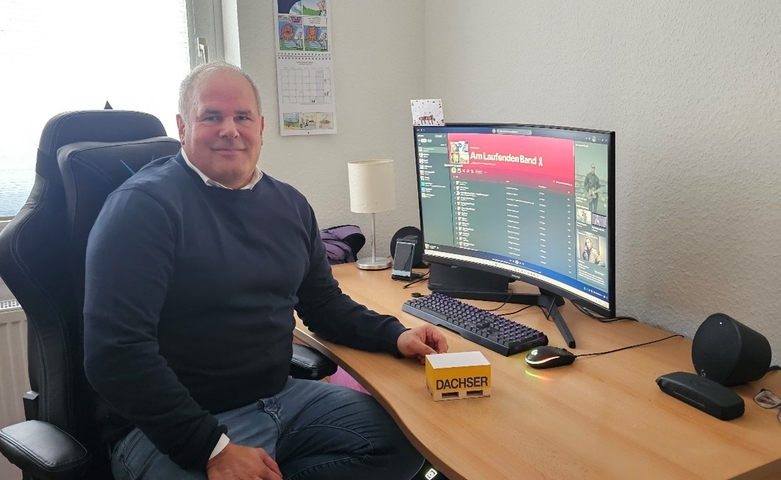
“Our training courses cover an estimated 50% to 60% of skilled workers required by the logistics industry in the Rhine-Main area, i.e., freight forwarders, airlines, and ground handling agents,” states LTC executive, Max Wasser. And just as importantly, “80% of our participants are taken on as permanent employees by the training company after successfully completing their final exams.” This is because two-year programs such as retraining as a freight forwarding and logistics expert, are split into a theoretical and practical part, with the latter module being carried out in cooperation with an external company, preferably the freight forwarders Dachser or Rhenus, as practice has shown.
These 24-month courses are paid for by the Federal Employment Agency, which also covers the candidate’s pension insurance for the duration of the training. Ultimately, this is more successful and probably even cheaper for taxpayers than paying unemployment benefits to people who have lost their jobs for whatever reason. Thanks to this duality of theory and practice, LTC’s courses are very strongly oriented towards real working life. For instance, those who have successfully completed the training are familiar with the dangerous goods classifications in air freight, basic customs regulations, and warehouse logistics. This makes graduates attractive to logistics companies, as demonstrated by the fact that four Polish course participants are now employed by DHL after completing a course on air freight. Or freight forwarder Dachser, which hired course participant, Nils Karry (NK), right after he completed his professional training.
Nils Karry’s career was considerably influenced by the vocational qualification measures of the LTC – photo: private
CFG: Nils, how come you were hired by Dachser?
NK: I was one of 15 attendees on a course in which participants from various professions were trained as freight forwarding and logistics services specialists. Part of the program took place at Dachser’s facility, so both sides already knew each other a little. On my wedding day, Dachser called and told me they wanted to hire me for good.
CFG: It sure was a double reason to celebrate. But looking back, what were the requirements to being considered for this type of training at LTC?
NK: In my case, the employment agency that financed the course required me to have three years of professional experience, which I was able to prove because I had worked for three years straight at a call center for the FAZ daily newspaper in Frankfurt after dropping out of university. However, the FAZ closed the call center, and I was left with no professional qualifications and practically nothing. I then contacted the Employment Agency and together we developed a program to qualify me professionally. To do this, I had to pass several tests and, after an interview between myself and a psychologist, the agency prepared a report on whether I would meet the requirements for the training program. The answer was yes, and I applied to LTC. I have to say that, at that point, I had no specific knowledge of road feeder services, air freight, customs declarations, or sea freight. But I dug into the task since I was motivated to learn something new. At the end, it all worked out well.
CFG: Wasn’t it difficult for you to go back to school again after you were no longer a teenager?
NK: It wasn’t really a big challenge, perhaps because I had attended university but left before graduating due to a parallel professional commitment. In that respect, I was familiar with structured learning. It was certainly more difficult for other course members with limited German language skills. I would like to emphasize that the course was not only very well organized, but the lecturers employed by LTC were highly qualified and responded to each individual course participant on a very personal level. This was not so easy, because overall it was a very diverse group. It included an army veteran who had fought in Afghanistan and a former professional soccer player who wanted to retrain. The four women from Poland mentioned earlier were also part of the group, as were two female migrants from Brazil. In the end, only two of the 15 participants in my course failed the final exam, which was held at the International Chamber of Commerce in Frankfurt.
CFG: So, was the LTC course a turning point in your professional life?
NK: Yes, and not only there, but also in my private life, as my wife and I decided to start a family after Dachser offered me a fascinating job.
Istanbul Airport (IST) is rapidly transforming into a major trans-continental air cargo gateway, linking Europe, Asia and the Middle East through advanced infrastructure, its favorable strategic location and extensive growth metrics. Its ascent not only reflects Turkey’s expanding role in global logistics but also marks a recalibration of freight flows toward hubs capable of supporting high-value, time-sensitive trade into and from Asia.
At the crossroads of Europe, Asia, and the Middle East, Istanbul Airport has become a key transshipment point on Asia–Europe trade routes.
Strategic location and scale Positioned at the juncture of three continents, Istanbul Airport benefits from a unique geography that places it within a five-hour flight radius of many major production centers in Asia, while maintaining direct connectivity with European and Middle Eastern markets. Analysts note that in just five years the airport climbed from 47th to 17th globally in cargo rankings. With 1.97 million tons handled in 2024 (a yearly increase of nearly 40%) IST overtook traditional European cargo hubs such as Frankfurt Airport to become Europe’s busiest cargo airport.
Infrastructure built for high-value flows The airport’s cargo ecosystem is anchored by major investments in terminal and warehousing infrastructure. The “Cargo City” complex spans around 1.4 million m² and is designed to scale to 4.5–5.5 million tons annual capacity, covering cross-dock, cold-chain, and value-added services. One flagship asset is the SmartIST terminal: equipped with high-bay automated storage, pharmaceutical-grade facilities, hazardous goods zones and integrated warehousing management systems. Leading integrators and airlines are anchoring their operations here. For example, FedEx Corporation officially launched its global air transit facility at IST in 2025. The 25,300 m² site, capable of processing up to 7,000 packages per hour, links 30 weekly flights and road feeder services across 45 countries.
Asia-bound focus and logistics chain connectivity Beyond raw tonnage, IST’s appeal lies in its ability to handle complex, high-value and time-sensitive cargo flows, which can indeed be critical for Asia-bound exports. The infrastructure supports temperature-controlled, pharma and express shipments, and its integrated network of passenger and dedicated freighter airlines enables flexible routing. Sources cite growth in e-commerce, pharma and specialized cargo as key drivers. From a routing perspective, IST offers direct freighter and belly-capacity connectivity through Middle East gateways and onward into Asia, combined with road and rail feeder links into Turkey’s broader logistics hinterland. The airport is now being utilized as a trans-shipment point for Asia–Europe and intra-Asia flows alike.
Competitive edge and implications for Europe–Asia trade IST’s rapid growth highlights shifting dynamics in global air-cargo hubs. Lower handling costs, modern infrastructure and fewer capacity restraints give it a competitive advantage over entrenched European airports, many of which face limited space or congested legacy operations. The German Aviation Association (BDL) cited IST’s near-40 % growth in 2024 versus Frankfurt’s 1.2 % as an indicator of structural shift. For companies aiming to reach Asian markets, Istanbul Airport offers more than just transit: it enables shorter ground-time, integrated logistics services and access into Eurasian markets that were previously less efficient via Europe-centric hubs. As such, freight forwarders, integrators and e-commerce platforms are increasingly including IST in their routing strategies for Asia-bound consignments. Looking ahead, the airport has set an ambitious target of exceeding 5 million tons of annual cargo capacity. With foundational infrastructure in place and strategic partners onboard, IST appears well-positioned to become one of the world’s major freight hubs for Asia-bound air cargo in the coming decade.
ISTANBUL AIRPORT FACTS
Performance
1.97 million tons of cargo handled in 2024 (+39% YoY)
Ranked #1 in Europe and #17 worldwide (ACI 2025)
Infrastructure
1.4 million m² Cargo City, scalable to 5.5 million tons/year
SmartIST terminal by Turkish Cargo: among the world’s most advanced automated facilities
Connectivity
85+ airlines linking Asia, Europe, and the Middle East
Strong RFS and rail access supporting multimodal flows
Outlook
Goal: 5 million tons annual capacity by 2030
Expansion of e-commerce and pharma logistics zones underway
Every week, CargoForwarder Global’s ‘Spotlight On…’ gives the stage to a different individual to illustrate the huge variety of roles that make up the air cargo industry. Technology plays a crucial part in bringing efficiency, control and order to our fast-moving, time-defined industry. Belli is one of a number of advanced software solutions providers that focus on replacing outdated manual processes and spreadsheets with end-to-end digital systems that support booking, acceptance, flight planning, load build-up, real-time tracking, billing, and operational insights, for example. This week, Qiao Hui Foon (QF), Senior Product Engineer at Belli, talks about her responsibilities and shares her views and advice for anyone considering a career in the air cargo industry.
Every shipment moved is part of a bigger story. Image: Qioa Hui Foon
CFG: What is your current function and company? And what are your responsibilities?
QF: I’m a Senior Product Engineer at Belli, and we build next-generation cargo management software for airlines. The unique thing that we do here is that we have product engineers do the on-the-ground implementation. This means that airlines are always interfacing with someone who is both (a) experienced in managing a cargo operation at an airline; and (b) comes from a software engineering background. So, my role involves building the product and connecting with airline partners to make sure we’re solving real problems on ground.
CFG: What does a normal day look like for you?
QF: There’s rarely a ‘normal’ day. My day could start with a call with a customer on the other side of the world, then product discussions with my team, and end with a trip to the cargo terminal. The variety is what I love most – whether it’s working on the next big feature or refining workflows based on user feedback on the ground, every day is an exciting challenge.
CFG: How long have you been in the air cargo industry, and what brought you to it?
QF: I’ve been in air cargo since 2022, and what got me hooked, was the opportunity to solve big problems in an industry that isn’t fancy at all. An industry that moves trillions in goods but is still managed with spreadsheets – that contrast made it the perfect space to innovate and to make meaningful impact, and I’ve been excited about it ever since.
CFG: What do you enjoy most about your job?
QF: It’s the small wins. When a cargo agent gets a shipment booked quicker or an airline operations team get their build up done faster because of the software we built, that’s what makes it all worth it. I also love the people – air cargo people are down-to-earth and always open to new ways to improve their work.
CFG: Where do you see the greatest challenges in our industry?
QF: Adoption speed. Many airlines want digital transformation but are constrained by legacy systems, data silos, and fragmented regulations. The challenge isn’t building new tech – it’s implementation and data integration across global operations.
CFG: What advice would you give to people looking to get into the air cargo industry?
QF: Be curious about both logistics and technology. The best people in cargo today understand how freight moves and how data moves. Most things can be learnt on the job, as long as you have a problem-solving mindset.
CFG: If the air cargo industry were a film/book, what would its title be?
QF: ‘Hidden in Plain Sight’. Because in many ways, air cargo keeps the world moving, but not many people notice the cargo going into the bellies of the planes they’re flying on. Every shipment moved is part of a bigger story, all while hidden in plain sight.
Many thanks, Qiao Hui!
If you would like to share your personal air cargo story with our CargoForwarder Global readers, feel free to send your answers to the above questions to cargoforwarderglobal@kopfpilot.at We look forward to shining a spotlight on your job area, views, and experiences.
Brussels Airport (BRU) can develop e-commerce as another commodity within its strategic focus, but fully digitized customs systems are imperative for it to work. That was one of the conclusions of Air Cargo Belgium’s (ACB) Cargo Talks on Thursday, 20NOV25, covered by CargoForwarder Global.
Almost every conference or symposium in the air cargo industry over the last few years has been partially or entirely dedicated to the booming e-commerce market, and ACB’s Cargo Talks were no exception to the rule. Roel Gevaers and Vincent Van Bockstael of the University of Antwerp highlighted the results of the study ‘Air Cargo E-Commerce Strategy for Brussels Airport – Market & Insight’, conducted together with Steven Polmans. According to Gevaers, e-commerce went through an average growth of 14% over the last 9 years, bringing a turnover of USD 5 trillion. China accounts for a volume of 2.8 million tons of which 65% is generated in the Guangdong region. Other products like fashion and apparel items from the industry in and around Zhejiang, are rapidly emerging, but they are not yet airfreighted to Brussels Airport due to missing network connections.
ACB Cargo Talks Panel Discussion L to R: Wendy Luo, Pieter April, Bert Selis, Roel Gevaers – photos: CFG/ms
New platforms emerging To comprehend the superfast penetration of e-commerce in the consumer market, Vincent Van Bockstael demonstrated that Temu surpassed Zara as the world’s most popular fashion brand, almost overnight. Temu, as well as Ali Express and Shein, show huge growth rates, and Tik Tok Shopping has recently been launched in the UK and France. This suggests a further increase in e-commerce flows from China to Europe. In a nutshell: These are the key takeaways of the study presented by Van Bockstael: China remains the primary engine for e-commerce; electronic platforms and marketplaces will increasingly dominate e-commerce logistics; digital data harmonization is becoming critical for future growth and, as far as Brussels Airport is concerned, the reliance on only a few carriers makes the flow of goods very risky, due to the concentration of capacity providers.
Brussels Airport has to adapt to the changing market Even so, in the low-value segment, Brussels Airport is no match for Liège Airport, as e-commerce is only one of many commodities processed there, alongside live animals, perishables or pharmaceuticals, said Pieter April, Brussels Airport’s Cargo Business & Network Development Manager. According to Peter April, the import volumes from China have risen by 30% over the last few years. “Currently, we have 29 flights from China, but we are interested in connectivity to regions in which we are not present yet.”
Pieter April, Cargo Business & Network Development Manager Brussels Airport.
So, the crux of the matter is to adapt the airport to the changing demand, manager April explained. “Apart from getting sufficient imports, we have to boost exports as well, to fill the return flights. We are also optimizing our infrastructure to realize our ‘100 minutes airport’: improving speed, transparency, reliability and digitization to gain and share insights.”
Full digitization is imperative Both Gevaers and April participated in a panel discussion moderated by Transport Economist, Prof. Wouter Dewulf of the University of Antwerp and C-MAT (Centre for Maritime and Air Transport). The other debaters were Wendy Luo, Sales Leader/HEC Paris EMBA/E-Commerce/Supply Chain Bpost, and Bert Selis, VP BD Freight Forwarding & E-Commerce Handling WFS. Speaking from daily practice, WFS executive, Selis, acknowledged that, in Brussels, B2B is shifting away, whereas B2C is expanding considerably. “Yet, sustainable growth is not easy to match with e-commerce and major changes are coming up. Flows can shift very fast,” he stated. Bert went on to say: “Speed is defined by the flow of digital data. Every month, Temu monitors the check-in processes of their consignments everywhere, and they do not really care about your airport. That should be a trigger for Brussels Airport. Fully digitized customs is the most important milestone for Brussels Airport to take between today and 5 years from now.” Wendy Luo of BPostgroup stressed the fact that, for Asian companies, connected data that can be shared and thus allow full visibility, is of the greatest importance. “There is not sufficient connectivity between the shareholders,” she said.
Awards At the ACB Awards ceremony with which the event was concluded, the Customs Administration was granted the Impact Award. In his words of thanks, Regional Director, Bart Vleugels said that digitization was extremely important for the Administration, especially since the EU is putting a lot of pressure on the actors to comply with new regulations.Swissport’s Peter Gysen, dnata’s Johan Rlsier, and Road Air Cargo’s Jan Van Bremt received the title ‘Ambassador of the Year’. Lufthansa Cargo was ‘Airline of the Year’, WFS ‘Ground Handler of the Year’, Jan de Rijk ‘Trucker of the Year’, EV Cargo ‘Forwarder of the Year’, while Ninatrans was awarded ‘Highflyer of the Year’ for its commitment to the air cargo community and ACB.
According to Data Intelo, the global pharma air freight market attained a value of USD 19.7 billion last year and, at a CAGR of 6.2% for 2025 and beyond, is forecasted to reach a value of USD 33.7 billion by 2033. There is swiftly rising demand for temperature-sensitive biologics and fast delivery solutions, fueled by the increasing globalization of pharmaceutical supply chains. Vaccines, biopharmaceuticals, and advanced therapies all require stringent temperature control and rapid transit to maintain their efficacy, and there are many regulations in place to ensure quality transportation. Yet, what happens when things go wrong? This week, CargoForwarder Global’s guest author, Delphine Perridy, Chief Commercial Officer at Envirotainer, looks at “What happens when the Cold Chain breaks?”
Often overlooked, the global pharmaceutical cold chain plays a vital role in delivering some of the most critical healthcare breakthroughs of our time. From life-saving vaccines to advanced cell and gene therapies, many of the medicines that patients depend on are only effective if kept within strict temperature ranges from the moment they leave the manufacturing site to the moment they reach the patient. When this chain breaks, the consequences can be serious. Temperature fluctuations can lead to spoilage, reduced efficacy or even the complete loss of a shipment. Beyond wasted product, the ripple effects can disrupt treatment schedules, undermine patient trust and create significant financial and environmental costs. As therapies become more sensitive and supply chains more complex, the margin for error is shrinking – and the need for controlled, secure cold chains is only growing.
There is more at stake than just the product if the cold chain breaks. Image: Delphine Perridy
The Scale of the Challenge Today, an estimated 40–60% of all pharmaceuticals require temperature-controlled logistics to maintain their safety and efficacy during transport and storage. As the world’s population ages and chronic diseases become more prevalent, the demand for advanced, temperature-sensitive therapies is accelerating. By the end of this decade, biologics, gene, and cell therapies are projected to make up a significant portion of the pharmaceutical pipeline, with nearly all requiring strict temperature control. Yet, despite these advances, 12% of pharmaceutical shipments still experience temperature excursions – incidents where products are exposed to conditions outside their safe range. For vaccines, the challenge is even more acute: according to the World Health Organization, up to 50% of vaccines are compromised each year due to failures in temperature control and logistics. These statistics underscore the urgent need for robust cold chain solutions to protect both patient safety and business outcomes.
Why cold chain failures matter Cold chain failures can happen anywhere along the journey – on the tarmac, in transit or during last-mile delivery. The most common causes are temperature fluctuations, delayed transport, handling errors and exposure to extreme environmental conditions. Even short deviations can render sensitive products unusable. Despite these risks, knowledge about cold chain vulnerabilities and the frequency of temperature excursions remains limited across the industry. Many ground handlers, airports, and even some logistics providers lack adequate training and awareness, leading to preventable errors and product losses. The consequences are significant. Each year, an estimated USD 35 billion is lost due to cold chain breakdowns. When the chain breaks, the consequences are profound: patient safety is compromised, public trust is eroded, and the financial and environmental costs can be staggering.
A more fragile landscape The pharmaceutical supply chain has always been complex, but new therapies are making it even more so. Cell and gene treatments, for example, often need to be kept anywhere between -60°C and -150°C, and their delivery timelines are measured in hours, not days. Each shipment is unique, and the path from laboratory to patient must be seamless. Any deviation can mean the loss of an irreplaceable dose. Climate change, geopolitical instability, and disrupted trade routes add further uncertainty. Even minor temperature deviations of just 1–2°C can significantly degrade sensitive products like biologics, vaccines, and insulin, affecting their safety, stability, and effectiveness. Each link in the chain faces new challenges in maintaining the precise conditions that medicines demand.
Evolving requirements In addition to this, the regulatory landscape continues to evolve. Authorities are tightening standards around data integrity, traceability and temperature monitoring. The expectation today is full, end-to-end control, not just of shipments, but of the data that underpins them. Pharmaceutical companies are under growing pressure to prove not only that products are safe, but that every stage of the journey can be validated and verified. These trends are driving a shift from passive logistics to active, risk-aware management. It’s no longer enough to react when something goes wrong. The most forward-thinking organizations are focusing on prevention and designing their supply chains to anticipate risk before it occurs.
Building resilience through prevention and collaboration Resilience has become the defining measure of a modern cold chain. While passive packaging solutions can be cost-effective for short distances, they offer limited temperature control and are highly susceptible to delays, extreme weather, and handling errors. In contrast, active solutions, equipped with real-time monitoring, deliver precise temperature control and greater reliability. These systems are the preferred choice for high-value, long-distance, or ultra-sensitive pharmaceutical shipments where product integrity is paramount. Modern cold chains are increasingly proactive rather than reactive. Organizations are leveraging real-time monitoring, predictive analytics, and early-warning systems to anticipate potential failures before they can occur. These tools allow logistics teams to track shipments minute by minute, identify potential changes, and intervene before product quality or patient safety is compromised. But technology alone is not enough, it must be used in conjunction with collaboration. The pharmaceutical cold chain is a shared ecosystem, involving manufacturers, logistics providers, carriers, packaging specialists and regulators. Each plays a critical role in ensuring that therapies arrive safely and on time.
The real cost of getting it wrong When the cold chain fails, the consequences extend far beyond the warehouse. A single temperature fluctuation can undo months of research, thousands in investment, and most importantly, a patient’s chance of treatment. As the pharmaceutical landscape evolves, resilience will increasingly define success. The companies that prioritize prevention, invest in innovation and collaborate across the ecosystem, will be best placed to make sure that the next generation of therapies reaches patients safely, wherever they are in the world. Because when the cold chain breaks, it’s not just products that are lost, it’s trust, opportunity and, sometimes, lives. Keeping that chain intact has never been more vital.
Delphine Perridy, Chief Commercial Officer at Envirotainer
After Air France-KLM had expressed their interest in TAP Portugal on 19NOV25, Lufthansa followed suit a day after, by throwing its hat into the ring. This means that there will be a showdown between the two heavyweights of European aviation over TAP. The third bidder, the IAG Group with British Airways, Iberia, Aer Lingus et alia, market experts are skeptical if they will be successful due to the group’s dominant position in Spain (Iberia + Vueling).
At the beginning of SEP2024, Lufthansa CEO Carsten Spohr flew to Lisbon to negotiate options with the Portuguese Ministry of Finance and high-ranking politicians to acquire stake in TAP Portugal. At the time of the trip, Spohr and his management team were still focused on acquiring the Italian airline ITA. This was accomplished in early JAN2025, with Lufthansa buying 41% of ITA’s shares for €325 million. In further steps, LH was conceded to acquire up to 90% of ITA’s shares. Air France-KLM and their U.S. SkyTeam partner Delta Air Lines had also expressed their interest in an ITA takeover but failed.
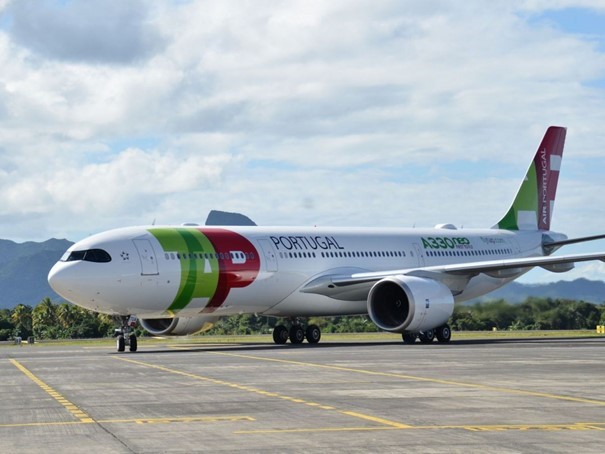
TAP’s 22 Airbus A330 are the backbone of its long-haul fleet – company courtesy
Three bidders Now it looks like there will be a new showdown in Portugal – with an open outcome. Especially since on 20NOV the IAG Group appeared as third bidder on the scene. “IAG confirms it has submitted a statement of interest to Parpublica, in line with the government’s process for the part-privatization of TAP,” a spokesperson said in a statement to French agency AFP, referring to the Portuguese state holding company that owns TAP. “Several terms would need to be addressed before IAG could propose an investment,” the statement added. In terms of prospects of success, Lufthansa has the advantage that TAP is a member of Star Alliance, the first global airline alliance founded in 1997 by five carriers, including Lufthansa, United, and Thai Airways. Another plus point is that the airline’s Hamburg-based technical subsidiary recently announced plans to build a new repair, overhaul, and maintenance center in Santa Maria da Feira near Porto, with a focus on engine maintenance. The number of employees there is expected to more than double from currently 450 to 1,000 by 2030.
Cherry on the cake At the same time, Lufthansa management assured that, if the bid is successful, it intends to strengthen Lisbon as a transatlantic hub for the Lufthansa Group and expand connections between Europe, South, Central, and North America, and Africa. TAP will also continue to fly under its traditional name, as do Lufthansa subsidiaries Swiss, Austrian, and Brussels Airlines after being taken over by the German carrier. When asked what significance the integration of TAP Cargo into the Lufthansa network would have from the perspective of Lufthansa Cargo, LHC spokesperson Jan Paulin delivered this answer: “At this stage, Lufthansa Cargo is not providing any further assessment or comment beyond the official Lufthansa Group statement.” TAP has a particularly strong presence in traffic to and from Brazil, both in terms of passenger and cargo transport. From this perspective, Brazil traffic is the cherry on the TAP cake for any investor. Last year, the airline carried a total of 16 million passengers on its network. It has been back in the black since 2022, after five consecutive years of losses.
Air France-KLM is a financially strong contender One day before Lufthansa’s announcement, Air France-KLM expressed its interest in acquiring a 44.9% stake in TAP Air Portugal. This was stated by CEO Ben Smith during a press conference where he presented the airline’s Q3 results. No information has been provided as to whether talks between Air France-KLM and the Portuguese government regarding TAP have already taken place behind the scenes. The Portuguese government confirmed nearly two years ago, in SEP2023, that it intended to privatize part of the national carrier. TAP, which was renationalized in 2020 to stem losses from the Covid-19 pandemic, is among the few remaining state-owned carriers in Europe, and is targeted by leading European airlines due to its routes to Brazil and Portuguese-speaking African states. The registration of further interested parties ended without result on 22NOV2025. TAP owner Parpublica expects to receive initial bids by APR2026.