This year’s TIACA Air Cargo Forum (ACF) will take place on Abu Dhabi’s 25 km² Yas Island – home to the Formula One Abu Dhabi Grand Prix (since 2009) and one of the Emirate’s largest tourism projects (since it also features Ferrari World Theme Park with its Formula Rossa – the world’s fastest rollercoaster.) Even though the event isn’t until 03-06NOV25, CargoForwarder Global has already secured its tickets and hotel rooms, as particularly the latter are likely to be snapped up quicker than a Formula Rossa ride. You therefore may well want to do the same to avoid disappointment or a higher than necessary expense for accommodation. TIACA has secured exclusive discounted rates at just one-third of the current published rates and, because there is another major event happening in Abu Dhabi at the same time, those rooms are limited availability and first come, first served. After that, TIACA tells us “prices will skyrocket, and hotel rooms will be hard to find, [so] act fast to lock in the best deals and ensure a smooth experience at ACF 2025!” Book your hotel now on aircargoforum.org.
CFG you there, at the end of this year! Image: TIACA
Now that you’ve got your accommodation sorted, don’t forget to arrange your flights, and – above all – to register for the event. Last year’s ACF in Miami, attracted over 3100 attendees, and the annual event is always well worth a visit with excellent networking opportunities as it brings together industry leaders, policymakers, innovators, and stakeholders to discuss the future of air freight. This year’s ACF 2025 is hosted by Etihad Cargo, and will again deliver engaging keynote addresses and panel discussions on the latest trends, challenges, and opportunities in the air cargo sector. In parallel to the event agenda, you can visit the booths of top names in the air cargo and supply chain logistics industries, and learn about their latest innovations and solutions in the global exhibition.
The agenda is rounded off with unique views and exclusive events such as a Desert Golf Tournament on the first day, and two exclusive networking events: “thrilling experiences at Ferrari World and a relaxing evening at The Beach Club,” according to TIACA, which is also still open to discuss sponsorships if you have not yet made up your mind. It offers four selling points:
Unparalleled Exposure – Showcase your brand to thousands of key stakeholders, buyers, and influencers.
Industry Networking – Connect with airlines, freight forwarders, airports, shippers, and logistics experts.
Innovative Insights – Be part of discussions shaping the future of air cargo and supply chain logistics.
Prime Location – Abu Dhabi’s strategic position as a global logistics hub makes this a must-attend event!
The British International Freight Association (BIFA) announced the promotion of two staff members as part of the current reorganization of its policy and compliance team. Pawel Jarza assumes the role of Policy, Compliance and External Affairs Director, and Robert Windsor has been appointed Senior Policy Adviser. Both gentlemen have a strong background in their respective fields. Pawel Jarza who holds a masters degree in International Trade Relations from the University of Wroclaw, bring more than two decades of experience in logistics with him. He joined BIFA as a Policy and Compliance Manager in 2017, and has held various customs-compliance-related roles during his career. “[He] is well known to many BIFA members as a result of his work in the Customs environment as frontier policy manager, and more recently as policy and compliance adviser,” the press release states. His responsibilities now include external lobbying and representation work for BIFA, mainly with relevant Government departments, but also with other key stakeholder groups.
Robert Windsor has played a key role representing the industry to government and statekholders, since joining the association in 2009. He is a leading authority on customs, compliance, and regulatory matters in UK freight forwarding. As Senior Policy Adviser, he is now responsible for surface policy matters, as well as legal and insurance issues, and currently leads a team that has been reviewing BIFA’s Standard Trading Conditions (STC). “BIFA’s STC are reviewed on a periodic basis in response to industry developments and legislative changes. This is a very time-consuming process but has become necessary in order to protect the interests of BIFA members as a result of issues stemming from the UK leaving the EU, and with growing global tensions that have increased trade difficulties and therefore risks to members,” the release explains.
BIFA’s Director General, Steve Parker, says: “The realignment of responsibilities will give Robert the opportunity to focus on the task in hand to ensure that a new set of BIFA Standard Trading Conditions (STC) remains as a foundation stone of the relationship between BIFA, its members and their customers. Pawel is tasked with working with BIFA’s recently appointed public affairs and government relations advisor, SEC Newgate, to open up new channels of communication and advocacy with various external stakeholders, as part of our drive to broaden the representative role we undertake on behalf of members, and the UK freight and logistics sector.”
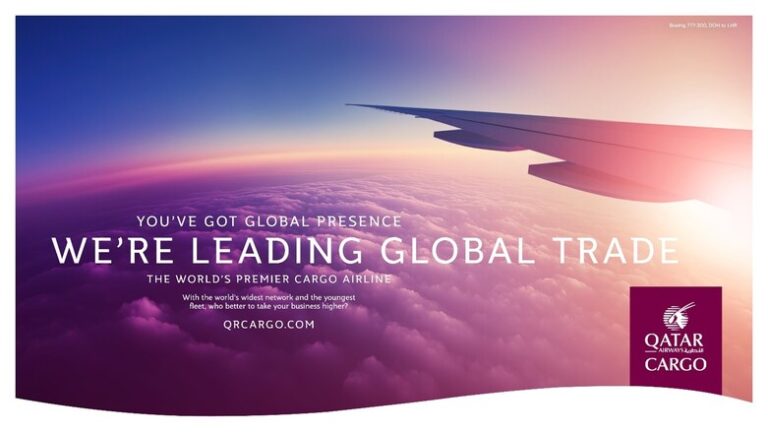
When you are at the forefront of the industry with one of the world’s largest freighter fleets, you have every right to blow your own trumpet. And what’s more, you have a responsibility to set standards and educate the general public. With what Qatar Airways Cargo itself terms its boldest brand campaign yet, the airline is impactfully demonstrating its role in driving international trade and modern society. ‘Leading Global Trade’ is “more than just a tagline, it’s a declaration of intent,” the press release underlines. It visually demonstrates how Qatar Airways Cargo enables the transportation of all kinds of crucial cargo from life-saving vaccines to fresh supermarket goods, cutting-edge technology, or live animals. “These shipments are the lifeblood of global trade,” it claims, and “It’s not just about transportation; it’s about setting new benchmarks for efficiency, reliability, and customer-centric service.” And that customer-centricity aligns with the airline’s reputation in its passenger business, too. Both passenger and cargo operations aim for the highest standards when it comes to online booking processes, customer support, and adopting innovation.
“Leading Global Trade’ is its boldest campaign yet.” Image: Qatar Airways Cargo
“At the heart of this campaign is a celebration of the customers who power global commerce. They are the visionaries shaping the future, and Qatar Airways Cargo is their trusted partner, ensuring that every shipment, no matter how complex or valuable, reaches its destination with the highest level of care and seamlessly. Every package carries a purpose, every movement fuels progress, and Qatar Airways Cargo is the force that keeps it all moving,” the release details. The campaign has kicked off with a focus on Qatar Airways Cargo’s new Aerospace and TechLift products that cater to the aviation and semiconductor industries. Over the course of the year, its other products and initiatives will be showcased, that “reinforce its position as a visionary leader pushing the boundaries of what air cargo can achieve”.
Mark Drusch, Chief Officer Cargo at Qatar Airways, summarized: “Leading Global Trade is our mission. We are redefining the standards of air cargo, putting our customers at the center of everything we do. Our role extends far beyond transportation; we play an important part in supporting global economic growth. This campaign reflects that ambition: to be the ultimate benchmark in the industry. From fresh produce delivered straight to your grocery store, to the technology powering mobile phones and electronics and the medications people rely on – we’re here to support every need, big or small.”
With the success that ULD management company, Unilode Aviation Solutions has achieved at its East Midlands airport location, thanks, it says to its exceptional team and customers, comes the need to move to a larges location and to operate a more sustainable facility. The latter point is one that the company has taken up in several of its locations around the world, as it looks to combine excellent customer service with a positive working environment. Alongside the East Midlands Airport operations move, it also have MRO improvement projects running in Hong Kong, Singapore, Newark (USA) and London Heathrow. Its aim is to ensure that it can adapt to customer needs at all times. Over in East Midlands, Unilode caters to key customers such as DHL, West Atlantic, Singapore Airlines, Aer Lingus, Finnair, TUI and others. It has therefore chosen to take an 8,230 m² facility (Unit 5b) at Stud Brook Business Park, Castle Donington, leased from Clowes Developments, to which it will soon be relocating. Stud Brook Business Park is just outside East Midlands Airport.
When things go well, you need more space. Image: Unilode
Janis Balkens, Chief Operating Officer at Unilode Aviation Solutions, commented: “The decision to relocate our operations, which includes our 30-strong workforce, to Studbrook Business Park, will not only enhance our service capabilities but also enable us to support a larger customer base while aligning with our sustainability goals on a local and global scale. Unilode also recognizes the importance of a sustainable business model that benefits our employees, customers, and the planet. With this new state-of-the-art facility, we’re committed to our sustainability initiatives, such as utilizing 100% renewable energy, improving waste management practices, and aiming for BREEAM certification for our new operations at East Midlands Airport. Together with our customers, partners, and suppliers, we are embracing a circular economy that drives positive change.”
Tim Gilbertson, Director of FHP Property Consultants, said: “It’s fantastic to announce the letting of a further unit at Stud Brook and again to a globally known company. The move will help Unilode expand and improve its services to its clients in the region, and from our perspective, it sees yet another deal done at Stud Brook with only a couple of units left available in the first phase. The final units are due to complete and be ready for occupation at the end of May,”
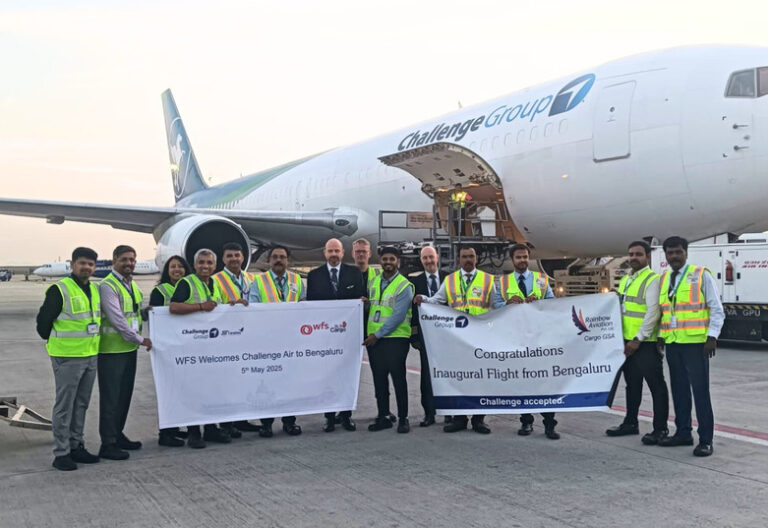
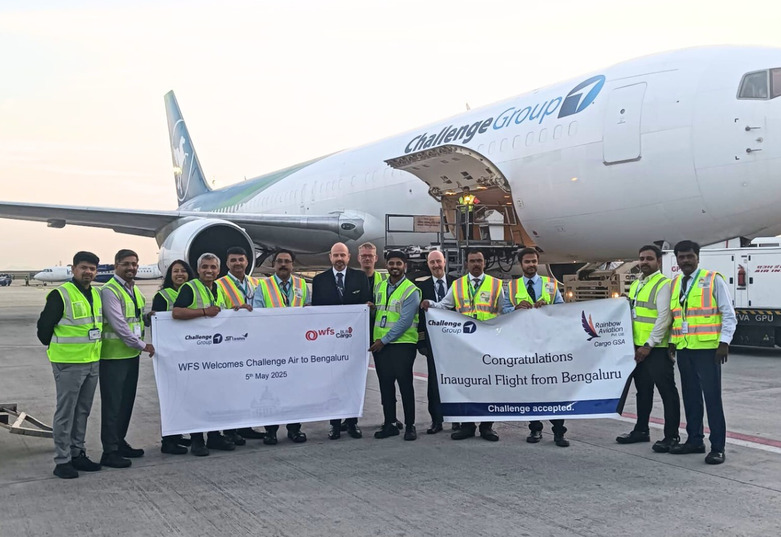
Sunday, 04MAY25 saw a new milestone being achieved in Challenge’s network expansion, with the start of a weekly Tel Aviv (TLV) – Bangalore (BLR) -Tel Aviv freighter service. Challenge Group has been serving India since just over a year, when it began flying to Mumbai in MAR24. That connection now runs three times per week. In OCT24, it commenced operations to Delhi with a twice-weekly service (CFG Reported), and now Bangalore expands its India offer. Challenge Group deploys a Boeing 767-300BDSF freighter on the route, which offers an uplift of around 50 tons to the southern Indian market. “The addition of Bangalore further strengthens Challenge Group’s strategic connectivity between India, the Middle East, Europe, and North America. […] The company maintains a strong global presence, with daily connections between Tel Aviv and Liège, serving as a central European hub. From Tel Aviv, cargo also moves twice a week directly to New York, ensuring timely service to the United States. Liège is further connected to New York with five weekly flights, offering ample capacity and flexibility for U.S.-bound shipments. In addition, weekly freighter services from Liège to Houston, along with twice-weekly flights to Atlanta, offer crucial connections to the southern United States, enhancing end-to-end connectivity across key pharmaceutical, high-tech, and industrial corridors,” the release explains, showcasing the many international connection possibilities as the airline aims to ensure “seamless and integrated logistics services that meet the evolving needs of global trade”.
Or Zak, Chief Commercial Officer of Challenge Group, commented: “Given that India is striving to become the factory of the world, and the production of key verticals has significantly increased during the past few years, our strategic decision to now launch a regular and direct India-Middle East-Europe service goes some way towards satisfying the intense customer demand on this route.”
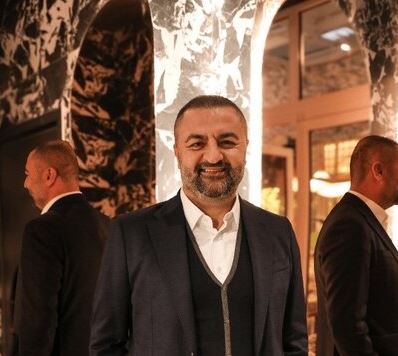
Global GSA Group announced the appointment of its new CEO last week: Aytekin Saray brings almost thirty years of air cargo experience with him, having started out with Panalpina in 1996. Four years later, he joined Global Airline Services which later became part of Global GSA Group. “Over the years, he played a key role in the Group’s expansion and success, notably as CCO and Managing Director for Central Europe,” the release states, lauding his industry expertise, commercial mindset, and long-standing history with the company.
Aytekin Saray, CEO, Global GSA Group. Image: Global GSA Group
Global GSA Group, which celebrates its 30th anniversary this year, is on a mission to become “the most agile and forward-thinking GSA in the market”, hence the promotion of Aytekin Saray to CEO, to drive the change. It recently also appointed Zafer Aggunduz as its CCO, and has been implementing changes aimed at better positioning itself on the market. To this end, it is also in a strategic partnership with CargoTech, looking to further improve its digital set-up. The press release emphasizes: “At Global GSA Group, change is not just a response to the market – it’s a driving force. With new energy, new leadership, and a clear vision, the Group is more determined than ever to become the GSA that grows, transforms, and inspires.”
Boris Blagojevic succeeds Saray in his previous role as Managing Director of Mondial Airline Services, overseeing operations in Germany, Austria, and Eastern Europe.
Ismail Durmaz, Chairman of Global GSA Group, stated; “Aytekin has lived every chapter of our journey – because he helped write them. He’s a leader with vision, strategy, and action. His appointment reflects our commitment to go further, faster, and continue offering our airline partners smarter, more agile, and more digital solutions.”
Aytekin Saray said: “It is an honor to step into the role of CEO at Global GSA Group. This company has shaped my professional journey, and I’m deeply committed to its values and future. Together, we’ll continue to strengthen our position as the independent GSA of choice, while guiding our partners through the evolving cargo landscape – from digitalization to sustainability and operational excellence. The best is yet to come.”
The fact that air freight and sea freight containers are becoming increasingly smarter is not really news. However, the reefer product, Controlled Atmosphere, offered to the market by shipping company Hapag-Lloyd and its Gemini partner, Maersk, is a whole new level in data capturing and transmission throughout the entire supply chain. It provides a constant overview of the atmospheric conditions inside a cool container.
In addition to the temperature inside the boxes, the oxygen content of the air trapped in a reefer is permanently monitored. The reason: the less the oxygen, the slower the ripening process of avocados, blueberries and lychees. This is what makes long-distance transportation of time and temperature sensitive agrarian products feasible and preserves their freshness. Tests have proven that, under optimal transport conditions, avocados retain their original quality for 35 days. For blueberries and mangoes, it is 28 days, and for bananas even 45 days.
Reefer expert Lisa-Marie Pietrek – all photos: credit Hapag-Lloyd
Keeping oxygen levels down To illustrate the Controlled Atmosphere product, Lisa-Marie Pietrek, Manager Global Reefer Strategy and Steering at Hapag-Lloyd, cites the sea transportation of bananas. “Once harvested, bananas continue to ripen quickly due to ethylene gas production and high respiration rates. In a standard Reefer Container, they might overripen or spoil before reaching their destination. But in a Controlled Atmosphere Reefer Container, the oxygen level is reduced and CO₂ levels are increased in a controlled way, which slows down respiration and ethylene sensitivity – allowing the bananas to arrive fresh and firm, ready to ripen at the destination to retain their quality and commercial value.”
The combination of Controlled Atmosphere and H-L First enables the highest product quality of perishable goods, states Hapag-Lloyd’s Clemens Holz
Transparent product Hapag-Lloyd launched the Controlled Atmosphere product in 2014. But only since the first quarter of this year, does it offer the market the option of remote monitoring. Where the ratio of nitrogen and oxygen does not meet the specifications, customers receive an instant alert, says Clemens Holz, Director Global Reefer at Hapag-Lloyd. “This makes our product completely transparent throughout its entire journey.” In the event of damage, the consignee can present data to the insurance company and demand recourse. Controlled Atmosphere reefers are primarily used on routes from Latin America to Europe, but also from South Africa or India to Rotterdam, Hamburg or Antwerp, i.e. where fresh produce accounts for a significant proportion of the shipment volume, says manager Holz. It costs USD 1,500 to booking such a steel box – a fee that comes on top of the normal container price. An additional USD 80 is charged for Hapag-Lloyd LIVE, i.e. the groundbreaking monitoring technology that guarantees the constant transmission of live data from the containers’ interiors to the consignee.
Premium service While requesting a quote, customers can add Controlled Atmosphere to their shipments. Once done, they receive a pricing and booking confirmation within just a few clicks, without the need for emails or phone calls. This digital rollout marks a major milestone. “It gives clients faster, more transparent access to a premium service that was previously only available through manual processes,” explains Lisa-Marie Pietrek. “Now they benefit from accurate pricing, streamlined bookings, and continuously available information – all in one seamless experience.”
A Hapag-Lloyd reefer container, showcasing the cooling and control unit on the front end of the steel box. Each unit is labeled with container ID numbers, weight specifications, and the Hapag-Lloyd logo.
“Shaping the future of reefer logistics” From a strategic standpoint, this development highlights Hapag-Lloyd’s continued focus on innovation and customer-centricity, emphasizes the shipping line. “By digitizing this value-added service, we are not just keeping pace with industry expectations – we are actively shaping the future of reefer logistics,” says the executive. Controlled Atmosphere is the shipping company’s second fully digital reefer solution, following the successful launch of Hapag-Lloyd LIVE. Together, they are a major step forward in the digital transformation of the reefer market.
Fresh flowers remain loyal to air freight For some products, these or other technical novelties have already led to a modal shift from air to sea freight, confirms Clemens Holz, as shown by the volumes of avocados, blueberries, lychees and some other commodities that had long been classic air cargo products, but are now increasingly being shipped by sea. Next to come are cherries traveling from their country of origin, Chile, to China. However, he is skeptical about transporting cut flowers by sea over longer distances and periods of time, so this is still good news for the air freight industry.
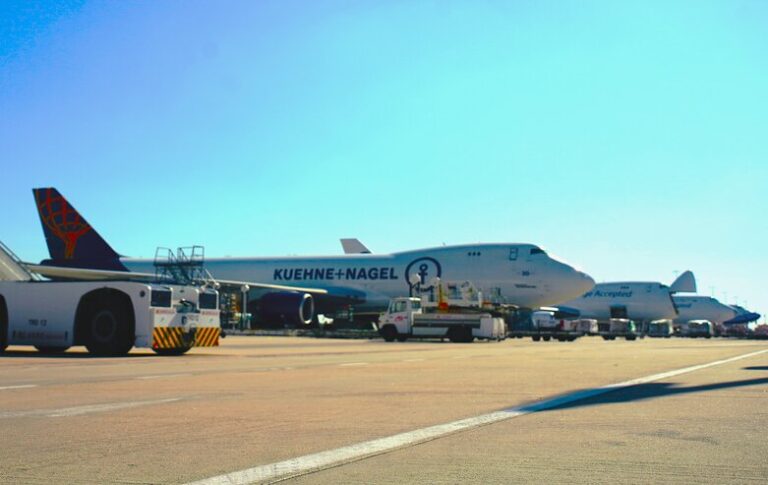
The Belgian airport has secured the services of Kuehne+Nagel. From now on, a B747-8F will land there twice a week, which Kuehne+Nagel has chartered long-term from ACMI provider, Atlas Air. The inaugural flight took place on Friday (09MAY25), with the aircraft bearing the name ‘Inspire’. According to Liège Airport’s (LGG) Head of Corporate Communication, Christian Delcourt, Kuehne+Nagel Management has decided to relocate the flights from Amsterdam Schiphol to the Walloon Airport.
Delcourt declined to speculate on the reasons for the translocation of the freighter flights, probably to avoid upsetting his colleagues in Amsterdam. Instead, he praised the advantages of his site, which allows clear conclusions to be drawn about Kuehne+Nagel’s decision. “At Liège, we offer airlines sufficient slots, meeting their operational demands. Congestion is an unknown word for us, and we don’t have any night flight curfew.” Only a week ago, U.S. integrator, FedEx, had announced that it will be increasing its weekly Liège-Memphis services from 5/7 to 8/7 – see CFG’s article.
From AMS to LGG. K+N translocated B747-8 freighter flights – photo: credit Liège Airport
Kuehne+Nagel’s step is knighthood for LGG, Laurent Jossart Kuehne+Nagel’s step reinforces Liège Airport’s growing role as a strategic hub for global freight services and highlights the confidence that major logistics players place in its infrastructure, capabilities, and its 24/7 operational flexibility. With this move, Atlas Air expands its presence at Walloon airport where it also operates flights on behalf of other customers such as, for instance, MSC Air Cargo. “We are delighted that Kuehne+Nagel has chosen to strengthen its operations at Liège Airport with the support of Atlas Air Worldwide,” stated Laurent Jossart, CEO of Liège Airport. The executive went on to say: “This expansion is a testament to the trust our partners place in our location, infrastructure, and ability to support complex and time-sensitive logistics.” Kuehne+Nagel’s two Boeing 747-8F aircraft (‘Inspire’ and ‘Empower’) offer an uplift capacity of 140+ metric tons each and a nonstop range exceeding 8,000 km when fully loaded. The agent’s air freight services include express, charter, consolidation, and temperature-controlled shipments monitored electronically all the way from departure to arrival, thus ensuring that customers have full visibility and have access to tracking solutions.
Premium around-the-clock service Jens Ludwig, VP Global Air Logistics Own-Controlled Network & Charter at Kuehne+Nagel, commented: “Liège Airport is a strategic hub for our European air logistics operations. This expansion with Atlas allows us to provide a premium around-the-clock service for our customers, leveraging LGG’s excellent facilities and capabilities.” With a global network covering over 1,300 sites in close to 100 countries, the logistics giant handles everything from pharmaceuticals and perishables to aerospace and industrial goods. The company is known for its strong partnerships, reliability, and commitment to sustainability – making it a trusted partner for air cargo across the globe, praises an LGG press release.
Forwarders go where the business is Experts also evaluate the relocation of the two weekly Kuehne+Nagel freighter flights from Amsterdam to Liège as a result of CEO Jossart and his management team’s efforts to attract more freight forwarders to the Walloon airport. This strategy, encouraging agents to open up stations at LGG, was announced at the beginning of 2024, in an interview with CargoForwarder Global. Since then, the number of freight forwarders running their own station at the airport has steadily increased. Prime pull factor was and continues to be the tonnage growth. In 2024, LGG handled 1,162,899 metric tons, an increase of 16% y-o-y. Freighter flights also grew 14%, totaling 27,184 annual movements. From now on, eight more flights per month will be added – the B747-8F services operated on behalf of Kuehne+Nagel.
CargoForwarder Global’s ‘Spotlight On…’ brings a different aspect of the air cargo industry to the fore each week, as seen through the eyes of the people working there. Air cargo travelling across the world, has to be processed on the ground before it can take off and after it lands. This is carried out by ground handlers or, as is the case at one of the world’s largest cargo airports: a dedicated air cargo terminal operator. PACTL is one such example. Its primary role as an operator of five different terminals at Shanghai-Pudong and Hongqiao Airports, is to provide comprehensive cargo handling services for all kinds of inbound and outbound shipments. International Business Development Executive at PACTL, Alex Aristov, explains his job and shares advice and views on the air cargo industry.
High stakes. High uncertainty. High resilience. Image: Alex Aristov
CFG: What is your current function and company? And what are your responsibilities? AA: I work in PACTL as an International Business Development Executive. My work includes three streams: working with international customer airlines, driving e-commerce projects in collaboration with leading Chinese and international e-commerce platforms, and the last stream is the international expansion of our cargo terminal.
CFG: What does a normal day look like for you? AA: I would say I have two types of days: office days and travel days. During office days, I usually have some calls and meetings, prepare reports. Occasionally I meet customers at our facilities and give them a tour of our facilities. We’re always very proud to show our new facilities, such as our e-commerce terminal in PACTL West, which never fails to leave an impression on our visitors. I am also a big fun of “Gemba” practice: I will often go to the landside/airside operation floor to see some of the processes with my own eyes, especially the ones pertaining to our e-commerce business. This always helps to get the insights that you’d never get sitting in your office and looking at the reports. For instance, going to the airside to see the build-up process for one of our e-commerce shippers enabled me to later provide valuable feedback to that shipper on the buildup instructions that they could later pass on to their forwarding agent to optimize the buildup. And then there are travel days, during which I have the most fun. Get up early, take the maglev to PVG, fly off to wherever duty calls. Have a few packed days of meeting new people, pitching ideas, encountering new business cultures. In China, we would say “你还要啥自行车?” (a Chinese internet slang in a humorous and down-to-earth way of saying ‘What more could you possibly ask for?’ or ’This is already pretty great.’). Meeting people in person is crucial in our industry, because that is how you get a real feeling of what is happening in the industry beyond the reports and charts. Whether during office hours or business trips, I’m constantly reminded how much our future depends on staying connected, not only digitally, but also globally. That’s why we’re expanding our international collaborations and accelerating digitalization to shape the next chapter of PACTL.
CFG: How long have you been in the air cargo industry, and what brought you to it? AA: Currently it’s my 5th year in the air cargo industry. Even though I had non-related stints here and there, I eventually ended up in this particular part of the aviation business – air cargo. From early in my career, I’ve been quite interested in the aviation business. In my undergraduate studies, I participated in multiple business case competitions, and one of them was assessing the viability of starting a new airline under Air France-KLM together with McKinsey & Co. After that, I went for an internship to a startup that was helping passengers to get compensation for delayed flights in EU. Eventually, I found myself in Cainiao, the logistics arm of Alibaba, arranging air freight solutions for the Eastern European market. That’s where I got my most intense experience in this industry: the year was 2022, and it was, to put it mildly, a challenging time to manage air freight in Eastern Europe. I worked in different companies in the Alibaba Group before eventually joining PACTL.
CFG: What do you enjoy most about your job? AA: It’s the people! As one of my mentors used to say, “Every business is people business”. After joining the industry, I would add to that: “And our business is very people”. You know, after I properly joined the industry with PACTL, I was taken aback by how everyone is welcoming and nice to me as a newcomer. Every time we meet new people in the industry, it always turns out to be a nice and memorable (in a good sense) encounter. What is great about working at PACTL, is that the spirit of working with rigor, care, and the willingness to help each other is quite alive here. Whether it’s a frontline worker sharing a tip from years of experience, or a cross-team brainstorming for our ramp services, you feel that dedication and collaborative mindset everywhere. Another thing that I like about our industry is that it is, I would say, quite artisanal. In the sense that the specific knowledge is not that accessible, you could even say it is passed down from one master to another. In this industry you sometimes can’t even get reliable answers from ChatGPT. I remember back in the e-commerce days, we needed to calculate how many boxes we can fit on a pallet on a certain position on a quite rare AC type, and there is only like one website left on the Internet where we could actually find this information.
CFG: What do you see as the greatest challenges in our industry? AA: I won’t be original here; the greatest one is, of course, uncertainty. From shifting global trade patterns to changing regulations and customer expectations, we’re navigating a marketplace that’s constantly evolving. At PACTL, we stay ready for change. We’re continuing the upgrade of our PACTL WEST facilities, bringing in more automation and digital tools to optimize our operational capabilities. We’ve built a state-of-the-art Cool Center, certified with CEIV Pharma to meet the highest cold chain standards. Our cross-border e-commerce cargo handling center is designed to meet the growing demand in this sector, and we’ve also upgraded our Pet Lounge to provide care and customized services for our furry passengers. In such a dynamic landscape, readiness is everything, and PACTL is always ready.
CFG: What advice would you give to people looking to enter into the air cargo industry? Any particular training they should aim for? AA: Can’t give much advice here – just be curious, I guess? Before I went into the industry, I thought logistics was something extremely complex, so I always wondered how people even get anything delivered, let alone delivered in time on short notice. And it’s in part because of this curiosity about how this complex logistics machine works, that I am now in this industry.
CFG: If the air cargo industry were a film/book, what would its title be? AA: I mean, you need to first imagine what the movie will be about, probably even finish writing it, and then sort of distill it in one word or phrase. So, what’s so catchy about our industry? High stakes? Sure. High uncertainty? Hell, yeah. High resilience? You bet. If I wrote a comedy, I’d call it “Pivot Weight”.
Thank you very much, Alex!
If you would like to share your personal air cargo story with our CargoForwarder Global readers, feel free to send your answers to the above questions to cargoforwarderglobal@kopfpilot.at We look forward to shining a spotlight on your job area, views, and experiences.
The Madrid-based group, Euroairlines, has an AOC and big plans, but no aircraft of its own. Instead, it uses the capacity of partner companies such as World2Fly or SATA Azores Airlines. It is already active in the passenger sector and will also set its footprint in air freight.
Soon, shipping parcels and boxes will complement Euroairlines’ activities focused on passenger services, announces management without delivering specifics. All what’s currently known is that the company’s new air freight strategy resembles that of the former Dusseldorf-based cargo broker, Leisure Cargo. The Air Berlin subsidiary successfully marketed the bellies of dozens of passenger airlines and was taken over by logistics player, Zeitfracht, after parent Air Berlin became bankrupt. Euroairlines’ concept is similar. The company’s services specialize in turnkey cargo sales and service concepts. It offers its customers personalized cargo management capabilities, including sales, ground handling and road feeder services, all supported by a broad GSA network with access to the capacities of a wide range of international and regional airlines serving key destinations in Europe and The Americas, as well as some parts of Asia.
Next to passengers, Euroairlines now also offers the market borderless cargo transports – company courtesy
On way to profitability? “Our solutions help airlines reach previously unreachable markets and customers, and enable agencies to access new routes, more competitive fares, and greater variety and quality in the options offered to their customers (including benefits such as additional baggage and onboard services),” reads a statement. And a company release specifies: “In an industry where connections mean everything, we are the bridge that enables airlines and agencies to maximize their business opportunities.” The company has access to the lower deck capacity of roughly a dozen airlines, cooperates with 200 interline partners and offers flights to 300+ destinations. Incepted in 2000, Euroairlines has grown steadily and runs offices in Bogotá, Buenos Aires, Cancún, Lima, Mexico City, Miami, New York, Santiago de Chile and Sao Paulo. Plagued by red figures, in 2024, the Group optimized its commercial strategy and diversified its service offerings. A capital increase, upping the player’s equity, will help achieve break-even. This is expected to happen in the second half of this year, predicts management in a release.
Diogo Elias is new CEO of Avianca Cargo – credit: Avianca
Avianca appoints Diogo Over in Colombia, Avianca Cargo announced the appointment of Diogo Elias as CEO of the Latin American freight carrier. In his former role as Senior Vice President, he and his team (including Chief Operating Officer, Gabriel Oliva), have solidified the company’s status as one of the region’s leading air cargo carriers. Under his tenure, Avianca Cargo has consistently fine-tuned its service portfolio, expanded the network, and developed strategic markets such as the United States. Following its successful emergence from post-pandemic Chapter 11 proceedings, it reduced the number of time-consuming triangular flights and turned to point-to-point routes instead. Diogo Elias has over 20 years of experience in strategic, leadership, and commercial roles, as well as a strong academic background in Business and Operations Management, including an MBA from the University of Michigan.