
Home Blog Page 94

Cargo demand outgrew capacity in Q1, 2025

According to DHL Global Forwarding’s latest Air Freight Market Update, global air freight transport demand grew between 4-6% in the first quarter of 2025, while capacity increased by only 3-4% in the same period. All in all Q1 saw only a moderate upswingdue to a variety of unfavorable factors like the uncertainty in tariffs and trade policies, e-commerce volatility, and lasting supply chain constraints. Ongoing conflicts in the Red Sea area, Russia’s war in Ukraine, Trump’s erratic tariff policy and the partial closure of Pakistani and Indian air space following recent hostile military actions continue to impact air cargo supply chains negatively.

In summary, the DHL market study concludes that the uncertainties in the industry have rarely been as great as they are today and that, due to the many and partially overlapping crises, there is currently no real silver lining on the horizon. However, as the survey also shows, individual regions are affected differently, exemplified for instance by Latin America’s booming perishable and flower business.
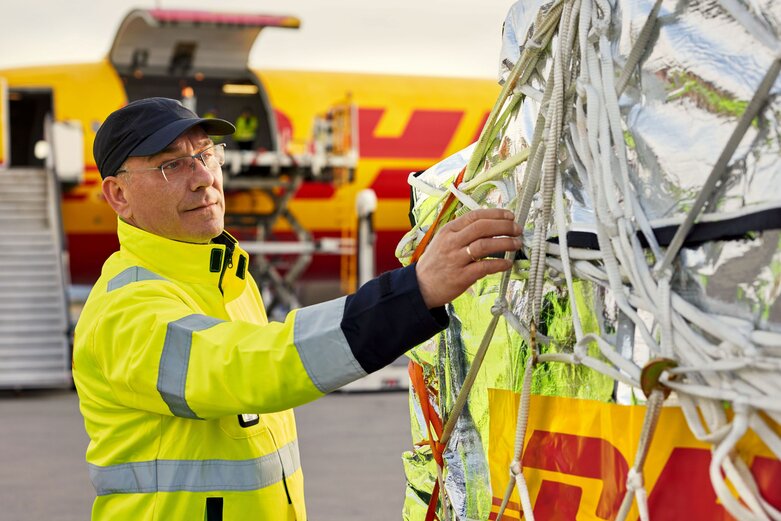
A DHL worker checks packages before loading. In the backgroung a DHL plane can be seen.

APAC keeps dominating transport volumes
Major volumes in Q1’25 were contributed by Asia Pacific (China, Hong Kong, Korea, Indonesia, and Japan). Key trade routes with significant growth YoY Q1’25 were Europe-Americas at 9%, Intra-Asia Pacific at 11% while Asia Pacific-Americas grew only 3%. The Asia Pacific economies will continue to lead the way, including fast-growing sub-markets such as Vietnam, Taiwan, Indonesia and also India.
In Q1, 2025, trade tensions, particularly between the U.S. and China, led to a surge in air freight as companies sought to bypass impending tariffs.

Middle East
To accommodate demand, carriers have started operating ad-hoc freighter flights within the region and between the Far East and Europe, increasing overall available capacity. Ongoing global economic volatility has driven higher demand for gold and silver transport. Meanwhile, spot rates from the UAE to Europe are falling as carriers offer more available space. This goes hand in hand with the rerouting of freighter capacity from Latin America or Africa to routes between East Asia and Europe or to North America, driven by the thriving e-Com demand. This trend is there to stay, predicts DHL GF.

Americas
With ongoing trade talks between the U.S. and many countries, it’s unclear how the tariffs will develop in the near or long term, and it is subsequently hard to predict the respective impact on trade and air cargo transport demand, states the logistics company. Trump’s recent back and forth over de minimis shipments exemplifies the dilemma the industry is facing if political decisions suddenly disrupt proven practices.
The de minimis threshold varies significantly across countries and plays a crucial role in international trade, especially in the e-commerce sector. Understanding de minimis values is vital for navigating customs regulations effectively, optimizing shipping strategies, and ensuring transparent pricing for consumers. This topic caused by far the biggest irritation in Q1, 25.

The de minimis shock
Stable de minimis values benefit business-to-consumer (B2C) orders because they are typically low value, that’s why they are exempt from duty or tax. When a de minimis value is set, it provides faster clearance and speeds up supply chains. Conversely, shock waves are the result when the entire scheme is changed practically overnight and repeatedly, as was recently done by the Trump administration.
DHL-GF concludes that current shifts in trade flows will result in higher volumes from China to Europe/Latin America and Southeast Asia/ India to the USA, depending on the outcome of the tariff debate. But as global uncertainties are mounting, the challenge remains for airlines, forwarders, and shippers to plan i.e. shippers rerouting from high tariff to lower tariff countries, re-directing products to factories and distribution hubs, with airlines re-aligning capacity to trade lanes where demand is strong.

IDS Fulfillment becomes part of DHL
Further to this DHL Supply Chain announces that it has acquired U.S.-based e-commerce fulfillment and retail distribution logistics provider IDS Fulfillment. Through the takeover, the company’s e-commerce capabilities can be further enhanced and its service offerings to small and midsized customers be expanded. The acquisition adds over 1.3 million square feet of multi-customer warehouse and distribution space strategically located across the U.S. This includes facilities in Indianapolis, Ind., Salt Lake City, Utah, Atlanta, Ga., and Plainfield, Ind., where the company is headquartered. Committed to ensuring a seamless transition for customers and associates, DHL will continue to operate all IDS facilities under existing local leaders, assures a press release.

ECS Group: Reflections, challenges, and the road ahead

CargoForwarder Global (CFG) met with ECS Group’s CEO, Jean Ceccaldi (JC), on the fringes of the World Cargo Symposium in Dubai, in APR25. He recently celebrated his first anniversary as CEO of the world’s largest GSSA to date, and talked with CFG about the year’s achievements, challenges, and the road ahead.

Jean Ceccaldi knows the ins and outs of every GSSA role. Image: ECS Group

CFG: After almost one year as ECS Group CEO, what have been the highlights so far?
JC: The past year has been dynamic and transformative for ECS Group. The company underwent significant organizational changes, restructuring into regional entities – Europe North and South – and appointed a new manager in the Americas. Asia has remained stable throughout these transitions. ECS Group secured several positive tender contracts, leading to excellent results in 2024 and putting us on track for a strong 2025. Despite some challenges related to the US and China, the group has not been heavily impacted as our exposure on transpacific routes is limited. Instead, we have seen stronger performance on transatlantic routes in both directions. I am super happy and grateful to the entire team for embracing these changes and making the transition smooth.

CFG: What effects has the recent Trump tariff upheaval had on ECS Group? What do you see as the greatest challenges here for the air cargo industry?
JC: So far, ECS Group has not experienced significant upheaval from the Trump tariffs. In fact, we have benefited from a strong transatlantic market, as shippers have increased stock movements into the USA. While there is anticipation of increased capacity during the summer, yields have remained stable. I see this environment as a potential opportunity rather than a threat.

CFG: Is 2025 going to be a year of growth, stagnation, or reduction for ECS Group? Where do you see the company on 31DEC25?
JC: Given the current instability in the global situation, it is difficult to predict the end-of-year outcome. However, based on ECS Group’s strengths and its contracts with airlines, I remain proactively optimistic that 2025 will be in line with our ambitious budget.

CFG: What major sustainability initiatives has ECS Group implemented in the past 12 months?
JC: Sustainability has been a major focus for us at ECS Group, and I am proud and thankful to have 100% of the team engaged in these efforts. Recognizing the air cargo industry’s environmental impact, we have invested in climate education and carbon footprint reduction initiatives. ECS Group now has sustainability ambassadors in every one of our subsidiaries, working to implement and promote best practices.

CFG: Looking at digital transformation in the industry, what specific technologies or innovations excite you the most? And how well placed is ECS Group in this regard?
JC: Thanks to our partnership with CargoTech, we have access to cutting-edge digital tools which gives ECS Group a significant advantage, especially during tenders. We are much stronger than most, in this regard. The integration of platforms like CargoAi and Wiremind’s SkyPallet have enhanced commercial operations, allowing for efficient cargo and volume management. At headquarter level, ECS Group uses Wiremind’s CargoStack and Rotate’s Sales Cockpit for advanced market analysis and business management, which positions us as hyper-proactive and technologically advanced compared to our competitors.

CFG: In what ways is ECS Group preparing for future trends in air cargo, such as e-commerce growth or environmental regulations?
JC: While many e-commerce customers work directly with airlines, ECS Group works together with Mail&More to serve the remaining clients, providing tailored tendering and quoting for mail companies. We have seen the e-commerce segment grow, and Mail&More now captures about 25% of the market with dedicated sales teams in Asia and Europe. Thanks to its business partners, ECS Group is well prepared to grow with e-commerce trends.

CFG: Over your 30 years at ECS Group, what has been your proudest achievement?
JC: I would say my proudest achievement is my journey from joining AeroCargo [one of ECS Group’s earliest subsidiaries] as a booking agent in 1997, to now becoming CEO. I spent three years in operations, then became a sales rep for one year, before being promoted to sales director – a position I held for 15 years. I then took on the responsibility of Managing Director for eight years, and now CEO.

CFG: How do you maintain work-life balance while leading a global organization?
JC: Maintaining balance is a priority. I make sure to disconnect completely for at least two days every month, where I step back from work to recharge and maintain perspective.

CFG: What advice would you give young professionals aspiring to build a career in aviation or air cargo?
JC: Patience is key. You will achieve your goals. My own career path was pretty unconventional. When I was at university, I happened to meet someone who was opening a logistics school in the south of France and was bringing all kinds of people, from truck operators to engineers, together, to think about the future of logistics. I stopped university and instead joined the school for 4 years. After that, I called a few contacts, and someone mentioned a GSA was looking for people. That was on Thursday. I called, got the job, and immediately began the following Monday. However, I almost resigned from my career as a GSA at the end of the first week, when I realized that I had no clue about what I was doing as I hadn’t been trained to be a freight forwarder. I stuck it out and the rest is history! So, patience is key. Persistence and openness to new opportunities can lead to success, even if the journey is not linear.

Thank you, Jean Ceccaldi.

Launch of new BIFA cargo community advisory body

There’s a whole new cargo community advisory body out there! Image: Impress Communications

The men standing on the viewing deck of the BT Tower, have every reason to smile. Nick Weaver, Head of BT CCS-UK (Cargo Community Systems) & BT Air Logistics, is pictured on the far left. Next to him is Steve Parker, BIFA Director General, James Golding, Head of Cargo and Airline Partnerships at Heathrow Airport, and finally, on the right, Andy Cooke, BIFA External Affairs Consultant. They are all celebrating the official launch, on 29APR25, of a new British International Freight Association (BIFA) cargo community advisory body, headed by Andy Cooke (who has 30+ years of freight forwarding experience), that will bring cargo stakeholders together to ensure that the Heathrow cargo redevelopment will take their requirements into account. In the past, much of this task befell the CCSUK User Group. In focus is the major overhaul that is planned for Heathrow Airport’s cargo village and the redevelopment of the ‘Horseshoe’ cargo center. Freight management systems are to be modernized to facilitate data sharing within the cargo community.
Steve Parker, BIFA Director General, explained: “Whilst we wait for the promised third runway, BIFA is focusing on the airport’s cargo development. On behalf of our members, BIFA is already working closely with the airport to support its ambitious plans to deliver a fundamental change to the way cargo operates at the airport. Our intention with the establishment of an advisory body is to allow BIFA members and other stakeholders to work with the airport authority to have a central role and be at the forefront of discussions in what needs to be addressed. The plans unveiled last October, will mean a significant redevelopment of the cargo estate which is set to commence in the next two to three years, as the airport looks to accommodate rising demand, modernize some ageing first-line cargo handling facilities, and improve cargo flows and efficiency. BIFA is already a member of a strategic governance board set up by the airport authority [and] want[s] to be the conduit through which BIFA members can be at the heart of what is being developed for cargo at Heathrow. By participating in this advisory body, BIFA members and other stakeholders will be able to help shape best practice as the redevelopment of the cargo area begins, and develop methods via which the group can represent members’ interests on this subject in conjunction with the airport authority.”

Cargologic scores second CEIV Pharma recertification in ZRH

Cool cargo is in good hands over at Swiss WorldCargo’s ZRH hub. Image:

Which is good news for Swiss WorldCargo as Cargologic takes care of its handling over at the airline’s Zurich hub. But it is also no great surprise, given the two companies’ strong focus on quality and safety for one of their most important cargo commodities. Both have been CEIV Pharma re-certified more than once. In fact, Cargologic was among the first to achieve IATA’s CEIV Pharma certification at the Zurich hub, exactly ten years ago. It was re-certified in 2022 and again this year, proving that its standards are very high. It also holds Swissmedic GDP compliance since 2014. Swiss WorldCargo was first CEIV Pharma certified in 2018, followed by re-certification in 2021 and 2024. “These milestones place Swiss WorldCargo among a selected small group of airlines that maintain full CEIV Pharma certification,” says the press release. Re-certification follows strict auditing that examines all handling and training processes, facilities, and commodity-specific requirements on site. Particularly when it comes to pharmaceuticals, quality and correct handling are of the utmost importance since failure to ensure product integrity can have fatal consequences.
Alain Chisari, Head of Swiss WorldCargo, stated: “We warmly congratulate Cargologic on their received CEIV Pharma re-certification and their continuous commitment to quality. This achievement reflects our handling partner’s dedication to reliable services and the key role they play in ensuring the integrity of our pharmaceutical shipments at our Zurich Hub. Together as strategic partners, we are pleased and proud to adhere to the highest standards in the air cargo industry and keep delivering secure and high-quality service to our pharmaceutical customers around the world.”
Marco Gredig, Managing Director of Cargologic, said: “This important award proves that our air freight handling processes are continuously being improved and meet the highest standards. Together with Swiss WorldCargo, we want to grow even more. As a leading company in the air freight industry, Cargologic attaches great importance to quality and excellent service.”

Ever heard of being Customer CenTECH? Ask Global GSA Group

Global GSA is a people business expertly supported by CargoTech tools. Image: Lemon Queen

Its success formula reads “Global GSA Group + CargoTech = Customer CenTECH”, because according to a press release, the international GSA and the digital experts share a deep passion for technology and human expertise when it comes to business efficiency. To that end, it works closely with the members of CargoTech to develop solutions that place the customer or user first. With over 60 international airline customers and a major global expansion strategy planned, Global GSA has a vested interest in ensuring that its 500+ employees have access to digital tools that help them provide the best customer service. It has seen double-digit efficiency gains through CargoTech tools such as SkyPallet, CargoAi Marketplace, and Rotate Live Capacity, and Global GSA Group’s new Chief Commercial Officer, Zafer Aggunduz, is driving further digital change.
Ismail Durmaz, Chairman of Global GSA Group, believes: “Two crucial factors set a successful GSA apart from a standard one: People and Tech. We always talk about being ‘customer-centric’, and for sure, air cargo always has and always will be a people business. However, those looking for sustainable success in the industry, need to focus on becoming what I would term ‘customer-cenTECH’. It’s the fusion of excellent human intuition with the solid proof that digital data analysis delivers, that is the winning combination. And CargoTech, which incorporates this exact same philosophy, has proven to be the perfect partner for us. […] Thanks to AI powered forecasting, we can better predict demand, optimize capacity usage and ultimately boost revenues for our airlines. Seamless and simple booking processes save time for everyone, and real-time tracking provides peace of mind once the cargo is en route. […] Tech allows us to be fully present and available for our customers – and that human interaction is what our customers expect and receive from us.” Cédric Millet, President of CargoTech, explains: “CargoTech was founded on the premise that every time-consuming manual process should be digitalized so that employees can redirect their focus to tasks that bring more value. Removing and automating mundane, repetitive activities creates a more efficient, productive and satisfying work environment – one that benefits the company, the employees who have more time to dedicate to their customers, and the customers who appreciate fast, reliable responses and the knowledge that a personal contact has time for them whenever they require it. Global GSA Group is a prime example of how technology provides a solid commercial foundation complementing human expertise and enhancing the interpersonal relationships that the company is known for in this highly people-driven industry.”

Mail&More – a niche mail and e-commerce GSA

The first of its kind: a GSA focused on mail and e-commerce. Image: Mail&More

As GSAs go, Mail&More is unique. It has specialized in providing services around mail and e-commerce logistics, and serves international postal operators, e-commerce retailers, and airlines of all sizes across the world, with a comprehensive solution for the transport of parcels and e-commerce: a segment that is still seeing double-digit growth in the air cargo industry. Its solution is fully scalable and allows airlines to participate in the e-commerce and small parcel logistics sector, doing away with the complexity often encountered in these commodities that do not follow standard cargo procedures. “Mail&More assumes responsibility on the airline’s behalf for all related commercial operations through to capacity sourcing and allocation, and is supported by innovative Mail EDI software,” the release explains, going on to say: “E-commerce features in every air cargo conference as the disruptor and fastest-growing commodity in air cargo. And it is one that requires specialized expertise given the sheer volumes of AWBs it generates as well as the last-mile network complexity of small parcels with very diverse end destinations.”
Mail&More’s tailored service, introduced just 3 years ago, was immediately welcomed by the market and the GSA today already caters to 20 international postal operators and 30 airlines – currently mostly headquartered in Europe and Asia. Its customers receive audits, strategic guidance, solution recommendations, and customized operational support as per the carrier’s size and structural focus; “whether large carriers aiming to further optimize and digitalize their e-commerce strategy, mid-sized airlines developing their parcel business with the right tools, or smaller and leisure airlines still defining their strategic direction.” Technology supports in product positioning, visibility and operational control. As a GSA, Mail & More is the connection between postal operators seeking ideal network solutions for the e-commerce platforms, consolidators and vendors that they serve, and airlines wanting to optimize their load factors. It brings both parties together, develops market shares, constructs routings, oversees and coordinates transport operations, and counsels customers on cross-border alternatives and other efficiency initiatives. “Because of its experience and understanding of regulatory bodies, customer expectations and airline processes in this product niche, Mail&More is a strong partner for airlines of any size seeking to improve or even launch their e-commerce strategy. What’s more, it is the only company in the world currently offering this service,” the release underlines.

Logistaas is certified as having highest data security standards

Kareem Naouri, Chief Executive Officer, Logistaas. Image: Meantime Communications

Logistaas, a UK, cloud-based transport management systems provider, is actively used by freight forwarders in more than 75 countries and is credited with powering air cargo operations for over 5,000 freight forwarders worldwide. It also integrates with major air freight platforms such as Traxon CargoHub, WebCargo by Freightos, and others, enabling electronic air waybill (eAWB) submissions to over 100 carriers and providing real-time access to competitive spot rates and booking capabilities directly within the TMS. It was recently awarded Systems and Organization Controls 2 (or OSC 2, for short) certification, denoting it as fulfilling the highest standards when it comes to data protection from cyber security threats – something it is committed to as a company and on behalf of its customers. As with similar certification processes, the company applying is subjected to a stringent audit that is carried out by an independent operator who checks its data handling controls and other compliance measures.
SOC 2 was developed by the American Institute of Certified Public Accountants. It is designed to ensure that service organizations, particularly those handling customer data in the cloud, have effective controls in place to protect data security, privacy, availability, confidentiality, and processing integrity, and has meanwhile become an internationally recognized standard.
Celebrating its tenth anniversary later this year, Logistaas develops TMS solutions for freight forwarders, shipping lines, and NVOCCs, and now boasts a global presence in over 75 countries, having integrated its systems with over 50 ocean and 100 air carriers,” the release states.
Kareem Naouri, Chief Executive Officer, Logistaas, explained: “Protecting customers’ commercially sensitive data has always been integral to Logistaas’ approach to product development. Cyber security threats are ever-changing and increasingly sophisticated, so our team is continually innovating to ensure we remain one step ahead of the game and our customers have peace of mind knowing their data is protected to the highest possible standard. SOC 2 certification is a testament to Logistaas’ rigorous security standards, and I am proud of the team for achieving this important milestone.”

WestJet Cargo ups its South Korean connections

Now serving South Korea more often. Image: WestJet Cargo

In just a couple of weeks’ time, on 19MAY25, WestJet Cargo will double its flight connections to South Korea, from three flights between Calgary and Incheon International Airport in Seoul, to six per week: an adjustment that will remain valid until 13OCT25. With this, the airline is reacting to growing demand for air cargo and passenger transportation between Canada and South Korea. It is just a year ago, on 17MAY24, that the airline first began serving South Korea, and the company believes that “Over the past year, this route has played a pivotal role in strengthening economic ties between Canada and South Korea while supporting increased trade and tourism opportunities.” The carrier deploys a Boeing 787 Dreamliner on the route, which means a potential weekly cargo uplift of around 130 tons and 480 cubic meters.
Kirsten de Bruijn, Executive Vice-President, Cargo at WestJet, stated: “Doubling our frequencies is a testament to our commitment to strengthening connections between Canada and South Korea. We’re proud to enhance flexibility and capacity, supporting businesses in navigating a dynamic global trade environment.”
Julius Mooney, Commercial Director, Cargo at WestJet, added: “This expansion is driven by market demand and designed to provide our partners with greater opportunities for seamless imports and exports. It’s about offering solutions that empower businesses across both regions.”

Strategic partnership in Canada and U.S.: AGI and ATS/ACI

ATS and AGI join forces to up operational efficiency and cost saving solutions – courtesy: ATS

AGI who provides ramp and cargo warehouse services in Canada and the U.S., and cargo handling solutions provider, Atlantis Transportation Services/ACI Air Cargo, have entered into a strategic partnership with the aim of enabling improved domestic and cross-border transport and seamless end-to-end cargo solutions across both North American countries. “Atlantis Transportation Services offers LTL and FTL services to major U.S. gateways including Miami (MIA), Chicago (ORD), New York (JFK), and Newark (EWR), along with dedicated routes between Montreal (YUL) and Toronto (YYZ). Leveraging AGI’s network of airport facilities as drop stations, the partnership enables efficient domestic and cross-border trucking options for customers,” the release details. Toronto Pearson International Airport (YYZ), in particular, where AGI was awarded cargo warehouse operations last month, and where it already cooperates with AGI’s ramp and warehouse services, is a case in point for unified cargo solutions at a key international gateway, offering efficiency, reliability, and customer service. “Airlines and freight forwarders can now benefit from a single point of contact for integrated cargo handling services, improving turnaround times, enhancing visibility, and driving customer satisfaction,” the release promises.
Jared Azcuy, CEO of AGI, said: “We are excited to join forces with Atlantis/ACI Cargo to create a streamlined, one-stop solution for cargo handling and transport. Our synergies support critical hubs for global trade, and this partnership ensures our airline and freight forwarding partners receive the highest level of operational excellence and support.”
Sylvain Lacelle, Vice President of ACI Air Cargo, confirmed: “At ACI, we’re proud to support this partnership, which brings not only operational efficiency but also innovative cost-saving solutions to the market. By combining ramp, cargo handling, and integrated trucking services under one umbrella, we offer customers a seamless experience with greater flexibility and reduced overhead. It’s a smart, forward-thinking approach that reflects where the industry is headed—streamlined, strategic, and customer-focused.”

Spotlight on… Abedin Dula, Business Development Lead, SkyCell AG

CargoForwarder Global’s ‘Spotlight On…’ illustrates the wide variety of career opportunities in the air cargo industry, by talking to a different individual each week. With growing volumes of pharmaceuticals being carried across the world, the need for intelligent temperature-sensitive solutions is also increasing. Ever-developing technology, too, such as the Internet of Things (IoT), is enabling many new process opportunities and even greater control of shipment integrity en route. One such specialized ULD and service provider is SkyCell. This week, Abedin Dula, Business Development Lead at SkyCell, takes us through his responsibilities, advice, and thoughts on the air cargo industry.

The race to digitalize the invisible engine of the world. Image: Abedin Dula

CFG: What is your current function and company? And what are your responsibilities?
AD: I head the commercial offering for the airline segment as a business development lead at SkyCell AG. SkyCell is a Swiss company specialized in three main areas: temperature-controlled pharma containers, pharma shipment monitoring and ULD tracking using IoT. I focus on the third area, helping airlines transform, digitalize and optimize their ULD operations. My responsibilities include developing the commercial strategy for this vertical, leading airline partnerships globally, and ensuring our IoT solution delivers real value by closely aligning it with our customers’ needs. It’s about transforming ULDs from static assets into smart assets, enabling enhanced visibility, automation and data-driven decision-making.

CFG: What does a normal day look like for you?
AD: There’s rarely a ‘normal’ day and that’s exactly what keeps it engaging. Most of my time is spent with (potential) customers, trying to truly understand their operations. That might mean formal meetings but often it also involves being on-site, in cargo warehouses or baggage halls, to observe firsthand where inefficiencies or bottlenecks occur. We speak with all levels of the organization, from operational teams to executive decision-makers, to get a full picture of the business. Then there’s also the cultural aspect. We work with airlines around the world, each with their own approach, pace, and internal dynamics, so adapting to different ways of thinking is a big part of the job. Internally, I collaborate with product, delivery and R&D to make sure our IoT solutions address the real issues we see in the field and continuously innovate. It’s fast-paced, international, and highly dynamic and that’s exactly what I enjoy about it.

CFG: How long have you been in the air cargo industry, and what brought you to it?
AD: My career originally started with an interest in the passenger side of aviation. I studied aeronautical engineering and later completed a master’s in air transport management with the goal of building a career in commercial aviation. Like many others, the pandemic disrupted those plans and I ended up in air cargo almost by accident. At the time, I simply wanted to stay in aviation in any form possible. Now, five years later, I’m still in air cargo and genuinely passionate about it. What started as a contingency became a long-term focus as I began to see the complexity and global impact air cargo has. It’s an industry where you can make a real difference, especially through innovation and operational change as we tend to be behind as an industry.

CFG: What do you enjoy most about your job?
AD: What I enjoy most about air cargo is that, despite all the digital transformation in the industry, it still remains a people business. Building relationships and understanding different perspectives across functions and cultures is still at the core of what we do. Secondly, I genuinely enjoy connecting the dots across business, technology and operations. Being able to translate challenges into practical solutions and deliver real value for airlines is what makes the work meaningful for me. It’s not just about selling technology but about solving actual problems that create real impact.

CFG: What do you see as the greatest challenges in our industry?
AD: One of the greatest challenges we face is attracting and retaining skilled and talented people. There are many ideas floating around as to why we’re falling short as an industry and I’ve also had the chance to meet some true visionaries who are approaching this the right way and are making a change. But what we still lack is a consistent, industry-wide approach to talent development and engagement. At the same time, we’re trying to close that talent gap through efficiency and digitalization but often end up taking a step backwards. Too often we see companies choose technology first and only afterwards try to define the problem they’re solving. Then there is also resistance to change at the organizational level which is not managed collectively. Many freight players still haven’t structured themselves in a way that supports digital thinking across the business. In my role, I try to remind them of this and that there is a better way of doing things.

CFG: What advice would you give to people looking to enter into the air cargo industry? Any particular training they should aim for?
AD: As I said earlier, air cargo is a people business, so start out by being curious and asking lots of questions to anyone in the industry and see what sparks your interest. Most of us are an open book and love talking cargo for hours! When it comes to training, my advice is to get your hands dirty. Understand what people actually do on the ground, in the warehouses and on the tow-trucks. Maybe even aim to do it yourself for a short while. That will be the best training and experience you’ll get and it will shape how you think and lead, later in your career, especially in air cargo.

CFG: If the air cargo industry were a film/book, what would its title be?
AD: Cargo Reloaded: The race to digitalize the invisible engine of the world

Many thanks, Abedin!


If you would like to share your personal air cargo story with our CargoForwarder Global readers, feel free to send your answers to the above questions to cargoforwarderglobal@kopfpilot.at We look forward to shining a spotlight on your job area, views, and experiences.