Whip your phone out and scan that QR code to access the survey. Image: TIACA
As a member of the air cargo industry, you have a duty to complete the fifth edition of TIACA’s Sustainability Survey (launched 14NOV24) before the 28JAN25 deadline. Why? Because only if we know where we stand as an industry, can we adapt and change to ensure ongoing progress. Be honest, be critical, be innovative and show us what your company is or is not doing. This survey’s importance lies in its ability to provide a comprehensive view of the air cargo industry’s sustainability efforts, challenges, and progress. It helps identify areas for improvement and guides future initiatives to make the industry more environmentally responsible and economically sustainable. TIACA says: “We need your help evaluating the industry’s progress toward a sustainable future. As you may know, the results of the survey are compiled, compared to previous years’ results, and analyzed to identify ways the industry has progressed and areas we, as an industry, need to work a little harder on. The result is the production of our annual #InsightsReport, made available to all.” TIACA’s annual Air Cargo Sustainability Survey gathers insights from a broad range of air cargo professionals, including airlines, airports, freight forwarders, ground handlers, and shippers. Its results are published annually in the Insights Report, which serves as a benchmark to measure year-on-year progression of the industry’s sustainability activities. As a reminder, Sustainability covers more than just environmental impact issues. It also embraces the UN’s 17 Sustainable Development Goals. The more companies that participate, the stronger the results and the better the aggregated data can be used by TIACA to advocate for favorable policies and regulations and represent the industry’s interests at regional, national, and international levels. So, put the effort in to benefit from the results.
Markus Schmidt and James Gilliard. Image: Meantime Communications
Since Bernardo Nunes’ appointment as Chief Operating Officer in NOV24, Chapman Freeborn has been focusing on restructuring its European cargo operations. The air charter specialist has now named two managers as it seeks to solidify and expand its charter broker business across Europe. With the appointment of James Gilliard as Vice President of Cargo Sales, and Markus Schmidt as Vice President of Cargo Commercial Operations, the company has now completed its strategic restructuring of the European cargo operations team. Both managers report directly to Reto Hunziker who continues in his function as President of Europe. Gilliard’s responsibilities include client acquisition management and expanding into new markets, whereas Schmidt leads brokerage operations and converting customer requests into new business opportunities. A particular focus is also being placed on Eastern European business, where Chapman Freeborn has now appointed a general sales agent. James Gilliard, Vice President Cargo Sales – Europe, Chapman Freeborn, said: “This is an exciting time to join Chapman Freeborn as it reinvigorates its sales drive into new untapped markets. With strong growth projected in the energy and government sectors, this forward-looking strategy ensures Chapman Freeborn is agile enough to seize these opportunities and continues to deliver the same high-quality service our customers expect.” Markus Schmidt, Vice President Cargo Commercial Operations – Europe, Chapman Freeborn, stated: “After directing cargo operations across the DACH region for the last two years, I look forward to now leading Chapman Freeborn’s cargo charter brokers across the continent.Our restructured team will engage more closely with new and existing customers to better align with market trends and aggressively target growth.” Reto Hunziker, President – Europe, Chapman Freeborn, commented: “With over 45 years’ experience working in the air cargo industry between them, James and Markus are ideally placed to ensure our team is responsive to volatile market conditions, and I look forward to working with them in this capacity.”
Jean Ceccaldi CEO ECS Group – Matt Petot CEO CargoAi. Image: Lemon Queen
Leading global GSSA, ECS Group, has partnered with CargoAi to revolutionize its email quotation process. The integration of CargoAi’s CargoCoPilot API into ECS Group’s operations has automated the handling of rate requests and quotations. Generative AI is used to digitally improve the entire quotation handling, doing away with the need for manual email processing. More than 10,000 quotations per month are now being handled digitally, transforming ECS Group’s quotation workflow in 23 of the countries in its network. CargoCoPilot has significantly reduced workloads and boosted efficiency for ECS Group’s operational and sales teams, giving them more time to focus on customer-facing tasks. The API converts unstructured email data such as shipment details, dimensions, and special handling codes (SHC), into structured information, feeding directly into ECS Group’s Quantum quotation tool and automatically generating email responses with quotations. Key benefits of the integration include effortless automation, enhanced accuracy, and global adaptability with multilingual capabilities. The rapid implementation, operational within a week of the proof-of-concept phase, demonstrates CargoAi’s commitment to delivering efficient solutions. Since implementation, ECS Group has achieved 34% automation of quotations in just a few months. This success has prompted plans for further market expansion, solidifying ECS Group’s position as a digital innovation leader in the air cargo industry. Jean Ceccaldi, CEO of ECS Group, shared: “Data entry is one of the least attractive aspects of the job for our teams. With CargoCoPilot, we’ve not only reduced manual workloads but also made the process significantly faster, more reliable, and more attractive for our staff as new hires aren’t thrilled about data entry. The tool has become a real companion, easily integrating into our teams’ routines and driving enthusiasm for its adoption without any training or guideline. Our teams can’t imagine going back to life before CargoCoPilot.” Matt Petot, CEO of CargoAi, commented: “Our partnership with ECS Group represents the future of air cargo operations, where AI-driven tools like CargoCoPilot empower teams to achieve greater efficiency and focus on what truly matters. Seeing such rapid adoption and enthusiasm from users is a testament to the strength and practicality of the solution.”
Bringing two digital powerhouses together. Image: CargoAi
Riege Software has partnered with CargoAi with the intention of further developing the digital air cargo capabilities of its Transport Management Systems (TMS), Scope. It has done this by integrating Scope with CargoAi’s Quote & Book API. The launch of this function has meant that all Scope users can now instantly search for rates and book air cargo shipments with over 117 airlines directly within their TMS. This brings significant efficiency to their operations and ultimately enables them to provide a faster, more stable service to their customers. “The integration aligns with Riege’s commitment to modernizing logistics through innovative and user-friendly digital solutions,” the press release states, going on to underline that the user-friendly interface means that users no longer need to switch between platforms. Instead, they can access information on rates and capacity from 117+ airlines across the globe and carry out bookings all from their own TMS. “This strategic integration represents a significant step forward in the digital transformation of airfreight, combining Riege’s robust TMS with CargoAi’s cutting-edge digital solutions.” Benjamin Riege, Chief Marketing Officer, explained: “At Riege Software, our mission has always been to provide freight forwarders with state-of-the-art digital tools. By partnering with CargoAi, we’re enhancing Scope’s capabilities, allowing our users to access real-time pricing and seamless booking without leaving the system they rely on daily.” Matt Petot, CargoAi’s CEO, commented: “Riege’s Scope is one of the most trusted TMS platforms in the industry, and we are excited to collaborate with them. Our Quote & Book API integration brings unmatched global airline access directly to Scope users, making their workflows smoother and more efficient.”
WCAworld has launched the WCA Live Events & Expo Network, a new addition to its portfolio of specialized logistics networks. This innovative platform caters to the growing demand for expert freight forwarders in the events and expo logistics sector. The network is open to logistics companies with proven expertise in handling high-profile events, including global sporting championships, music concerts, art exhibitions, and international conferences. Members will gain access to world-class partners and WCAworld’s industry-leading benefits, such as the WCA Worldwide Annual Conference and financial protection program. This new network reinforces WCAworld’s position as “the largest and most powerful network of independent freight forwarders”, offering members enhanced opportunities in the specialized field of events and expo logistics. Adam McKenna, General Manager WCA Live Events & Expo, stated: “The expertise within our existing networks is incredible, and members regularly share their achievements in the events logistics space – from FIFA World Cups to major expos, our members are at the heart of global events. This network creates a dedicated space for them to connect, collaborate and continue growing in this exciting field.” Dan March, CEO of WCAworld, underlined; “The WCA Live Events & Expo Network reflects WCAworld’s dedication to listening to our members, understanding their needs, and delivering solutions that enable growth. We’re excited to see the range of extraordinary achievements that will undoubtedly emerge from this new venture.”
NAV Aero collaborates with Oman Air Cargo – credit: NAV Aero
NAV AERO, a global cargo GSSA network, has formed a strategic partnership with Oman Air Cargo, expanding its airline portfolio and enhancing its global reach. This collaboration aims to provide clients with increased connectivity, flexibility, and comprehensive cargo solutions worldwide. Oman Air Cargo, established in 2009, has quickly become a prominent player in the air freight industry. Operating from its advanced hub in Muscat, the carrier specializes in handling high-value and sensitive shipments, including pharmaceuticals, perishables, valuables, and dangerous goods. The airline utilizes the SmartKargo system for reliable handling, seamless shipment monitoring, and real-time updates. With a diverse fleet comprising Boeing 787s, Airbus A330s, and Boeing 737s, Oman Air Cargo ensures efficient deliveries to key destinations across the Middle East, Asia, Africa, and Europe. This partnership allows NAV AERO to offer its clients more flight options and tailored logistical services, meeting the growing demand for efficient and secure air cargo services. Both companies view this collaboration as mutually beneficial, supporting their long-term growth strategies in the air cargo industry. Mike Duggan, Head of Cargo at Oman Air, stated: “We are thrilled to join forces with NAV AERO, a network known for its dedication to innovation and service excellence. This partnership strengthens Oman Air Cargo’s reach and allows us to deliver our premium cargo services to a broader client base. Together, we are setting new benchmarks in air cargo logistics, focusing on reliability, quality, and customer satisfaction.” Ralph van Eijk, Head of GSSA Network and Airline Development at NAV AERO, commented: “Bringing Oman Air Cargo into our network is a testament to our commitment to providing unmatched service and flexibility for our clients. Oman Air’s reputation for innovation and quality aligns perfectly with our vision of connecting the world’s cargo markets through a trusted and efficient network. This partnership enhances our ability to address specialized client needs and reinforces our position as a leader in the air cargo industry.”
Jordan Airport has a new automated ULD storage system. Image: Lödige Industries
AHS/Menzies has implemented an advanced automated ULD storage system from Lödige Industries at its new Cargo Terminal in Queen Alia International Airport, Amman. The project, completed in JUL24, features a customized automated storage system with a 136 ULD capacity, including an Elevating Transfer Vehicle (ETV) for efficient storage and retrieval. The terminal incorporates a tailor-made conveyor system with powered roller decks and elevating workstations for optimized build-up and break-down processes. Lödige Industries also provided a cargo control system interfacing with AHS/Menzies’ cargo management system, along with mobile terminal equipment. Spanning 8,000 m², the facility includes a Very Narrow Aisle racking system with 2,400 skid positions for diverse shipments and pallets. An additional 4,000 m² of airside space accommodates GSE and ULD storage. The new terminal is expected to increase handling capacity to 60,000 tons annually, supporting AHS/Menzies’ regional operations and the Menzies Global Network. Lödige Industries will provide ongoing maintenance support to ensure smooth operations for AHS/Menzies at this state-of-the-art cargo facility. Guy Walker, Managing Director of Lödige Systems Middle East, said: “The fully equipped new freight terminal enables AHS to automate its ULD handling to a large extent and ensures a high throughput of cargo for long-term growth at the Queen Alia International Airport. As the leading supplier, we were able to meet all of the customer’s requirements ranging from design and production to commissioning and maintenance from a single source.” Dominique Ceulemans, Managing Director at AHS Jordan, added: “We are pursuing a long-term growth plan and have therefore chosen a reliable and powerful system from Lödige Industries to equip our new cargo terminal. The high level of automation allows us to handle cargo quickly, efficiently and safely thus achieving the high-quality service we want to offer our customers.”
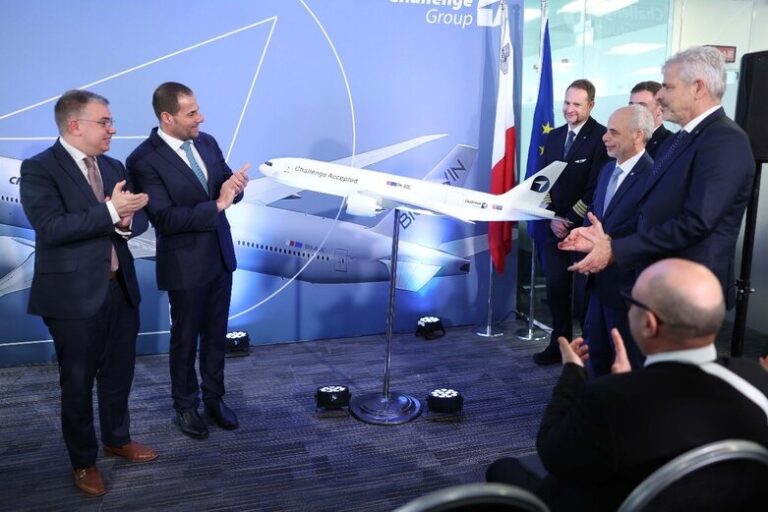
Celebrating the addition of Big Twins to the CG fleet. Image: Challenge Group
Challenge Group has signed a lease agreement with AerCap for two Boeing 777-300ERSF converted freighters, making it the first European operator of these aircraft. This announcement follows a successful 2024 for Challenge Group, during which it expanded its fleet to 10 aircraft, completed its Boeing 767 conversion program, and operated over 4,000 flights transporting more than 200,000 tons of cargo. The 777-300ERSF, known as the “Big Twin,” offers 25% increased capacity compared to other twin-engine cargo aircraft and is optimized for e-commerce and express operations. Challenge Group celebrated the lease milestone on 17JAN25, at its Malta Head Office, with attendees including the Prime Minister of Malta and other dignitaries. The first aircraft has been registered as 9H AOC on the Maltese registry. For 2025, Challenge Group plans to consolidate its network while pursuing new market opportunities, focusing on strategic growth and operational excellence. This expansion reinforces Challenge Group’s position as a key player in the global air cargo industry. Yossi Shoukroun, CEO of Challenge Group, commented: “Today marks a historic moment for Challenge Group and Malta’s aviation sector. The registration of the first-ever Boeing 777-300ERSF converted freighters in Europe under the 9H AOC is a testament to our relentless pursuit of innovation and excellence. These aircraft, with their unparalleled capabilities, will enable us to meet the growing demands of global trade and reinforce our position as a key enabler in the supply chain.”
Unexpectedly, given the recent LinkedIn photos of successful Beluga operations of helicopters to Shenzhen or satellites to Florida in the past couple of months, news is out that the Airbus Beluga Transport company is no more. 75 people are affected by the surprising decision.
Airbus Beluga Transport Company (AiBT ) has surprisingly ceased operations on 24JAN25 – picture: Airbus
The French newspaper, Les Echos, seemed to get hold of the story first: Airbus Beluga Transport (AiBT), which specialized in oversize cargo missions, suspended all operations with immediate effect on 24JAN25. There is no published statement on the Airbus website thus far, but Reza Fazlollahi, Head of Sales & Contract at Airbus Beluga Transport, confirmed the news on his LinkedIn profile that evening: “It is with deep sadness that we were informed this week of the unexpected closure of our company.” He spoke of the extraordinary past six years in which he had been involved in the concept and launch of such a unique airline, and thanked his colleagues and everyone involved, including “so many great customers and partners from all over the world, who have never stopped believing in the great potential of our service to meet a real market need […] Part of me will continue to believe that Beluga will one day come back even stronger thanks to all these lessons learned.”
Totally out of the Beluga/blue… The news was met with astonishment, and many expressed their sadness at the end of what looked to be a promising, growing niche operating airline. Yet, it would appear that what made the A300-600ST Beluga aircraft operations unique is also what led to the board’s decision to cease operations. An Airbus spokesperson revealed that the main challenge was the fact that the mega-aircraft requires specially trained teams and loading equipment, and this posed significant operational challenges. Challenges that also limited network flexibility, since not all destinations are equipped to handle such a large aircraft.
A letter to its customers apparently mentioned ‘economic factors’ as a primary cause, alongside a lack of external customers for the outsized cargo transport service also being a contributing factor to the decision. The return of more favourable sea freight conditions may have been a consideration, too, going forward.
It had all appeared so promising Back in a dedicated press conference in 2022 – in fact almost to the day: 25JAN22 – Airbus had enthusiastically outlined its new commercial, global outsize cargo transport solution and ultimately the planned launch of its very own cargo airline. AiBT was launched in mid-2022, in response to a global shortage of outsized air cargo capacity – a situation exacerbated by the destruction of the Antonov An-225 Mriya during the invasion of Ukraine. Yet, despite its unique design, the BelugaST struggled to compete with larger cargo aircraft like the Antonov An-124-100 Ruslan in terms of lifting capacity. This competitive edge of other cargo aircraft may have contributed to the economic challenges faced by AiBT.
Yet, in 2022, the message had been one of complementary rather than competitive operations. Reza Fazlollahi, then Airbus Business Development Manager, had emphasized during the 2022 call: “We do not see ourselves as direct competitors. The AN124 does great job, especially with regard to payload. We will complement these oversize transport solutions and are specialised on volume as our unique selling point.” So, the idea at the time was: Antonov for large and heavy, Beluga for large and voluminous.
The hope at the time At the time, CargoForwarder Global reported on AiBT’s then marketed selling point: the fact that the Beluga has the world’s largest interior cross-section, able to take cargo up to 7.1m in width and 6.7m in height. Phillippe Sabo, then Head of ATI Air Oversize Transport at Airbus, said during the 2022 press conference: “The Beluga’s wider cross section will open up new markets and new logistical possibilities – which would not be feasible with other current airborne transport means. For example, customers could consider in their future manufacturing process to make larger parts to be transported whole without prior disassembly.” The message was that no need for disassembly and assembly meant quicker handling times, less complexity, less risk of damage or loss, and ultimately less cost in the overall transport operation, making the Beluga attractive to all kinds of industries – in particular, satellite, space, airline (AOGs such as wing engines, for example), helicopter, oil & gas and energy providers, machinery, land vehicles and other military equipment, and humanitarian supply distributors.
But it was not enough Unfortunately, things appear not to have worked out or are not being given enough time to prove their worth. Airbus Beluga Transport (AiBT) which eventually received its Air Operator Certificate (AOC) in NOV23, has become a short-lived independent airline venture, ceasing just 14 months later. It is not yet clear what will happen with the A300-600ST fleet in the mid to long term. As for the 75 employees affected by the decision, Airbus has emphasized that supporting them through the social process is a top priority and that it is committed to ensuring that they are taken care of during the currently undefined transitional period.
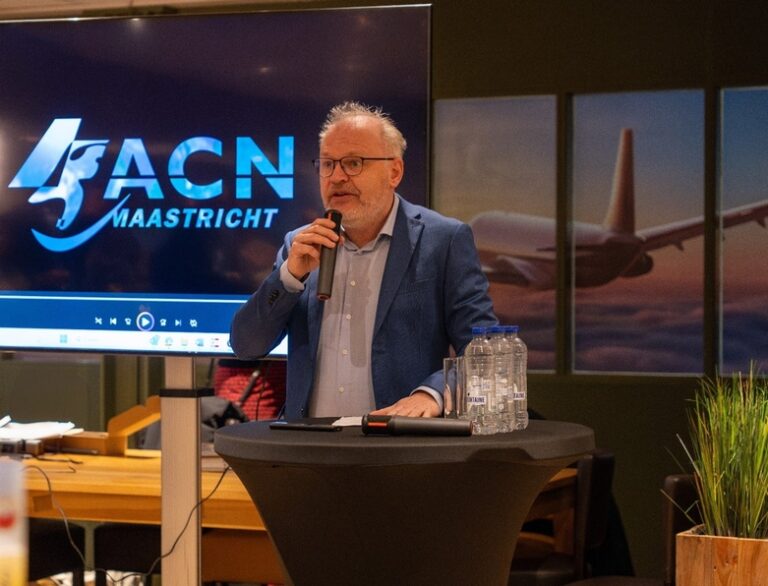
This intention was announced by Joost Meijs, CEO of Maastricht Aachen Airport (MST) at a recent meeting with members of the local cargo community from Limburg Province in the Netherlands. Without mentioning it directly, this step could be a door opener for cargo airlines affected by future slot cuts at Schiphol. After all, the new rightwing government’s aim is to reduce noise emissions at and around Amsterdam Airport by 20%, forcing out older freighters. Affected airlines could switch to MST.
Managing Director Maarten van As of Air Cargo Netherlands delivered a keynote address at the organization’s Maastricht meeting – picture: courtesy Dwayne van Honk
In 2024, a total of 110,000 tons of cargo were handled at Maastricht Airport. Until the turn of this year, management expects an increase of 20%, resulting from the looming growth of freight flown, with trucking volumes remaining constant.
Just days ago, Atlas Air launched weekly flights between China and Maastricht on behalf of MSC, operating a Boeing 777 freighter, enthuses Dean Boljuncic, Head of Commercial Development. “The shipments consist primarily of e-commerce products, with other goods supplementing the loads.”
The second newcomer that began serving MST in DEC24, is Airtrans. The carrier is based in Larnaca, Cyprus and operates A321P2F equipment. It serves Maastricht thrice weekly and offers the market a loading capacity of 27 tons per flight.
Investing 70 million euros Because of the traffic growth, Maastricht is updating its ground infrastructure by adding three parking positions for widebody freighter aircraft to the existing five. Work is intended to be completed by 2027, but this timing is not carved in stone yet. Further to this, an additional warehouse of 10,000 m² stands on the airport’s to-do list, including modernization of the current cargo facilities. “In 2023, we started renovating the runway and invested 70 million euros in updating and modernizing our cargo facilities,” states manager Boljuncic. This is complemented by initiatives kicked off by members of the local Air Cargo Netherlands lobby group, who developed various high-quality logistics centers near MST Airport. One example is a state-of-the-art freight terminal of 13,000 m², complemented by an office complex totaling 1,200 sqm, built in the vicinity of the airport and operated by MST subsidiary Maastricht Logistics Services BV. The facilities, erected outside the airport fence, were inaugurated in fall of 2024 and allow for one-stop shopping solutions.
Maastricht Airport closes its gates from 23h to 06h to protect local residents against noise – picture: credit MST
Closer cooperation with AMS “It is our responsibility as an airport to provide a competitive performance by investing in excellent cargo handling and cargo facilities. In addition, we see possibilities in an improved and strong collaboration with Schiphol for the air cargo industry. Especially since our airport is part of the Royal Schiphol Group. That will be our focus for the coming years,” exclaimed Airport Chief, Joost Meijs, at the gathering of the local Air Cargo Community.
Favorable cargo environment The meeting demonstrated once again the ACN members’ commitment to the freight business in MST. Arjan Hage, Managing Partner of Maastricht Logistics Services and Chair of ACN Maastricht stated: “Limburg’s central position in the Euroregion, the international mindset of businesses here, and the strong cargo community in the area create the perfect environment for a thriving logistics sector. The collaboration of the local cargo community within ACN Maastricht creates strong appeal for airlines and other (logistics) businesses,” emphasized the ACN official.
“We’ve been working in this structure for over a year now, and we are beginning to see the benefits through efficient and strategic partnerships,” he added.
In mid-2023, Amsterdam Airport acquired a 40% stake in MST, with Limburg Province remaining majority owner. Since then, both sides kept emphasizing the importance of cargo and efforts to coordinate their commercial and strategic policies.