Counting on the support of AVS GSA Thailand’s cargo expertise. Image: Thai VietJet
Thai VietJet has selected ECS Group subsidiary, AVS GSA Thailand, to grow and develop its cargo business on its Bangkok (BKK) -Mumbai (BOM) route. Following the recent signing of the agreement, the first cargo shipment set off from BKK on 21JAN25, landing safely later that day. Thai VietJet offers a daily BKK-BOM-BKK connection, serving the route with A320/321 passenger aircraft. AVS GSA will ensure that the cargo holds are filled with commodities such as general cargo, spare parts and e-commerce shipments out of BKK. Pharmaceuticals and garments will likely be coming the other way, connecting with other Thai VietJet flights via its BKK hub. The airline stands to benefit from proven cargo sales expertise as well as the larger ECS Group network, and can look forward to growing cargo volumes as the partnership progresses. Jean Ceccaldi, CEO of ECS Group, stated: “This agreement with Thai VietJet underscores our dedication to empowering airline partners through our extensive network, advanced solutions, and industry expertise. By working together, we can support Thai VietJet maximize its cargo potential and seize new market opportunities efficiently.” Chirasak Chandratat, Managing Director of AVS GSA Thailand, commented: “Our collaboration with Thai VietJet demonstrates the power of partnerships in achieving growth and operational excellence. Leveraging ECS Group’s capabilities, we aim to enhance Thai VietJet’s cargo reach while delivering exceptional service to the market. This agreement marks a significant step forward for both organizations.”
Timo Stroh migrates from Dachser to BeCon Projects – photo: CFG/hs
Air freight consultancy, BeCon Projects, has appointed Timo Stroh as Managing Director. The cargo veteran has over three decades gathered experience in logistics and cargo companies, most recently as Head of Global air freight at Dachser and previously in key roles at UPS and DHL. Timo Stroh brings extensive industry knowledge and a global network to BeCon Projects, a world leader in integrates air freight solutions. Founded 2009 by Uwe Beck, the company offers comprehensive consulting services from a single source, including strategic infrastructure and building planning, integration of material handling systems (MHS) and implementation of digital solutions. Stroh has headed the air freight committee at DSLV since 2019 and is committed to representing the interests of German air freight forwarders. His expertise in the pharmaceutical industry complements his profile and strengthens BeCon Projects’ ability to meet the diverse requirements of its clients. “Current key projects include the new air cargo building for dnata with an annual throughput of 800,000 tons at Schiphol airport in Amsterdam and for WFS at JFK Airport in New York,” reports CEO Beck. “I chose BeCon Projects because I found the ideal platform here to act entrepreneurially in a dynamic environment,” explains Stroh. He adds that his passion for air freight and the inspiring, incomparable atmosphere of this industry motivates him anew every day. “With the best conditions and a highly motivated team, I am looking forward to actively shaping the next growth phase of BeCon Projects.” At BeCon Projects, Timo Stroh will expand the core business: “Innovative technologies such as AI and robotics will be key to driving automation forward in our industry,” the executive states. These innovations increase the efficiency and resilience of the supply chain. With a focus on digital solutions, BeCon Projects strives not only to improve existing standards, but also to develop new business models that optimally prepare customers for the future. “In Timo Stroh, we have gained a visionary leader who will continue to drive BeCon Projects forward strategically and operationally,” Beck confirms. “Jointly, we prepare BeCon Projects to continue to grow as a trusted partner for airlines, airports and cargo handling agents and to lead the company into the next generation.”
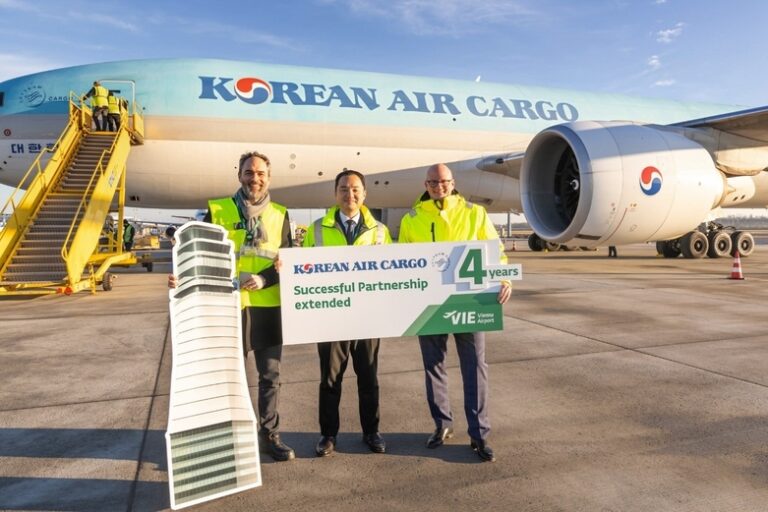
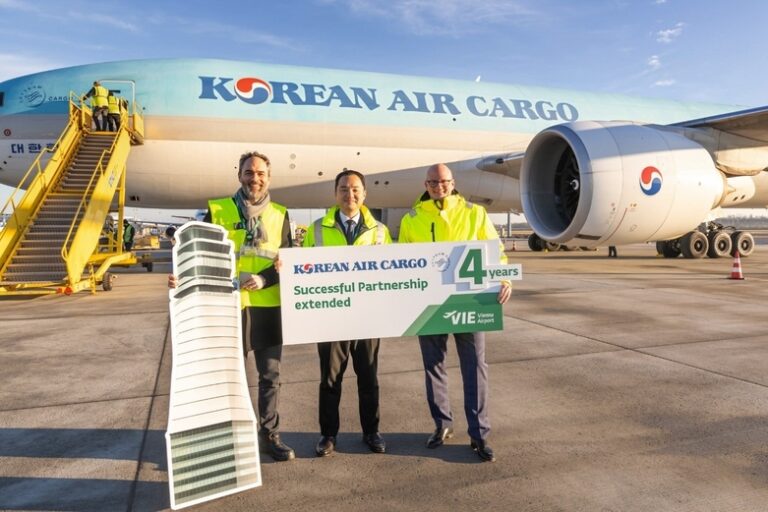
(L to R) Michael Zach, SVP Ground Handling & Cargo Operations, VIE Airport, Janghan Stefan Kim, Regional Manager of Austria Korean Air Cargo, Julian Jäger, CEO & COO, VIE Airport. Image: VIE Airport
Korean Air Cargo and Vienna Airport have been cooperating since 2004. Following on from its 20-year anniversary, last year, the cargo airline has now officially extended its cargo handling contract with the airport for another four years. Thus, the connection linking Austria’s Vienna Airport with Korea’s Incheon Airport, will continue until the end of 2028. Korean Air Cargo is responding to the increasing demand for air cargo services between Korea and Europe and uses Vienna as a gateway for shipments destined for Central and Eastern Europe. The latest Memorandum of Understanding (MoU) goes beyond mere handling activities, since the two companies are planning joint marketing initiatives and exchanging expertise regarding logistics systems as well as expanding services for freight forwarders and customers. Julian Jäger, joint CEO and COO of Vienna Airport, announced: “The successful partnership between Korean Air Cargo and Vienna Airport has been extended for another four years – a strong sign of the trust and cooperation that has connected our companies for 20 years. Together, we will continue to develop cargo handling between Seoul and Vienna at the highest level and expand our position as a leading European cargo hub. Austria, its neighboring countries, and Asia will thus remain closely linked economic zones through international airfreight traffic in the future. We look forward to continuing this success story.” Eum Jaedong, Executive Vice President and Head of Cargo Division at Korean Air Cargo, exclaimed: “We are delighted to announce our continued partnership with Vienna Airport. Our co-operation has led to successful business results, and we are confident that this contract extension will lead to further growth and development. We look forward to providing our customers with the best possible transport services and further strengthening Vienna Airport’s position as a major hub for logistics in Eastern Europe.” Michael Zach, Senior Vice President Ground Handling & Cargo Operations of Vienna Airport, explained: “The extension of the Korean Air Cargo contract until 2028 is clear proof of Vienna Airport’s strength as an air cargo hub. We offer comprehensive services, modern infrastructure and a dedicated team that ensures maximum efficiency and reliability. Korean Air Cargo is one of the most important cargo airlines at the site and we look forward to further expanding our good collaboration.”
The World Air Cargo Summit 2025, hosted by Ostend-Bruges Airport, ended with a philosophic and philanthropic presentation delivered by Peter Hinssen. Peter is a thought leader on technological evolution, innovation and a top ranked keynote speaker. He likes to describe himself as pathological optimist. It is people like Peter who think out of the box, place everyday developments in larger contexts and thus transcend intellectual boundaries. We have summarized key aspects of his presentation here, which is less about pallets and containers and more about the tension between human evolution and technological achievements. It would be wonderful if philosophical, social, and historical aspects were included at more air cargo events. They provide a lot of food for thought.
Peter Hinsen advocated to embrace the “Never Normal” – courtesy: de Spreker.nl
As is always the case with innovative leaps, the results are not automatically met with enthusiasm by those affected. This was already demonstrated by the first effects of the industrial revolution around 250 years ago, which led to innovative mechanization, steam-powered machines, and deep social change. Every change triggers basic interest as well as fears about the consequences for one’s own job. AI is no different today.
AI on the advance Meanwhile, algorithms are taking over a big chunk of what we have been used to doing ourselves so far.
Through algorithms, our refrigerators can be refilled remotely, and we are informed through advanced technology about our health status or the energy consumption in our homes. At first glance this sounds enticing, it positively influences our work-life balance since we need to work less, and we gain more spare time.
Baruch Spinoza (1632-1677), a Dutch philosopher, stated that no matter how thin a slice is, there will always be two sides. Even at that time, people knew well that there is a second side to the coin. Translated into today’s world of increasing data exchange, robotic and questionable information, contents, or situations, this means that for social and cultural progress, people should not withdraw to sulk in the corner according to the motto “I can’t change anything, after all,” but should instead stay curious and open to new developments. Otherwise, they will be sidelined by innovations and become dispensable sooner or later, which will only frustrate them even more. Their goal should be to jump on the bandwagon to adapt to a new economic and technical environment. For air freight, this means that only then will this sector succeed, products be improved, and sustainable solutions gain ground, benefiting customers through tailored services and product offerings
What about Universal Basic Income? However, is this development really the starting point for the much-debated Universal Basic Income (UBI)? As is well known, UBI is nothing new.
In the 16th century, the British humanist and statesman, Thomas Moore wrote his book, Utopia, in which he explained his belief in a better world based on Greek Physiology and Christian faith. Perhaps this was the starting point for a basic income paid to all people. Five centuries later, this remains a utopian vision, far away from realization. Yet, it does not spare mankind from the task of thinking about how society should deal with more time at most people’s disposal. Soon, it could perhaps be spent on education, care for our fellow human beings, and finally contribute to the generations that follow, enabling them to live in a safe, healthy, and clean world. It will not be the end of humanity, but maybe its real beginning.
Saudi Arabia’s largest cargo airline carried 577,870 tons of cargo in 2024, representing a 27% growth in transported weight and a 13% increase compared to 2023. The share of e-commerce shipments amounted to 23%, which translates into 64,000 tons. And this segment continues to grow very strongly.
Loay Mashabi, CEO and MD of Saudia Cargo: “Our goal is to belong to the world’s top ten air cargo carriers by 2030.” – Courtesy: Saudia Cargo
In addition to these bold figures, however, is the fact that high-value shipments including hi-tech electronics, pharmaceuticals, jewelry, works of art, bank notes and similar commodities, accounted for 54% of total revenues. To ensure the safe transportation of these items, a rigorous and seamless security regime must be in place from source to destination. This also includes well-constructed packaging materials such as multi-walled corrugated boxes capable of withstanding the rigors of shipping, handled and taken care of by professional personnel.
SkyTeam contributed to the upswing Commenting on the year’s figures, Loay Mashabi, CEO and Managing Director of Saudia Cargo, stated: “Our 2024 results reflect our steadfast dedication to delivering innovative and agile cargo solutions that drive global trade and adapt to market dynamics. We remain focused on growth, strengthening partnerships, and providing advanced solutions that drive success for our customers. By prioritizing sustainability and operational excellence, we are steadily progressing toward our goal of ranking among the world’s top 10 air cargo carriers by 2030.”
Remarkable customer satisfaction As Saudia Cargo points out, its membership of the SkyTeam Cargo Alliance has also contributed to the positive results. The SkyTeam Cargo club offers customers the world’s largest freight network and its eight airline members, handling options at 60 shared warehouses. Soon, however, SkyTeam Cargo will lose ITA Cargo since its parent, ITA Airways recently joined the rivalling Lufthansa Group, into which it will be integrated.
Another important aspect in 2024, from Sudia Cargo’s perspective, was the fact that the carrier managed to enhance its digital offerings by 10%, launched a specialized e-portal, and improved communication channels. Further to this, it raised customer satisfaction to 47 points and achieved a cybersecurity rating from the Saudi Arabian National Cybersecurity Authority of 81.8%.
“Life Uninterrupted” Looking ahead, Saudia Cargo will expand its fleet with next-generation aircraft, adopt sustainable transportation methods, and invest in AI-driven digital infrastructure to enhance tracking and efficiency, the carrier has announced. This is complemented by initiatives to advance automated cargo handling systems, reduce costs, and implement eco-friendly logistics. It will continue to leverage Saudi Arabia’s strategic location. Saudia Cargo remains committed to driving economic growth and achieving the country’s official “Vision 2030”, guided by its promise ‘Life Uninterrupted’, the press release states.
Riyadh Air ante portas Further developments are likely to be exciting. This is because Saudia is facing competition from Riyadh Air. The newcomer, based in Saudi Arabia’s capital, Riyadh, has recently ordered 60 Airbus A321 neo and signed 38 purchase agreements for the Boeing 787-9, including 33 options for this long-haul Boeing variant. Partnership agreements have been signed with Delta, EGYPTAIR, Singapore Airlines, Virgin, Air China and China Eastern. Commercial flights are scheduled to begin in 2025. Last week, Riyadh Air received an operational certificate from the General Authority of Civil Aviation (GACA) for its very first Boeing 787-9 RX7000 full-flight simulator. Management announced plans to serve 100+ global destinations come 2030.
Besides the breathtaking growth of Air India and IndiGo there is probably no airline with more ambitious goals now. Whether this also applies to the air freight business of the Arab newcomer is unknown. There is nothing about the role of cargo on the newcomer’s website or in its press releases.
What did 2024 bring? What are the challenges for 2025? How to cope with perpetual disruption? These were the top themes discussed at the Executive Panel ‘The Big Picture’. It was one of a dozen exciting topics listed on the agenda of the World Cargo Summit in Ostend, Belgium, orchestrated by Swedish event organizer, EuroAvia International, last week.
Illustration provided by event organizer EuroAvia International.
Streamlined into questions by TIACA Director-General, Glyn Hughes as moderator, the above-mentioned issues were discussed by Eduardo Arenas, Head of Strategy & Transformation of Avianca Cargo, Winston Kwong, CEO HACTL, and Dr Stéphane Graber, Director-General of FIATA.
The issue of disruptions was the first to hit the floor as President Trump’s threat to tax imports from Colombia by 25%, led to a wave of panic among the flower producers in the period leading up to Valentine.
Staying on the topic of Latin-America, Dr Graber reminded the audience of the fact that the organization’s World Congress annual meeting last year was held in Panama, another of the new U.S. president’s targets.
That Panama had been eager to accept Chinese investments was not abnormal given that the U.S. was neglecting to invest in Panama. “So, no wonder that the Chinese took advantage of the gap and stepped in,” reasoned FIATA Chief Graber. “Whenever something happens in the maritime industry, it has a direct impact on aviation,” he concluded.
E-commerce is raging Avianca Cargo’s Eduardo Arenas acknowledged the uneven flows between the U.S. and Latin America, noting that up to now “there was more demand for goods traveling southbound to destinations in Latin America.” However, now there is a lot of uncertainty on what is going to happen under the new president.
That e-commerce is still raging through the industry was demonstrated by Winston Kwong, who said that 60% of the 168 freighters handled daily by HACTL in Hong Kong, are filled with e-commerce shipments. In absolute terms, that is 101 cargo aircraft.
Regarding 2025, he stated: “We are currently observing some growth, despite the potential imposition of tariffs. It will be a year of uncertainty. But each year we have seen the ability to maneuver and overcome the obstacles.”
Bring in the forwarder Within this context of uncertainty and challenges, the role of the freight forwarder is not to be underestimated. “The challenge today, is to navigate in a changing world. Preparedness is the key to success,” said Dr Graber.
He described the four levels the forwarders should work with: develop a global network, start new corridors, add optionality, and provide resilience to absorb shock by increasing visibility and prediction. Digitization remains an ongoing challenge in freight forwarding. The industry needs a higher technological profile, the FIATA official urged.
In NOV24, Avianca Cargo overhauled its brand, among other things, by the introduction of new A330 freighter aircraft. “We work on three levels: booking, tracking, and invoicing; how we use these tools and how we relate with them to the other actors in the chain,” said Mr. Arenas. “The challenge is keeping up with varying standards to secure permanent connectivity.”
Data sharing Stricter demands on shipment data are no small venture for HACTL, especially in e-commerce, in which most items are of low value. Wilson Kwong explained: “There are a lot of new requirements we have to address, and I expect some volatility. However, since the shipments are initiated by the buyer and processed through the seller, we possess all the necessary data.”
Touching the ongoing topic of digitalization, Graber referred to the Model Bilateral Agreement for Multiple Filing that his organization had launched in APR24. “Our aim is tomove the industry further into digitization, making business processes more transparent and error-free. We share only indispensable data, and the ownership always remains with the forwarder. What FIATA guarantees is compliance. However, the entire process can only succeed if everyone involved in the value chain is willing to interconnect with the other parties involved in the supply chains.”
The robots are coming Wilson Kwong agreed that robotics is the next big thing the industry is going to embrace. As a ground handler, he experiences an increasing shortage of labor, day in, day out. Managing this bottleneck and ensuring the constant flow of goods is a massive challenge. It will not work without new technical solutions that result in a symbiosis between man and machine. The answer is to use industrial robots that perform simple and repetitive tasks and thus relieve the burden on staff in warehouses and on airport aprons. This is a global problem and not limited to Hong Kong and China but similarly affects Europe and North America. So, there is no alternative to using robots to do the job and keep cargo flying safely and on time.
CargoForwarder Global’s ‘Spotlight On…’ highlights a different segment of the air cargo industry every Sunday, thus demonstrating the huge variety of careers on offer. To ensure that what happens in this ‘Freight Club’ is talked about and published across the media, many air cargo companies seek and invest in the professional expertise of specialized public relations (PR) agencies. One such agency is Meantime Communications where this week, Dulcie Jervis takes us through her job as Account Manager, and how she views the air cargo industry.
An important, impactful, and interesting industry. Image: Dulcie Jervis
CFG: What is your current function and company? And what are your responsibilities?
DJ: I’m a public relations (PR) account manager at Meantime Communications, a specialist PR agency focused on the logistics and supply chain industries. My role involves helping clients communicate with their target audiences through press releases, interviews, feature placements, and social media, working closely with industry press to boost brand awareness.
CFG: What does a normal day look like for you?
DJ: When I’m not travelling, a typical day usually starts with checking and responding to any emails that have come in overnight – our customers are spread out all over the world, so there are always messages to wake up to. I check in with the team (and some of my clients if time-zones allow), make a to-do list, and get cracking on the high-priority tasks.
After lunch, I’ll usually have a mix of client meetings, copywriting and proofing, and lining up social posts for the upcoming days, but thankfully, no two days are quite the same; there’s always an exciting new story or project to work on.
CFG: How long have you been in the air cargo industry, and what brought you to it?
DJ: I’ve been in the industry just over a year now, and it’s flown by (pun not intended). After graduating, I wanted two things out of my job; to work in PR, and within an industry that interested me. Along came Meantime’s job opening. The role offered both (the latter in excess), and the rest is history.
Unlike many new-comers to the industry, the behind-the-scenes world of global logistics was not completely unknown to me; my father has worked in logistics and supply chain all my life, and I’m not the only one of his children to follow in his footsteps. We were brought up spotting container ships on holiday, guessing Eddie Stobart truck names on road trips, and fighting over exhibition merchandise from his business trips. I now collect my own, and laugh at my younger self who thought that DSV exclusively made memory sticks, and that Malcolm Group was a jellybean company.
CFG: What do you enjoy most about your job?
DJ: I would say that my two favorite things about my job – the people and the places – go hand-in-hand, and they meet at industry events.
Each event I’ve attended has not only been a catalyst for PR activity, but has also given me the opportunity to spend time with people face-to-face, whether this is my clients, journalists, or meeting new people across the industry. You get the opportunity to talk to amazing people from all around the world, and then you get to reunite with them somewhere new at the next show. The standouts for me so far have been air cargo China in Shanghai last summer, and the 2024 IBJ Awards in Antwerp.
CFG: What do you see as the greatest challenges in our industry?
DJ: I think this is more of an opportunity than a challenge (that’s the PR practitioner in me), but I would say attracting and retaining young talent. More young people should know just how important, impactful, and interesting this industry is – not to mention, it’s also a lot of fun.
CFG: What advice would you give to people looking to enter into the air cargo industry? Any particular training they should aim for?
DJ: Absolutely do it. It’s a fascinating world, and it’s everywhere.
In terms of training, I would say to get stuck in and speak to people. The air cargo industry is full of individuals with invaluable experience, and they’re often more than happy to share their knowledge – all you need to do is ask!
CFG: If the air cargo industry were a film/book, what would its title be?
DJ: Freight Club. ‘The first rule of Freight Club is…’
Thanks for talking about Freight Club after all, Dulcie!
If you would like to share your personal air cargo story with our CargoForwarder Global readers, feel free to send your answers to the above questions to cargoforwarderglobal@kopfpilot.at We look forward to shining a spotlight on your job area, views, and experiences.
The Ostend Symposium provided a blueprint for regional airports to break out of their niche and significantly increase their share of air freight traffic. However, this requires several parameters that have similarities but can vary greatly depending on the location. The topic was on the agenda twice with different emphases. It was one of the most important topics discussed at the World Cargo Summit.
At the Ostend session, Yvonne Ziegler, Professor of Aviation Management at Frankfurt’s University of Applied Sciences, explained how a regional airport can achieve hub status. She highlighted these main parameters: An airport must enable unrestricted 24/7 traffic, provide sufficient warehouse space, and have at least one runway that can accommodate widebody freighter aircraft. In addition, there must be cool rooms for perishables and pharmaceuticals and, if possible, the airport should also be CEIV certified.
Accommodating an integrator spurs traffic Yvonne cited Liège (LGG) and Leipzig (LEJ) as successful airports that have grown from regional to global status. In both cases, integrators have pushed their growth. In LEJ, it was and still is DHL Express, while LGG benefited from the relocation of TNT from Cologne to the Walloon airport. Although TNT has long since been absorbed by FedEx Express, Liège has used the time efficiently to successfully attract other cargo traffic. In addition, the ground infrastructure was consistently expanded, an offer that triggered additional demand.
According to Yvonne Ziegler, these two airports are exemplary for the development from regional to global status. She did not forget to mention that both LGG and LEJ received, and in some cases still receive, strong political support, which has been a key driver of growth. In these cases, the result is a win-win-win: thousands of new jobs have been created: The airports also benefit from increased fees and additional companies have settled in the structurally weak neighborhoods, increasing the state’s tax revenue.
Ostend-Bruges CEO Eric Dumas outlined the benefits offered to airlines by regional Airports – photo: courtesy: OST
Different needs result in different solutions The fact is, however, that not every ambitious airport manager can copy the paths of LGG or LEJ. That is because the conditions are often too different. CEO Eric Dumas of OST, for example, explained why the existence of his airport is necessary and why its growth is limited. After all, major players such as AMS, BRU, and LGG are located in relatively close geographical proximity. Dumas’ reasons: “Because geographically, we are the closest airport to the UK on the European mainland. There is a partnership with the train operators of Eurostar, so that fast transportation of goods arriving in OST and destined for the UK across the Channel, is guaranteed.”
EGYPTAIR Cargo prefers market closeness That, in spite of an unfavorable geographical location, an airport can still attract airlines, is illustrated by EGYPTAIR Cargo. The company has been flying to the Belgian airport for over 33 years. Alongside Hahn (HHN), OST is its second most important destination for supplying the markets in Western Europe and the UK, with Egyptian fresh produce.
In contrast, Karaganda Airport (KGF) is a new kid on the block. Located in central Kazakhstan, it is completely privately owned. KGF has a 3,600 m-long S/L, various warehouses and cool rooms. The aim is to become a transit airport for traffic between East Asia and Europe, similar to Baku or Astana. To this end, managers presented an ambitious master plan at the meeting in Ostend.
Regional airports score with customer-centric services Hahn has a different focus. The motto for this airport is ‘small is beautiful’, although further traffic growth is expressly desired. HHN scores with unrestricted 24/7 access, a rare privilege in the German airport landscape. The management pursues a customer-first approach, which also includes time efficiency and specialized solutions, if requested by customers.
Are we seeing a new work sharing model? Last but not least, Chicago/Rockford International Airport in Illinois has long since surpassed the status of a regional airport. There are road feeder connections to all major U.S. agglomerations. Thanks to the many cargo flights, it has developed into a partner of big Chicago O’Hare Airport, based on a division of labor similar to Viracopos (VCP) and Guarulhos (GRU) in Brazil. “We are constantly coordinating our strategies with each other,” said Zachary Oakley, Executive Director of Rockford International at the congress in Belgium.
Perhaps this is a model for the future: close coordination between a traditional and highly frequented combination hub for passenger and cargo traffic, and a nearby airport where cargo plays first and even second fiddle.
Innovation, digitization, e-commerce and capacity remain the recurring themes in air cargo. The World Cargo Summit 2025 held in Ostend-Bruges last week made no exception. But the industry’s legitimate concerns, its economic achievements, impacts, and its demand for a level playing field eliminating traffic distortions barely get beyond internal circles. This was also largely the case in Ostend. The reason: Most actors are too modest and shy away from national or international conflicts. But is this restraint still appropriate?
Air Cargo – raise your voice! – illustration: courtesy FREEP!K
2024 was an excellent year for the industry, with double-digit growth in demand and elevated load factors and yields. But what about the future? First, of course, there is the impact of the decisions of the not-so-new occupant of the White House, whose proposed tariffs may impact 20% of the global air cargo market revenue.
Capacity shortage On the mid-term, there is the observation that 2024 saw 13% less widebody belly freight capacity on the major air cargo routes vs. 2019, the fact that over 30% of the in-service freighters are over 30 years old and that only 12% new freighter capacity is expected to be delivered by 2030, vs. today’s in-service capacity. On the major trade lanes, linking the Fareast, Europe and North America this capacity is being devoured by e-commerce.
Capacity shortage is, however, not limited to aircraft. On the ground too, stricter regulation may force operators to look for other opportunities. Secondary airports are vying for this additional traffic. Host airport Ostend-Bruges International is one of them, as are Maastricht-Aachen (not controlled by Schiphol Group) and Hahn in Germany.
E-commerce The rise of e-commerce shipments is so overwhelming that it is driving general cargo out of the aircraft decks. As TIACA Director-General Glyn Hughes put it in one of his moderations: “The growth of e-commerce is masking the evolution of the other verticals.”
E-commerce accounts for 1.5 mln tons per day (sic!) in the industry and it was the mean driver for the rapid ascent of Liege Airport in the cargo airports ranking. While most companies set a period of 72 hours – read: 5 working days – as their target for delivery, customers would like to see these squeezed to 3.5 days.
Digitization So, if speed is what the customers demand, time-consuming regulatory compliance is what the authorities are longing for. Digitization may be the match maker to bring these contradictory forces together. It has been one of the buzz words of the industry for years and still is, which demonstrates the snails-pace process in its implementation.
According to McKinsey, 40% of leading managers in logistics say that digital transformation will reshape their business model by 2025.
The better sharing of data that by many actors in the chain are still protected with a Fort Knox attitude, as well as AI and robotics on the work floor are seen as imperative to speed up the surface processes.
A survey has shown that only 12% of logistic operators think that the current collaboration efforts in the supply chain are fully effective, underscoring the scepticism about its true impact.
Wanted: freight forwarder This upcoming traffic jam of shipment and authorities linked information is in urgent need of traffic control, which will add another function to the freight forwarders’ already comprehensive package of tasks. They are the liaison officers between the ever-demanding shipper and the logistics player expected to comply to the former’s wishes.
Visibility Visibility is a feature that is supposed to be an integral part of the logistics process, but it may also make sense for the air cargo business and by extension for the logistics industry as a whole.
In other words, the industry has to stand up for itself. It needs to be recognised as the backbone of global trade, but in this respect a lot is still found wanting. Unlike the farmers, the air cargo industry cannot block highways with tractors or pour manure on the doorsteps of government offices.
But does the industry’s message resonate sufficiently in the ivory towers at the WTO, the EU and the like? Asked by CFG if specific actions should be taken to put the industry more on the foreground, the rather vague answer of the panelists was that the confidence in the current professional associations IATA, TIACA, FIATA and the like is unwavering. “Air freight players prefer quiet tones and the diplomatic approach to draw attention to their concerns,” stated an airline executive in response to CFG’s advance. So far, however, the results of this barely audible strategy are more than modest.
ADP gets new chief As CFG has learned from internal sources on the sidelines of the Ostend meeting, Philippe Pascal will become the new head of the French airport company ADP. His nomination is supported by French President Emmanuel Macron, but still requires parliamentary approval, which is expected in February. The French state owns a 50.6% stake in ADP. Monsieur Pascal succeeds Augustin de Romanet, who has held the position since 2012.
With each announcement of new mega-orders of aircraft or the plans for larger airports and growing global airline networks, it is clear: aviation is on the increase. IATA forecasts that passenger numbers will reach 5.2 billion this year (+6.7% on 2024), while cargo volumes may rise to 72.5 million tons, (+5.8% on 2024) Passenger figures are predicted to hit 12 billion by 2030 and 16 billion by 2050, with cargo exploding to an annual 400 million tons by 2050. More planes in the sky means more air traffic control (ATC) is needed. And yet, the industry is already struggling with a shortage of skilled workers.
Safety in the skies is ensured through ATC staff on the ground. Image: CFG/gorodenkoff
The devastating fatal collision between an Army Blackhawk helicopter and an American Airlines flight over Washington D.C., pending the results of the investigation, has however thrown the concerning shortage of air traffic controllers (ATCs) to the fore. Apparently only two people were on shift that evening, when there should have been four, and the team of 19 fully trained ATC (status SEP23) should ideally number 30, according to the controllers’ union and the FAA.
A global shortage Washington D.C.’s Ronald Reagan National Airport, (incidentally named after the president who, in AUG81, fired 11,359 striking air-traffic controllers), is not alone in its ATC understaffing problem: 77% of US ATC facilities are missing personnel. Nor is this a pure-US issue. While the FAA, which currently employs around 11,500 ATCs, reported a shortage of around 3,000 controllers early last year, the gap in Europe stands at around 700 to 1,000 ATCs. The International Federation of Air Traffic Controllers’ Associations (IFATCA), reports that almost every part of the world suffers a similar shortage of controllers, with Asia Pacific being the least affected. And it is not a new problem, either. Back in 2011, an ICAO study projected a global shortfall in training capacity equivalent to 40,000 air traffic controllers by 2030. With the developments in aviation since then, along with the challenges thrown at the industry through COVID, this projection is likely to be on the conservative end by today’s standards. The results of this shortage are flight delays or cancellations, industry growth limitations, and possible safety risks through controller fatigue.
ATCs aren’t born overnight Training to become a fully certified and independent air traffic controller takes time – usually between 3 years (such as in the UK) to 5 years, depending on national processes. FAA Academy training in the US takes 2-5 months and is followed by 2-4 years of on-the-job training for full certification. Recruits must be under 31 years of age. Last year, the FAA hired 1,512 new controller candidates, however it also lost over 1,300 employees due to retirement, training dropouts, or those who failed their exams. The FAA Academy averages a pass rate of between 60% and 70% – in other words, two in three go on to forge a career as ATCs.
Early retirement and retiring early The average age of an air traffic controller is 38 years old. This relatively young average age is due to several factors. For one, the mandatory retirement age for air traffic controllers in many of the world’s countries, is 56. This goes back to a study in the early 1970s, which found that the high cognitive demands of the job become more challenging with age – more specifically, research suggests that brain capacity for memory, reasoning, and comprehension skills can start to deteriorate from the age of 45. In 2009, IFATCA was even proposing to lower the retirement age to 50. Indeed, such early retirement options do exist in certain countries, after a minimum of 20 years’ service.
Seriously stressful Air traffic control per se is widely recognized as a highly stressful occupation. The constant pressure of safeguarding against midair collisions and ensuring expeditious air traffic movement in an increasingly overcrowded airspace, takes a heavy toll on controllers’ mental and physical capacity. Studies have shown a significant increase in stress-related symptoms as controllers gain more experience, with health effects (such as hypertension, sleep disorders and chronic fatigue, depression or anxiety, PTSD following critical incidents, headaches, or chronic pain due to prolonged sitting, to name but a few), becoming more pronounced after age 40. These health issues can be exacerbated by factors such as shift work (often including evening, day, and midnight shifts within a five-day period), long hours (between 6 and 10 hours per shift), and the constant pressure of maintaining air safety. The cumulative effect of these stressors can lead to burnout, decreased job performance, and potentially compromise flight safety if not properly addressed.
The effects of shortages Adding in the effects of staff shortages, and these already challenging conditions are further magnified. Air traffic controllers frequently work six-day weeks to cover the shortages, often with 10-hour days/mandatory overtime. The extended hours and reduced rest time between shifts have raised concerns about controller fatigue and its potential impact on air traffic safety. Looking at FAA records for 2024, there was indeed an increase in safety incidents such as runway incursions and near-misses – a number of which were attributed to ATC decisions. It is therefore not surprising that these conditions have increased the risk of burnout and led to earlier retirement among experienced controllers as they balance safety considerations with their own well-being.
Measures in place Measures have been taken to mitigate the impact of the ATC staff shortage. These include extensive recruitment campaigns to attract new talent, more streamlined and enhanced training processes (using advanced simulation technologies to provide realistic training scenarios and accelerated learning pathways, for example), and various retention strategies (such as more competitive salaries, better working conditions, and providing mental health support to address the psychological demands of the job).
Looking ahead, AI may be one answer to addressing ATC staff shortages, by enabling routine task automation and improving process efficiency, however human controllers will remain essential – particularly when it comes to complex decision-making. It will take time to combat the staff shortage problem. And this may well mean that aviation’s planned expansion does not progress as rapidly as some airlines would like. After all, safety comes first – always.