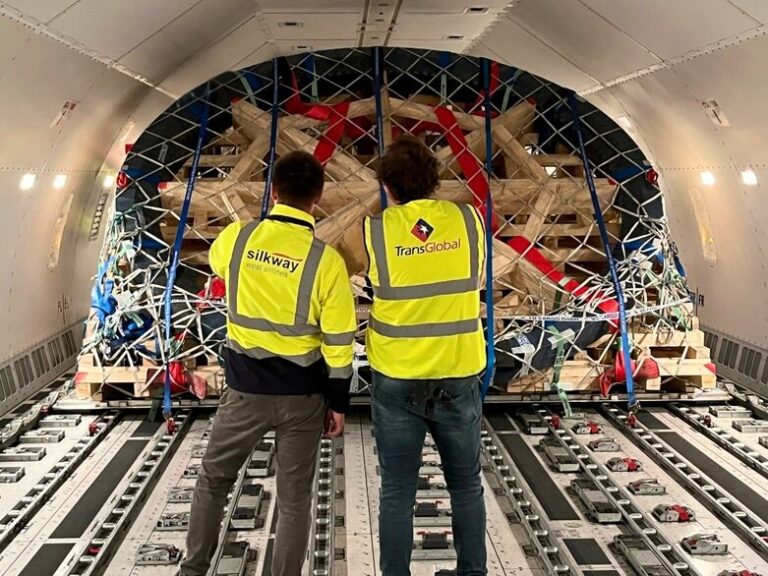
TGP transported an oversized slewing ring, measuring 4.3 meters in diameter and weighing 6 metric tons, on a B-777F. Image: Company courtesy.
A ‘slewing ring’ or ‘turntable bearing’ is a rotational rolling-element bearing that typically supports a heavy but slow-turning load in combination (axial, radial and moment loads), and is often found in conventional crane, windmill, forklift attachments or welding turnover jigs, for example. Considering that slewing rings start as small as just 100 mm in diameter, the one transported by Trans Global Projects (TGP) in SEP24 from Germany to China, is a true giant. Its diameter measured 4.3 meters, and it weighed in at an eye-watering 6 tons. With that kind of size and weight, careful planning is all the more crucial for a safe flight – and these shipments usually require bespoke transport equipment, as was the case here. TGP was responsible for designing the frame to allow the ring to be safely loaded and stored in a Boeing 777F. The frame tilted the slewing rig to a loading width of 360 cm, so as to allow it to fit through the 372 cm-wide freighter door. The oversized slewing ring which was indeed going to become the element of a crane in China, was successfully delivered overnight on 22SEP24. It had first been transported to Frankfurt Hahn Airport in Germany on 22SEP24, using a hydraulic tilt trailer system which avoided the need for a specialized road permit – as this would have taken a long time to acquire. It safely departed from Hahn Airport, landing in Zhengzhou Airport, China, the next day, well in advance of Golden Week celebrations so as to be unaffected by any related travel disruption. TGP says that its tailored air cargo solution won the project as it offered a faster and more cost-efficient service than alternatives “such as the slower ocean freight or the complex, costly, and limited availability of an Antonov 124,” the press release explains. Gijs Vlasman, Head of Commercial – BENELUX, Trans Global Projects, said: “We all recognize the extraordinary effort and ingenuity required to achieve what initially seemed impossible. This slewing ring is one of – if not – the largest, most complex, and heaviest piece ever transported using a B-777F. Our success is a testament to the creative thinking and capabilities of our team.”
Adam McKenna, Erwinvan der Genugten, Bryce Barnhart. Image: WCAworld
The world’s largest network of independent freight forwarders (numbering 12,451 member offices in 195 countries), announced management transitions at the start of the year, following the retirement of two of its long-standing managers at the end of 2024. Bruce Cutillo, General Manager of both WCA Dangerous Goods and WCA Projects networks, retired after 11 years at the helm. He reflected: “WCA Projects has been the most enjoyable part of my career since 1981. It has been a privilege working with such highly professional members, many of whom I count as friends.” He built both networks to what they are today: WCA Dangerous Goods is considered “the world’s foremost independent dangerous cargo forwarding network, now boasting over 160 member offices in 45 countries,” and WCA Projects which focuses on project logistics, now numbers 400+ international member offices and is “recognized for its stringent quality standards and dynamic member partnerships.” Alongside him, Brian Churchman who was Managing Director of Lognet Global since 2010, also stepped down, having developed Lognet Global into “one of the world’s most dynamic and respected freight forwarder networks, known for its exclusivity and quality”. Brian commented: “I am truly proud to have supported Lognet Global’s members and will miss the camaraderie, especially at our conferences. I wish all members continued success in their business and personal lives.” Stepping into their shoes are: U.S.-based Bryce Barnhart, long-time senior WCAworld manager, who will succeed Brian as Managing Director of Lognet Global. Amsterdam-based Erwin van der Genugten, takes on the role of General Manager of WCA Projects, alongside his existing responsibilities as Regional Manager Europe WCA and Managing Director EGLN Network. UK-based, Adam McKenna, is the new General Manager of WCA Dangerous Goods. David Yokeum, Chairman and Founder of WCAworld, remarked: “Our retiring leaders have set the gold standard for network management. We are deeply grateful for their contributions and confident that their successors will lead with the same passion, dedication, and innovation.”
David O. King, Senior Vice President – Commercial, SEKO Logistics. Image: SEKO
The Airforwarders Association (AfA) has a new board member in the form of David O. King, Senior Vice President – Commercial, SEKO Logistic. His appointment was announced on 09JAN25, alongside the re-election of existing members: Aaron Ambrite, AIT Worldwide Logistics, Amanda Barlow, Global Critical Logistics, Dennis Mitchell, Lynden International, Jarrett Williams, Estes Forwarding Worldwide, Kendra Tanner, Allstates WorldCargo, and Matt Castle, C.H. Robinson. All listed are now embarking on a three-year term on the Airforwarders Association board, and are tasked with promoting and strengthening the interests of the air cargo supply chain and its around 400 members across the U.S. and abroad. David O. King brings with him a wide range of experience in finance, business functions in logistics. His aviation career began at American Airlines in 1998, and since then, he has worked for Continental Airlines, United Airlines, Maersk, and others, before joining SEKO in JUN24. David O. King, SEKO Logistics, said: “I am honored to join the board and contribute to the Association’s vital work in representing the air forwarding industry and uniting industry stakeholders across the global supply chain. The AfA plays a critical role in ensuring the air forwarding community remains resilient, responsive and forward-thinking in navigating today’s challenges. I look forward to bringing a diverse career perspective to this leadership role, fostering collaboration and driving strategic initiatives that will shape and strengthen the future of air forwarding.” Brandon Fried, Executive Director, Airforwarders Association, declared: “We are thrilled to have David join our Board of Directors. His extensive experience in the logistics sector and commitment to advancing industry innovation will be invaluable as we continue to address the challenges and opportunities facing air forwarding. We look forward to his contributions to our shared mission of connecting and empowering our members.”
For the U.S. Customs and Border Protection (CBP) watchdogs, 2025 began with two success stories. At the cargo warehouse in New York’s Champlain Port of Entry, inspectors seized multiple shipments of jewelry for trademark infringement. Over in Pennsylvania, CBP officers intercepted counterfeit vehicle inspection stickers produced in Israel, to the estimated value of USD 1.4 million.
CBP officer at work – photos: courtesy Agency
Back to the seized counterfeit Tiffany & Co. jewelry: From DEC24 to 06JAN25, CBP agents inspected several separate shipments which contained various pieces of what appeared to be high-end jewelry. After a thorough examination of the goods, the jewelry was determined to be counterfeit. All the items were seized for intellectual property rights (IPR) violations. Had they been genuine, they would have fetched a total retail price value of approximately USD 29,989, experts estimate.“CBP continues to play a crucial role in protecting the consumer and businesses from the importation of fraudulent merchandise,” commented Champlain Port Director, Steve Bronson, following the seizure. “I’m proud of the outstanding job our officers and import specialists do in targeting these shipments and identifying these violations.”
Fake Luxury items seized in New York
Tough legal consequences The turnover resulting from trade in counterfeit luxury products is constantly increasing, and the methods used by criminals to smuggle goods through airports or seaports or across the borders to Mexico or Canada, are becoming more and more sophisticated, despite all search successes, warns the U.S. agency. Counterfeiting effects, if uncovered, can have significant legal consequences for those involved, it said in a statement. In Philadelphia, CBP officials detected more than 20,000 fake license plate stickers originating from Israel and destined for a U.S. consignee whose name the agency did not reveal. Nor did it say what consequences he would be facing for importing counterfeit products. Had the falsified stickers been affixed to license plates of vehicles that are no longer roadworthy, the risk of accidents would have increased dramatically, endangering traffic participants in general.
Falsified vehicle sticker produced in Israel
Raising customer awareness Trade in counterfeit and pirated goods threatens the U.S. economy, the competitiveness of the businesses, the livelihoods of U.S. workers, and, in some cases, national security and the health and safety of consumers, reads a CBP statement. Individual consumers may be liable for a fine even if they did not intend to import counterfeit or pirated merchandise. To curb the trade in counterfeit goods, CBP has established an educational initiative termed Counterfeit Campaign, to raise consumer awareness about the consequences and dangers that can be associated with the purchase of falsified and pirated items.
After plans of operating Embraer 190 P2F converted freighter aircraft went to ashes, Nairobi-based Astral Aviation intends to grow its fleet by adding Boeing freighters. “We are talking about one B737-400F joining the fleet by the end of this year, complemented by a B737-8F in 2026,” Sanjeev Gadhia, CEO of the African cargo airline told CargoForwarder Global in an exclusive call. He further indicated that more freighters are to come.
Originally, Astral Aviation intended to operate two leased P2F converted Embraer 190F. However, after comparing the pros and cons, the executive stepped back from the Embraer deal, originally signed in 2021. He named a couple of reasons for this retreat: The freighters were ordered in the aftermath of the Covid pandemic when yields were going through the roof. At that specific time the E190F, seemed to be the right equipment for serving pan African routes.
Astral Aviation will attend the upcoming Air Cargo Africa trade show, held from 19-21FEB25 in Nairobi’s Sarit Expo Center – image: CFG/hs
Major price gap However, shortly after, rates went rapidly south. This price decrease made it impossible to generate profits with the aircraft, Sanjeev states. The limited payload in combination with excessive lease rates and declining yields were other obstacles Astral Aviation was not willing to shoulder. This said, management decided to step out of the deal and target Boeing freighters instead. “While the E190F can accommodate 12 tons, its competitor, the Boeing B737-400F ‘classic’ can uplift 18 tons per flight,” he reasons. The price difference in operating the two models amounts to 40% in favor of the B737F, he calculates. Hence, in comparison, the B737-400F delivers better value-for-money.
More B737F and B767F The executive leaves open whether this is a fundamental decision against P2F converted freighters originally built by the Brazilian airframer or whether the plans have just been pushed into the backburner and might be reactivated at a later stage if operational conditions are more favorable. Time will tell and much depends on market conditions in Africa, he says. Now he wants to add another B737-400F “classic” to the fleet, which will happen before the end of this year. In 2026, a leased B737-8F is to follow, upping the fleet to four B737F units, enabling the Kenian cargo carrier to expand and densify its intra-African network. In addition, Mr. Gadhia announced to CargoForwarder Global that the B767F sub-fleet consisting of three units will be supplemented by two further aircraft of this Boeing type for long-haul flights to the Gulf States and the Far East, with Astral relying on the B777F in the longer term.
Africa will be a dorado for e-Com, but only in a few years’ time So far, Africa, he says, is a low-yield air freight market overall, which is particularly true for general cargo. And e-commerce is still in the initial phase. Many places lack the necessary infrastructure for e-trade, for example in terms of electronic availability, the use of cashless payments or delivery options on the last mile. “We are four years behind the global trend, but Africa, with its very young population, is gradually catching up with e-trade. I expect the first major boom in 2027.” With the four leased B737 freighters and the B767-F sub-fleet, Astral Aviation should be well prepared for the expected upswing in terms of capacity and the routes it serves.
CargoForwarder Global’s ‘Spotlight On…’ series brings a different area of the air cargo industry to the fore each week. Usually, we focus on people, however every now and again – as in the real world of logistics – delivery hiccups occur. This week, therefore, we are letting a ULD have its say. Having seen the distressing video of the storm at King Abdulaziz International Airport in Jeddah (JED), on 06JAN25, where containers were flying through the air, hitting airside vehicles and being shredded, it is obviously necessary to highlight the crucial importance of proper container storage and training in handling and protecting ULDs. Without them, air cargo would not be happening.
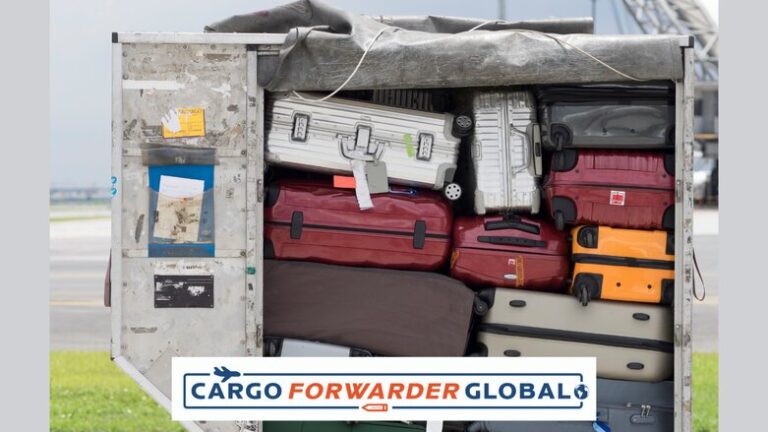
Whether they carry passenger baggage or cargo, ULDs have a tough life. Image: Canva/CFG
CFG: What is your current function and company? And what are your responsibilities? ULD: I am a Unit Load Device (ULD) container, currently working for a major international airline. My responsibilities include grouping and restraining cargo, mail, and baggage for air transport. I’m designed to be directly restrained by the aircraft Cargo Loading System (CLS) and become part of the aircraft’s structure during flight.
CFG: What does a normal day look like for you? ULD: A normal day for me is quite dynamic. I start at the cargo warehouse where I’m loaded with various shipments. Then, I’m transported to the aircraft, where ground handling staff use specialized equipment to load me into the cargo compartment. Once inside, I’m secured to prevent movement during flight. After landing, I’m unloaded, and my contents are distributed or transferred to another aircraft.
CFG: How long have you been in the air cargo industry, and what brought you to it? ULD: I’ve been in the air cargo industry since the 1960s when containerization revolutionized air freight. The need for efficient and safe cargo transport brought me into existence, and I’ve been an integral part of the industry ever since.
CFG: What do you enjoy most about your job? ULD: What I enjoy most about my job is the critical role I play in global trade. I facilitate fast and easy transfer of cargo from one aircraft to another and even between different modes of transport. I also take pride in protecting the contents loaded from loss and damage.
CFG: What do you see as the greatest challenges in our industry? ULD: The greatest challenges in our industry include capacity constraints, sustainability requirements, and adapting to changing trade patterns. The air cargo market is facing potential capacity crunches, with belly capacity growth slowing and aircraft production delays. Additionally, new regulations like the EU’s ReFuelEU Sustainable Aviation Fuel (SAF) mandate are increasing costs and complexity.
CFG: What advice would you give to people to get into the air cargo industry? Any particular training they should aim for? ULD: For those looking to get into the air cargo industry, I’d advise gaining a thorough understanding of ULD regulations and operations. The IATA ULD Regulations (ULDR) is an excellent resource, covering technical and operational standards, regulatory requirements, and guidelines for all aspects of ULD operations. Training in areas such as ULD serviceability checks, build-up/break-down procedures, and transport and storage guidelines would be beneficial.
CFG: If the air cargo industry were a film/book, what would its title be? ULD: If the air cargo industry were a film, its title would be “Sky High Logistics: Connecting the World, One ULD at a Time.”
Thank you, ULD, for highlighting your story.
ULD’s answers were provided by Perplexity. CargoForwarder also asked Perplexity what could have been done to prevent the scenes at JED on 06JAN25. Here is what it said: On 06JAN25, severe weather, including strong winds and heavy rain, struck Jeddah International Airport (JED), resulting in cargo containers being tossed across the airfield. This incident was widely shared on social media, with videos showing containers being blown around like tumbleweed, causing disruptions to airport operations and reported flight delays as crews worked to ensure safety amid the storm.
To prevent such incidents in the future, several measures could be implemented:
1. Enhanced Weather Monitoring: Airports should invest in advanced weather monitoring systems to provide real-time updates on severe weather conditions, allowing for timely responses.
2. Cargo Securing Protocols: Implementing stricter protocols for securing cargo containers during adverse weather conditions can help prevent them from becoming projectiles. This includes using weight bags or anchoring systems.
3. Operational Adjustments: During forecasts of severe weather, airports could temporarily halt ground operations involving loose cargo or reposition containers to more sheltered areas.
4. Training and Awareness: Regular training for ground handling staff on safety protocols during severe weather can enhance preparedness and response strategies.
5. Infrastructure Improvements: Developing more robust storage facilities for cargo that can withstand high winds may also reduce the risk of damage during storms.By adopting these strategies, airports can better protect cargo operations and ensure safety during adverse weather events.
Good points, wrong order In my view, it all starts with proper training (point 4), which, in addition to IATA mentioned in ULD’s answer above, can also be found on www.uldcare.com pages – in particular the https://www.uldcare.com/uld-care-code-conduct/store-uld-damage-free-manner-environment/ which explains how containers should be correctly stored (point 2). For that to happen, the airport must have invested in the right infrastructure for ULD storage (Point 5). Points 1 and 3 ought to be standard operating procedures in any case. What are your thoughts on Perplexity’s answers – both as a ULD and as a damage prevention suggestion?
If you would like to share your personal air cargo story with our CargoForwarder Global readers, feel free to send your answers to the above questions to cargoforwarderglobal@kopfpilot.at We look forward to shining a spotlight on your job area, views, and experiences.
What do DANX Carousel and logistics heavyweight, DSV, have in common? Both are based in Copenhagen, Denmark, are active in the transport sector, and are growing primarily through acquisitions, albeit at significantly different company sizes. As far as time-sensitive logistics services are concerned, DANX has now put a new spin on the ongoing consolidation in this particular sector, by taking over the German LPR Group.
The step directly affects around 700 employees, including 200 engineers, who are transferring from the LPR Group to DANX Carousel. Most of them are specialists working in maintenance and repair, pre-configuration, refurbishment, inspection, and warranty services.
Axcel’s top management on way to new horizons. Private equity investor Axcel took over DANX and Carousel in JAN2022, with LPR now added to the portfolio- photo: courtesy Axcel
Complementing services The LPR Group serves customers from a wide range of sectors, from energy suppliers to healthcare groups or retailers. LPR complements DANX Carousel’s business activities by offering both night and day-time express services, on-site repairs, emergency and spare-parts logistics, as well as warehousing solutions, including the installation, maintenance, and replacement of consumable materials. Thanks to the LPR acquisition sealed on 08JAN25, DANX Carousel strengthens its position as the leading European provider of time-critical logistics solutions. The takeover rounds off a period in which the DANX Carousel Group made several acquisitions to consolidate its position in the time-sensitive logistics market. The step “is part of our ongoing drive to build Europe’s leading time-critical logistics provider. LPR’s regional and technical capabilities complement our own and together we can deliver more comprehensive end-to-end solutions across the full supply chain,” commented Klaus Rud Sejling, Chief Executive Officer, DANX Carousel, following the signing of the deal.
Exciting opportunity His group has been owned by private equity firm Axcel since 2022. The executive did not provide any details on the price of the transaction. “Our new partnership with DANX Carousel presents an exciting opportunity to strengthen our time-critical logistics capabilities and continue to match our customers’ high expectations. Following a period of sustained growth across the business, particularly in the retail, healthcare, and IT services sectors, I look forward to working with DANX Carousel as we cement this progress and expand our geographic reach,” replied Michael Bonnes, Chief Executive Officer, LPR Group.
For time:matters, DANX Carousel is a competitor but also a reliable partner, states t:m executive, Larsch Krosch – photo: CFG/hs
time:matters stays cool According to Lars Krosch, Managing Director and Chief Operating Officer (COO) of the competing time:matters Group, the DANX Carousel/LPR merger will only have a minor impact on his company’s own time-sensitive logistics activities. The Danish company specializes in time-critical overnight transports by road, while time:matters focuses on the delivery of ultra urgent goods by freighter aircraft covering an intra-European overnight network. “DANX Carousel is a competitor, but to a certain extent also a partner with whom we work closely in some areas,” illustrates Krosch. He also told CargoForwarder Global that time:matters has signed a new exclusive 5-year contract with railway operator, Deutsche Bahn for urgent courier services. The pickup and delivery of the goods are included in the deal. The use of speed trains reduces time:matters’ CO2 footprint further, the executive emphasizes. He expects the consolidation process in this special business field to continue.
The Hungarian Civil Aviation Authority, as part of the Ministry of Construction and Transport (ÉKM), has issued an Air Operator Certificate (AOC) and operating license (OL) to Hungary Airlines KFT. This was published on the regulator’s website on 08JAN25. After the low-cost airline, Wizzair, it is the second airline with home carrier status at Budapest Airport. However, there are more questions than available facts about the ownership structure, business model, and the influence exercised by the Orbán regime.
Questions arise, for example, about the official owner of Hungary Airlines. According to local sources, it is the Chinese businessman, Wu Jiang, who owns more than a 50% capital stake in the airline. He is complemented and supported by his righthand, co-founder, Duan Bo, another Chinese national. The management also includes two Hungarian aviation professionals, Gábor Talabos and Gábor Varga, both well-known figures in the country’s aviation sector.
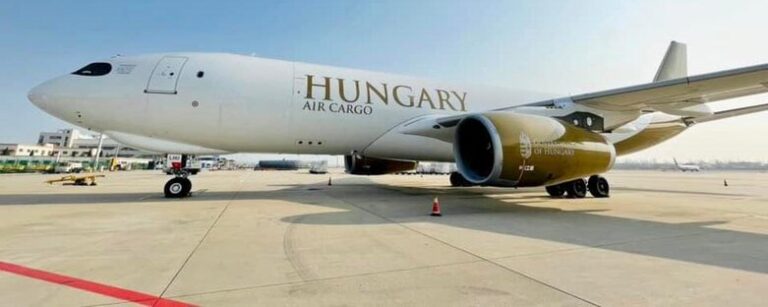
A330F operated by Hungary Airlines – courtesy: Hungary Today
Opaque ownership structure Other stakeholders include Beijing-based UTL Digital Logistics Co. Ltd., and the Hungarian state-owned Air Hungary Szolgáltató Plc., which became a minority shareholder in NOV24. Hungary Airlines aims to bolster trade and transportation links between Europe and China, in this way supporting the close ties between the Orbán administration and Beijing’s policymakers. The airline’s main task is to strengthen Hungary’s position as an emerging logistics hub in Central and Eastern Europe, and cement the importance of China’s One-Belt, One-Road initiative within the eastern part of the EU. The carrier’s IATA code is “HUA” and its call sign is “BUDAPEST”.
A project in line with Orbán’s policy According to EU law, at least 50.01% of the ownership shares in an airline registered in the EU must belong to owners whose passports were issued in one of the 27 member states. In the case of Chinese-born Wu Jian, it is completely unclear whether he obtained Hungarian citizenship. The airline does not provide any information on this. A telephone inquiry by CargoForwarder Global to management remains unanswered. The history of the carrier is also peculiar, as is its naming. The company, which was initially registered in 2021, began operations as Universal Translink Airline Hungary Kft. (UTA). Shortly after, it changed its name to Hungary Cargo Airlines Kft., and in the spring of 2024, became Hungary Airlines Kft. In MAY24, it recruited staff and started developing its brand image. Yet, its website went offline months ago, reports online portal, Világgazdaság.
The fleet plans also remain in the dark Meanwhile, equipped with its AOC, HUA has commenced operations with a state-owned Airbus A330F, its sole aircraft so far. The freighter was purchased by the Hungarian government in 2020 for USD 57.5 million, and handed over to local budget carrier, Wizz Air. In this way, the Orbán regime was able to secure the air transport of urgently needed medical and hygienic supplies from China to Hungary during the Covid-19 pandemic. Ever since then, and on behalf of the government, Wizz Air has operated the state-owned freighter three times per week between Hungary and China. Now, the newcomer will continue serving this sector, complemented by occasional charter missions.
On 05NOV24, Aviation Business published an article highlighting a growing optimism surrounding eVTOL (electric vertical takeoff and landing) technology and suggesting that 2025 could be a pivotal year for the industry’s commercial debut. A couple of weeks’ prior, however, the German eVTOL company, Lilium, filed for bankruptcy protection, followed soon after by a second prominent, German eVTOL company, Volocopter GmbH, which filed for insolvency on 26DEC24. Turbulence in the final months of 2024. However, things are looking up again. The two German companies have rescue plans, and – across the Pond – Canadian aerospace company, New Horizon Aircraft Ltd. announced this week, that it has signed a Letter of Intent (LoI) with Discovery Air Chile Ltda., for 5 of its Cavorite X7 Hybrid eVTOLs.
First, however, to the bankruptcies. The fact that they happened highlights the many challenges facing the eVTOL industry. First and foremost, the high development costs, with estimates varying depending on whether these are electric air taxis eVTOLs or air cargo drones – the range extends from half a billion USD to even 5 billion USD. Time is also an issue. Dronamics, for example, has been around since 2014 and its commercial launch plans intended for early last year, have now shifted to early this year, if all goes as intended. Other factors presenting obstacles to market entry are the complex certification processes, limited market readiness and public acceptance, and therefore also difficulties in securing ongoing funding in what is already a challenging financial environment.
New Horizon Aircraft Ltd.’s Cavorite X7. Image: Horizon Aircraft
Going ahead Despite the challenges, according to Aviation Business, logistics professionals appear optimistic, with two in every three believing that mainstream deployment of eVTOLs will happen this year. They see rapid progress happening in eVTOL technology, and this seems to be driving confidence in the sector. Regarding regulatory frameworks, the EU and the US, in particular, are shifting forward. One key factor driving interest is the prospect of greatly reduced operating costs. Horizon Aircraft’s press release, this week, illustrates that point. Its states that its: “Cavorite X7 provides a cost-effective alternative to traditional helicopters with twice the speed and up 75% lower operating costs.” Its aircraft is named after the fictional gravity-defying material featured in H.G. Wells’ 1901 novel: ‘The First Men in the Moon’. The Cavorite X7 being developed by the advanced aerospace engineering company, one of the first of its kind: a hybrid eVTOL aircraft, combining a conventional aero engine with battery-powered wing-based fans. It is designed to carry a payload of approximately 680 kilograms, has a projected range of over 800 kilometers, and will have the USP of being able to recharge its batteries in-flight and operate without ground charging infrastructure.
Horizon Aircraft to deliver 5 Cavorite X7s in 2028 Though it won’t be happening this year. The LoI it signed with leading Chilean helicopter operator, Discovery Air Chile Ltda., this week, to lease five Cavorite X7 eVTOLs, has a projected delivery timeline of 2028. Chile can then look forward to “dramatically reduc[ed] transfer times for passengers, patients, and time sensitive goods while cutting costs for operators.” Álvaro González, General Manager, of Discovery Air Chile Ltda., announced: “We are proud to be the first South American operator of Horizon Aircraft’s Cavorite X7 Hybrid eVTOL. Sustainable, cost-effective operations and innovative technology, such as what Horizon Aircraft offers, advances Chilean regional air services and is integral to maintain competitive operations. The Cavorite X7 is expected to transform the speed, flexibility, and cost to transport people and critical goods. This will be transformative for Chilean air movements at a regional level.” Brandon Robinson, CEO and Co-founder of Horizon Aircraft, added: “This agreement with Discovery Air Chile Ltda. marks a significant milestone for Horizon Aircraft as we further expand our international footprint into South America. In Chile, when it comes to emergency evacuations, transfers and quickly reaching hospitals, speed is essential. Our Cavorite X7 hybrid eVTOL offers a compelling economic and operational alternative to helicopters. Our aircraft can fly almost twice as fast as a traditional helicopter with an estimated 30% lower per-hour operating cost. This results in over 75% savings as compared to a traditional helicopter on a per-mile basis.”
Plans to turn Volocopter around Though it had filed for insolvency on 26DEC24, just four days later, Aerospace Global News reported that “Volocopter remains confident its VoloCity eVTOL will enter the market in 2025, despite having filed for insolvency – a process that will necessitate developing and implementing a restructuring concept by the end of February, and coinciding with its existing CEO stepping down.” A provisional insolvency administrator has been appointed and Volocopter has until the end of next month to source additional financing, so that it can continue. Meanwhile, despite the insolvency proceedings, business operations are continuing as normal, though the company has reduced its workforce from approximately 700 to around 500 employees. Its current CEO, Dirk Hoke, is set to depart by the end of FEB25.
Things are looking up for Lilium, too Over at Lilium, things are looking brighter again for the first time since OCT24, when the company’s bankruptcy triggered huge consternation and criticism. In 10 years and 10 months, it had already been listed on the US NASDAQ stock exchange, employed 1,000 staff which were then laid off, and had received USD 1.5 billion in investments. On 03JAN25, however, a rescue deal to the value of EUR 200 million/USD 206 million was announced, with a new consortium of investors: Mobile Uplift Corporation (MUC). It is made up of previous and new investors, though the full list has not been published. Speaking on behalf of MUC, the Berstein Group consultancy firm revealed that the capital increase was intended to provide Lilium with the necessary funds to bring its small electric aircraft to market maturity. It already had around 700 firm advance orders from customers in the United States, the United Kingdom, France, Saudi Arabia and other countries, and the consortium felt that to lose Lilium would be a major setback for Germany and Europe. It therefore also agreed to purchase the business assets of Lilium’s two key subsidiaries, Lilium GmbH and Lilium eAircraft, in addition to the cash injection, though for a sum not disclosed. The sales are still to be legally approved, but MUC believes that the company’s reorganization will have been completed by the end of MAR25. Possibly 750 of its employees will now be brought back.
Officially established in MAY18, “on the principles of innovation, integrity, and excellence,” according to its CEO’s words on its website, the Karachi-based private airline, K2 Airways took delivery of its first Boeing 737-400SF on 01JUL24. In DEC24, it finally received its Air Operator Certificate (AOC) from the Pakistan Civil Aviation Authority (PCAA) in DEC24, and promptly launched its cargo operations with an inaugural flight. Hailed as “a significant milestone in Pakistan’s aviation history,” K2 Airways’ freighter, which offers an 18.6-ton payload, took off from Karachi on the night of 26DEC24, landing in Lahore, less than 2 hours later.
K2 Airways’ inaugural flight took off on 26DEC24. Image: K2 Airways
The airline aims to ensure efficient air cargo operations initially across Pakistan, with plans to serve international markets at a later stage, “pending regulatory approvals”. As it sets out to expand its fleet and network, K2 Airways will also generate further employment opportunities. Its cargo focus will also contribute to the country’s economic development. “K2 Airways’ drive towards operational excellence positions it to become a key player in the region’s logistics infrastructure,” the press release promises.
Tariq Raja, Chief Executive Officer, commented: “K2 Airways represents a new chapter in Pakistan’s aviation sector. Our mission extends beyond mere cargo transportation – we aim to strengthen Pakistan’s position in the global aviation landscape. I want to express my deepest gratitude to the Pakistan Civil Aviation Authority for their unwavering support and guidance throughout our certification journey. Their commitment to maintaining high standards has been instrumental in bringing K2 Airways to this milestone.”