Madrid-based Air Europa joined the SkyTeam Alliance including SkyTeam Cargo, on 04SEP07 – a pact led by Delta, Air France-KLM and China Eastern. Now the Spanish carrier could become a full member of the Air France-KLM Group should the management of its majority owner, the Spanish Globalia Group (80%), approve the sale of the airline. There is some evidence for this, after the planned merger with IAG involving British Airways and Iberia turned to dust due to strict conditions imposed by the EU competition authorities. Hence, Air Europa is on the buyers’ market.
Market analysts approached by CargoForwarder Global agree that Air France-KLM would be a suitable partner for Air Europa against the backdrop of the current wave of consolidation in European air traffic. The Franco-Dutch carrier is not yet represented on the Iberian Peninsula, and lost the race for the planned entry into the Italian ITA, (supported at the time by Delta Air Lines), to Lufthansa. With Air Europa, Air France-KLM could therefore fill a gap in its southern European network which includes many transatlantic connections from Spain to the Caribbean region and 15+ destinations in Latin America. It would create a counterweight to the concentrated market power of IAG members, Iberia and Vueling, in south-western Europe. This also applies to the air freight business, although Air Europa’s route network primarily comprises tourist destinations, especially in the Caribbean Islands, which are rather of little attraction for air freight.
Air Europa operates 26 Boeing 787 jetliners – company courtesy
Intra-Brazilian traffic rights In 2018, the company decided to set up a separate division for air freight transportation after this business had been managed by GSAs for many years. One year later, the airline obtained a license from the Brazilian regulator, allowing it to operate flights on domestic routes. Should the Air France-KLM Group submit a tender to take over Air Europa, the price is likely to be similar to the EUR 1 billion offered originally by the IAG Group. However, the 20% stake that IAG has held in the Spanish airline since AUG22, would also have to be acquired. It was a loan to support covid-hit Air Europa to get back on its feet again after the pandemic forced commercial aviation to stay on the ground. Later, this loan was converted into a 20% in shareholding. In bold financial terms, this value is likely to be 200 million euros, which should up the total price for the Spanish airline to around 1.2 billion euros. Irrespective of the expected ownership changes, Air Europa is continuing to expand its own fleet. Last week, the airline put another B787-900 into operation – its 26th long-haul aircraft altogether.
Uniform Boeing fleet Despite the current delays in the delivery of commercial aircraft, Air Europa continues to meet the forecasts specified in its Strategic Plan. First and foremost, the company, which has an exclusive agreement with frame maker Boeing, has unified its fleet structure. In addition to the 26 Boeing 787s, the Madrid-based carrier operates 27 single-aisle Boeing 737-800s, which will soon be joined by its first Boeing 737 MAX. Cargo-only aircraft do not belong to its fleet.
CargoForwarder Global’s ‘Spotlight On…’ series illustrates a different career aspect of the air cargo industry each week. As we are now in the midst of the summer holiday season and the industry’s workload is currently spread over fewer backs, we take a break from the usual seven questions, to instead focus on the importance of taking a holiday. Air Cargo is an industry that never stops and most of our Spotlight guests thus far have pointed out that there is not really anything like a ‘normal day’ or simple 9-5 job. Any number of funny memes on LinkedIn frequently illustrate the effects of the stress that those superpowers working in logistics are constantly exposed to – a 24/7 job with an ever-changing daily potpourri of challenges…
In that kind of environment and with most of us equipped with global digital access in our pocket, it can be very difficult to actually turn off and take a proper holiday. I, too, found myself answering work emails and WhatsApps whilst on a long walk in the woods (and the heat!) this week, knowing full well that I really should go offline for a while. Yet, we fall into the trap of thinking we are indispensable and that can be very dangerous for our health – both physical and mental.
Can’t see the wood for the trees? You need a holiday! Image: B. Gledhill
Take a load off to get those loads on! The dangers of not taking a holiday are many, and – at the end of the day – it is not just you who suffers: your work and your relationships may also be negatively affected. Catch yourself getting short-tempered? Forgetting things? Feeling overwhelmed with all the tasks on your desk? Continuous work without time off increases the risk of mental health issues such as anxiety or depression. Not taking a break heightens stress levels which in turn can lead to mood swings, insomnia, and general unhappiness or lethargy. The longer those symptoms last, the greater your chance of Burnout, which is characterized by emotional, mental, and physical exhaustion. I know of too many in my network of air cargo colleagues, who have been hospitalized or on extended sick leave because their body suddenly shut down. Needless to say, therefore, chronic stress without recovery time can severely impact both your personal and professional life.
Longer hours do not mean greater output There is false pride connected with working long hours. If you are one of those people who enjoy pointing out how busy you are (and I will slap my own wrist for my actions this week), and how many hours you are putting in, know this: the longer you work, the less productive you become. The return on investment on the hours you put in, takes a nosedive: Fatigue hampers cognitive functions, decision-making, and creativity, and reduces your overall work efficiency. If you work in a physical environment, then you increase the risk of an accident happening in the workplace. You’re not safe when you’re tired.
Married to your desk? And if you are stuck at your desk all the time, not moving, then you put yourself at risk of physical health issues such as cardiovascular disease and a weakened immune system, thus increasing your overall susceptibility to illnesses. Your body needs time to recover from the physical and mental demands of work. That’s the work part of things. If your family never gets to see you because your workplace always comes first, then your personal relationships will suffer. The inability to spend quality time with family and friends can lead to isolation, misunderstandings, and even conflicts. Social connections are essential for emotional well-being and neglecting them can have long-term negative effects.
The long and short of things Taking regular holidays is crucial for maintaining both mental and physical health. It helps prevent burnout, boosts productivity, and strengthens personal relationships. National and international aviation authorities such as ICAO, IATA, the FAA and its peers, set strict regulations regarding work hours, rest periods, and holidays to ensure the safety and well-being of its workers. These standards are designed to prevent fatigue among flight crew members, which is critical for maintaining safety in air operations, including cargo flights. So, what about all those in air cargo operating on the ground? They are subject to the labor laws in the respective country. Most countries will ensure that workers receive paid leave and holiday entitlements, yet these can differ wildly depending on where in the world you are. Some countries offer generous paid leave, while others leave it largely up to the employer. Whereas the U.S. averages 10 days of paid time off per annum, the EU has some of the most generous holiday entitlements in the world at 4-5 weeks of paid annual leave (not including public holiday), as just two examples.
Take that holiday! A good employer understands the importance of taking a holiday and will encourage you to make full use of your time off. Regular vacations contribute to a better work-life balance, improved productivity, stronger team spirit and better quality of life overall. The recent pandemic and the devastating pressure on air cargo staff led to greater labor shortages and a 15% higher rate of burnout among logistics managers (according to a 2021 study published in the Logistics and Transportation Review). Thus, those companies with an interest in their employees’ health have begun incorporating wellness programs. Work-Life-Balance initiatives include more flexible working arrangements, mental health support, and robust stress management programs. Trainings on stress management, time management, and resilience can help staff cope with the demands of their job. Learning to delegate so that you can really turn off during your time off, is also to be encouraged.
The Right to Disconnect To those of you currently reading CFG on your holidays – we hope you enjoyed the article whilst relaxing on a sun lounger somewhere, and that you will now put your phone to one side and get on with enjoying the company of the people around you. (Or, if you are going to Google, then look up the ‘Right to Disconnect’ for your country and find out if you really are expected to answer emails during your paid leave…) To those reading this at work – well done on grabbing that coffee break!
If you would like to share your personal air cargo story with our CargoForwarder Global readers, feel free to send your answers to the above questions to cargoforwarderglobal@kopfpilot.at We look forward to shining a spotlight on your job area, views, and experiences.
A week ago, dramatic footage that could have been taken from any Hollywood action movie, made the rounds on global news media and LinkedIn. Unfortunately, it was not computer-generated imagery, but actual video material of a shipping container exploding on board of a Taiwanese cargo ship docked at China’s Ningbo-Zhoushan Port, just south of Shanghai – one of the world’s largest cargo ports. Class 5 goods overheated in an unplugged refrigerated container during an early afternoon where outside temperatures were a hot 36°C. With rising world temperatures come rising cargo challenges.
Remarkably (or allegedly), according to local media outlets, no one was injured or killed, though the damage affected containers in the vicinity, sent metal parts flying, and resulted in a huge black cloud of smoke. Reuters later reported that the container’s contents had included lithium batteries and tert-Butyl peroxybenzoate which is an organic compound that is flammable and explosive and should not be stored in an environment over 30°C. The responsible shipping company, Yang Ming, issued a statement in Chinese wherein it revealed that the owner of the goods had declared them as requiring dry, cold storage, without the need for plugged-in electricity, CNBC reported. Obviously, some serious mistakes in cargo declaration, acceptance and handling which led to the appalling incident, and these will all need looking into. Yet one of the culprits in this story is heat.
Extreme heat brings a number of risks for aviation and air cargo. Image: AI Image Generator/CFG
Foaming at the gates A more light-hearted image of another likely costly incident that may also have been the result of consistently high temperatures of 37°C (CFG assumption), is that of around 400 gallons of high-expansion foam spilling out of two gates at the United States Coast Guard’s Aviation Training Center hangar in Mobile, Alabama, last Sunday. This high-expansion foam activates when the fire alarm goes off or a button on the wall is pressed, according to the U.S. Coast Guards, yet no fire or emergency had been declared, and the reasoning was a ‘fault in the system’. Had that fault been triggered by ongoing daily temperatures of 37°C, dropping only to 25°C in the night? Who knows? Fact is – temperatures are rising and over at Villa Gledhill in Austria, which is seeing its hottest year since temperature recording began, even a tiny, solar-powered mobile power bank was recently unable to take the heat. It fell off the balcony table, began smoking and then expanded before bursting apart. A call to the Fire Brigade ensured that the small device was properly disposed of. First-hand experience of what could have been part of the large-scale problem that triggered the Shanghai container explosion.
Extreme heat is a challenge Honing in on air cargo: it’s a fact that extreme heat poses significant challenges to air cargo operations. High temperatures affect everything from aircraft performance to the integrity of shipped goods. And with global temperatures on the rise, companies need to prepare for these challenges. (On a side note: interesting that the world’s mega-airports are being planned in regions that are already hotter parts of the world – the architects have their work cut out for them to ensure sustainable cooling systems. But that’s by the by.) As we have already seen: heat impacts cargo integrity. In the worst case, volatile dangerous goods and highly sensitive items such as electronics or chemicals. Perishable goods are also at risk – food, pharmaceuticals and biological materials. Even when transported in temperature-controlled containers, prolonged exposure on the tarmac during loading/unloading or delays can lead to spoilage or reduced shelf-life. Yet, all other cargo is also at risk, since extreme heat can negatively affect packaging materials. These can degrade, adhesives can weaken, plastics warp and seals can fail – thus diminishing their ability to protect goods.
Aircraft performance and increased costs Extreme heat basically translates into less economical – and therefore less ecological – performance. Given that high temperatures reduce air density and thus decrease lift, aircraft require longer runways for takeoff. Airlines may need to impose weight restrictions and reduce cargo loads during heat waves, to ensure safe departures. These capacity constraints can cause delays, backlogs, and ultimately result in increased operational costs – not to mention less environmentally-friendly operations. Engine efficiency is also negatively impacted during extreme heat – this leads higher fuel consumption (higher fuel costs) and more carbon emissions. All of which can affect the profitability of air cargo services. Less efficient engines can potentially limit the range or payload capacity of the aircraft, which also increases costs and may limit the number of routes available for air cargo. Operational costs are again increased if sensitive cargo is transported during extreme heat, as it is expensive to maintain the required temperatures both in flight and during ground handling. Refrigerated containers require power, additional fuel is needed to run auxiliary power units (APUs), and cooling systems require more frequent maintenance.
A threat to health and safety Last, but certainly not least, since where would the air cargo industry be without its workers? Worker safety is a crucial issue: exposure to high temperatures poses health risks to ground handling staff. These include heat exhaustion, dehydration, and heatstroke, and can lead to slower operations, increased errors, and potentially hazardous conditions if workers are not adequately protected. To ensure safety, ground operations may be slowed or halted during peak heat, which can result in delays in cargo handling, loading, and unloading, and may disrupt tight schedules and affect delivery timelines.
How is your company preparing? At the end of the day, extreme heat significantly impacts air cargo operations by reducing aircraft performance, compromising cargo integrity, and increasing operational costs. In 2023, the global mean annual temperature change on land was 1.8 °C compared to the 1951–1980 baseline, and was the highest on record. The last nine years since 2015 were the nine warmest years on record. 2024 is looking to set another record. The earth is getting hotter, and the aviation industry larger. How is your company preparing to ensure safe operations in the air and on the ground, as well as product integrity in the years to come?
If you would like to write an Opinion Piece on this topic, please contact CargoForwarder Global on info@cgofor.eu
… is Oliver Hellwig’s entrepreneurial credo. After he sold his shares in Cologne Bonn’s Cargo Center, he decided to invest in a large handling facility located at Frankfurt Hahn Airport, or TRIWO Hahn Airport as the airport has been rebranded following the insolvency proceedings. We spoke with Oliver Hellwig (OH), the owner of Hahn Cargo Services, and his Managing Director, Robert Kurth (RK), about their goals and the airport’s prospects of acquiring additional cargo business.
CFG: What makes Hahn attractive from an air freight perspective?
OH: There are several unique and very positive factors that speak in favor of Hahn Airport (HHN), which had a decisive influence on our decision:
The airport never sleeps since it operates 24/7/365, so a night flight ban does not exist. It is located close to Europe’s largest cargo airport, Frankfurt Rhine-Main. Added to this is the positive attitude towards Hahn Airport by the neighborhood and local policymakers.
New market entrants are offered a broad range of slots which are not regulated at HHN.
The cooperation between the airport management, operator Triwo AG, the responsible authorities such as customs officials, and the ground handling agents, works absolutely smoothly and is very transparent.
The housing market for labor is excellent, which helps when recruiting new employees. This is a major difference compared to most other airports throughout Germany, such as Frankfurt, Munich or Cologne, to name but three.
The airport offers very flexible handling options. So, customers feel welcome and are treated with respect and utmost priority.
Being an entrepreneur requires courage, visions and a climate of social recognition, states Oliver Hellwig, owner of Hahn Cargo Services GmbH – photo: private
Three success factors
CFG: In the air freight industry, everyone is currently talking about e-commerce as a growth engine. What does Hahn Airport need to become a serious player in this market? OH: That’s a good point. In my opinion, Hahn is one of the most suitable airports in Europe for e-commerce. This said, three factors are necessary for upping e-commerce throughput in Germany: Firstly: Indirect protectionism must end. It favors the national carrier which is unable or unwilling to handle the volumes ordered by German consumers. This is why a number of competing carriers are forced to land in neighboring countries from where most of the goods are trucked across the border and handed over to German buyers. Secondly, customs authorities must interpret the European Customs Code homogeneously, which is not the case so far. According to our experience, the customs authorities at Hahn Airport are very willing to support all actors, especially in providing additional human resources at short notice when urgently needed. Last, but not least, the same aviation security standards decided by the EU need to be applied in all member states of the block of 27. Regrettably, this, too, is still not the case. For instance, deploying sniffing dogs to detect explosives or drugs is everyday practice in Amsterdam, Strasbourg, Paris or elsewhere, but forbidden at German airports, despite identical EU laws. This said, the German regulator should take action fast to ensure a level playing field in the industry. In addition to this, I might say that a bit less bureaucracy would also be helpful to spur e-trade. Once implemented, not only airlines, consumers and airports would benefit, but the state as well, since the Berlin government could cash in millions of additional tax revenues.
Tailored solutions
CFG: What was and is the current reaction of airlines to your handling company’s offer to process their air freight shipments, including customs clearance of the goods? OH: Our aim is to offer airline customers and/or trading platforms (e.g. Amazon, SHEIN, Temu), a tailored solution covering their needs from A to Z. This offer includes services such as customs clearance of a large number of single shipments, for instance 50,000 items loaded on an import flight. This all the more since most of the e-commerce shipments arriving at airports in neighboring European countries have been ordered by German consumers. From there, they have to be trucked across the border on the last mile, which ups greenhouse gas emissions significantly. We are currently working through an increasing number of inquiries with the aim of providing customers with flexible, functioning e-commerce handling solutions. As to the timeline: we expect to handle first fully e-commerce loaded freighters at Hahn Airport in the third and fourth quarter of 2024.
CFG: Robert, for smooth last mile delivery, among other things, you are looking for a reliable partner that offers an electronic interface to coordinate the processes between all parties involved, including customs and trucking. Is there already a candidate on the shortlist? RK: There are an abundant number of service providers in Germany, most of whom have invested large funds in optimizing electronic data transmission, benefitting the ground infrastructure and the flow of goods. As a rule, potential customers have existing agreements with various providers. Nevertheless, the aim is to coordinate the processes throughout the entire logistics chain, including the use of night-time hours, with the aim of delivering the consignments as quickly as possible upon arrival at Hahn Cargo Services to the market.
Cargo veteran Robert Kurth is Managing Director of Hahn Cargo Services – picture: HCS
Border control reopened
CFG: The border control point at Hahn Airport was reopened this year and is now located directly on the hahncargo site. What does this step mean for handling? RK: It is a big step in the right direction. In our role as handling agent, we would like to thank the relevant authorities and Hahn Airport for reopening the facility as quickly as they did. Everyone involved worked together very professionally and purposefully. Now, it is a matter of collaborating in a customer-oriented and flexible manner in the coming months when the perishable season starts. Here, of course, we offer tailored handling services including at night times or during weekends if desired.
CFG: One of your main competitors reports a new cargo airline landing there practically every week. Most recently, Maersk Air Cargo apparently opted for the Walloon airport. Are there any new candidates on Hahn Cargo Services’ list who are knocking on your door? OH: We are in talks with various cargo airlines, including trading platforms. As we have often concluded “non-disclosure agreements”, we are not allowed to mention names today. It must be acknowledged that some of our neighboring peers in Belgium or Southeast Europe have developed excellently by growing cargo throughput and upping employment. Encouraged by their own success stories, they are determined to invest big money for their further development. This said, my feeling is that a growing number of customers are increasingly looking for personalized services instead of getting lost in a big and constantly growing pool filled with fish. Some of the companies we are talking to, and this much I can say, are currently customers of the above-mentioned airports.
Remote but not isolated
CFG: Hahn Airport is located in a rather rural region. As a ground handler, how do you manage to find qualified personnel who are willing to work here and don’t prefer Frankfurt, Cologne or Leipzig, where employees are also urgently sought-after? RK: As Oliver mentioned earlier, in comparison, there is a much better housing market situation around Hahn Airport. We also have long-standing, experienced employees who are willing to train new staff in the best possible way.
CFG: HCS intends to expand: What is the plan? OH: We have around 16,000 m² of apron-side expansion space right next to our existing cargo handling terminal, that can be built on at short notice. In addition, there is the option of developing further areas with warehouses in reaction to rising demand. Therefore, we won’t see any queues of trucks waiting here to deliver or collect goods.
Africa’s leading passenger and cargo carrier inked a contract with Arabian consultancy company, Dar Al-Handasah, to conceive a concept for the construction of a mega airport city 40 km off Addis Ababa Bole International Airport. The project, of which this intended state-of-the-art airport is the centerpiece, is part of Ethiopian Airlines’ (ET) 15-year strategic plan to become one of the most competitive aviation groups in the world. It shall cement Ethiopia’s position as the crossroads of the world’s most rapidly expanding air travel markets – Africa, Asia, and the Middle East – and as Africa’s global transportation hub for the 21st century.
The figures presented by the consultancy team are remarkable. The new Abusera Airport (provisional name) will feature a 1.1 million m² terminal including passenger facilities, 126,190 m² of airline support facilities, and over 100,000 m² of cargo and airport support facilities. It will also include an associated airfield and other essential airport infrastructure such as telecommunications and buildings to house technical services. It will provide parking areas for 270 aircraft. An express rail link will run from the airport to downtown Addis Ababa. The consortium headed by Dar Al-Handasah, promises to deliver world-class services from concept design to supervision of construction. The airport’s terminal will be intuitive to navigate and characterized by its future-readiness with on-site renewable power generation as well as the collection, storage, and reuse of rainwater. Plans to build the airport were first announced in 2018, but postponed due to the pandemic. However, they are even more urgent now, because Bole Addis Ababa International Airport will soon reach its maximum capacity of 25 million passengers per year.
Ethiopian Airlines’ Group CEO, Mr. Mesfin Tasew and Dar’s Director of Operations in Ethiopia Tariq Al-Qanni
Africa’s flagship carrier With more than threefold growth in the past ten years, Ethiopian Airlines has become Africa’s largest carrier – and one of the fastest-growing airlines worldwide. As a result of this steady upswing, it commands the lion’s share of Africa’s cargo and passenger network, operating to more than 150 domestic and international destinations located on five continents. Upon completion, Abusera Airport is projected to have the capacity to serve 110 million passengers annually, which is four times the current capacity of Bole International Airport. Even if ET management does not provide any information on the expected throughput of air freight once the complex is online, cargo experts expect a strong increase in tonnage and the strengthening of the carrier’s role as a hub airline, connecting domestic African and intercontinental routes via its new airport.
Driver of economic growth This was emphasized by Ethiopian Airlines’ Group CEO, Mr. Mesfin Tasew, while detailing the plans for the Mega Airport City: “The project will not only enhance connectivity but also drive economic growth and prioritize environmentally responsible practices in our country and beyond, reflecting the airline’s commitment to innovation and sustainability.” The executive pointed out that the new airport promises to lift African aviation and strengthen partnerships, marking a significant advancement for the region’s air travel infrastructure. Dar’s Director of Operations in Ethiopia, Tariq Al-Qanni replied to this: “We are privileged to be collaborating with Ethiopian Airlines on this visionary new airport, which will provide vital global air connectivity, accelerate economic growth in Ethiopia, and elevate Ethiopian Airlines into Africa’s most strategic and most competitive aviation group.”
The airport will display Ethiopian heritage The first phase is scheduled to be completed in 2029. It will then already be able to handle an annual volume of 60 million passengers. Abusera Airport is positioned at a lower elevation compared to the current primary hub, Addis Ababa, situated at one of the world’s most elevated locations which results in unique operational challenges for cockpit crew. As far as its design is concerned, the architectural team will incorporate elements of Ethiopian heritage to establish a new emblematic structure for the nation, a people-centric, intuitive airport characterized by sustainability, resilience, and future-readiness. Ethiopian Airlines remains steadfast in its commitment to elevating customer experience to unprecedented heights, ensuring every journey is marked by excellence and innovation, the airline’s press release promises.
The USA now has its first ever airside Centralized Examination Station (CES). Thanks to collaboration between U.S. Customs and Border Protection (CBP), Dallas Airport (DFW), and dnata Cargo USA, shipments landing in DFW can be dealt with more quickly, efficiently, and safely. A particularly necessary gain given the huge influx of e-commerce. While 2020 saw some 16,000 international e-commerce clearances at DFW, this grew to 20 million packages in 2023, and has already exceeded 23 million packages in just the first half of this year. A CBP Centralized Examination Station with direct access to an Airport Air Operations Area (AOA) enables the direct transfer of cargo from airplanes to the CBP inspection facility, instead of first having to take them off airport for inspection – a time-consuming, costly and potentially risky process that happens elsewhere. “While the vast majority of importers follow U.S. laws and regulations, transnational criminal organizations constantly attempt to circumvent the system by hiding their contraband under the massive flow of legitimate shipments. CBP now has another resource to address the challenges faced in the de minimis environment, helping CBP better protect the American people,” the press release reads. The CES is also equipped with the latest non-intrusive inspection technology to further expedite cargo exams, streamlining the overall package clearance process at DFW.
More than just a pretty tablecloth. Image: U.S. Customs
CBP Dallas Area Port Director, Jayson Ahern, said: “We are better suited to process legitimate cargo while protecting American business and consumers by intercepting illicit and possibly unsafe goods. This is at the core of CBP’s mission. By expediting the commercial flow of legitimate goods, this innovative Centralized Examination Station has proven to be an economic stimulus to the region. CBP has assigned officers, agriculture specialists, and supervisors to this facility since its inception, we have seen greater speed and efficiency in clearing cross-border e-commerce and imports targeted for inspection. For the American consumer, it means their products make it to their doorstep faster and safer. This CES will serve as a model for future port efforts throughout the United States. Together with our DFW and dnata Cargo USA partners, we’re proud to be on the front end of this innovative effort.”
Chris McLaughlin, DFW’s Executive Vice President Operations, said: “The CES is a key part of supporting DFW Airport’s rapid growth of international e-commerce package clearances. We’re just beginning to tap into our immense business potential in cargo, thanks to our location in the center of the country, coupled with our extensive air service network. We thank our partners at CBP for choosing DFW as the first airport in the nation to lean into this new operating model.”
Delhi-based IT provider, CargoFlash, has succeeded in gaining Qatar Airways Cargo’s interest for its Octoloop cargo booking platform in India. The airline has chosen Octoloop since it offers customers another digital booking channel, and one that includes wallet service. The roll-out in India began with the launch of Octoloop on India’s national day: 15AUG24. A gradually increasing amount of freight forwarders in Delhi and Mumbia (initially) are being given the opportunity to view and book cargo capacity on Qatar Airways Cargo’s extensive network. For the airline, the extra booking channel helps to bring greater efficiency into sales and operations. Octoloop’s platform includes features such as real time rates with dynamic pricing, instant capacity bookings, revenue enhancement opportunities, and opens up the market to include SME perhaps not currently having access to the airline.
QR Cargo expands digital booking offer in India with Octoloop. Image: Octoloop
Faisal Karamat, Vice President Cargo Customer Experience at Qatar Airways Cargo, commented: “Adopting Octoloop aligns perfectly with our goals to maximize our reach in markets and offer superior service to our customers enrolled via the pay module. This tool will not only enhance our customer base but also support our growth ambitions in the Indian market. Digitalization is a key pillar of our strategy and by providing our customers in India with another option to book online via Octoloop, we are enhancing our omni-channel offering too.”
Jasraj Chug, Co-Founder and Director of Cargo Flash, said: “Our collaboration with Qatar Airways Cargo marks a milestone in digital logistics. Octoloop is designed to transform cargo operations by enhancing efficiency and connectivity. We are excited to see how this partnership will greatly benefit the logistics ecosystem in India.”
Southeast Asia’s largest integrated logistics provider, Teleport, has teamed up with Etihad Cargo and the two have committed to increasing cargo capacities and frequencies on their respective cargo networks between Southeast Asia and the Middle East. The move is a reaction to the increase in air cargo demand and trade between the two regions which is forecasted to be in the region of USD 757 billion, come 2030. Trade between the Gulf nations and emerging Asian nations stood at USD 383 billion in 2021, and experienced a 35% growth explosion to USD 516 billion in 2022. It is still growing at a fast rate.
Teleport and Etihad ink partnership. Image: Teleport
Though just announced now, the partnership was signed in MAY23. Already, Teleport has enabled Etihad to transport machines, raw materials, phones and chip sets, etc., on its twice-weekly freighters from Ho Chi Minh to Kuala Lumpur, with onward connection via Etihad’s capacity to Abu Dhabi and beyond. Belly capacities on passenger flights to locations such as Bali and Phuket have also been better utilized. “Etihad will deepen its connectivity in Southeast Asia on the back of Teleport’s extensive network in the region, while Teleport leverages on Etihad’s strong global network to expand its network reach into the Middle East, Europe, Americas and the African regions,” the release states, predicting that 1,600 tons will have been transported between the two regions by the end of 2024.
Stanislas Brun, Vice President of Cargo at Etihad Cargo, commented: “We continue to anchor our strategy on key partnerships that will enable us to better serve our customer needs while supporting global trade. This recent partnership with Teleport is important to enhance our connectivity to Southeast Asia, and we are confident that through the integration of their freighter operations and our capacity, we are able to continue to grow and build a more efficient and robust network that better serves both regions, and quickly.”
Jagedeswaran Nadrajah, Head of Air Partners at Teleport, said: “The integration of Etihad’s global network with our largest Southeast Asia network has opened up a more dynamic way to connect cargo between these two regions – leveraging on the strengths of both our networks. This is valuable to both our existing and new customers trading between two important regions.”
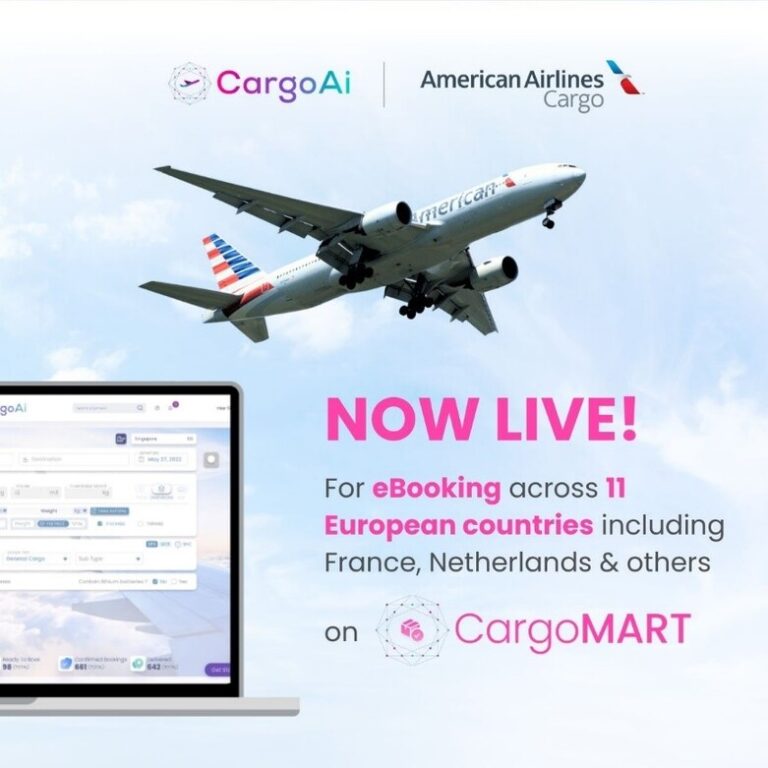
More capacity to the U.S. is now available on CargoMART. Image: CargoAi
Following its successful pilot in France, the cargo airline decided to expand its strategic partnership with CargoAi, to 11 European countries. The two companies first disclosed their partnership in MAY23, wherein American Airlines Cargo announced that it would begin to seamlessly integrate into CargoAi’s CargoMART booking platform as part of its modernization journey. Having seen the success of offering its capacities on the platform to users located in France, it recently broadened its available network. CargoMART now shows American Airlines Cargo routings out of origin airports in Belgium, Denmark, France, Germany, Ireland, Italy, Netherlands, Portugal, UK, Spain, and Switzerland. More regional expansions are still to come as American Airlines Cargo and CargoAi continue to grow their partnership and move towards greater digitalization in the industry. With every additional routing published on CargoMART, American Airlines Cargo MART, offers freight forwarders access real-time capacity and rate information, and a channel on which to quote, e-Book or Track and Trace. CargoAi also shows users the carbon emissions each offer generates. CargoMART complements American Airlines’ own digital booking platform, thus offering greater digital choice to customers seeking capacity and managing bookings on American’s cargo network.
Greg Schwendinger, President, American Airlines Cargo, stated: “We are excited to announce our inaugural launch on CargoAi, following a successful test run out of France. This is the first milestone in what we expect to be a strong and collaborative partnership with CargoAi, as well as a crucial part of our digital distribution strategy to expand our network reach to more cargo customers.”
Matt Petot, CEO of CargoAi, added: “We are delighted to extend our collaboration with American Airlines Cargo to multiple European origins. This partnership underscores our commitment to providing our users with best-in-class digital solutions that optimize their operations and drive efficiency in the air cargo industry.”
Feeport’s press release speaks of a “small revolution” now happening at Finland’s main air hub: Helsinki-Vantaa international airport (HEL). It is increasingly welcoming greater volumes of e-commerce cargo arriving from Asia. Three factors play into this success: “the rapid rise of a new local e-commerce logistics company – Nordic Parcel Express”, which has enhanced its handling expertise through the use of “a new type of neutral and scalable software technologies”. The latter is Tallinn-based technology firm, Feeport OÜ’s own Saas-based platform, x7trade (established in 2021), which enables automated customs clearance and ENS compliance of low-value e-commerce goods (<150EUR), as well as ICS2 compliance.
In less than a year, the Parcel team has grown from 1 to 8. Image: Feeport
The third success factor is Nordic Parcel Express’ close collaboration with HEL cargo handling partner: ASR Cargo Center. ASR also relies on an SaaS air cargo handling system for e-commerce handling and customs reporting: Qstep, developed by Qstep logiciel OÜ. Qstep and x7trade work well together and ensure smooth operations. Launched in the ASR Cargo Center in AUG23, Nordic Parcel Express is specialized (and licensed) in customs clearance, handling low-value e-commerce goods, and supply chain member coordination. In just one year, it has grown from a single-person operation to an 8-person team, and continues to recruit. e-commerce imports at HEL have sky-rocketed from just 50,000 kg in 2023, to a forecasted circa 1 million kilos monthly by the end of this year. Also impressive: e-commerce imports are released to last mile deliverers within as little as 4 hours after aircraft arrival.
Luis Pimentel, the CEO of Feeport OÜ, explained: “With x7trade, we aim to provide our business clients with the full e-commerce compliance package from Entry Summary Declaration (ENS) submission and customs clearance of low value e-commerce goods to shipment status updates in the cargo terminal. Finland has been a success story for us, and we want to build on this success across all EU markets.” Including Finland, 10 of the 27 EU member states are already covered.”
CEO of ASR Cargo Center and Board Member of Nordic Parcel Express, Samuli Naskali disclosed: “In our board meeting in 2023, we decided to pursue the e-commerce side of the cargo business. Close cooperation with airlines, cargo handlers and neutral technology providers such as Feeport and Qstep, gave us the technology tools to start pursuing this endeavor. A lot of work followed and I’m now happy to say that we have accomplished what we set out to do. Bringing in more volume to Finland by making Helsinki more attractive for e-commerce than ever, and making our portfolio bigger by claiming e-commerce as one of our areas of expertise.”