Home Blog Page 148

Exclusive – QR Cargo and Martinair Cargo say Adios to South America

0


At least partially. The two carriers intend to suspend some of their freighter services to the
sub-continent. While Martinair continues serving Bogotá as sole destination south of the Panama Canal, QR Cargo pulls their B777 freighters out of Santiago and Viracopos but continues offering freighter flights to Bogotà, Quito, and Guarulhos, a spokesperson told CargoForwarder Global. Simultaneously, the Arabian carrier will also abandon some routes to the U.S.  These unexpected network decisions, both becoming effective during the course of SEP24, have caught forwarding agents by surprise – particularly those who had been allocated major volumes by their airline partners on routes across the South Atlantic.

The network decision strengthens AF-KLM-Martinair’s cargo footprint in the Far East, reasons the group’s head of cargo, Adriaan den Heijer – image: courtesy KLM

Capacity crunch looms
Their withdrawal means that roughly 600 tons of capacity will be removed from the market. In the case of Qatar Airways Cargo, it concerns three B777-F flights connecting Luxembourg with South America, accounting for 300+ tons. Martinair used to operate three weekly B747ERF flights from Amsterdam to Viracopos (VCP), with two of the services connecting VCP with Buenos Aires (EZE) and Santiago de Chile (SCL), offering a total of 330 tons.

Forwarding agents are not amused
Why this move and why at this time, i.e. in the middle of the current summer flight schedule period which runs until 27OCT24? These questions come to mind. There are three key considerations. Firstly, the shift of capacities from transatlantic routes to the Far East is based on commercial considerations. There, the rates per kilogram are significantly higher compared to South America rotations. Secondly and related to the aforementioned reason: The e-commerce market is booming on routes to and from China, so shifting additional capacity on sectors served between the Far East and Doha or Amsterdam, is a plausible consideration. Thirdly, rotations between Europe and Buenos Aires, Montevideo, Santiago de Chile or even Viracopos, are time consuming and thus costly. If these services do not generate sufficient margins over a longer-term period, scaling them down or discontinuing the services completely is sensible.

Far East flights pay off more
This is confirmed by Adriaan den Heijer, EVP Cargo at Air France-KLM and Managing Director Martinair: “In the East Asian market, the e-commerce segment is growing steadily, driving increased demand for efficient and reliable air freight solutions. The introduction of this [Martinair’s] new Boeing 747 freighter service [to HKG] is a crucial step in adding main deck capacity to our extensive belly network. This expansion not only strengthens our freighter footprint in Asia, but also offers more options and greater flexibility to our customers. By enhancing our connectivity and broadening our reach, we are better positioned to support the growth and evolving needs of our global customer base.”

Returning after almost a decade
The network change at Martinair (MP) will take effect on 19SEP24. On that day, the airline’s first flight to Hong Kong will take off from Amsterdam, ending an absence of almost nine years. All flights, initially three per week but to be increased to 4/7, will be operated via Dubai, using a Boeing 747-ERF that offers a payload of 110 tons per flight.

At least MP is not withdrawing completely from the subcontinent. Flights to Bogotá will continue with three B747F rotations per week via Miami. The Franco-Dutch group also emphasizes that Air France-KLM operates 145 weekly passenger flights to 24 destinations in Latin America and the Caribbean, offering abundant capacity in their cargo holds.

QR Cargo shifts capacity to Asia and Europe
Qatar Airways Cargo will discontinue the above-mentioned flights to / from South America in the course of September. According to its itinerary, these are 4 weekly frequencies. The carrier enjoys strong partnerships with a number of airlines on routes to Latin America, so that the discontinuation of flights to Santiago and Viracopos could be easily compensated by partners jumping in. One of them is the Chilean airline LATAM and its cargo arm, with which QR is on friendly terms. This amicable pact does not include a capacity agreement between the two airlines, although QR holds a 10% stake in LATAM. A LATAM executive told CargoForwarder Global that without regulatory approval such accords are illegal for compliance reasons.

Further north, QR Cargo will also scrap routes between Europe and the U.S. This affects Atlanta that is completely taken off the route map, among other destinations, while Chicago will continue to be served.

Asked about the network changes, QR Cargo delivered this statement: As the world’s leading cargo airline, operating in a dynamic market, it is our responsibility to address market needs. Our global customers and consumers drive our capacity and market changes, resulting in Qatar Airways Cargo adding extra frequencies to India, China, Vietnam and Europe. The Doha-based cargo carrier serves a global network of more than 60 freighter destinations and 170 passenger destinations utilizing freighters and belly-hold passenger aircraft. 

Qatar Airways withdraws its freighters from South America and thins out its North American network – photo: courtesy QR Cargo

Demand tends to outgrow capacity
QR Cargo’s and Martinair’s withdrawal of main deck services from the South American market (except for Bogotá) leads to a considerable capacity gap. This might at least partially be filled by freight hungry Cargolux, Lufthansa Cargo, and LATAM Cargo, which will continue to operate freighters across the South Atlantic as documented in their itineraries. LATAM Cargo, for instance, operates 10 cargo flights per week deploying B767Fs ex Amsterdam, Brussels and Frankfurt, and serving the Brazilian destinations Viracopos, Florianopolis, Curitiba, as well as Montevideo, Buenos Aires, and Santiago de Chile. Thus, the airline holds pole position in freight traffic between Europe and South America. This is a considerable advantage, especially should the demand for air transportation increase moderately or even sharply in the coming peak season.

Cargolux offers customers three B747 freighter flights a week to Viracopos, Rio de Janeiro, Curitiba and Quito, and Lufthansa Cargo operates four freighter frequencies to six destinations, complemented by daily passenger services to Sao Paulo, Buenos Aires, and Bogotá (5/7). The cargo holds in the lower decks of Lufthansa’s jetliners, are roughly equivalent to the capacity of three Triple Seven freighter aircraft.

It is unlikely that EK, EY or TK will fill the capacity gap
It is not known whether the cargo divisions of Emirates, Turkish Airlines, and Etihad have plans to adapt their networks to and from Latin America following the withdrawal of Qatar Airways Cargo and Martinair. Yet even if they do, it will not bother LATAM Cargo, CV Cargo, or Lufthansa Cargo as their peers from the Middle East do not siphon off European produce to first fly them eastbound to their hubs Istanbul, Dubai or Abu Dhabi, and from there westbound across the South Atlantic to Latin American final destinations. Such time and fuel consuming detours make neither commercial nor ecological sense.

Bahri’s Schenker tender exit puts Berlin under pressure

Saudi Arabian state-owned Investor Bahri has exited the Schenker sales process. It is the second preferred bidder stepping out of the Schenker race, following the withdrawal of Danish shipping company Moeller Maersk weeks ago. The remaining two bidders are the Danish shipping giant DSV and a consortium consisting of CVC Capital Partners, the Carlyle Group, and the Abu Dhabi Investment Authority. When the German government announced their intention to sell Deutsche Bahn’s logistics unit, more than 20 potential bidders had expressed their interest in Schenker. 

Schenker parent, state-owned Deutsche Bahn had expected revenues of up to 15 billion euros from the sale of its logistics unit, eventually even more. With Bahri’s withdrawal, however, these hopes seem to vanish into thin air. After the financially strong Saudi investor pulled out, following Moeller Maersk’s step weeks ago, the remaining two bidders will probably reconsider their Schenker offers. After all, less competitors means that the remaining investors have more leeway in price negotiations. 

Schenker is Deutsche Bahn’s cash cow
The German Minister of Transport, Volker Wissing of the Liberal Party (FDP), had high hopes of a windfall when he announced plans to sell Schenker, an intention backed by its coalition partner, the Green party at the time. In contrast, the Social Democrats, which head the coalition, remained reserved.

The proceeds were to be used to pay off Deutsche Bahn liabilities of €7 billion and investing the difference of 7 or 8 billion euros for modernizing the dilapidated railway system, including driving Deutsche Bahn’s digitalization roadmap ahead.   

Since DEC 24, the tender process is underway. Schenker has long been the most important source for annual profits channeled into the (empty) coffers of parent Deutsche Bahn. In 2022, this amounted to 1.8 billion euros, partly due to the catch-up effect of the pandemic, followed by one billion euros in fiscal 2023, which was characterized by economic normalization.

At DB, reliability and punctuality are foreign words 
In 2002, the rail group acquired Schenker for around 2.5 billion euros and hoped for synergies with its rail division. However, these hardly materialized, partly due to a lack of political support that kept favoring the automotive industry instead of rail transports. Currently, Schenker has 76,000 employees standing on its global payroll. The company runs stations in around 130 countries. 

The deplorable state of Deutsche Bahn, which was literally cut to the bone during Chancellor Merkel’s term in office, was recently experienced by thousands of visitors to the European Soccer Championships held in Germany. Many of them were unable to get to the arenas on time due to technical problems or other hiccups. But not only attendees were hit but players as well like the Dutch squad that was forced to fly from Braunschweig to 272 km distant Dortmund, to arrive in time for their soccer match against England. The train they had booked for the trip was faulty and no replacement was available at short notice.

According to earlier announcements by Deutsche Bahn, the outcome of the Schenker sales process was expected for the end of August. However, whether this date is still valid is uncertain. With reference to the confidentiality of the entire due diligence phase, the Deutsche Bahn Group is not making any statements on the status of the tender or whether the withdrawal of bidder Bahri would affect their divestment plans. 

Wissing under fire
Market experts do not exclude the tender to be called off altogether. They indicate increasing concerns within the Berlin government backed by unionists opposing the Schenker divestment. Doubts are fueled by dubious decisions repeatedly made by Transport Minister Wissing in support of traditional car manufacturers clinging to fossil fuel, thwarting e-mobility. 

Now Wissing could be embroiled in a scandal. According to a report aired by nationwide TV station ZDF, Wissing and his state secretary Oliver Luksic (both FDP) are said to have been available for “exclusive VIP meetings” with industry lobbyists in return for money. Although both politicians denied the allegations, the documents presented by the TV station are clear. Not only the opposing Christian Democrats are demanding clarification, but also the Greens, who are part of the government. 

Provided Mr. Wissing were to resign, this will not be without consequences for the DB Schenker tender process. 

Russian airspace closure hits Finnair hard

0

Finland was once a key gateway for passengers and air freight shipments on routes between northern Europe and China. In the meantime, the former flow has become a trickle. This is because the long-standing advantage of short flight times between the two countries has grown from formerly nine hours to twelve hours or even more. From the moment Moscow’s air space closed for Western airlines, Finnair lost a key USP that had benefitted the carrier over many years.

Hans-Ulrich Klose, the former mayor of Hamburg, was known for his clear words. During a meeting of aviation journalists, he once said: “If I want to fly from Hamburg to China, why should I first fly to Frankfurt, Paris or London to catch a long-haul flight to Beijing, Guangzhou or Shanghai, from there, only to fly, four or five hours later at an altitude of around 10,000 meters above Hamburg, where I had begun my journey towards the Far East.” And he added: “The smarter route is Hamburg-Helsinki-China, which saves air travelers 5 hours or more.” His statement immediately caused outraged protests at Lufthansa.

Finnair’s geographical advantage on routes between Northern Europe and the Far East ended with the Russian invasion of Ukraine – photo: courtesy Finnair

Salmons demand speedy transport
Mr. Klose died in 2023. The hassle caused by time-consuming long-haul flights on routes between Europe and the Far East, has become even more acute since then. Hardest hit are passengers from Scandinavia and northern Germany, but also freight forwarders doing business there. This is particularly a challenge for Norwegians who rely heavily on time-definite salmon and seafood transportation bound for Korea and Japan. Flight times are longer, prices have increased, and greenhouse gas emissions per flight have also risen due to the detours Finnair or SAS are forced to take to avoid touching Russian airspace.

Sharply reduced flight program
Finnair has so far scrapped flights to six Chinese cities due to cost-cutting measures. Only Shanghai and Zhengzhou are still served, albeit with fewer frequencies. Since 2020, the formerly highly frequented Helsinki-Shanghai route has been cut by 9%. Flights between Helsinki to six other Chinese cities have been stopped altogether, as data identified and evaluated by Cirium consultancy, shows. “Helsinki’s main attraction was its favorable geographical position enabling shorter flying times between northern Europe and China, benefitting not only many travelers but shippers and forwarding agents alike,” states Nouri Neller, Managing Director of general sales agent and cargo broker, AirCargoConcept (ACC).

Trains stopped running
Meanwhile, the number of Chinese tourists to Finland toppled from a late-2019 peak of more than 40,000 per month, to last year’s monthly apex of around 12,000, according to the Bank of Finland Institute for Emerging Economies, states South China Morning Post in a report. Rail services crossing the vast Siberian land bridge between China and Finland, have stopped altogether. As have trains formerly running between Helsinki and St. Petersburg, with onward transportation to final destinations in China. 

Trade volumes go south
This all led to a sharp contraction of trade volumes between China and Finland. According to Chinese customs data, it reached USD 2.6 billion in the first five months of this year, versus USD 3.3 billion for the same time span in 2023. It doesn’t take a prophet to predict that the trade volume between the two countries will continue to decline, since the Russians do not appear to be willing to end their war against Ukraine. In that case, sanctions will not be eased but stepped up instead. These are not hopeful signs for intercontinental air traffic between China and Europe, not to mention the mounting technical and financial pressure bringing Russian airlines to their knees.

DHL partners with Central Airlines

0

In Sichuan’s capital, Chengdu, leading executives of DHL Express and cargo carrier, China Central Airlines, met to agree on a cooperation. The outcome of the gathering was that both sides signed a letter of intent to start joint freighter operations. This will be enabled by two Triple Seven freighter aircraft provided by the integrator, that will be deployed on international routes. The multi-year agreement is the first one ever between the package delivery company and a Chinese cargo carrier.

The two B777-200 freighter aircraft belong to DHL’s fleet and will be utilized to strengthen DHL’s intercontinental e-commerce services. “This increases our capacity offering to the market and adds another puzzle piece to our global network,” says Sabine Hartmann, spokesperson for DHL Express. She adds to this that many technical, operational and staffing aspects still have to be carved out, since a letter of intent is just a memorandum of understanding aimed at joining forces without specifying the terms of the forthcoming collaboration. Therefore, network decisions or operational issues are still not defined. This also includes cockpit arrangements, whether Central Airlines’ own pilots will operate the aircraft or DHL own cockpit crew instead.

Central Airlines is DHL’s first contractual airline partner in China – photo: company courtesy

Dual logo on the hull
Since the deal was inked in Chengdu, it can be assumed that the aircraft will be based at Chengdu Tianfu Airport, located 51 km southeast of the city and operational since mid-2021. However, the letter of intent reveals no information on this.
In contrast, it has been agreed that the freighters will display the logo of both partners on their fuselage, following the proven dual livery example of Polar/DHL or Kalitta/DHL, where both companies’ names appear on the jointly operated freighters.
“The signing of the Letter of Intent is an important milestone for both parties in the process of establishing a partnership and is another important step for DHL Express to deliver its commitment to long term development in China, and to seek and deepen its cooperation with Chinese companies. The partnership with Central Airlines will further strengthen our capacity on intercontinental cargo routes from China, while providing more convenience and higher efficiency for Chinese enterprises to expand their businesses globally,” said Dongming Wu, CEO China at DHL Express.

Strengthening e-commerce traffic
Annie Hou, Chairman of Central Airlines, reacted to this statement with the following words: “We are very pleased to establish a partnership with DHL Express and are full of expectations and confidence in the prospects of cooperation between the two sides. The partnership fits well with our current B777 freighter operations planning. With the two additional B777-200 freighters, we will provide stronger capacity to support DHL Express and contribute to the development of cross border e-commerce and promoting China’s supply chain and Chinese firms going abroad.”
In MAY22, China Central Airlines filed an application to change its main operating base airport from Zhengzhou Xinzheng International Airport to Haikou Hainan Meilan International Airport. After approval, the freight carrier relocated its headquarters to Haikou Airport. Since AUG22, it is the first airline to run a full cargo main base in the Province of Hainan.

Royal Air Maroc Cargo goes digital on cargo.one

The first of the North African airlines to choose cargo.one. Image: cargo.one

On 19JUL24, it was curtains up for Royal Air Maroc Cargo’s digital debut on cargo.one, setting a precedence in the Maghreb as the platform’s first North African carrier. In the same vein, cargo.one is the carrier’s first digital platform. It was chosen because of its proven user-friendliness, efficiency, global market reach, and opportunities to grow its business. All freight forwarders using cargo.one across the platform’s 121 markets, will be able to explore the Moroccan national carrier’s international cargo network and book capacity either in the belly holds of its passenger fleet, or on its dedicated freighters over the coming weeks. Selected EMEA markets already have access, with North America and the Middle East soon to join, too. “Royal Air Maroc Cargo is developing fast. With a flexible fleet and its main hub in Casablanca, the carrier benefits from a geostrategic location at the crossroads of international air cargo lanes linking the Americas, Europe, Africa and the Middle East,” the release states. The airline serves a wide range of industries. It accepts bookings for General Cargo shipments of up to 1000 kg on its wide-body aircraft, and 500 kg on its narrow-bodies. Soon, perishable shipments will also be bookable, “with all bookings benefiting from cargo.one standards for usability, control and competitive rates.”
Yassine Berrada, VP Cargo at Royal Air Maroc, stated: “Partnering with cargo.one enables us to enter the digital market strongly and deliver our customers a world-class digital booking experience. cargo.one is currently empowering our internal teams with valuable tactics to capitalize upon all our relevant market potentials.” Moritz Claussen, Founder and Co-CEO of cargo.one, commented: “It is great news for freight forwarders that Royal Air Maroc Cargo capacity is now within effortless digital reach. For Royal Air Maroc Cargo, we will of course apply our experience from digitalizing the sales functions of over 60 airlines globally, to power its digital strategy and strengthen its future growth.”

Air France KLM Martinair Cargo and IndiGo Cargo join forces

Mark Sutch (left) and GertJan Roelands seal a strong EU-India future. Image: AFKLMP Cargo

In a first step, the two cargo airlines have agreed a Special Prorate Agreement (effective since 16JUL24), and are set on developing a strong cargo partnership. Air France KLM Martinair Cargo (AFKLMP) and IndiGo CarGo signed an extensive Interline Agreement earlier this month, which will facilitate connections between their respective global networks. The signing took place IndiGo’s headquarters in Delhi, following discussions on how the collaboration could be developed and expanded in future. Fast-growing low-cost carrier, IndiGo, has a fleet numbering over 350 aircraft, offers 2000 flights a day to more than 85 Indian destinations and over 30 international destinations. An attractive partner for forwarders looking for robust network coverage in India. Likewise, forwarders based in India can look forward to greater international connections through the combined networks. “Both companies look forward to better serving the global cargo market, leveraging their complementary networks to provide enhanced services and explore new opportunities in airfreight transportation,” the release states.
GertJan Roelands, Senior Vice President Commercial, Air France KLM Martinair Cargo, explained: “India is a strategic growth market for AFKLMP Cargo. Having a strong partner in India is great building block in our network strategy. The cooperation between IndiGo CarGo and AFKLMP Cargo will give our customers even more choice and solutions.”
Mark Sutch, Chief Commercial Officer, IndiGo CarGo, said: “We are consistently expanding IndiGo CarGo’s network and capabilities. The strategic focus on growing international presence is greatly complemented by our partnership with Air France KLM Martinair Cargo. This collaboration not only broadens our service offerings but also allows us to leverage their extensive global reach, thereby providing our customers with a wider array of options across diverse geographies.”

Belugas fly Silk Way Airlines to Spain

Focus throughout was on the comfort and health of the belugas. Image: Oceanogràfic València

“We are honored to be a part of this mission, having successfully transported two beluga whales from Moldova to their new home in Spain. This challenging operation underscores our commitment to animal welfare and showcases our expertise in handling delicate cargo,” the airline declared. A Beluga in the sky is nothing new over in Europe. However, this was not the aircraft, but the real thing – two of them – in a delicate, complex, and highly unique operation. These beluga whales had been evacuated from an aquarium in war-plagued Ukraine, and eventually flown to safety to Spain.
Such a mission requires careful planning between the airline, Silk Way Airlines, the project instigators, Oceanogràfic, and a group of international animal transporters specializing in the complex transport of marine mammals. Planning took three months and was made even more challenging by the ongoing illegal military onslaught on Ukraine. Direct flights were hence not an option, and so the belugas first traveled overland to Moldova. From here, Silk Way Airlines flew them to their new home in Spain where they will receive the care and environment they need to thrive. Focus at all times was on the mammals’ safety and wellbeing, throughout the journey. This required skill and experience in handling and flying the animals, as well as the cooperation of animal care experts and veterinarians, who monitored the whales’ health and comfort during flight and on the ground. Specialized equipment and containers designed to ensure a stable and secure environment, were also arranged and used. Mustafa Azimov, First Deputy Director of Silk Way Airlines, declared: “We are honored to have been chosen for this critical mission. Our team’s dedication and expertise in managing sensitive and unique cargo ensured the successful and safe relocation of these impressive creatures. I would like to thank the entire rescue team engaged in this mission and especially the crew for their exceptional efforts during takeoff, flight, and landing. They ensured the journey was smooth and stress-free for the animals, and delivered them safely to their new home. This operation was very difficult and sensitive, but together we undertook a painstaking job that lasted about 3 months in total, ensuring it would be a success. We are proud to have been part of this unique mission to rescue these two magnificent whales.”

Menzies and KLM agree on another 5 years

Smiles all round at the renewal signing in AMS. Image: Menzies

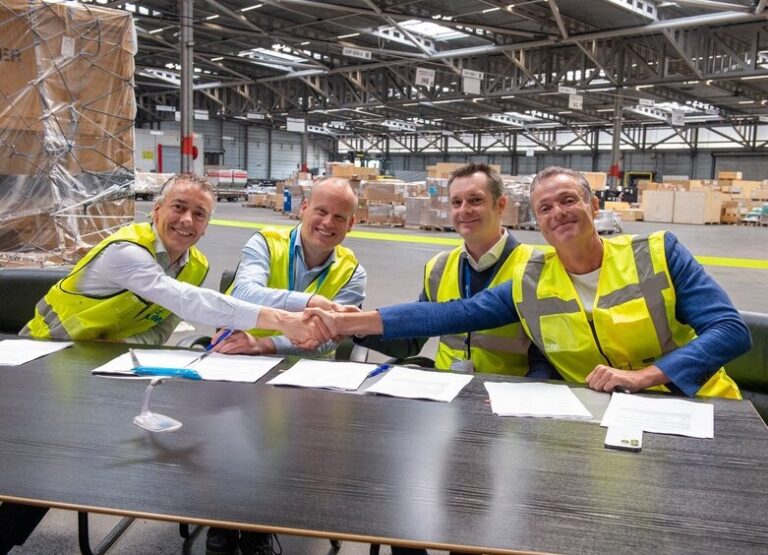
The 18JUL24 witnessed the official signing of the latest edition of the ground handling contract between Menzies and KLM, on site in Menzies’ Amsterdam Airport Schiphol (AMS) cargo facility. The two companies which enjoy a decades-long partnership in AMS, agreed to renew for another five years. Miguel Gomez, Menzies’ EVP Europe, and Dave Beekman, Menzies’ SVP Benelux celebrated the occasion with KLM Cargo’s Koen Bolster, Vice President Worldwide Operations, and Paul van der Wardt, General Manager Martinair Cargo. The Dutch flagship carrier and Menzies Aviation collaborate at more than ten locations in Europe, Africa, India, and Latin America. The renewed agreement which covers cargo warehouse and ramp handling services for all KLM/Martinair freighter operations at AMS for the next five years, is Menzies’ largest contract at the airport. It involves annual totals of circa 600 aircraft turns and around 100,000 tons of cargo.
Paul van der Wardt, General Manager, Martinair Cargo, stated: “We are glad to continue our great partnership after all these years of close cooperation. We are looking forward to further developing the ramp handling activities together with Menzies.”
oen Bolster, VP KLM Cargo Worldwide Operations, agreed: “We are delighted to renew our partnership with Menzies Aviation at Amsterdam Airport Schiphol. This longstanding collaboration has been instrumental in our success, and we are confident that, together, we will continue to provide exceptional cargo and ground handling services to our customers. We look forward to further strengthening our relationship and delivering excellent operations.” Miguel Gomez, EVP Europe, Menzies Aviation, added: “We’re very proud to have renewed our long-running partnership with KLM at Amsterdam Airport Schiphol, marking another milestone in our long-running partnership. This extension reflects the mutual trust and success we have built together over the years. We are excited to continue building on this strong foundation and delivering world class cargo and ground handling services for the Dutch flag carrier at one of the busiest airports in Europe.”

Challenge Group announces an ‘Eyvi-lution’

In a growing conversion market, recycled spare parts are gold. Image: Challenge Group

The clever play on words is based on Challenge Group’s new Head of Materials and Logistics, Eyjolfur (Eyvi) Vestmann Ingolfsson. With a twenty-year background in materials and spare parts management with Bluebird Nordic, ICA, and ICT, Evyi has been brought in to grow the group’s services regarding recycled aircraft parts. His responsibilities include the provisioning, procurement, inventory management, and distribution of spare parts both for the group’s aircraft fleet and customers, as well as ensuring safety and regulatory standards are adhered to whilst also remaining cost-efficient.
The large influx of passenger to freighter conversions, along with the delays in delivery of production freighters or parts, means that the aftermarket for recycled aircraft parts already has a global, annual value of USD 2.2 billion, and its attractivity is set to increase. Recycled spares are faster to get hold of, significantly cheaper, and a sustainable option. Challenge Group has therefore decided to increase its focus on sourcing and supplying these components, in anticipation not only of growing demand from the aviation industry, but also other industries looking to upcycle aircraft elements.
Eyjolfur (Eyvi) Vestmann Ingolfsson, Head of Materials and Logistics at Challenge Group, explained: “Recycling aircraft parts is an absolute win-win-win – for the environment, for the aviation industry, as well as for Challenge Group, since it serves as a prime example to illustrate the benefits of collaborating with an all-in-one service provider. With Challenge Technic, Challenge Handling and Challenge Air Cargo, we combine the professional MRO, handling, and transportation expertise required to ensure the highest quality of service in this particular niche market. Nowhere is the focus on flight safety greater than on the components that make up an aircraft. Aviation begins with a fully functional and airworthy fleet.” Regarding safety, he confirms that: “Challenge Group collaborates with the leading platform dedicated to aircraft recycling and spare parts reuse, and only purchases recycled and regenerated parts from EASA certified providers. With the clear trend towards sustainability and an ever-increasing number of converted aircraft, Challenge Group has solid plans to expand its activities in this segment. The aircraft recycling sector is poised for significant growth, and we see it as our duty to enhance our services and impact, and support our customers in their challenge of procuring and receiving highest quality recycled parts.”

MSC Air Cargo debuts in Hong Kong

Now offering Milan-Hong Kong as scheduled twice-weekly routing. Image: MSC Air Cargo

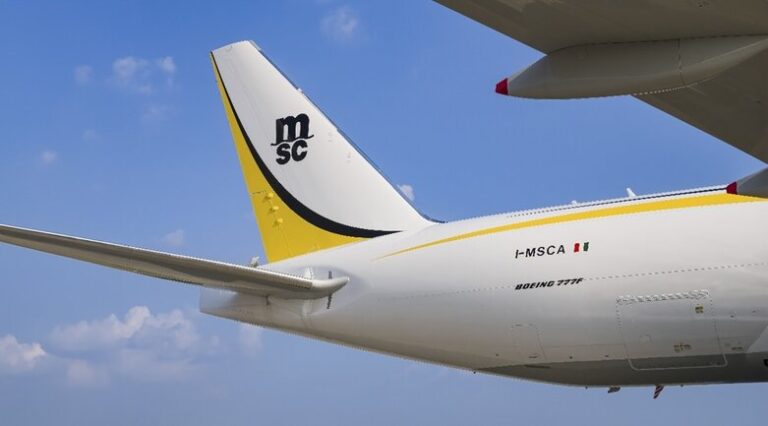
Nineteen months into the game, and MSC Air Cargo is already up and running with clear plans for its future. It recently took delivery of its fifth MSC-branded freighter – a Boeing 777-200F, bearing the registration I-MSCA, and operated by AlisCargo Airlines. This particular aircraft has a unique claim to fame as it is Italy’s first allocated brand-new widebody freighter in over four decades. Poised for “a new era in air freight logistics,” the airline is set on growing its network and capabilities, and so recently celebrated another premiere in the company’s history: its inauguration flight to Hong Kong International Airport (HKG), took off last week from Milan Malpensa Airport (MXP). It was the first commercial flight for the airline on this routing, and will henceforth be served twice a week.
The acquisition of AlisCargo, which began in AUG23, through SAS Shipping Agencies Services Sàrl, (a wholly owned subsidiary of MSC Mediterranean Shipping Company SA), was completed few weeks ago, and is now 100% owned by SAS Shipping Services Sàrl. “The addition of AlisCargo’s expertise and resources, combined with a new state-of-the-art Boeing 777-200 Freighter, will support and enhance MSC Air Cargo’s commitment to innovation while honoring the Italian heritage of the MSC Group,” the release explains.
Another focus point of the airline, is its focus on products. The first specialized product went live just a few weeks ago: Shipped Pharma. MSC Air Cargo also has plans to achieve CEIV certification by the Summer of 2024.
Jannie Davel, Senior Vice President of MSC Air Cargo, said: “The completion of the acquisition of AlisCargo and the receipt of this aircraft represent significant milestones for MSC strategy in the air cargo business. With our own European Air Operator Certificate (AOC), we enhance our efficiency and capabilities to better serve our customer base and trade lanes. Our mission remains unchanged – to be a customer-centric company, offering specialized and tailored solutions to meet the unique needs of our clients.”
Ricardo Cavero, Vice President Commercial Sales & Marketing Europe & Israel, The Boeing Company, commented: “The 777 Freighter is the world’s largest, longest range and most capable twin-engine freighter. We wish MSC every success as it launches the first commercial flight to be operated by AlisCargo Airlines and look forward to many years of partnership as it grows its air cargo division.