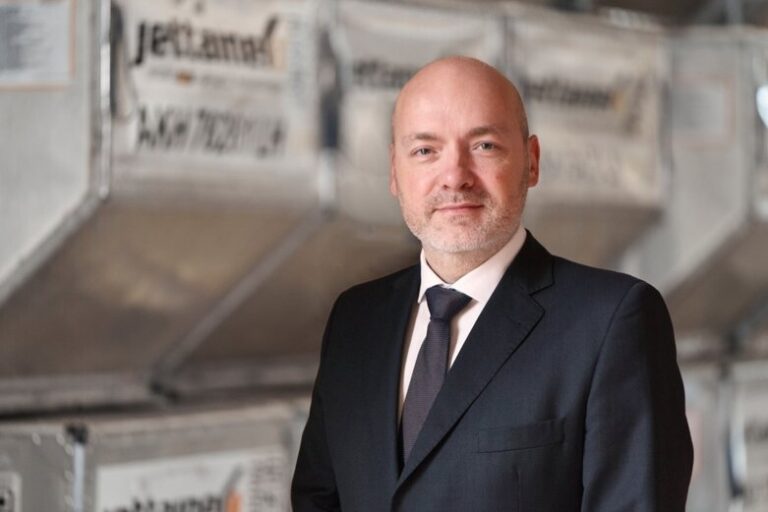
Dr Gert Pfeifer now heads the company’s Europe faction. Image: Jettainer
General Manager Europe, now embodied by Dr Gert Pfeifer for Jettainer, is a new position within the ULD management company. He assumed the new role on 01APR24, thus laying another milestone in the company’s reorganization plans. “This position was created to align Jettainer’s sales and organizational strategy for Europe with regional market requirements and the group’s overarching commercial strategy,” the release explains. With Dr Gert Pfeifer, Jettainer has a manager who knows the business inside and out, having joined the company back in 2009. Prior to his current position, he was Head of Operational Excellence Supply Chain and responsible for fleet management, ULD engineering, repair, and maintenance processes, as well as new customer integration. He had a strong focus on IT and operations and was co-responsible for the development of digital twins. These are virtual images of real ULDs that enable users to identify improvement potentials.
With this latest appointment, Jettainer has added to its existing General Managers for the Americas and for the Middle East and Africa. “Gert’s new responsibilities include developing and implementing a regional sales and operations strategy for Europe to enhance and ensure the market-driven and reliable ULD management service at all times. He and his teams will handle all aspects of customer relations in the region, including sales, operations, and customer service, reinforcing Jettainer’s dedication to excellence in serving its customers,” the release outlines. Thomas Sonntag, Jettainer’s CEO commented: “Our new structure is designed to reflect the specific customer needs and market situations in the various regions. It brings us closer to our customers, which subsequently benefits our entire global customer network. Thanks to his many years with the company, particularly as Head of Operational Excellence Supply Chain, Dr Gert Pfeifer has in-depth knowledge of the ULD market and our customers’ requirements and has all the skills needed to drive Jettainer’s growth in Europe.”
CargoForwarder Global’s ‘Spotlight On…’ series takes a look at the many different career aspects within the air cargo industry. Of the manifold stakeholders involved in ensuring that cargo flies from A to B safely, efficiently, and on time, those involved in training also play a crucial role. This week, Elke Wasser (EW), Managing Partner, Logistic Training Center GmbH, highlights her involvement in attracting and equipping new talent with the skills needed to become a part of an industry that is literally always on the move.
Elke has inspired more than 1,500 people to join the air cargo industry. Image: LTC / Elke Wasser
CFG: What is your current function and company? And what are your responsibilities?
EW: I have been the managing partner of Logistic Training Centre GmbH since 2010. We train people looking to work in the air freight and logistics industry, on IHK-certified training programs. Upon training completion, we place them with future employers. The responsibility lies in not disappointing either side and on offering people in training a future.
CFG: What does a normal day look like for you? (Or is there such a thing?)
EW: No two days are the same in our business. We have to constantly adapt to the requirements of the logistics industry and employment agencies. The volatility of air freight means that companies’ personnel requirements fluctuate considerably. The changing political decisions regarding the labor market are also a major challenge. Our task is to accommodate and adapt to these fluctuations for both sides and to provide companies with the right personnel at the right time. The third challenge is to always find and assign the specialized trainers with the approved teaching qualifications.
CFG: How long have you been in the air cargo industry, and what brought you to it?
EW: I have been working in the logistics industry since 1979. My father was an air freight pioneer and I always wanted to work in air freight. Even as a child and teenager, I found the international flair and the smell of kerosene fascinating. I was then able to fulfill my dream of entering the air freight industry in 2001.
CFG: What do you enjoy most about your job?
EW: I love my job because it is extremely varied. We work with a lot of different people and agents. The challenge is to dovetail these different parties, namely air freight logistics, with the other stakeholders in the labor market. What I like best, however, is that over the last 30 years I have been able to inspire more than 1,500 people to join the air freight industry as apprentices and career changers. Many of my apprentices and trainees are now working in leading positions. I am also helping to give air freight a face in the job market. It always gives me thrill when this leads to success.
CFG: Where do you see the greatest challenges in our industry?
EW: I see the biggest challenge in keeping the relatively expensive and highly regulated air freight location of Germany competitive in an international comparison. Our daily work is a real challenge due to the excessive legal requirements, especially in Germany with its regulatory frenzy.
CFG: What advice would you give to people looking to get into the air cargo industry? Any particular training they should aim for?
EW: Our industry has always been open to people from other career backgrounds. So, my advice can only be: Dare to get to know this international, exciting and always varied industry. I recommend that the companies responsible also give outsiders a chance, as this can be an opportunity for both sides. Our candidates, in particular, have acquired all the necessary training and can therefore be immediately deployed. Routine then follows automatically.
CFG: If the air cargo industry were a film/book, what would its title be?
EW: How we saved the world together – successful supply chains during the pandemic.
Islamabad has pulled the emergency brake on state-owned Pakistan International Airlines. The government is willing to sell the company completely or at least 51% of its shares. This is in response to urgent advice from the International Monetary Fund (IMF) to dispose of loss-making state holdings. Otherwise, the fund may freeze its payments for the country.
It seems unlikely that President Asif Ali Zardari and his cabinet will change their minds about selling PIA at the last minute, because the highly indebted country needs cash. And new money will only flow if Pakistan is willing to divest itself of permanently subsidized assets by selling them to private investors.
A hot candidate standing high on Islamabad’s list is state-owned Pakistan International Airlines, which has only remained afloat for years thanks to the inflow of state subsidies.
PIA jetliner on way to privatization? – photo: courtesy AP
“Debt-lite” new structure Recently, the government has set up a Privatization Panel. In an advertisement published in different newspapers, it named 03MAY24 as the application deadline for statements of interest in PIA. The airline has piled up arrears of payments in the region of several hundreds of billions of rupees. At the same time, Lahore-based Etihad Consulting was appointed as the financial adviser for the intended sales proceedings. “The restructured PIA is being offered to potential investors in its ‘debt-lite’ new structure for a 51% stake,” the Privatization Commission states in its website presentation. It added that it intends to sign a share price deal by 24JUN24, after all provisions in the forthcoming transaction are completed.
Mixed fleet Once restructured, “PIA provides an opportunity for investors to acquire a full-service airline,” reads the Commission’s statement. Currently, the airline holds a share of 23% in Pakistan’s aviation market, ahead of Emirates, Etihad, flydubai or any other foreign carrier. It operates a mixed fleet of 34 aircraft, including 17 Airbus A320s, 12 Boeing B777s and 5 ATRs. In recent times, it was forced to cut flights to the Middle East due to stiff competition from its Gulf-based peers.
These figures may sound attractive to potential investors at first glance, but the airline has a battered reputation caused by endless scandals in recent years – scandals that were tolerated and enabled by political patronage. For a long time, staff appointments were based on close family ties to influential political or administrative circles or to senior managers at the airline, with the applicant’s qualifications only playing a minor role.
Standing on EASA’s blacklist This led to considerable safety deficiencies, objected to by global aviation regulators for years, who have repeatedly called into question PIA’s governance and safety standards. In 2020, the European Union Aviation Safety Agency (EASA) banned the carrier from its most lucrative routes in Europe and the UK, following a crash near Karachi which killed 97 passengers and crew members. An investigation report published on 24JUN20 by the Pakistani Aircraft Accident Investigation Board (AAIB), held both pilots responsible for the crash. During the approach at Karachi Airport, they had been extremely distracted by an intense conversation about the Covid-19 pandemic, so they ignored multiple visual and acoustic warning signals from air traffic control.
Shortly after, the airline cancelled the licenses of 15 pilots which were based on falsified documents. A further 14 cockpit crew were declared unfit to operate any aircraft.
The ban imposed by EASA cost PIA an annual revenue of roughly 40 billion PAK rupees, which translates into 133 million euros.
Every investor will therefore have to consider how to eliminate these serious deficits in order to regain trust and improve the airline’s tarnished reputation. Presumably many heads will roll, not only those of the top management, but also those responsible for technology, safety, and personnel issues.
As it goes, airport operating licenses are never welcomed with a standing ovation, and Brussels Airport’s is no exception. The cargo users take a ‘wait and see ‘approach. CargoForwarder Global (CFG) asked some of the airport’s clients what they think of the new permit of “unlimited duration,” which is bound to some prerequisites pertaining to noise emissions and aircraft movements.
Director Public Relations, Lorenzo Van de Pol, DHL Express – company courtesy
Air Cargo Belgium’s Director, Freek De Witte admits that the new license safeguards cargo operations and short-term growth, but also mortgages the long term. “The new permit does also not give real incentives for further fleet renewal,” Mr. De Witte says.
DHL Express is relieved that the new license does not bring a ban on night operations, even if it will reduce the number of landing and take-off slots. The demand for less noisy aircraft will also have consequences for the operations of the integrator’s aging fleet of A300s and B757s.
“All of this will inevitably have an impact on the organization of our network,” says Director Public Relations, Lorenzo Van de Pol. “It will necessitate serious efforts to marry the global connections with the more restrictive conditions.”
Workable straight jacket “On first sight, to DHL, these conditions are a tight straight jacket, but also a workable one,” Mr Van de Pol continues. “For us, it is logical that efforts are demanded from everybody and we will live up to these conditions as we see that the license tries to provide a subtle balance between the interests of the airport, the economy and the surrounding area. Also, in the future, the economic viability of the airport must be guarded permanently by all means.”
“But the clarity is there,” he says. “Clarity in a long-term framework creates the space to investigate, plan and execute new investments such as in the sustainability of our activities. That trust is back, also for our dedicated staff. From now on we can offer our present and future staff a stable working environment, beyond discussion.”
Waiting for Europe In the period to come, DHL will analyze the conditions in detail so as to map their total impact. The future impact of a number of issues like the cap on the number of flights and the formulation of more stringent noise targets beyond 2030, are not completely clear.
And there is still the European ‘balanced approach’ procedure which has to weigh all measures and conditions before they can be implemented. Only then will DHL Express introduce adjustments in its activities to continue its operation from Brussels Airport, the company says.
ACL Airshop gained a new CEO on 01 March 2024. Bernhard Kindelbacher, a former Lufthansa Cargo executive, took over the top leadership at ACL Airshop, following Steve Townes’ nine-year tenure. ACL Airshop provides a customer-centric variety of ULD services for over 150 airlines, including tailored solutions customized to a client’s specific requirements.
Kindelbacher is based in Amsterdam, however CargoForwarder Global (CFG) met up with him for an exclusive interview at the IATA World Cargo Symposium in Hong Kong. Here is what he had to say about his initial steps and feelings regarding his new position and market perspectives of his company.
Former Lufthansa Cargo executive Bernhard Kindelbacher heads ULD manager ACL Airshop since five weeks – photo: private
CFG: If you reflect on the period before your official start, what primarily influenced your decision to join ACL Airshop?
BK: The opportunity initially presented had a strong entrepreneurial element. Having recently completed a work assignment in the USA and Canada, where I engaged deeply in leading an operation, this aspect of the job intrigued me. And even within the global Lufthansa structure, it often felt like we were running our own medium-size, unique cargo organization in North America. Upon examining the structure of ACL Airshop, I saw parallels to my previous experiences, coupled with the freedom to drive the Company forward within the logistics sector on a global scale. ACL Airshop asked me to bring airline and air cargo ‘know-how’ and that is what we are doing now. There are many opportunities for ACL Airshop to grow. The ingredients for a comprehensive Cargo ULD Management are all here in ACL Airshop, but it is all about putting them together, making it work, and presenting custom ULD solutions to our customers.
CFG: Which steps have you already taken in terms of onboarding and transition?
BK: We did a lot, quickly and efficiently. I visited on a global tour our stations and customers first in the USA, then in Europe, and finally in Asia with my respective COO colleagues joining me. These experiences contributed to my understanding of the company’s operations, its goals, teams, customers, stations, and my colleagues. It was a perfect onboarding and I received such a warm welcome from all the ACL Airshop colleagues as well as the customers.
CFG: Did anything unexpected happened during this period?
BK: Not really. Maybe one surprise: ACL Airshop offers all the ingredients, yet we’re still not perceived as a comprehensive ULD fleet management provider, despite having all the necessary solutions and services. People don’t recognize yet that we can offer more than just individual parts. I believe there’s much more potential here. With my 30 years of experience in the industry, I view it as a familiar challenge that we need to navigate within the ULD environment now.
CFG: What makes the ACL Airshop model different from competitors on the market?
BK: It arises from the ACL Airshop origins, with one aspect being short-term leasing solutions. Others operate within the framework of a more closed, fixed system, but we can offer much more additional benefits. We now offer long-term comprehensive ULD management programs as well, with roughly 50% of our large worldwide ULD fleet under multi-year contracts with major customers. That includes not only the flexibility through our available stock worldwide but also our network of Repair Stations, our award-winning logistics technologies such as Bluetooth track/trace and ULD mgt software, and our substantial manufacturing resources in-house which is a plus in the supply chain. It is a competitively unique combination of all those features, all aimed toward satisfying customer requests. We possess greater flexibility, faster reaction time and global ad-hoc capabilities. We have a very large network of service locations plus our large available inventory of lease-ready ULDs. I believe this full array of skills and deliverables are unique and very attractive for our customers so they can focus on generating revenues while ACL Airshop takes care of their cargo ULD Management.
Secondly, my colleagues at ACL Airshop bring so much air cargo experience on the table from their times in airlines. This background aligns very well and provides a better understanding when we interact with customers. We know from customer surveys that they rate our people very highly in terms of responsiveness, speed, solution orientation, professionalism and dedication. That stems from over 4 decades of a vibrant, customer-centric organization.
CFG: Could you state a couple of goals to be achieved in the upcoming future?
BK: First, our goal is to clarify in the market that we are a comprehensive cargo ULD fleet management provider. Our aim is to become a more-dominant cargo ULD management provider. We are already well-established in the USA and Europe, so the next step would be to establish a greater presence in Asia. We have an advantage there, as the Asian market is mainly driven by cargo carriers or divisions, and we have all the necessary knowledge within our team. Our footprint of air hub locations across the APAC region is large and still growing.
Secondly, our aim is to retain and attract professionals from the industry with extensive knowledge, the right spirit for our challenges, and great interest to develop and use modern technology and innovative processes.
ACL Airshop in short: More than 74,000 Unit Load Devices (ULDs) are owned, maintained, and leased by ACL Airshop. These include air freight pallets and containers, sourced from 57 airport hub locations across North America, Europe, Asia Pacific, the Middle East, and Latin America. The overall company employs close to 250 people globally.
At the BUD Cargo Forum on 27-28 September 2023, cargo director Jozsef Kossuth (JK) and his managers were betting that BUD would handle more than 200,000 tons in 2023 for the first time in the airport’s history. A year before, it was a total of 194,000 tons. In the end, the figure was 201,300 tons, which corresponds to an average increase of 3.8% year-on-year. Their estimate, based on half-year figures, was therefore correct.
Jozsef Kossuth is Cargo Director of Budapest Airport and Board Member of the local Logistic Centers Association (MLSZKSZ) – photo: CFG/hs
Even more pleasing: cargo continued to grow in Q1, 2024, with 62,000 tons handled in the first three months, including 23,720 tons in March. These were the strongest figures ever achieved into the start to a year and in a single month.
Changing of the guard BUD has thus become the most challenging cargo competitor in Eastern Europe, where 43,800 tons were handled at Prague Airport in 2023, vs. 245,000 tons at Vienna Airport, according to their websites. However, compared to 2019 when VIE reported 283,000 tons, the current figure appears rather sober.
The longer-term trend reveals a changing of the guard in the cargo ranking of airports between Germany’s eastern border and the Black Sea region. At no other airport has cargo grown as dynamically as at Budapest Liszt Ferenc International (+120% increase from 2015 to 2023, or 48.5% increase from 2019 to 2023).
Cargo comes first The reasons are widely known. First and foremost, it is due to the management’s clear focus and commitment to the cargo business.
Visible proof is its Cargo City, which was inaugurated in 2019 and extended by 10,000 m² in FEB24 (+30% handling capacity increase), thanks in part to a multi-million-euro investment by the airport and also co-operation with ground handlers and main tenants, Celebi Ground Handling Hungary and Menzies Aviation Cargo.
Another advantage that plays into BUD’s hands is the fact that there is no airport in Eastern Europe with hub status, except for Vienna, home of Lufthansa subsidiary, Austrian Airlines.
Investing in ground Infrastructure Meanwhile, BUD’s expansion continues. During the upcoming second development phase of the Cargo City, additional warehouses will be erected, and cargo airlines offered new freighter stands right in front of the building, speeding up loading and unloading of the aircraft. This infrastructural enlargement aims to elevate the airport’s annual cargo capacity to 300,000 tons, which translates into a 40% capacity increase of BUD Cargo City. With these developments, Mr. Kossuth is optimistic that more freight carriers will choose BUD as their cargo airport of choice:
Main deck capacity spurs growth
JK: “Besides the development of cargo infrastructure and the efficient cargo operational environment, the steadily expanding cargo connectivity is the third key element to the success. In our case, the strong presence of full freighters at BUD are the backbone to our growing volumes, complemented by an extensive belly cargo and RFS network. In bold figures: about 60 weekly full freighter flights accounted for a total of 120,000 tons of cargo in 2023. Many of our existing airline partners (DHL, UPS, FedEx, Turkish Cargo, Qatar Airways, Cargolux, Hungary Air Cargo / Wizz Air), increased capacities, and newcomers e.g. from China entered the market (Sichuan Airlines, SF Express, My Freighter Airlines, and some others).”
The Cargo City, opened at the end of 2019, spurred cargo growth at BUD, as the chart shows –Courtesy Budapest Airport Cargo
Speed requires no witchcraft In addition to handling general cargo, the e-commerce sector is experiencing a remarkable ascent at Budapest as well. All major integrators have been operating there long-term: DHL Express, UPS, and FedEx. During the last 2-3 years, more new service providers started co-operation with large e-commerce companies, Meanwhile, BUD has gained the status of a regional air freight gateway for Alibaba, Shein or Temu, amongst others.
When it comes to handling express shipments, BUD is considered a very fast airport. Director of Cargo, Kossuth explains why this is the case:
Air beats ocean, rail, and road
JK: “e-commerce consigners use all transport modalities, sea, rail, air for their intercontinental transports, but prefer air solutions due to speed, security and reliability reasons. Large numbers of e-commerce volumes can be handled at an airport if professional service providers manage ground operations. BUD offers the market plenty of capacities on the airside and landside, allowing for the rapid processing of shipments. Important to mention is also that the customs authority has digitized processes allowing ground handling agents the fast throughput of large numbers of consignments based on strict safety controls.”
One final question to the Cargo Chief remains: How many tons does BUD expect to handle in 2024?
JK: “It is advisable to be cautious when you talk about the future – this is what we have learned especially during the last 5 years.We started Q1 with more than 20k tons per month. Provided this trend goes on, we will close the year with around 240,000 tons.”
René Droese, the deputy CEO and Chief Development Officer of Budapest Airport Zrt., left the company on 31MAR24. During his tenure of 17 years, he held various leading management positions. Going forward, he takes on the role of Managing Director of a company belonging to the Munich Airport Group. Its name: LabCampus GmbH.
New job, new responsibilities, new business environment. A wide range of new tasks awaits René Droese in MUC – photo: CFG/hs
The manager has put Budapest on the global air cargo map since the opening of BUD Cargo City in 2020. This includes the development of its express business as seen by an increasing number of flights operated by DHL Express and on behalf of its sister company Global Forwarding, U.S. integrator FedEx, and the Hungarian Post. In addition to his cargo responsibilities, he developed passenger capacities via Pier 1, the new Terminal Parking facility, a number of hotels already built or currently under construction in the immediate vicinity of the passenger terminal, and numerous capacity improvements at Terminal 2. Further projects implemented under his lead include the preparation of Terminal 3, as well as several infrastructure developments, such as hangars, office refurbishments and facilities for airport partners, including Wizz Air, Lufthansa Technik and Aeroplex.
Opening doors to the ecosystem In his new role at LabCampus, he will be responsible for developing an area at the site of Munich Airport comprising approx. 500,000 m², creating a working environment for promising start-ups that can benefit from the local infrastructure, encouraging encounters and dialogues with each other. This includes opening doors to the ecosystem in the Bavarian metropolitan region and to international innovation hotspots. Hence, the manager faces a very demanding, multifaceted task in bringing together young companies and their innovators with research institutions and high-tech industries across various sectors, focused on incubating and creating new market opportunities. The three catchwords written on his task board are: ‘connect’, ‘create’, and ‘collaborate’. A second major task is to take responsibility for the development and leasing of non-passenger related airport properties including new cargo facilities for MUC’s Cargo community. For this, he can make use of his vast freight experience gained in Budapest.
Lots of success in MUC Ever since it became known that Droese was leaving Budapest Airport, there has been an avalanche of reactions. After all, he has left deep footprints there. Here is a brief selection:
Jozsef Kossuth, Head of Cargo Budapest Airport Zrt, stated; “I would like to express our gratitude on behalf of the entire BUD Cargo community, cargo partners, our cargo team and especially myself, for all René has accomplished, his efforts, professionalism, motivation, engagement, support, humanity, collaboration, and fairness coupled with great energy to develop air cargo in the last 17 years at and around Budapest Airport. We definitely wouldn’t be where we are today in cargo without René and his enduring commitment. Being my superior for quite some time, he acted more like a mentor and colleague than a boss. I promise to René that we continue our cargo journey at BUD, and I wish him lots of success in MUC!”
He did an amazing job Dr. Marie-Theres Thiell, Member of the Supervisory Board, Member of the Board of Trustees and Managing Partner of the business network, DialogueHungary had this to say: “Dear René. Congratulations on your new tasks 💐. I remember countless flights on which we met on the Dusseldorf – Budapest route and vice versa. Like me, you felt very much at home in Budapest and were an integral part of the local business community. I wish you much success and energy for the new challenges in Munich.”
Others reacted by posting short statements on LinkedIn, like TIACA Chairman, Steven Polmans: “Congrats René Droese and all the best and lots of success and fun in your new role!”
So did Tiago Lopes, Senior Aviation Engineer at the European Investment Bank: “Dear René Droese. This is a fantastic challenge after an already great career! I am sure you will succeed in your future role. All the best!!”
Another post worth mentioning comes from Lyudmíl Elshishki, Network Operations Central Europe, DHL Express: “Congratulations and all the best. It’s been great to witness all that you’ve done for Budapest Airport and even more so a real pleasure to work with you!”
Droese leaves big footprints Last but not least, Nouri Neller, Managing Director FREX Air Cargo, delivered these remarks: “René Droese did an amazing job in Budapest and brought cargo traffic up front. Word of this achievement has spread far beyond Hungary and has been a topic at international conferences and panels, as seen at the latest Air Cargo Europe event. The upswing in air freight is benefiting the local economy, which is offered reliable supply chains thanks to the steadily growing number of cargo flights to and from BUD Airport. René has left a clear mark in Budapest, which a successor must now fill.”
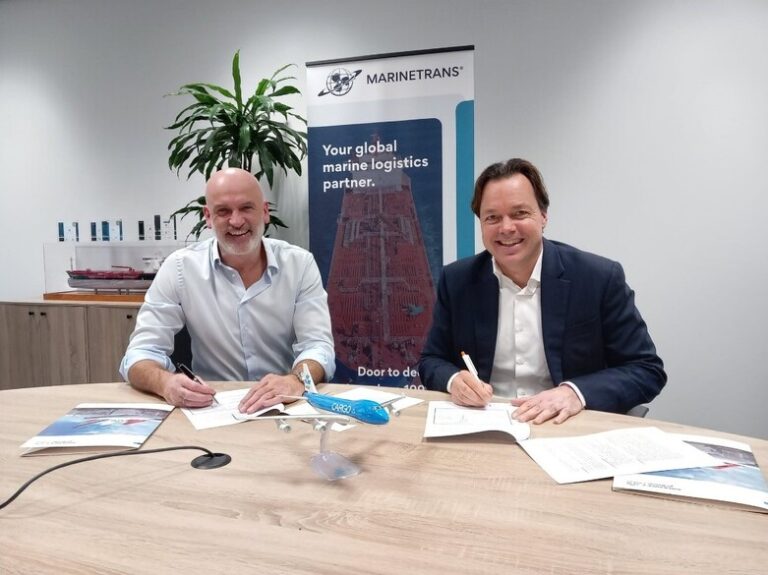
Two years on since the industry’s first SAF program was first launched, and the first contract extensions are already being signed: Air France KLM Martinair Cargo announced last week that the Global Transport Solutions Group (which has its own Going Green initiative) has co-signed to continue supporting SAF flights, together. (The Global Transport Solutions (GTS) Group includes Marinetrans and Best Global Logistics (BGL).) Only when companies work together, can SAF development progress, and positive, environmentally-friendly change be brought about in the logistics and air freight industry. The program enables partners to opt for partially-SAF-powered flights, thus decreasing the carbon emissions impact of their shipments.
In this together for the longer term. Image: AKLMP Cargo
John Burgstra, Co-CEO of Global Transport Solutions, announced: “We are pleased to extend our long-term collaboration with AFKLMP Cargo’s SAF program. This partnership reflects our commitment to sustainability and our shared determination to reduce the impact of aviation on our planet. By participating in the SAF program, we are proudly contributing to the scale-up of biofuels for the aviation sector and to making our shipments more sustainable.”
GertJan Roelands, SVP Commercial at Air France KLM Martinair Cargo, commented: “We are thrilled to continue our collaboration with the GTS Group on Sustainable Aviation Fuel (SAF), as part of our ongoing efforts to reduce our carbon footprint. We commend the GTS Group for their leadership in sustainability, and we are proud to partner with them as we work towards a more sustainable future for the logistics and air freight industry. Since introducing the first SAF program in 2022, we have partnered with over 60 stakeholders and introduced numerous solutions to further reduce our industry’s carbon footprint. While we acknowledge that we have a long way to go, we remain committed to making a difference and taking action on this critical issue.”
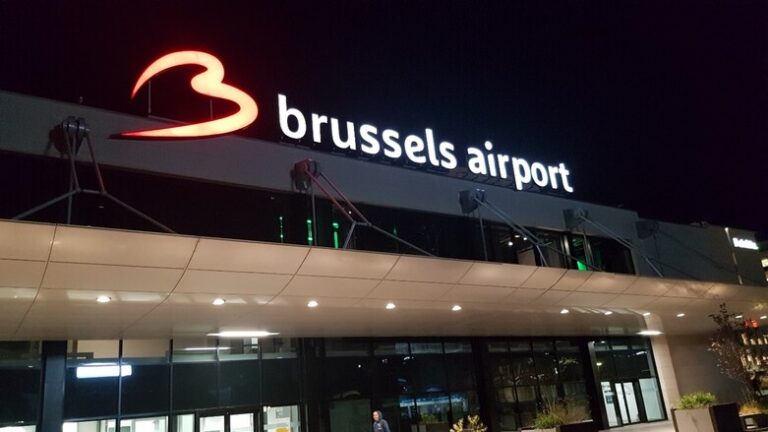
On 29MAR24, Brussels Airport received a new environmental permit “of unlimited duration” from Flemish Environment Minister, Zuhal Demir. Its existing permit would have expired on 08JUL24. Unlimited duration sounds good but is shackled to strict operating conditions. While the airport has the go-ahead now, to continue its activities, it is also bound to observe conditions pertaining to aircraft movements and noise. This means that growth and development is secured in the short-term, but the conditions could impact the airport’s longer-term growth beyond 2032, since flight movement numbers are restricted. According to the release, this “jeopardizes the future of the entire airport ecosystem. 240,000 flight movements per year gives a growth margin until 2032, however an adjustment will be necessary to allow for growth thereafter. In addition, the license also contains strict noise reduction targets.”
That said, the release also stipulates: “First the European ‘Balanced Approach’ regulation must be followed before such operating restrictions can be imposed. The outcome of this procedure will have to show whether the present measures can be effectively imposed or require adjustments. If these restrictions are implemented as such, they would lead to the airport having to cut back on its activities which would have a severe impact on the connectivity of our country and the socio-economic role of the airport, with today accounts for 64,000 direct and indirect jobs.”
Brussels Airport has always been keen to establish a balance between fulfilling its socio-economic role and ensuring connectivity. And is concerned about its impact on the environment, thus sustainability features top in its business strategy.
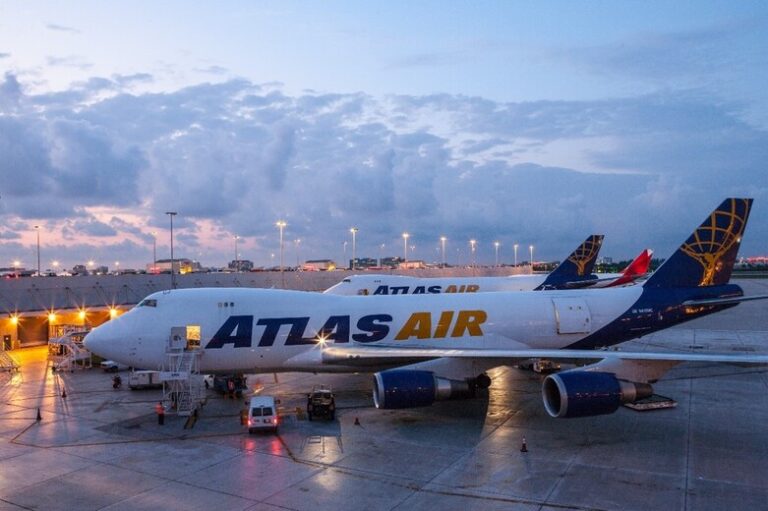
Atlas Air and YunExpress announced last week, that they are expanding their strategic partnership. From next month on, a second Boeing 777-200 freighter will commence long-term charter operations for YunExpress. Operating between China and the United States six times per week, this second B777F aircraft freighter will serve to augment YunExpress’ international logistics network, particularly with regard to offering capacity for cross-border e-Commerce from China.
Expanding its partnership with YunExpress. Image: Atlas Air
Michael Steen, Chief Executive Officer, Atlas Air Worldwide, said: “We are delighted to expand our strategic and long-term partnership with YunExpress. Cross-border e-Commerce is driving significant demand for Atlas’ dedicated large widebody freighter capacity. Through our partnership with YunExpress, we are strengthening our position as the preferred supplier of dedicated air freight capacity to leading players in the e-Commerce industry. Atlas has unmatched global operating capabilities and high-quality solutions that power our customers’ global supply chains.”
Wang Zuan, President of Zongteng Group, commented: “Last December, YunExpress, in collaboration with Atlas, launched charter service between Xiamen, China and Miami utilizing a 777 freighter, which has been operating with solid performance. The signing of this new long-term agreement further deepens and strengthens the strategic partnership between us. Through YunExpress, we aim to meet the growing demand for air freight capacity between China, Europe, and North America. Looking ahead, we aim to further expand routes and fleet size to provide customers with more convenient and diverse global transportation options, ensure supply chain resilience, and support the steady development and growth of our customers’ international businesses.”