Home Blog Page 54

Noida relieves Indira Gandhi

0

The chronically overloaded airport in India’s capital Delhi, Indira Gandhi International (DEL), is bursting at the seams. Getting a suitable slot is like winning the lottery for passenger and cargo airlines. But relief is on the way. The new Noida International Airport, located about 20 km southeast of Delhi, is scheduled to open before the end of the year and will have five runways when fully completed. It will be one of the largest airports in the world.

At present, however, the oppressive spirit of Berlin still hangs over the 4,755-hectare site on which Noida is being built. Uttar Pradesh’s government gave the green light for the greenfield project back in 2001. However, due to an objection from India’s largest private airport operator, GMR Airports Limited, which is closely affiliated with France’s Aeroports de Paris (ASDP), the Noida project was put on hold. In 2014, after an alternative location was ruled out, the original plan was revived. Zurich Airport received the building permit, along with an operating concession for a period of 40 years. The Swiss invested the equivalent of around 815 million euros in the project. According to the announcement at the time, the first aircraft was scheduled to take off in 2022.
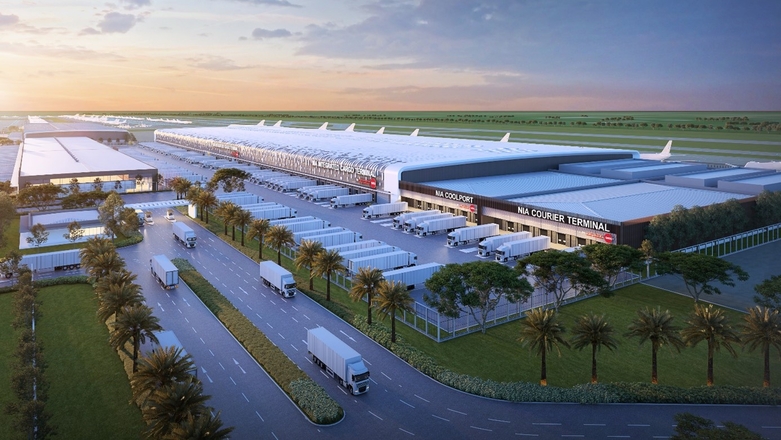
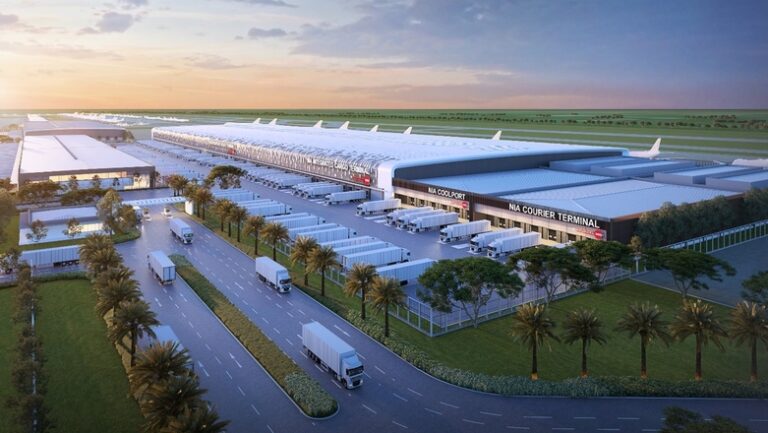
Artist impression of India’s first-of-its-kind integrated multi-modal cargo hub   –  courtesy operator

Still pending: the official opening date
But delays have repeatedly pushed back the inauguration of the airport until today. According to latest announcements by local politicians, the airport will be inaugurated before the end of the year. However, no precise date has been named yet.

Different construction phases
Meanwhile, roofing work on the passenger terminal has been completed, and multiple technical trials are underway. A comprehensive Operational Readiness and Airport Transfer (ORAT) program is in progress, covering system checks, simulations and stakeholder training. This includes trials for baggage handling systems, security equipment, check-in counters and boarding gates.
The entire project is split into various phases. Initially, Noida will become operational with one runway and an annual passenger capacity of estimated 12 million. Once fully developed, the airport will house five runways and handle up to 300 million passengers annually, positioning it among the world’s largest airports.

Freight plays a key role
In addition to passenger traffic, air freight is also an important pillar of the airport’s business. The government of the state of Uttar Pradesh named the airport in a statement “a game-changer for India’s logistics and air cargo ecosystem. Seamlessly connecting manufacturers, markets, and global supply chains across North India, from arrival to final dispatch every stage is digitally monitored to ensure speed, safety, and transparency. With ample slots and competitive ATF [Aviation Turbine Fuel] pricing, it drives growth in the world’s third-largest aviation market while enabling cost-efficient airline operations.”
Phase 1 offers 19 truck docks, nine X-ray machines and 12 ULD roller decks, including 2 dedicated freighter bays with 24×7 seamless operations. The cargo center includes domestic, international, and express air freight terminals. The facilities are directly connected to the nearby Yamuna Expressway, allowing for fast road feeder movements.

Aviation is on the rise in India
Once the operating license has been issued by the Indian regulator, Directorate General of Civil Aviation (DGCA), Akasa Air, Indigo, and Air India Express will be the first users. The number of aircraft they intend to base there is still open. Initially, they will fly domestic routes within India, for example to Kolkata, Chennai, Mumbai, or Hyderabad. However, in the medium term, flights to neighboring countries and the Middle East are also planned. Overall, the Indian aviation industry is currently experiencing tremendous growth. This can be seen in the constantly rising traffic figures and the recent massive aircraft orders placed by Air India and Indigo. India is thus on its way to becoming the world’s third-largest aviation market after the U.S. and China.
MUC enlarges cargo facilities

0

Munich Airport (MUC) is in an enviable position: Air freight volumes keep growing constantly but uplift capacities are barely keeping pace with increased market demands. This is despite the fact MUC’s intercontinental route network has grown lately and carriers have upped their frequencies. Nevertheless, there is still a gap between supply and demand. To avoid bottlenecks, MUC is now further expanding its ground infrastructure.

According to forecasts tabled by the airport’s cargo division, 334,000 tons of air freight will be handled at Munich Airport in 2025, which translates into an 8.5% year-on-year increase. By the end of OCT25, the throughput was 279,000 tons. Compared to other German airports which report average air freight increases of a meager 1.1% in 2025, Munich’s figures are remarkable.

They could be even higher if there were more flights to and from MUC. “As soon as a new intercontinental airline commences serving our airport, it can count on high tonnage figures right from the start,” says Markus Heinelt, the airport’s head of cargo. In short: The demand is there; new facilities will limit the capacity shortage.  As a result, some of the road feeder services coming from the Czech Republic, Slovakia, Hungary, Poland, Austria or the Balkan states bypass MUC and continue their journeys to Frankfurt because of the dense intercontinental network offered by airlines there.

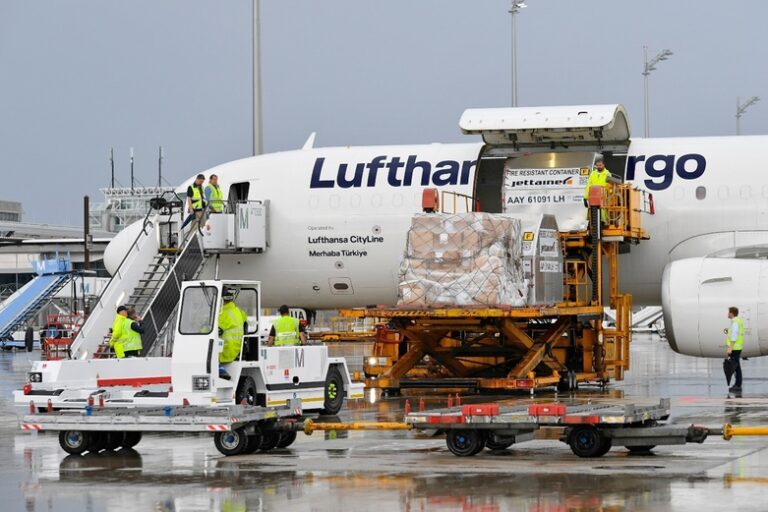
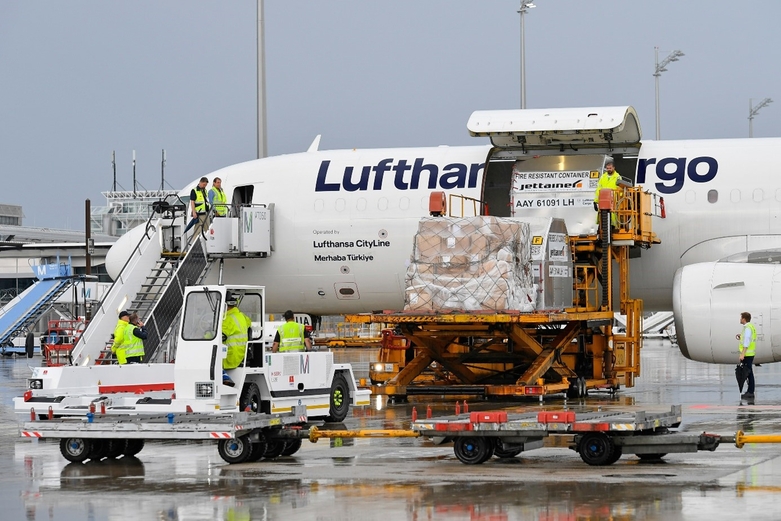
Lufthansa Cargo serves Munich Airport with its regional fleet of A321 P2F converted aircraft, complementing the lower deck capacity of its long-haul passenger fleet  –  photo: courtesy MUC 

More would be possible
They could be even higher if there were more flights to and from MUC. “As soon as a new intercontinental airline commences serving our airport, it can count on high tonnage figures right from the start,” says Markus Heinelt, the airport’s head of cargo. In short: The demand is there, but also a capacity shortage coupled with a limited global network that limits higher volume growth. As a result, some of the road feeder services coming from the Czech Republic, Slovakia, Hungary, Poland, Austria or the Balkan states, bypass MUC and continue their journeys to Frankfurt because of the dense intercontinental network offered by airlines there.
The demand is there; new facilities will limit the capacity shortage.  As a result,

Belly cargo dominates
However, the Bavarian airport is catching up step by step. Since mid-2025, Cathay Pacific has been serving Munich Airport four times a week, operating A350 passenger aircraft. Vietnam Airlines has increased its Dreamliner flights from 4/7 to 5/7. Lufthansa will serve Sao Paulo and Johannesburg with its A350 passenger aircraft year-round and not just seasonally. The carrier also offers daily passenger flights from Munich to Beijing. And its leisure subsidiary, Discover, connects Munich with Orlando, Florida, thrice a week, operating Airbus A330s, thus bypassing the overcrowded Miami Airport. In addition, its logistics sister company, Lufthansa Cargo flies twice a week with an A321 freighter from Istanbul to Munich and back. The freighter aircraft can accommodate 30 tons per flight. Incidentally, this is the first all-cargo aircraft operated by the Lufthansa Group to serve Munich. Finally, Etihad is returning to double daily flights between Abu Dhabi and Munich, thus returning to pre-Covid capacity levels. “This means that all three Gulf carriers, including Emirates and Qatar Airways, are serving Munich twice a day with long-haul aircraft which provide ample cargo capacity in their lower deck compartments, with most of the consignments transiting at their hubs in the Middle East to end up in the APAC region or India,” summarizes Manager Heinelt.

Infrastructure initiatives
The airport also announced that a 13,000 m² staging area will be developed where build-up pallets and containers can be stored temporarily before being loaded onto an aircraft or, in the case of import shipments, onforwarded by truck to their final destinations. Construction work is expected to be completed in Q3, 2026.
The development of a 60,000 m² area in the second line, behind the existing cargo facilities, will take a little longer, namely until 2029/30. The concept was developed by Hamburg Port Consulting, whose solutions for connecting the second with the first line include a corridor wide enough to enable cargo vehicles to pass by without getting in each other’s way. There is already strong demand for these plots, says manager Heinelt. “We want to attract freight customers, freight forwarders, and airlines to the site.” René Droese, Vice President Real Estate Development and Sales at Munich Airport, is responsible for developing and leasing the space. Until 31MAR24, he was head of cargo at Budapest Ferenc Liszt International Airport. Together with Jost Lammers, the former CEO of BUD and now helmsman of Munich Airport, Droese designed and built the cargo center at the Hungarian airport. Due to growing freight volumes, it has since been enlarged several times.

Exclusive – Fiege to take over Cologne Bonn Cargo Center

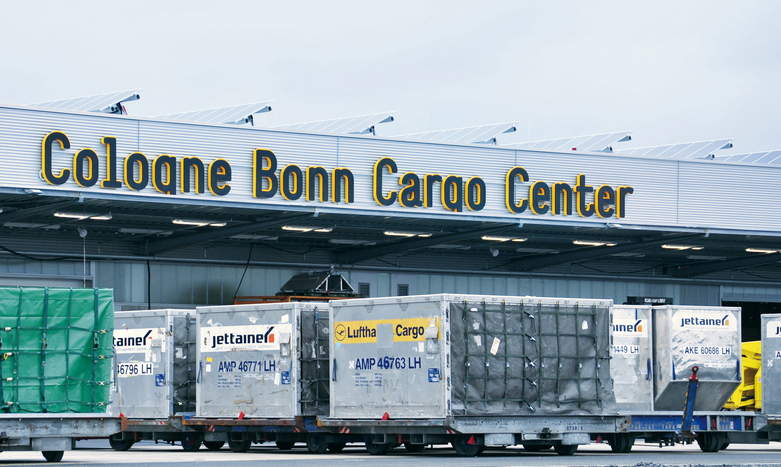
Fiege Logistics is about to become the new operator of the Cologne Bonn Cargo Center (CBCC), succeeding Emirates’ subsidiary, dnata, which ends its cargo operations there on 31DEC25. This concerns half of the 12,000 m² freight terminal. For the remaining part of the warehouse, a second player has come to light, credible sources told CargoForwarder Global (CFG).

As confirmed to this online portal by people close to the case, contract negotiations between Fiege, dnata and Cologne-Bonn Airport are well advanced. Initial personnel decisions are also said to have been made. Sources say that Christian Bieseke will become the new head of the Cargo Center managed by Fiege, once the contract is signed. That is due to happen on Tuesday or Wednesday, next week, provided that some remaining legal and financial issues have been resolved. Asked about the contractual status, airport management and Fiege remained tight-lipped. “We cannot provide any new information at this time. As soon as there are developments that can be communicated, we will provide the relevant information,” said press officer, Alexander Weise from CGN Airport, in response to an inquiry by CFG.

A new chapter begins for the air freight center at Cologne Bonn Airport this coming January  –  courtesy: dnata

High expectations end in disappointment
In 2022, dnata started its CBCC journey with high hopes. The takeover of the CBCC ground handling activities from agent, Wisskirchen Handling Services, was supposed to be the start of dnata’s expansion into the German air freight market. However, setbacks soon followed as several airlines turned their backs on Cologne (CGN). The Canadian cargo airline, Cargojet Airways moved from Cologne to Liège (LGG), Egyptair relocated its cargo flights to Hahn Airport (HHN) and Ostend (OST), and Magma Aviation, a capacity provider belonging to the Avia Solutions Group, decided to move from CGN first to Hahn Airport and later to Liège in Belgium.

Exodus
Only the Turkish freight carrier, MNG, has so far remained loyal to CGN by operating scheduled cargo services. This exodus, which the airport management was apparently unable to stop or compensate for by attracting new customers, caused volumes to plummet and siphoned much money out of dnata’s coffers. Finally, last summer, dnata pulled the plug and quit the lease contract for CBCC as of 31DEC25.

Potential operators did not line up
Ever since, there has been speculation about who will succeed the ground handler. Two names were mentioned: CHI Deutschland Cargo Handling GmbH and Fiege Logistik. However, CHI dropped out of the race weeks ago, leaving Fiege as the only applicant – without there having been a tender process beforehand. The company is based near Cologne and made a high three-digit million euro sum with a dubious mask deal during the Covid pandemic. In 2021, its subsidiary FIEGE Air Cargo Logistics GmbH & Co. KG took over the physical cargo handling for Lufthansa Cargo at its Frankfurt Lufthansa Cargo Center (LCC). Yet, that contract expires in 2026 and has not yet been renewed.
Fiege will certainly draw on its Frankfurt experience in the future management of the cargo business in Cologne-Bonn, provided the deal is done.

UPS is said to be interested in parts of the cargo complex
However, as sources close to the case told CFG, the logistics company will only run the “Bravo” area of the CBCC, which offers a ground floor of about 5,000 m². Integrator UPS is interested in taking over the remaining half of the facility. Cologne-Bonn Airport, whose operating permit allows 24/7/365 traffic, is the U.S. package delivery company’s main European gateway. The case is now on the table of the airport’s real estate department. If UPS is awarded the contract, CGN’s vision to become a major destination for e-commerce traffic would be dashed. This is because there is no available ground infrastructure anymore. Either a new building would have to be built to process the parcels and packages, or Fiege would have to start handling e-commerce shipments in its part of the cargo building. However, this does not seem very realistic. Fiege’s communications department did not comment on any of the points mentioned here.

Swiss WorldCargo and Lufthansa Cargo deepen their ties

0

Both carriers embark on a new strategic cooperation to enhance customer value. This will be achieved by jointly creating operational synergies and upping commercial activities. The carrier’s electronic booking system for air freight is also to be unified.

Lufthansa Cargo and Swiss WorldCargo intensify their  collaboration  –  image: LHC / Swiss

A key point from Swiss WorldCargo’s perspective is that both brands will continue to exist side by side and thus independently. To be clear: Swiss WorldCargo will not become Lufthansa Cargo, despite the announced intensified cooperation. This means that Swiss Air Lines’ cargo division will escape the fate of Lufthansa subsidiaries, Austrian Airlines and Brussels Airlines, which no longer have their own cargo divisions and whose air freight business is managed by Lufthansa Cargo from its Frankfurt headquarters. A future candidate for this model is the Italian airline, ITA, whose cargo personnel have already been taken over by Lufthansa Cargo and whose customers already book their shipments via Lufthansa Cargo’s booking tool (e-booking) for most intercontinental ITA routes.

SkyChain or e-booking – only one platform will survive
It remains to be seen whether the Lufthansa Cargo IT-system, which has been online since AUG25, or its counterpart, SkyChain, at Swiss WorldCargo will establish itself as a uniform platform. SkyChain, which replaced the old IT platform ‘SwissWorks’ just a few days ago, is said to have been launched with great success, according to the Swiss cargo airline.

Different product priorities
The joint release stresses that both partners will focus on their proven strengths when it comes to products.

Swiss WorldCargo has made a name for itself as a premium carrier. It wants to keep it that way by concentrating on high-value, care-intensive, time-critical air freight items, transported in the bellies of its passenger fleet and offering personalized and high-quality services across more than 130 destinations worldwide. Lufthansa Cargo describes itself as the efficiency leader with a global capacity offering of both belly and freighter capacity, and a broad network, leading in digitalization and well-known for its innovative solutions, reads the carriers’ joint release. Retaining both individual brands and combining their unique strengths into a more distinct and comprehensive product and service portfolio will benefit customers and partners, both carriers reason.

Combined network
“We are building on the complementary strengths of Lufthansa Cargo and Swiss WorldCargo – two brands with distinct identities, shared values, and a continuous commitment to quality and care. By combining our capabilities, expertise, and market presence, we will create new, industry-leading synergies and provide greater value to our customers. Together we are shaping the future of specialized and premium air cargo services across our combined network,” says Alain Chisari, Head of Swiss WorldCargo.

The joint press release does not address the impact that the intensified cooperation will have on corporate communications. However, as both companies will continue to operate as independent brands under their respective names, which also applies to the cargo business of Swiss subsidiary, Edelweiss, there will probably still be two press departments based in Frankfurt and Zurich respectively. There is also no indication of whether parts of Lufthansa Cargo’s B777F long-haul fleet will take off from Zurich in the future or even be stationed there.

In the end, the customers benefit, claim the carriers
Thanks to deeper cooperation, customers will have access to one of the broadest networks in the industry along with a wide product portfolio with highest quality combined with many years of expertise. We are very pleased to be able to offer our customers even more tailored solutions for the transport of their freight. By aligning the two organizations even closer, we further strengthen Lufthansa Groups’ purpose of connecting people, cultures and economies in a sustainable way,” explains Ashwin Bhat, CEO of Lufthansa Cargo.

As former head of Swiss WorldCargo (2015-2021), the now announced close strategic and operational cooperation of the two freight carriers is likely to be very much in his interests.

Menzies focuses on safety and sustainability

0
Yogesh Parekh is Menzies’ first Chief Safety & Training Officer. Image: Menzies Aviation

Menzies Aviation issued two press releases this week. The first announced the creation of a new role – that of Chief Safety & Training Officer, to which it has appointed Yogesh Parekh. Yogesh’s career with Menzies began in precisely this field back in 1990 and since then, he has held numerous positions in operations, safety, audit and risk. In 2020, he became SVP Group Risk, moving to SVP Risk & GSE MEAA in 2024. From 01DEC25, he will take up his new position as Chief Safety & Training Officer – a role that has been created to demonstrate and ensure the company’s global safety culture, built on a fully trained and resilient workforce. Yogesh is based in Dubai, and will continue to develop risk management tools and policies to maintain professional quality levels across Menzies’ global network.

Philipp Joeinig, Group CEO, Menzies Aviation, said: “Safety is our number one priority and having highly experienced safety leaders across our business is critical. The creation of the Chief Safety & Training Officer role reflects our commitment to continually raising the bar and we are pleased to see Yogesh stepping into this position. Yogesh has been a trusted safety leader within our organization for many years and is highly regarded within the industry. His expertise will enhance our global safety and training culture as we continue to grow our company.”

In other news, Menzies Aviation revealed that it is another step closer to net-zero 2045, in London Heathrow and London Gatwick, since it has increased the use of Hydrotreated Vegetable Oil (HVO) as opposed to diesel fuel at these airports. “At Heathrow, around 60% of Menzies’ GSE fleet now runs on HVO and more than 50% at Gatwick, with the remainder of all GSE equipment electric,” the release states, speaking of an annual usage of 65,000 liters of fuel and saving of up to 165 tons of CO2e through the transition to HVO: “the equivalent of removing more than 35 passenger cars from the road”. Similar transitions have taken place at Gothenburg (GOT), Stockholm Arlanda (ARN), and Amsterdam (AMS), San Diego International Airport (SAN) and San Francisco International Airport (SFO). John Geddes, Chief Governance & Sustainability Officer & Company Secretary, explained: “Advancing the use of HVO at two of our largest UK ground handling operations represents another important milestone in our journey to decarbonize and achieve net-zero by 2045. HVO provides an immediate reduction in emissions while we continue to invest in electric ground support equipment as part of our Electric First initiative. By combining renewable fuel alternatives with our long-term electrification strategy, we’re taking tangible action to support our customers’ sustainability goals and the wider industry’s net zero ambitions.”

Lufthansa Cargo cuts ribbon on new Cargo Campus

0
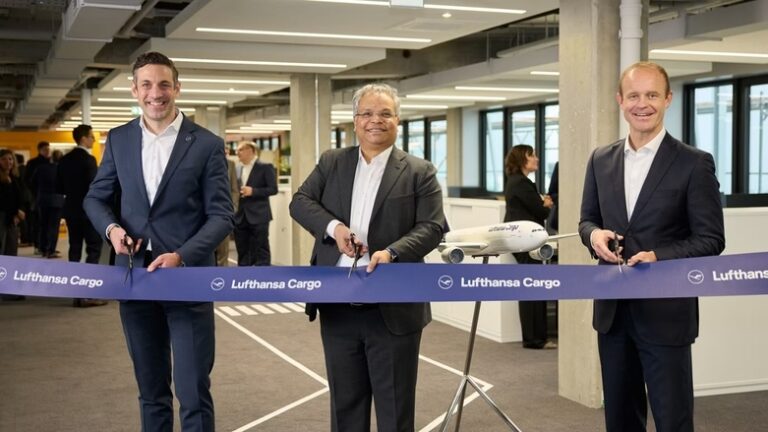
Lufthansa Cargo’s Executive Board cuts the ribbon on its renovated HQ. Image: Lufthansa Cargo

Things are beginning to take shape with Lufthansa Cargo’s LCCevo transition. The company proudly announced that the first of four phases of the largest infrastructure project in its history has now been completed. It cut the ribbon on its renovated headquarters at Frankfurt Airport last week, though the building authorities still need to give their final approval before people can start moving into their new office workspaces there. This is planned to happen mid-DEC25, and in the first step, 60 workspaces will then be operational. According to Lufthansa Cargo, the construction plan is running as per schedule with the second phase due for completion towards the end of next year and two further phases taking place until early 2028. 10,000 m² of modern office space will make up part of the Lufthansa Cargo Campus, which is also getting a new cargo hub. Once finished (in 2030), LCCevo will measure 330,000 m², or, as the company press release put it: the equivalent of circa 46 soccer fields. Work is ongoing whilst daily operations continue at what is planned to become “the most modern air freight location in Europe in the future,” according to Lufthansa Cargo, including a 42 m high high-bay warehouse which will become one of the tallest buildings at the airport. “The Lufthansa Cargo Center has been operating continuously 24 hours a day, seven days a week, since 1982 and has since established itself as a central hub in global air freight traffic. With 1.4 million tons of freight per year, around 80% percent of the company’s global freight volume is handled there,” it states. Ashwin Bhat, CEO of Lufthansa Cargo, enthused: “The new headquarters is more than just a building – it is a place where our culture comes to life and a clear commitment to the future of our company and our location in Frankfurt. With our modern workspaces, we are creating space for collaboration, innovation, and growth – and thus sending a clear signal about our ambitions to shape the air freight of tomorrow. In addition, the modernization of our cargo hub forms the basis for offering our customers reliable and high-quality transport solutions around the world.”

CARGOLAND again hosting the EU CBEC 2026

0
The prestigious Palais des Congres Liège will be the backdrop to the CBEC. Image: Lemon Queen

It stands to reason that CARGOLAND, which has been defining itself as a key European e-commerce cargo hub over the past years, should get involved (again) in hosting the EU CBEC next year. EU CBEC stands for the ‘EU Cross-Border E-commerce Forum’ and has been held annually since 2019. It is a joint Belgium–China initiative that seeks to bring together retailers, brands, and global logistics leaders with digital platforms and technology providers, so as to ensure innovation, progress and smooth operations in this field. The 2026 version will actually be the fourth time that air cargo stakeholders involved in e-commerce, will convene at Liège Airport, to discuss what is one of the world’s fastest growing segments these past years. It will take place on 08-10SEP26, at the prestigious Palais des Congres Liège. The CBEC will include focused panels on the CBEC stage, and a large exhibition area. Around 300+ companies, 100 freight forwarders, 60 airlines, shippers from a wide range of sectors, and 15 trade media outlets are expected to attend. In the past, the event has played host to numerous innovations in the fields of digital systems, smart fulfilment, and advanced cargo handling solutions aimed at improving efficiency across global logistics networks. Next year’s event will continue with the mission to drive innovation and digital transformation, and will offer a dynamic mix of seminars, networking sessions, expert panels, keynotes, exhibition booths, B2B meetings, and company visits.

The 2026 edition will expand its focus beyond e-commerce, addressing the major trends of the air cargo industry, from digitalization, multimodality, and sustainability to safety and security. Dedicated e-commerce sessions will explore cross-border trade trends, emerging growth drivers, and strategies for airlines and airports navigating the sector’s continued expansion. Complementary topics such as digital marketing, data integration, and regulatory compliance will also feature on the agenda,” the release explains.

Frédéric Brun, Head of Commercial Cargo & Logistics at LGG, revealed: “The event has more than doubled in size since we first hosted it in 2019, and it continues to grow in scale and influence. We already have 60 airlines confirmed, 53 renowned speakers, and expect more than 850 participants, possibly even breaking the 1,000-attendee mark in 2026. If you’re active in air cargo, this is where you need to be.”

Torsten Wefers, Vice President Sales & Marketing at LGG, added: “The EU Cross-Border e-commerce Forum provides exceptional networking opportunities to connect with senior decision-makers and leaders from across the logistics spectrum, shippers, freight forwarders, technology innovators, airlines, and e-tailers, all gathered in one place.”

WebCargo welcomes Jambojet to its platform

0
Fleet of 7 De Havilland Canada Dash 8-400. Image: Freightos

The freight arm of Kenya’s first low-cost airline, Jambojet, has opted to publish its cargo capacities on Freightos’ WebCargo platform. Jambojet Cargo, which is billed as Kenya’s leading regional carrier, operates a fleet of 7 De Havilland Canada Dash 8-400 which each offer up to one ton of cargo space. From its main hub in Nairobi and secondary hub in Mombasa, it serves nine main routes linking Kenya and Tanzania. Its network destinations are Nairobi, Mombasa, Kisumu, Eldoret, Malindi, Diani, Lamu and Zanzibar. As its cargo business grows, the airline plans to establish interlining agreements in line with customer demand. The airline currently carries mainly fresh produce, pharmaceuticals, and e-commerce. Now that its capacity is available on WebCargo, it will reach a greater customer base and WebCargo users will have access to cargo routes across East Africa. “With Jambojet Cargo now live on WebCargo by Freightos, and in the future available to interlining agreements, freight forwarders can compare live rates, book shipments instantly, and manage air cargo digitally, improving visibility, reducing manual coordination, and ensuring faster, more reliable service. Freightos processes an annualized run rate of over 1.6 million transactions on its platform,” the release elaborates.

Zvi Schreiber, CEO of Freightos, commented: “Partnering with Jambojet Cargo expands WebCargo by Freightos’ reach in one of Africa’s most dynamic logistics markets. By bringing more regional carriers online, we’re continuing Freightos’ mission to make global trade smoother and more efficient – helping forwarders and shippers access the capacity they need, when they need it and where they need it.” Karanja Ndegwa, MD & CEO at Jambojet, confirmed: “Digitalization is reshaping air cargo across Africa, and Jambojet is proud to be at the forefront of this change, providing our customers with a modern and easy-to-use booking experience. By joining WebCargo by Freightos, we’re giving freight forwarders faster, smoother, and more reliable access to our network – supporting the region’s expanding trade and connectivity. Looking ahead, we’re excited to make our capacity available for interlining on WebCargo by Freightos’ platform, helping strengthen links between African markets and the world.”

Glasgow Airport’s China services growing at a pace

0
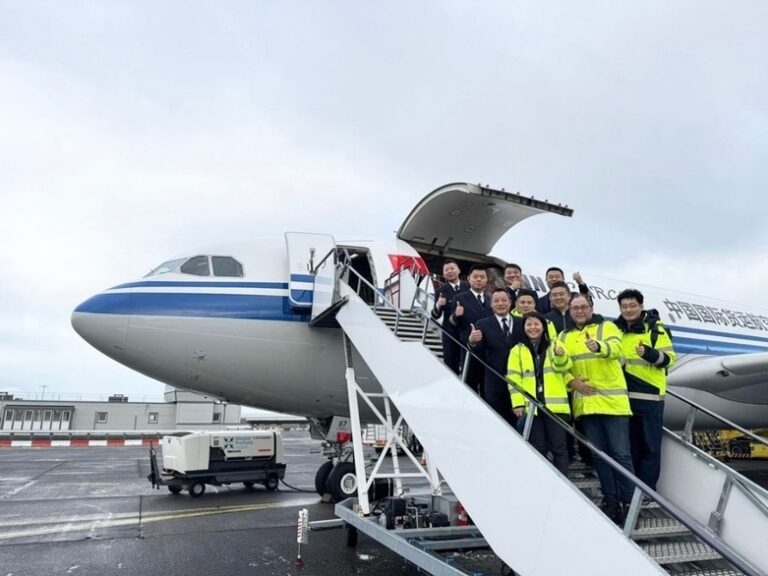
Air China Cargo flight crew are welcomed on their maiden flight to Glasgow Prestwick Airport. Image: Meantime Communications

The amount of press releases this year announcing Chinese connections out of Glasgow appear to know no end. Now, in the week of the e-commerce annual highlight, Black Friday, the Scottish Airport announces that it has doubled the number of weekly Air China Cargo flights linking it with China. Now eight instead of four weekly freighter services carry freight between the two countries. This is because Air China Cargo has also begun flying from Chengdu Shuangliu International Airport (CTU), China, in addition to its existing flights out of Guangzhou (CAN). Chengdu-Prestwick connections began on 22NOV25, and are served by an A330 freighter.

Air China Cargo established its UK cargo hub at PIK in June earlier this year, and the airport also services regular scheduled flights from China Southern Air Logistics and Beijing Capital Airlines,” the release states. Hong Kong Air Cargo also began flying to Glasgow very early on this year. CargoForwarder Global has reported on the airport’s growth throughout. See: https://cargoforwarder.eu/?s=Glasgow+China&post_type=post

Glasgow Airport states that the growth in services has resulted in an increase of 200 jobs at the airport, and its one-million-pound investment “in new equipment and a dedicated cool chain team allowed the airport to launch a new Scotland to China seafood export service in September”.

Ian Forgie, Chief Executive Officer, PIK, detailed: “Air China Cargo’s decision to double its flights from Prestwick, is a strong vote of confidence in our team and our cargo capacity. The past six months have been among the busiest in Prestwick’s history, as we have welcomed three new scheduled cargo operators and expanded our facilities to support sustained growth. This has been a transformational year, and we expect this momentum to continue into 2026 as we deepen our role as a strategic gateway between the United Kingdom and the rest of the world.”

VRR produces its first pallets: ‘We keep it simple”

0

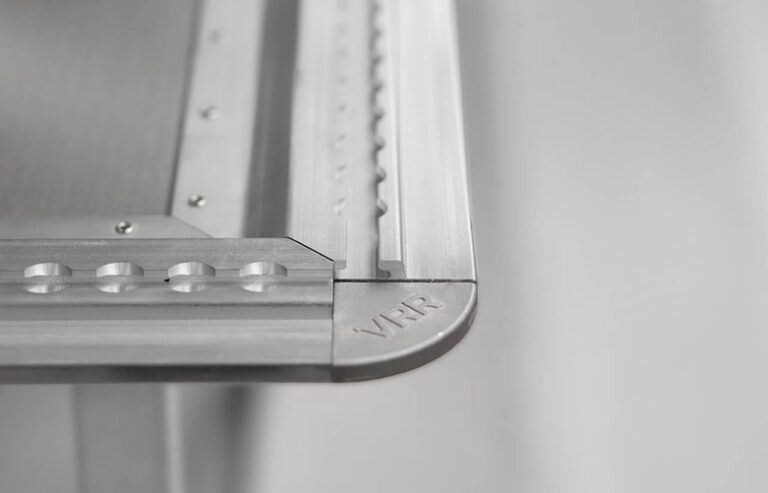
From the company known for its ‘origami’ ULDs as CargoForwarder Global reported back in 2019, 2022 and 2023 (with fun titles such as “Two have and to fold” – sadly those articles are no longer available since we changed websites), VRR has now answered a growing customer requirement and has added pallets to its ULD range for the first time. Available in the two industry standard sizes of 88” and 96”, and in differing thickness, the aluminum pallets belong to its newly launched ‘We Keep It Simple’ range – likely with more ULDs to come. The tare weights of the pallets have not been disclosed, but VRR states that they were designed with weight saving and sustainability in mind and are thus as light as possible, without losing strength and durability. That durability is estimated to be in line with industry norms – in other words: an average lifespan of 7–10 years per pallet. After that, they can be fully recycled thanks to their aluminum material.

Sleek, functional, built to last. Image: VRR

The big change here, is that VRR has always focused on more complex products – such as horse stalls – completely customized solutions and highly innovative products. Pallets is an entirely new product group we offer, so as to be able to support even more customers with our solutions,” VRR tells CargoForwarder Global. “We thoroughly tested the pallets, as we do with all our products. We want to ensure that they are strong, safe, and durable. The certification process went smoothly.”

The new aluminum pallets have been ETSO-certified as airworthy, are therefore fully accepted by aviation authorities, and are compatible with a wide range of aircraft types – both passenger and cargo variants. “The ‘We Keep It Simple’ pallet range is designed to give operators exactly what they need for safe, efficient and cost-effective freight transport,” the release states, going on to emphasize that, with this launch, VRR has extended its “engineering expertise into one of aviation’s most competitive sectors”. The company also announces that each pallet can be customized as per customer wish: “Optional logo and color branding to align with customer livery,” the release invites. Geert van Riemsdijk, Managing Director of VRR, explained: “VRR has a long history of making complex air cargo challenges simpler for our customers. By applying that same philosophy to pallets, we’ve created a straightforward product that delivers on durability, certification and handling – without unnecessary extras. The timing felt right to move into pallets. Operators are asking for certified, sustainable equipment, and we’re in a strong position to deliver it.”